AI Companies Race Toward IPOs Before Growth Narratives Weaken


Alex Kantrowitz and Ranjan Roy argue on Big Technology that OpenAI’s potential IPO is less a sign of financial readiness than a race to define the AI market before Anthropic does. They say OpenAI’s huge revenue and deep losses, Anthropic’s reported acceleration and possible profitability, and SpaceX’s AI-heavy IPO pitch all point to companies trying to sell public investors on future infrastructure demand before the current growth story weakens. The discussion also frames rising public hostility to AI as a practical risk: the industry needs capital to build, but it may also need permission.
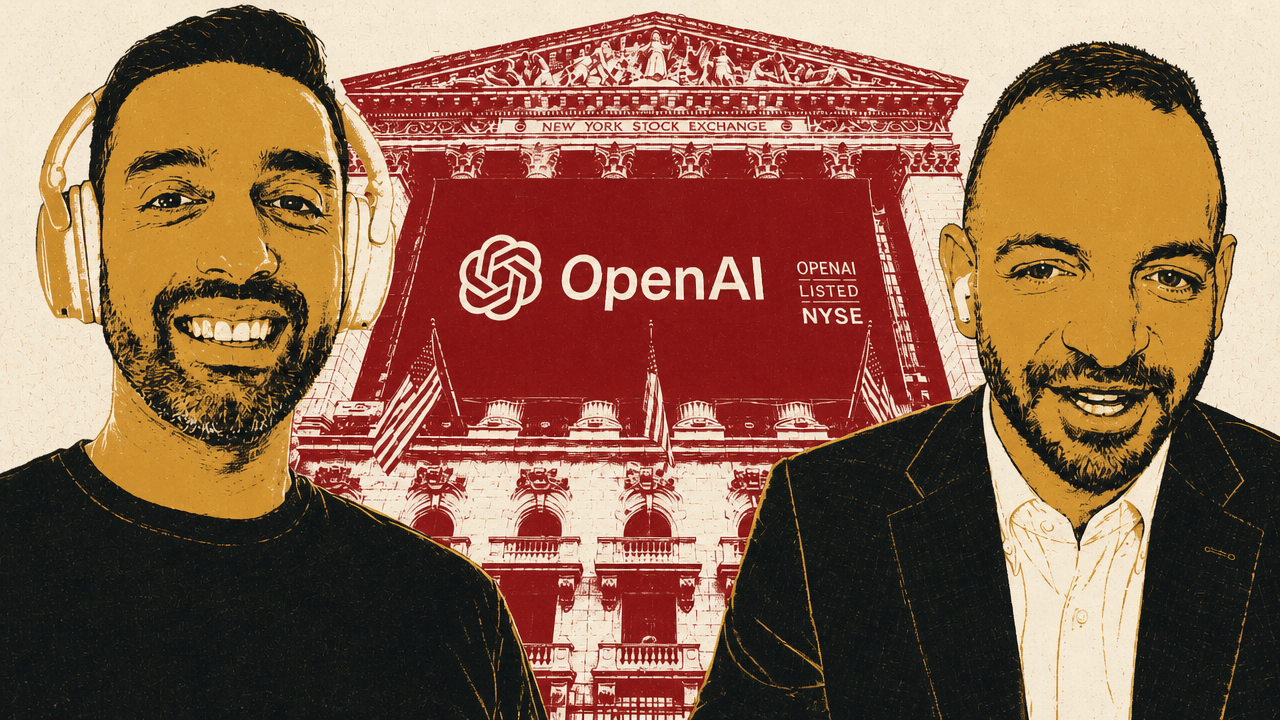
OpenAI’s IPO question is less about readiness than timing
OpenAI’s possible IPO sits on a contradiction: the company is producing enormous revenue, but the reported numbers do not resemble the usual pre-IPO story of improving economics and a clean path to profitability.
The Information reported that OpenAI generated about $5.7 billion in revenue in the first quarter, nearly $1 billion more than Anthropic in the same period. The same reporting said OpenAI’s adjusted operating income margin was negative 122%. Alex Kantrowitz translates that directly: for every dollar of revenue, OpenAI lost $1.22, even after excluding large items such as stock-based compensation.

| Metric | Reported figure |
|---|---|
| OpenAI quarterly revenue | $5.7 billion |
| OpenAI annualized revenue, February | $25 billion |
| OpenAI adjusted operating income margin, Q1 | -122% |
| Average weekly active ChatGPT users, Q1 | ~905 million |
| Weekly active ChatGPT users, February snapshot | ~920 million |
| Paying ChatGPT consumer subscribers, Q1 | 55 million |
Ranjan Roy does not treat the loss figure as surprising in itself. Everyone has known these companies are burning money, in his view; what is new is that the market may soon see the burn directly, in standardized public-company filings. Operating income still includes core business costs — cost of goods sold, R&D, SG&A, people and salaries — so a loss at that level is serious. But Roy says the broad picture was already apparent: OpenAI’s costs exceed its revenue, and stock-based compensation being excluded is not unusual for a company with this kind of employee-heavy compensation profile.


The more important question is why a company with those economics would go public now. Kantrowitz describes the conventional startup path as getting economics in shape, continuing to grow, and then going public once management can show a convincing line toward significant profitability. Roy pushes back on the premise: OpenAI may not be able to make itself look like a conventional software company before going public because AI economics do not behave like software economics.
His comparison is Uber, where the IPO-era argument was that sales and marketing spend could eventually be turned down once users were acquired and sticky. For AI companies, Roy says, the cost base is structurally different. Compute is not a one-time customer acquisition expense; it scales with use. The resources going in can scale “linearly or somewhat linearly” with revenue. In that sense, the business looks less like traditional software and more like an industrial company with ongoing input costs.
That distinction sits underneath the IPO debate. If OpenAI waits for software-like margins before going public, it may be waiting for a business model no one has yet figured out. If it goes public now, it is asking the market to underwrite a different story: that its losses are the cost of building enough compute infrastructure to win later.
Kantrowitz’s central explanation for the timing is not that OpenAI’s financials are ready. It is that Anthropic may be about to tell a better growth story.
Anthropic’s growth may force OpenAI to move first
The IPO race is also a narrative race. OpenAI remains larger by reported revenue in the first quarter, but Anthropic’s growth rate appears to be moving faster. Alex Kantrowitz points to a Wall Street Journal report that Anthropic expected revenue to surge 130% to $10.9 billion in the June quarter and reach its first operating profit.
| Company | Reported revenue signal | Reported profitability signal |
|---|---|---|
| OpenAI | $5.7 billion in Q1 revenue | -122% adjusted operating income margin in Q1 |
| Anthropic | $4.8 billion in Q1 sales; projected $10.9 billion in Q2 | Projected $559 million operating profit for the quarter ending June |
That creates a narrative problem for OpenAI. If Anthropic goes public first while its revenue curve looks steeper and its profitability briefly looks better, OpenAI may have to follow with a more complicated pitch: that it is currently losing far more money because it has invested more aggressively in infrastructure, and that the payoff will arrive later when demand rotates back toward the company that can serve it.
Kantrowitz connects this to an earlier claim from Anthropic CEO Dario Amodei that demand had grown 80x and that Anthropic would prefer “more normal growth.” He also recalls Amodei’s criticism of OpenAI-style infrastructure buildout as “YOLOing.” In Kantrowitz’s reading, Anthropic may look disciplined and profitable precisely because it underbuilt relative to demand, while OpenAI may look reckless precisely because it is trying to ensure it can meet demand later.
The public market, however, may not reward that nuance if Anthropic gets there first. Kantrowitz’s view is that OpenAI would rather set the narrative before Anthropic files. Otherwise, OpenAI may be forced to wait years for its infrastructure thesis to show up in the numbers.
Ranjan Roy agrees with the race-to-market interpretation. He says he has increasingly read every major move by these companies through the lens of who can get to the public market first. In theory, an IPO should be a financing event, not an end state. These companies have already raised sums far beyond ordinary IPO proceeds. Roy notes that if a company can raise roughly $120 billion privately — several times larger than the biggest IPO capital raises — it is not obvious why it needs to go public for financing alone.
That leaves a more cynical reading: an IPO may provide liquidity for investors and employees by shifting ownership to public-market investors. Roy says the “desperate race” to go public can make it feel as though the companies do not fully believe they are worth what they are valued at privately.
Kantrowitz offers a less purely cynical version. If the companies truly believe in exponential demand, they will need much more money for infrastructure. The issue is not just whether an IPO raises cash, but whether it raises cash at the best possible valuation, before a rival defines the market’s expectations. Once public, there is no second first impression.
Geopolitics may be an accelerant. Kantrowitz suggests Gulf State money may no longer be available as the next major financing tranche, especially with the Iran war affecting the region. A New York Times article displayed on screen described severe damage to Qatar’s energy sector, with Iranian strikes and a blockade paralyzing Qatar’s gas engine and creating a bottleneck likely to stall exports for years. Roy says that if Middle Eastern sovereign wealth is drying up, the urgency around IPO timing starts to make more sense.
If you really cared about safety and the good of the people that you're building AI for, go public so we can see whether you're BSing us or not.
The result is an odd convergence: both speakers see strong reasons for the companies to go public, but not because the businesses have settled into mature economics. Kantrowitz says the companies are important enough to the economy that the public should see the numbers. Roy turns that into a governance argument: if AI labs claim to care about safety and public benefit, they should open the books.
Anthropic’s profitable quarter may be harder to interpret than it looks
Anthropic’s reported profitability becomes the most disputed part of the OpenAI-Anthropic comparison. Alex Kantrowitz initially questions why Anthropic would want to emphasize profitability at all. In the AI infrastructure logic he has described, profitability can imply underbuilding: if demand is exploding and the company is making more money than it is spending on buildout, it may not be investing aggressively enough to meet future demand.
Ranjan Roy answers that Wall Street will still like profitability. Even if insiders understand the buildout narrative, public investors will value control over the business. He argues that the shock some people felt at OpenAI’s negative operating margin shows how much the market still responds to conventional profit signals, even when everyone supposedly knows AI labs are burning cash.
The numbers Roy cites from The Wall Street Journal are dramatic: Anthropic had $4.8 billion in sales in Q1 and was expected to more than double to $10.9 billion in Q2. But he emphasizes that the quarter was only halfway through when the projection appeared. That means the reported Q2 number was not simply a backward-looking result; it depended on extrapolation. He also notes that OpenAI’s Codex had recently appeared, and he had seen “endless chatter” about developers switching from Anthropic, making a straight-line continuation of growth less certain.
The sharper question is the reported operating profit: Anthropic was said to be heading toward $559 million in operating profit for the quarter ending in June. Roy highlights an observation he attributes to Ed Zitron about SpaceX’s S-1. In Roy’s description, the filing says Anthropic agreed to spend $1.25 billion per month through May 2029, and also specifies that May and June 2026 would be charged at a reduced fee. The size of the reduction is not disclosed in the discussion.
Roy’s inference is that the reduction could matter a great deal for Anthropic’s near-term profitability. He says the reduced fee could theoretically be zero, though he does not present that as known. From there, he sketches an explicitly speculative mechanism: Anthropic could commit to a large long-term spend with SpaceX, giving SpaceX a marquee AI customer ahead of its own IPO, while receiving a sharply reduced rate in May and June that would improve Anthropic’s own near-term numbers.
Roy says he does not want to go “full conspiracy theory,” but he considers the timing difficult to ignore: a reduced fee in exactly the months that would shape Anthropic’s reported profitable quarter, followed by a leaked investor prospectus showing profitability.
Kantrowitz is skeptical at first because the theory assumes Anthropic wants to show profitability despite the risk of looking underinvested. But he concedes that a profitable filing would be powerful if Anthropic went to market before June 30. Anthropic could present accelerating revenue and operating profit, while OpenAI would be left explaining why losing $1.22 per revenue dollar is a sign of future strength.
Roy calls Anthropic a “communications maestro,” despite its public image as a research-lab culture of “nice guys.” In his view, the company understands the public-market narrative: if it can enter the IPO window with profitability — even profitability that proves temporary or is helped by timing — the market may prefer that story to OpenAI’s losses.
Kantrowitz worries about the catch. If a company goes public on a profitable quarter that does not recur, the burden follows management. The discussion does not establish whether Anthropic’s profitability is a clean operating milestone, a temporary artifact of timing, or a market signal shaped by deal terms. It preserves the tension: profitability may be a sign of discipline, a sign of underbuilding, or a useful optical advantage in a race to IPO.
The possible top is not AI itself, but the current acceleration curve
The uncomfortable possibility is that OpenAI and Anthropic may be rushing because they see some kind of top. Kantrowitz does not argue that AI is ending. The question is whether the strongest growth narrative available to these companies is happening now, before usage growth slows, enterprise budgets tighten, or customers become more disciplined about token costs.
For OpenAI, the consumer signal is ChatGPT usage. The Information reported that OpenAI’s weekly active users averaged about 905 million in Q1, while a February snapshot reached about 920 million. The lower quarterly average implies weaker usage during the rest of the quarter than the February snapshot. The company had expected to reach one billion weekly active users by the end of the previous year, and employees were reportedly warned to expect “rough vibes” as Google’s Gemini chatbot made gains.
Ranjan Roy is less alarmed by the consumer-user issue because he believes OpenAI’s IPO story is likely to focus heavily on enterprise. If the company is now organizing around Codex and enterprise adoption, the difference between 905 million and 920 million weekly active ChatGPT users may be less central. Alex Kantrowitz agrees that enterprise is likely to dominate the pitch, but he says the consumer numbers still matter if the company’s earlier story depended on ubiquitous adoption.
The broader question is whether generative AI’s growth spikes are turning into durable habits. Much of the adoption so far has come from novel uses that generate bursts of attention: image generation, voice generation, and now agentic coding tools. Those spikes establish behavior and interest, but they do not necessarily prove the durable mainstream use case. Kantrowitz asks whether Codex and Claude Code will become the intuitive, widely used application that everyone reaches for, or whether they will be another surge that fades.
Roy’s answer is that everyday search and information gathering already feel like the killer use case. He describes sitting with his wife on opposite ends of a couch, both dictating into their computers and speaking quietly so they would not interfere with the other person’s AI. In his circles, including his parents, the chat experience has become ingrained. Kantrowitz’s response is that if this behavior is becoming universal, it should show up in the user-growth targets.
The enterprise side has its own risk: customers may discover that unconstrained AI tool usage is expensive. Kantrowitz cites Uber exhausting its Claude budget in four months, broader company discussions about ROI, and a Verge report that Microsoft planned to remove most Claude Code licenses and push many developers toward Copilot CLI. A Chamath Palihapitiya post displayed on screen argued that Microsoft pulling Claude was “the first, but not the last,” because without context and oversight, the tool can “spin forever” and create an enormous cost burden across an employee population.
Microsoft pulling Claude is the first, but not the last. The issue isn't that the tool isn't useful.
Roy says this fits what he has seen over the previous six months. Claude Code arrived as a revolutionary product, and companies gave engineers broad access without thinking much about token budgets. Usage exploded. Revenue exploded. Then the bills arrived, and companies began asking whether the productivity gains justified the spend.
He calls that period “token maxing”: a point-in-time frenzy where everyone believed they had to run with the new tool, and only later stopped to ask what it cost. In his view, the next phase will emphasize model routing, interoperability, and model-provider agnosticism. Different requests will go to different models depending on cost and complexity. No single model will rule everything. He uses video as an analogy: Veo may be expensive, so a system might route a request to Sora, Kling, or another model depending on what is needed.
That would not mean AI demand disappears. Roy says he believes AI will become something dramatic over a multiyear period, though not necessarily the $28.5 trillion total addressable market Elon Musk assigns to SpaceX. But he does think the kind of growth Anthropic has seen — from roughly $4 billion to a projected $10.9 billion in a quarter — is unlikely to continue at the same pace. Kantrowitz formulates the point as “not the top,” but possibly the end of this acceleration curve. And if the market rewards acceleration more than deceleration, that is precisely why now would be an attractive time to go public.
SpaceX’s filing asks investors to buy an AI story, not just a space company
SpaceX’s S-1 shifts the discussion from AI labs to the broader AI financing narrative. Bloomberg reported that SpaceX showed a $4.3 billion loss as Musk targeted a record IPO. The filing revealed a $4.28 billion net loss on $4.69 billion of revenue in the first quarter, compared with a $528 million net loss on about $4 billion of revenue a year earlier. The filing also included a super-voting share plan that would allow Elon Musk to retain control.
Ranjan Roy says the SpaceX numbers shocked him more than OpenAI’s negative margin. OpenAI losing money was expected. But SpaceX, at a reported $18.7 billion in total revenue, with $11 billion coming from Starlink, did not look to him like the vast capital machine implied by a $2 trillion company. He thought SpaceX was already a larger generator of cash and capital than the filing suggested.
Alex Kantrowitz centers his frustration on SpaceX’s total addressable market claim. The company described a $28.5 trillion opportunity — what Roy quotes as “the largest addressable market in human history.” But the striking part, for Kantrowitz, is that 93% of that opportunity is AI, with enterprise applications accounting for the vast majority. In his reading, SpaceX is no longer pitching itself mainly as a space company. It is positioning itself as an AI company.
That raises basic questions. Kantrowitz says SpaceX has brought xAI into the story and argues that Grok, by the numbers under discussion, trails Google, Anthropic, and OpenAI. His objection is not that SpaceX has no AI story at all; it is that the filing asks investors to believe SpaceX can capture a vast enterprise AI applications opportunity even though, in his view, that was not its business a year earlier and is not where its current visible strength lies.
The alternative interpretation is that SpaceX is pitching infrastructure: data centers in space. Kantrowitz is deeply skeptical. His practical objection is simple: terrestrial data centers constantly have problems, and technicians fix them. If a data center in space has a problem, someone has to send an astronaut or otherwise perform a far more complex intervention.
Roy initially says data centers in space “could” happen, but normally one would build them and then IPO. Kantrowitz presses that the sequence is backwards: SpaceX is going public on a story before the capability exists.
The filing also presents a more conventional SpaceX story, but Roy says that is not the emphasis. The space segment — launching payloads and building rocket ships for others — has historically made money but has been declining overall. Future growth is tied to Starship, which Roy describes as not yet started in the relevant commercial sense and still pure R&D. Starlink, by contrast, is a strong business in the numbers he cites: roughly $11.7 billion in revenue and $4.4 billion in profit. But even that profitable satellite internet business is not the core of the IPO story as presented in the discussion. The core is a broad, vague AI opportunity.
| SpaceX item discussed | Figure or claim |
|---|---|
| First-quarter revenue | $4.69 billion |
| First-quarter net loss | $4.28 billion |
| Revenue one year earlier | About $4 billion |
| Net loss one year earlier | $528 million |
| Total revenue cited by Roy | $18.7 billion |
| Starlink revenue cited by Roy | About $11 billion to $11.7 billion |
| Starlink profit cited by Roy | $4.4 billion |
| Total addressable market claim | $28.5 trillion |
Kantrowitz notes that Jeff Bezos also sees data centers in space as possible. Bezos said on CNBC that a two- to three-year timeline was ambitious, while Blue Origin had submitted FCC plans for 51,600 data center satellites in low Earth orbit under Project Sunrise. Kantrowitz concedes the basic conceptual pitch: satellites in orbit, cooled by space, networked together, computing AI off Earth. But the risks become obvious as soon as the infrastructure is made concrete. He worries about space junk and the public reaction if spacecraft were endangered because society chose to put AI data centers into orbit.
The SpaceX discussion therefore mirrors the AI-lab IPO debate in a sharper form. A company with real assets and a real profitable business is asking the market to value an enormous future AI opportunity that is not yet demonstrated. The pitch depends on investors accepting that AI demand is so large that even space infrastructure becomes a plausible growth path.
The AI industry has a public-permission problem
AI’s public reputation problem is now visible enough that it can affect the industry’s ability to build. Alex Kantrowitz points to commencement audiences booing AI references at multiple universities, including when former Google CEO Eric Schmidt spoke at the University of Arizona. Gloria Caulfield, a real estate executive, was booed at the University of Central Florida. Scott Borchetta, CEO of Big Machine Records, was booed at Middle Tennessee State University and responded to graduates by saying, “Deal with it. Like I said, it’s a tool.”
Ranjan Roy asks whether the audiences were booing Eric Schmidt personally or AI itself. Kantrowitz says both may be true, but the pattern points to AI: every time AI came up in Schmidt’s speech, the boos grew louder, and the same reaction appeared at other commencements.
Kantrowitz highlights a formulation from Buko Capital: one of three things is true about Big Tech’s AI narrative. Either nobody can tell a compelling story about how AI will be good for society; it has not occurred to them to tell that story; or they believe it will be bad and do not think it is their job to fix it. Kantrowitz says he does not know which is more damning.
Roy connects the backlash to industry messaging. Dario Amodei has warned about job decimation; other AI leaders have failed, in Roy’s view, to paint a positive picture of how the world gets better. The public is hearing displacement, surveillance, and arrogance more clearly than abundance or public benefit.
Meta’s layoffs and internal messaging become the concrete example. Roy says Meta laid off about 8,000 people; Kantrowitz says that is about 10% of the workforce. Leaked audio from an internal all-hands included Mark Zuckerberg explaining why Meta wanted internal employee activity to train AI models. Kantrowitz reads the relevant language: AI models learn by watching smart people do things; Meta’s employees are significantly more intelligent than the average pool of people who can perform the tasks; and having internal employees build tools or solve tasks to teach the model to code should increase Meta’s model coding ability faster than competitors that lack thousands of strong engineers.
Kantrowitz says the logic makes sense to him. AI training increasingly involves watching people operate in environments and using that activity as reinforcement learning. If Meta has thousands of strong engineers, their behavior could plausibly be valuable training data.
Roy agrees that it is “coldly correct,” but says the messaging is disastrous. He hears Zuckerberg effectively telling employees they should feel honored that their keystrokes are more valuable than those of lower-quality contractors. The distinction may be technically relevant, but socially and politically corrosive. Roy offers a different version Zuckerberg could have used: Meta’s models had fallen behind; improving them was existential for the company and employees’ jobs; everyone, including Zuckerberg himself, would participate in training them; and the company would collectively get back in the race. Kantrowitz says that would have been much better.
The same communications failure appears in Marc Andreessen’s comments on Joe Rogan. Kantrowitz acknowledges that Andreessen is likely trying to provoke outrage, but says the line still matters. Andreessen described bots as never getting frustrated, sick, depressed because a girlfriend breaks up with them, or filing HR complaints. Kantrowitz’s response is blunt: “Even if you think these things, don’t say these things.”
His concern is not just tone. Bad public storytelling can have material consequences. Candidates may campaign on kill switches or moratoriums. Data centers may become harder to build. The public may turn against the technology.
The boos matter, is my point.
AI is becoming a political issue. If something polls badly enough, Kantrowitz says, politicians will learn how to exploit it.
Roy asks whether the problem comes from a culture of invincibility among leading tech figures who have not lost in a long time. Kantrowitz says the technology’s progress has continued largely unabated, especially in the United States, and AI may diffuse widely whether the public likes the messengers or not. That belief may make executives less careful. But in democracies, unlike in China, the public has some latitude over whether infrastructure gets built and how the technology is regulated.
Roy contrasts that with China’s AI leaders, wondering whether prominent executives there say similarly inflammatory things or whether the system simply does not allow it. Kantrowitz notes that big personalities in Chinese business face different constraints, and asks how many international media interviews the DeepSeek leader has given. Roy’s takeaway is that the Chinese approach appears to be lower profile: make the country proud and avoid becoming the story.
Kantrowitz does not argue that U.S. AI leaders should imitate China’s political environment. His practical message is narrower: tone it down. In an election year, with public skepticism rising, the industry’s inability to explain itself could become a constraint on the very buildout its financial story depends on.