Investors Question AI Spending as Google’s Search Economics Shift


Big Tech’s selloff reflects more than investor unease about rising AI bills, Alex Kantrowitz and Ranjan Roy argue: it exposes uncertainty over whether companies’ established businesses can sustain the spending. Google’s search advertising remains large and profitable, but AI answers could weaken the flow of web traffic that has supported its economics. Roy also says Anthropic’s filing leaves investors without a clear view of its compute costs, while falling model prices raise questions about how durable AI companies’ returns will be.
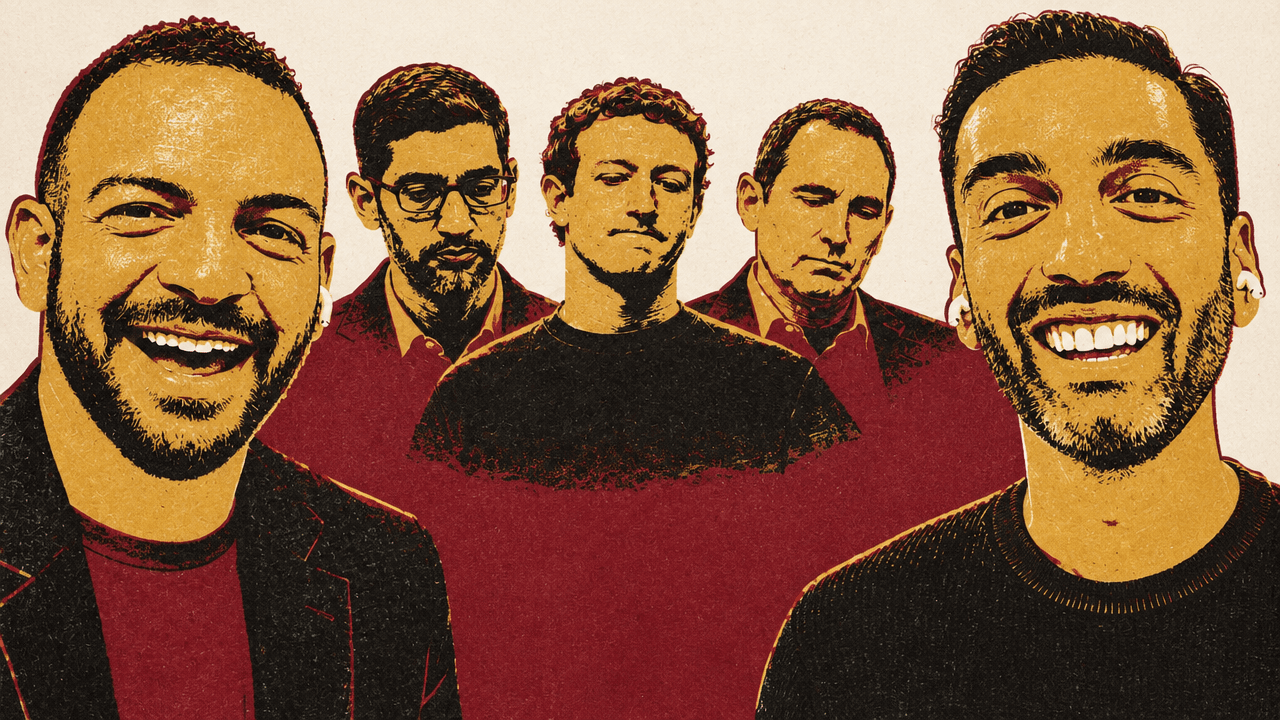
The selloff is about what AI spending is supposed to replace
Big Tech companies lost nearly $900 billion in market value after reporting another rise in AI spending. The immediate question was whether investors had turned against the buildout. Alex Kantrowitz argued that the deeper concern was what the spending would have to replace: established businesses whose economics are unusually strong, but whose future shape is less certain.


Alphabet had recorded negative free cash flow for two consecutive quarters, Kantrowitz said, as capital spending rose. The free-cash-flow chart he discussed showed the recent deterioration against a longer history of positive cash generation. For him, the issue was not simply that Google was spending heavily. It was whether its core advertising business would remain strong enough to support that spending.
Search advertising revenue reached $63.3 billion in the quarter, up 12%, Kantrowitz said, below the 15% growth expected. He cautioned against treating 12% growth on that base as weak. The miss mattered because investors were trying to understand whether the growth engine beneath Google’s AI investment was changing.
Ranjan Roy agreed that the core business was central to the market’s reaction. Google and Meta, he said, had built exceptionally profitable advertising businesses that were difficult for competitors to enter. If those businesses are changing, investors have to ask what the companies are becoming: Is Google a search company, an AI-compute provider, or an enterprise-services business?


Roy pointed to the strength still visible in Google’s results: quarterly revenue was up 25%, operating profit up 30%, and operating margins were around 30%. Search was not disappearing. But, he said, the report made it harder to expect it to remain the business it had been. Google had said overall search queries were increasing, including at their fastest year-over-year rate in five years; it had also said AI Overviews had grown from 2% to 8% of searches.
The meaning of that query growth was unsettled. Kantrowitz asked whether AI Mode interactions count as searches, and whether an increase in reported queries could coexist with fewer conventional searches. Roy said Google did not disclose enough detail to resolve the question. The company’s figures may include AI interactions, he suggested, but the discussion did not establish exactly what Google counts as a search.
That distinction matters because a search business has traditionally sent people to websites. If a user gets an answer inside an AI interface instead, a rise in query volume may not mean a corresponding rise in clicks or referrals. Kantrowitz raised the possibility that people could also search less on Google if they increasingly turn to services such as ChatGPT, Claude or Grok. Roy noted that Google says its queries are growing, while agreeing that aggregate numbers alone do not explain how people are using the service.
Reddit CEO Steve Huffman supplied a concrete example of the changing relationship between search and the web. As Kantrowitz quoted him, Google was crawling Reddit as much as ever while sending it less traffic. Huffman said AI Mode did not drive traffic to Reddit, and that Google was teaching people to go directly to Reddit.
Roy saw this as a break in the old exchange between websites and search. Publishers allowed Google to crawl their material in part because search referrals brought people back to their sites. Google may continue to extract information from websites without delivering the traffic that once made that arrangement valuable. Roy said businesses had already stopped treating search traffic as their lifeblood; it was increasingly one channel among others.
Kantrowitz pushed a related possibility: if people stop clicking out from search results, Google may weaken the very web ecosystem that has supported its advertising business. Roy was less certain that direct navigation would become widespread, but agreed that Google’s changing role could leave businesses with less control over how customers reach them.
The central uncertainty is not whether Google is still large or profitable. It is whether activity that Google counts as search continues to create the clicks and referrals on which its advertising model has depended. Investors are being asked to value an expensive AI buildout while that question remains open.
AI leadership may not translate into advertising advantage
The contrast between Google and Meta sharpened the question of whether being good at AI will protect a company’s existing business. Kantrowitz discussed an eMarketer forecast that Meta would overtake Google in global digital advertising revenue in 2026 and extend its lead through 2028. The same forecast showed Amazon moving from a more distant third toward a closer contest with Google. These were projections, not reported future results.
The forecast looked counterintuitive to the hosts. Google had invested heavily in AI and, as Kantrowitz put it, had leading models. Meta had not made the same visible shift in its consumer experience. Yet the projection suggested that Meta’s advertising revenue could pull ahead.
Roy’s explanation was about where the ads appear. Meta sells ads inside Facebook and Instagram; Amazon sells them within its own retail and related environments. Google’s search advertising, by contrast, depends more on an open web: users search, visit websites, and encounter ads along the way. If AI answers more questions without sending users to those sites, the value exchange supporting search advertising becomes less clear.
Meta and Amazon have more control over the environments in which their ads appear. Roy argued that Meta’s format could remain valuable even as interfaces change: people may continue scrolling through Facebook and Instagram and seeing ads there. That does not establish that either company is insulated from AI’s effects. It does suggest why a company can lag in large language models and still be well placed to sell advertising.
Kantrowitz and Roy did not argue that Google had already lost its search business or that it could not find ways to monetize AI interactions. The tension is that Google may be trying to change the interface before it has shown that the new one can preserve the economics of the old. A successful AI product could answer more questions while sending fewer visitors to the websites that have helped sustain search advertising.
Kantrowitz described this as a reinvention bet. Technology companies may have to risk disrupting what works rather than hold on to an interface that could become obsolete. But the bet comes with a near-term cost: investors can compare the established economics of search advertising with the less certain returns of AI infrastructure and AI services. A business can remain profitable and growing while becoming a less certain foundation for a much larger investment.
Strong cloud growth does not settle the return on AI infrastructure
Amazon illustrated why growth in the infrastructure business may not, by itself, reassure investors. AWS reported $46 billion in revenue for the three months through September, up 39% year over year, according to the Wall Street Journal excerpt Kantrowitz discussed. The article described this as Amazon’s highest AWS revenue growth in years. Amazon’s overall revenue increased 12% to $201.9 billion, and net income was $20.7 billion; the excerpt said both figures were below analyst estimates. Amazon’s stock fell.
For Kantrowitz, the result captured the difference between a proven business and a hoped-for next one. Search advertising has established economics. A cloud business expected to power a still-uncertain AI expansion represents a different kind of bet. Investors may see the opportunity while remaining unsure what returns the infrastructure will produce.
Amazon’s retail business also came up as an example of how a company’s core identity can shift. Groceries and “Everyday Essentials” accounted for half of units sold on its retail site in the quarter, according to the same Wall Street Journal excerpt. Kantrowitz said the figure suggested a move away from the image of Amazon as the internet’s everything store toward more habitual household purchases. Roy cautioned that unit counts can make cheaper products look especially prominent and suggested Amazon might be emphasizing recurring purchases to investors.
The exchange did not turn on whether those purchases are good or bad for Amazon. It illustrated the broader difficulty of valuing companies whose familiar businesses are changing while they spend heavily on AI. Amazon’s retail and cloud operations remain substantial; the unresolved question is how much confidence investors should place in the returns from the next phase of investment.
Kantrowitz compared year-to-date share performance with the S&P 500, which he said was up about 10%. Alphabet was down about 11%, Amazon up about 5.5%, and Microsoft up about 10%. Microsoft’s performance stood out to him because, he said, it had not been praised as much for its AI initiatives. He also said Nvidia was trailing the index.
Roy contrasted this public-market caution with continuing enthusiasm in private markets. Public investors, he said, appeared less willing to reward companies simply for spending heavily and accepting negative free cash flow. Meanwhile, talk of Anthropic at valuations of $1.5 trillion or $2 trillion remained optimistic. The contrast sharpened the question of whether investors were reassessing AI itself, or tempering expectations for companies whose market values were already enormous.
Anthropic’s reported efficiency leaves its compute costs unclear
Anthropic’s S-1 showed rapid growth and improving reported efficiency, according to Ranjan Roy’s reading of the filing. But Roy’s main concern was that it did not give investors enough information to understand the company’s underlying unit economics: what it costs to serve the business, and how those costs might change as the company grows.
Kantrowitz cited an increase in customers spending at least $100,000, from 1,500 in December 2025 to 11,900 in June. He also noted growth in customers spending at least $1 million and cited a rise in revenue per dollar of compute spending, from 40 cents to $2.08. Roy, meanwhile, read the filing as showing compute costs falling from 71.6% of revenue in the first quarter to 48.1%, compared with 225% of revenue a year and a half earlier.
Roy said those figures made the economics look almost “magical”: revenue rising while compute costs declined as a share of revenue. But they did not tell investors what compute would cost at market rates. The discussion did not establish whether every figure used the same accounting definitions or could be compared directly. Roy’s broader point was that the filing did not make clear how much of Anthropic’s apparent efficiency came from its own operations and how much from favorable compute arrangements.
All I want is to understand the unit economics of Anthropic’s business to give a reflection of what a great AI business can look like. And I did not get that.
That question matters alongside Anthropic’s large future spending commitments, which the hosts described as being in the neighborhood of $500 billion, much of it non-cancelable. Roy did not argue that those commitments necessarily made the business unsound. He wanted investors to understand the costs and assumptions behind them.
Roy pointed to the company’s relationships with Amazon and Google. He said Amazon’s convertible-note arrangement explicitly included discounted compute and referred to similar arrangements involving other companies. If those discounts substantially reduced Anthropic’s costs, he argued, the reported figures would not fully show what its margins might look like without them.
Kantrowitz questioned whether the known investments—Amazon’s agreed $4 billion and Google’s announced commitment of up to $2 billion—could account for the difference. Roy said the investment totals did not answer the question. What mattered was the value of the compute discounts and how they affected expenses.
Roy cited compute spending of $300 million in the first quarter, $500 million in the subsequent quarter and $800 million in the first half of the year. He argued that the numbers made the impact of any large discounts more important to understand. The discussion also included conflicting estimates of Anthropic’s cash burn, so it did not settle how much the company had spent overall. Roy’s request was narrower: disclose what the company actually paid for compute and how its discounts worked over recent periods.
Kantrowitz asked whether Amazon and Google might be providing discounted compute beyond their investments. Roy said that was consistent with what he understood about the arrangements, especially Amazon’s, but did not claim to know the full value of the discounts. He also raised the possibility that discounted compute could be recorded in a way that inflated revenue. Roy called that an aggressive accounting scenario and said it was not his main concern.
The filing’s growth figures also drew competing readings. Kantrowitz said the S-1 included a substantial increase in large customers and improving reported efficiency, while the absence of third-quarter revenue left a gap. He described expectations that quarterly revenue growth could slow from more than 100% to around 40%. Roy said the S-1 numbers were strong, but that the improvement made it more important to understand the cost structure behind them. He expected the third-quarter figures to be released later and did not treat their absence from the S-1 by itself as evidence of a problem.
The S-1 therefore left Roy with a specific unanswered question: if Anthropic’s compute costs were discounted, how would its margins look at market rates, and how durable are the economics it is reporting? The answer matters both to the company’s growth story and to the scale of its future commitments.
A hypothetical listing would concentrate wealth on an extraordinary scale
The wealth estimates in the discussion came from two different calculations. Andrew Benson’s posts, which Kantrowitz described, concerned a hypothetical OpenAI listing at $2 trillion. They estimated roughly $199 billion for seven controlling co-founders, about $28 billion for Greg Brockman if his stake matched theirs, around $100 billion for the OpenAI Public Benefit Fund, and $331 billion in employee options and restricted stock units. Benson estimated that the employee pool covered about 5,300 people, averaging roughly $62 million each.
Benson’s estimates varied by hiring year: about $110 million to $400 million per employee for hires by 2023; $200 million to $300 million for 2024 hires; $70 million to $95 million for 2025 hires; and $10 million to $20 million for 2026 hires. The figures were back-of-the-envelope estimates based on a hypothetical valuation, not guaranteed payouts.
A separate claim concerned Anthropic. Kantrowitz read Sam Parr’s estimate that around 1,000 Anthropic employees could become worth more than $100 million at a $2 trillion market capitalization. Parr compared that number with an estimate of about 11,000 Americans holding $100 million in investable assets, and suggested that including OpenAI could make the concentration greater.
Roy said the scale of the potential wealth creation was difficult to absorb, and wondered why it had not become a larger political issue. Kantrowitz saw a tension between the prospective fortunes and Anthropic leaders’ warnings about AI risks. The company’s leaders have described the technology as potentially dangerous, he said, while employees could become extraordinarily wealthy if the company reaches the valuations being discussed.
Kantrowitz also speculated that the S-1’s lengthy risk-factor section could make its most consequential warnings easier to miss. Roy was less persuaded by that interpretation. He said existential risks had been discussed publicly for years and noted that risk disclosures also serve legal and investor-facing purposes. Their disagreement was about how to read the document’s presentation, not whether Anthropic had raised those risks before.
Price cuts put pressure on the case for high-margin models
The reductions in OpenAI and Anthropic pricing have made the prospect of an AI price war more concrete. Kantrowitz cited a sequence assembled by Max Woolf. On July 30, 2026, OpenAI announced an 80% price cut for GPT-5.6 Luna. On August 10, Anthropic made a temporary Sonnet 5 price cut permanent. On August 21, OpenAI cut GPT-5.6 Sol prices by about 20%. On September 22, OpenAI announced GPT-6 Sol at half the input and output prices of the temporarily discounted GPT-5.6 Sol, and released GPT-6 Luna at half the previous version’s prices. Anthropic announced Claude Opus 5.5 the same day; Woolf calculated that its total cost was 40% to 60% lower than its predecessor.
Anthropic said Opus 5.5 required less compute to serve than Opus 5 and that its pricing reflected that. Woolf offered a second explanation for the reductions: models were becoming more interchangeable for some tasks. In his view, it could be difficult to distinguish new models beyond subjective impressions, while a user could switch models through a tool such as OpenCode or Zed Agent, or by changing an API endpoint through OpenRouter. That ease of switching could weaken providers’ pricing power.
Roy said the cuts challenged the idea that expensive frontier models would remain high-margin differentiators. In enterprise settings, he was seeing more attention to routing tasks to whichever model offered the best balance of cost and capability. If customers can shift tasks to a cheaper model when it performs well enough, providers have to justify higher prices through a meaningful advantage.
Lower prices could also expand demand. If more work becomes agent-driven, Roy said, a larger volume of use might offset lower prices per unit. But he did not think that possibility removed the pressure on the business model. More use would need to translate into enough revenue to compensate for lower prices, and the discussion did not establish whether it would.
Woolf also proposed a less competitive explanation: infrastructure improvements may allow models to be served with less compute. If that is driving price reductions, lower costs could be passed on to customers rather than indicating that providers are simply losing pricing power. But greater efficiency raises a question for the data-center investment story. If models need less compute to serve, the assumptions behind large infrastructure buildouts could change.
Roy said that possibility connected the pricing discussion back to the earnings selloff. More efficient models could alter the economics of data-center expansion; demand might still grow enough to use the added capacity if agents become widespread, but the scale of that demand was uncertain. The sources of price cuts could overlap: infrastructure may be getting more efficient even as customers find it easier to switch among models.
Kantrowitz raised another possibility: companies approaching an IPO might want to show usage growth. He questioned whether token volume was the kind of growth Wall Street would reward. Roy said investors would ultimately care about revenue and costs. Whether lower prices reflect better infrastructure, weaker differentiation, or both, usage alone does not settle the question of durable returns.
Recording wearables make the AI interface a social question
Amazon’s Bee Frontier, described by Kantrowitz as a $74.99 wristband, brought the debate about AI products into ordinary social interactions. Amazon presents it as a personal AI wearable that can turn conversations into summaries and actions. Kantrowitz objected to routine recording: if people expect conversations to be captured and replayed, he argued, they may start treating ordinary interactions as performances.
Roy separated that concern from the question of whether Amazon’s product strategy made sense. He asked whether connecting the device to Amazon’s wider Alexa ecosystem could make it a useful bet. Kantrowitz found it difficult to set aside the social consequences. He imagined meeting someone at a party and knowing their conversation might later be reviewed by an AI assistant.
Roy joked that an Echo Show might already offer unsolicited dating advice, drawing on its ability to connect a recipe to groceries a user had bought. The joke pointed to a real tension in the product idea: a system that remembers purchases and conversations can feel convenient in one setting and intrusive in another.
Kantrowitz worried that a visible wristband might not be the final form of recording technology. Less detectable devices, he said, could leave people unsure whether a conversation was being recorded. He argued that there should be some stigma attached to bringing recording wearables to dinner. Roy, who said he liked his Meta Ray-Bans, pointed to the possibility that social norms could limit features, noting that Meta had removed photo capabilities from some models.
The exchange did not settle what disclosure people should expect or whether conversational recording will become acceptable. It identified a constraint on consumer AI wearables: the product’s usefulness may depend on recording interactions, while recording can change how people behave around the device.