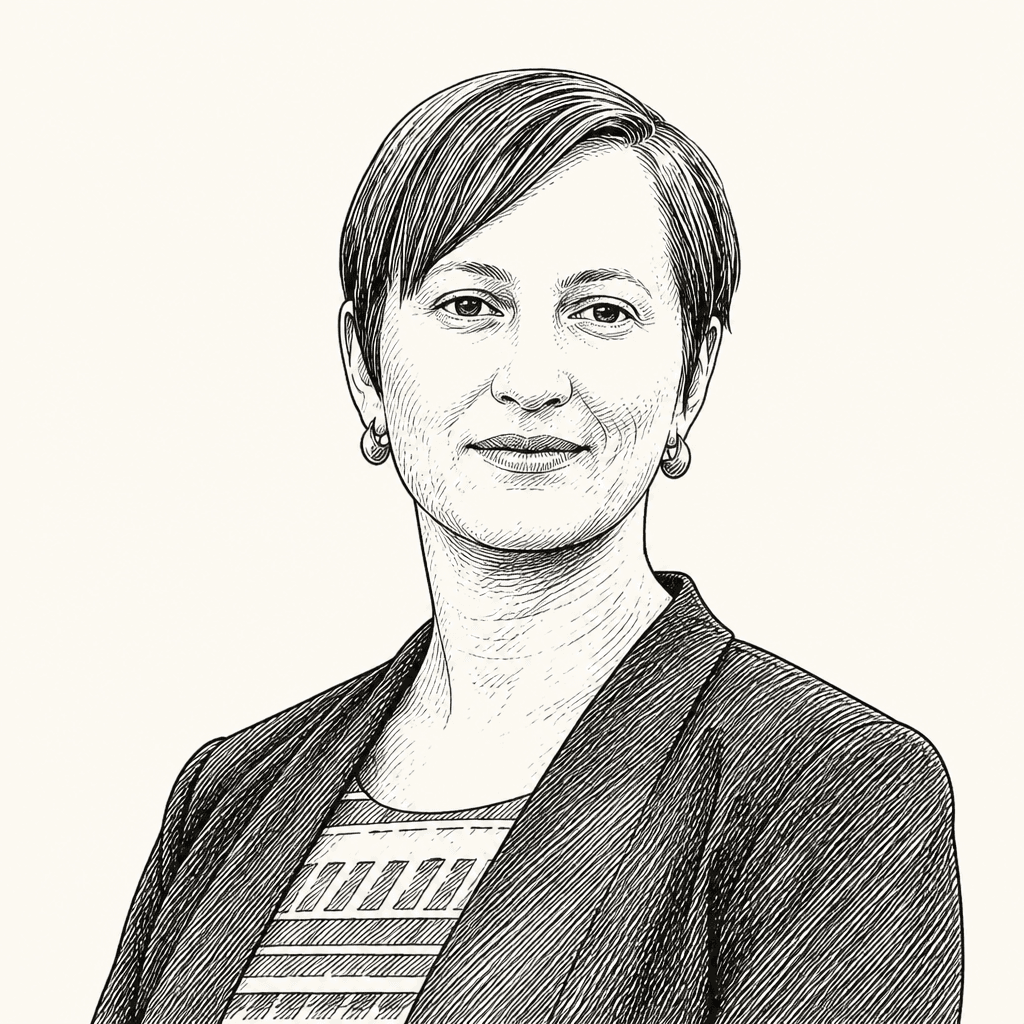
Risa Wechsler
Stanford and SLAC cosmologist Risa Wechsler is Director of the Kavli Institute for Particle Astrophysics and Cosmology, Director of Stanford’s Center for Decoding the Universe, and a professor of physics and particle physics/astrophysics whose work spans galaxy formation, dark matter, dark energy, large cosmological surveys, data science, and AI/ML for astrophysics discovery.
Physics AI Work Depends on Rigorous Problems and Interdisciplinary Collaboration
Risa Wechsler used her opening remarks at Stanford’s 2026 Conference on Physics and AI to argue that physics is well placed to make serious use of AI because many of its hardest problems are already rigorous, data-driven and computational. Speaking as director of KIPAC and Stanford’s Center for Decoding the Universe, she framed the opportunity less as a broad endorsement of AI than as a call for grounded collaboration between physicists, data scientists, computer scientists, engineers and statisticians.
AI Tools Target Labeling, Simulation, and Scaling Bottlenecks in Research
At Stanford’s second AI+Science lightning-talk session, three researchers presented AI less as a general-purpose scientific shortcut than as infrastructure for specific measurement problems. Matt DeButts argued that PRC-linked patronage can reshape Chinese-language media markets by helping already favorable outlets survive; Samuel Young showed how self-supervised learning can extract particle structure from unlabeled detector data; and Benjamin Dodge described using AI-scale computation to make Gaussian process priors practical for 3D maps of Milky Way dust. The shared claim was that AI’s value depended on a sharply defined bottleneck: too many articles to label, too few reliable detector labels, or too large an inference problem for conventional computation.
AI Is Pushing Science Beyond the Paper as Its Core Artifact
In closing remarks from an AI and science meeting, Risa Wechsler argued that AI is reshaping scientific fields unevenly, depending on their data, theory and modes of inquiry, and that scientists should use the moment to choose structures aligned with human values. Surya Ganguli pushed the question toward scientific communication itself, suggesting that papers may be too narrow an artifact for AI-assisted science and that richer institutional records of research could better transfer knowledge. Both framed AI for science as a design problem around human purposes, not just faster automation.
AI Is Making Scientific Throughput the New National Advantage
Dario Gil, the U.S. Department of Energy’s Under Secretary for Science, used his AI+Science keynote to argue that AI is shifting scientific advantage from access to instruments and computing toward the throughput of integrated discovery systems. He presented DOE’s Genesis initiative as the national-scale architecture for that shift, linking data, AI models, high-performance computing, experimental facilities, and industry partners into closed-loop workflows. Gil’s case was that the test is not more papers, but whether faster scientific cycles can produce measurable gains in productivity, security, and industrial capability.
Stanford Merges AI and Data Science Institutes Around Open Scientific Discovery
Stanford’s AI+Science Conference opened with James Landay announcing that the university is merging the Human-Centered AI Institute and Stanford Data Science into a single institute for AI and data science across Stanford. Landay, president Jonathan Levin, Surya Ganguli and Risa Wechsler framed the move around a common argument: AI is becoming a scientific instrument, but one that will require open research, domain-specific rigor, uncertainty-aware methods and human judgment about which questions matter.