AI’s Expanding Reach Tests Oversight, Governance and Human Agency
Nvidia’s concentrated commercial influence and founder-centered identity sharpen questions about corporate governance, while James Landay argues that AI adoption is outpacing efforts to assess its effects. Eric Ries focuses on the incentives shaping what companies build; across both debates, the unresolved measure is whether AI expands people’s capabilities and agency.

A company—and an industry—built around concentrated power
Nvidia makes the tension between reach and oversight concrete. Bloomberg reported that U.S. officials suspected an executive at Megaspeed International, a major Nvidia customer in Southeast Asia, of being recruited by Beijing to target Jensen Huang, and suspected Megaspeed of smuggling advanced chips to China. Those are reported suspicions, not established findings. Nvidia’s board said it had no reason to believe national security or company secrets had been compromised and appointed independent directors, assisted by outside counsel, to investigate. China called the allegations a smear. Separately, Huang acknowledged an affair and apologized to his family and colleagues.
The personal matter and the reported national-security inquiry are distinct. Their convergence nevertheless raises a governance question for a company whose strategy, public identity and government relationships are closely associated with its founder. The board’s review is one formal response; it is not a finding about what happened or what the episode means for Nvidia’s future.
The company’s concentration of influence extends well beyond its leadership. Nvidia sells chips and software, invests in startups and data centers, and is pushing across the infrastructure used to build and deploy AI. Huang describes the business as a “five-layer cake,” from energy and chips through infrastructure, models and applications. He argues that customers choose Nvidia and that the company must earn its place every day.
That account sits beside a more complicated commercial picture: Nvidia’s technology and capital are woven through many leading AI companies, while its investments may support companies that later buy its products. Bloomberg raised the question of whether those investments can also create demand. Huang says the financing helps an unusually capital-intensive ecosystem and that Nvidia is generally not the lead or largest investor in the companies it backs. The reporting establishes neither improper dealing nor that Nvidia represents the industry as a whole. It does show why scrutiny of the company’s reach cannot be separated neatly from scrutiny of how it governs itself.
Succession makes the founder question practical as well as reputational. Huang said he hopes Nvidia’s next CEO is already at the company, but no successor has been designated. His description of a flexible organization offers an account of how Nvidia intends to adapt, not evidence of how it would manage the departure of a leader who has run it since its founding. Here, company-specific facts open a broader question: how can institutions assess concentrated power when a company’s commercial position and public identity are so closely bound to one person?




The institutions meant to keep pace are under strain
The scale of AI investment and adoption helps explain why oversight is being pressed to move faster. James Landay, director of Stanford’s Institute for Human-Centered Artificial Intelligence, said global corporate investment in AI exceeded all of 2025’s total by 46% in the first half of 2026. He also cited AI use in 88% of surveyed organizations. These figures describe investment and reported adoption, not whether AI is improving outcomes or how its effects will be distributed.
Landay said the United States and China accounted for more than 90% of notable AI models released so far in 2026. In the survey he presented, 32.7% of U.S. respondents said they were excited about AI products and services, compared with a global average of 51%. He urged researchers to investigate that uncertainty rather than dismiss it. Together, the figures point to a mismatch: development and adoption are accelerating, while public attitudes differ and model production is concentrated in a small number of countries.
The employment evidence Landay cites is narrower than a general forecast. Research by Erik Brynjolfsson and colleagues found an employment gap for young workers in AI-exposed occupations such as software engineering; the researchers attribute it to employers hiring fewer young workers in those fields. Landay called this an early warning, not proof of economy-wide job loss. The distinction matters: the signal warrants monitoring, but does not settle what AI will do to employment overall.
Landay’s proposed response includes testing whether benchmark scores predict real-world outcomes, searching for rare failures, and making methods and tools open to examination. Those are different tasks from measuring investment or adoption. A benchmark may offer a repeatable score; the question is whether that score tells evaluators what will happen when a system is used in a particular setting. And failures that are infrequent may still matter when people depend on a system.
The institutional response also depends on expertise beyond computer science. Evaluating an AI tutor, for example, calls for knowledge of how students learn; assessing a system used in public administration requires knowledge of the work and rules it enters. Landay points to interdisciplinary projects at Stanford in biology, government and education as examples of technical work joined to domain knowledge. Universities can contribute independent inquiry and make findings open to examination, he argues, but they are one part of a wider response, not a substitute for it.
The two Articles on institutional capacity and corporate incentives raise related but distinct oversight problems:
| Question | Landay’s emphasis | Ries’s emphasis |
|---|---|---|
| What can be assessed? | Whether tests predict real-world outcomes and expose rare failures | Whether organizational incentives shape what is built and prioritized |
| What might distort judgment? | Limited evidence about effects in real settings | Anticipated preferences of investors or other resource holders |
| What can help? | Independent measurement, openness, and relevant domain expertise | Attention to corporate purpose, governance, and trustworthiness |
The comparison does not imply that one problem causes the other. An evaluator may lack evidence about a system’s consequences; an organization may face incentives that influence which systems it builds or which consequences it prioritizes. Independent tests can inform decisions, but they cannot by themselves determine an organization’s purpose. Conversely, concern about incentives does not establish what a particular system does.



Governance is also a question of corporate incentives
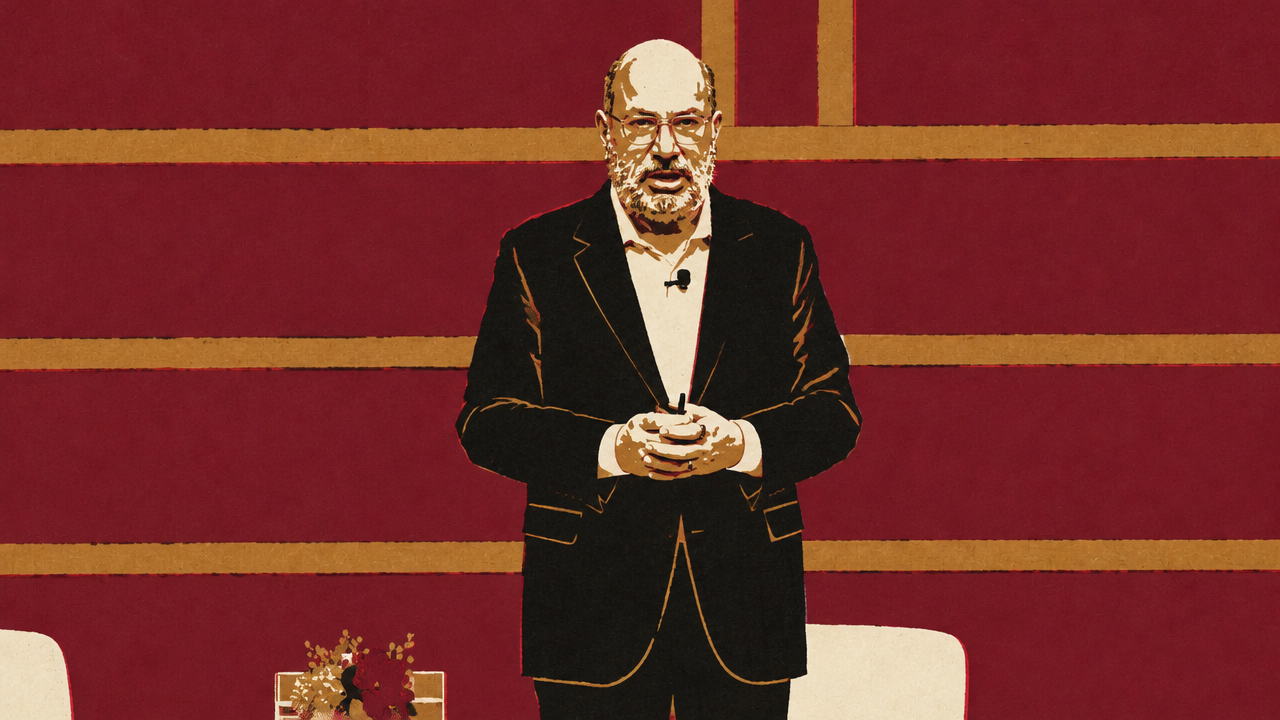
Eric Ries’s “financial gravity” is not a law that every successful company becomes extractive. In his conversation with Krista Tippett, Ries argues that people may anticipate what investors, donors or other resource holders want even when those people have made no direct demand. In his framework, that expectation can pull organizations away from creating value and toward extraction. It is an account of a pressure, not a demonstrated explanation for any particular AI company’s decisions.
Ries and Tippett name Costco, Patagonia, IKEA, Novo Nordisk and some credit unions as examples they consider exceptions to the expected drift. Their examples support Ries’s claim that the pressure can be resisted; they do not establish one common model for doing so. His argument is that the pressures shaping an organization deserve attention alongside the formal rules governing it.
That distinction matters for AI oversight. Landay’s call for independent evaluation asks whether tests reveal real-world outcomes and rare failures. Ries asks what organizations are rewarded for building, and whether anticipated investor or market preferences narrow choices before anyone issues an explicit instruction. One concern is about the evidence available to assess AI; the other is about incentives that help determine what gets developed and assessed. Neither, on its own, explains the other.
Ries argues that trustworthiness can have economic value even when it appears costly in the short term. He says organizations that cannot be trusted cannot endure indefinitely, and frames the loss of a company’s ethos as a business concern as well as an ethical one. His estimate that losing Google’s “Don’t be evil” ethos may have cost the company between one and ten trillion dollars is his own estimate, not a measured finding established in the conversation. The point he advances is that a narrow focus on immediate returns can leave trust out of the calculation.
This is relevant to technology governance without turning Nvidia into a proxy for the sector. Nvidia’s board has announced an independent investigation into reports concerning its founder and a customer; that is a specific governance response to specific allegations. Ries’s argument operates at a different level, asking how corporate structures and expectations shape behavior over time. The first does not prove the second, and the second does not determine what Nvidia’s investigation will find.
Tippett names mechanisms discussed in Ries’s book, including a “governance fortress,” a mission-lock vehicle and a “culture bank.” The conversation does not explain how they are designed or how they would work in practice, so they cannot be treated as demonstrated solutions. Ries’s argument is narrower and more useful than a catalogue of fixes: technical evaluation and corporate governance answer different questions, and scrutiny of powerful technology may need to attend to both.




The measure of progress is what people can do
At Stanford HAI’s October 28 conference, executive director Russell Wald framed the question as whether AI strengthens human purpose, creativity and independence or comes at the expense of human dignity. This is a stated aim, not a finding that the conference established how to achieve it. It shifts the measure of progress beyond investment, adoption or technical capability: what does a system enable people to do, and do they retain room to direct their own work and lives?
The institutional and corporate questions bear on that standard without answering it. Landay’s account of employment research makes the effect on young workers a question for continued monitoring, while his call for real-world evaluation asks whether tests can anticipate what happens when systems are used. Ries’s framework asks how organizational incentives influence what gets made and whose interests matter. Neither the early employment signal nor the financial-gravity argument settles whether AI will augment or displace people’s capabilities.
Wald placed research, policy and design among the areas that can shape how AI enters people’s lives. The conference material does not offer a recipe. It frames agency as something to pursue: students, workers and leaders can take an active role in shaping the technology’s development and use. That aspiration makes the earlier questions consequential. What institutions measure, what companies prioritize and how tools are designed all affect the conditions under which people encounter AI—but no one of those choices guarantees the outcome.
The available arguments leave open whether AI’s current trajectory will widen human capabilities or narrow people’s control. They make the outcome a matter not only of what systems can do, but of how their effects are assessed, what organizations are rewarded for doing and whether people retain influence over how the technology is used.