Orbital Data Centers Bet on Falling Launch Costs
 Jared Friedman
 Garry Tan
 Philip Johnston
 Diana Hu
 Harj TaggarY CombinatorWednesday, August 5, 202610 min read
StarCloud co-founder and CEO Philip Johnston argues that falling launch costs could make orbital data centers a practical alternative to terrestrial facilities constrained by power, permitting and local opposition. The company’s first satellite demonstrated that an NVIDIA H100 can operate in orbit; its next systems are meant to sell processing capacity to satellite operators before pursuing larger deployments for hyperscale customers. Johnston’s case remains conditional on cheap, high-cadence launch capacity and on StarCloud solving heat rejection, radiation tolerance and connectivity at infrastructure scale.
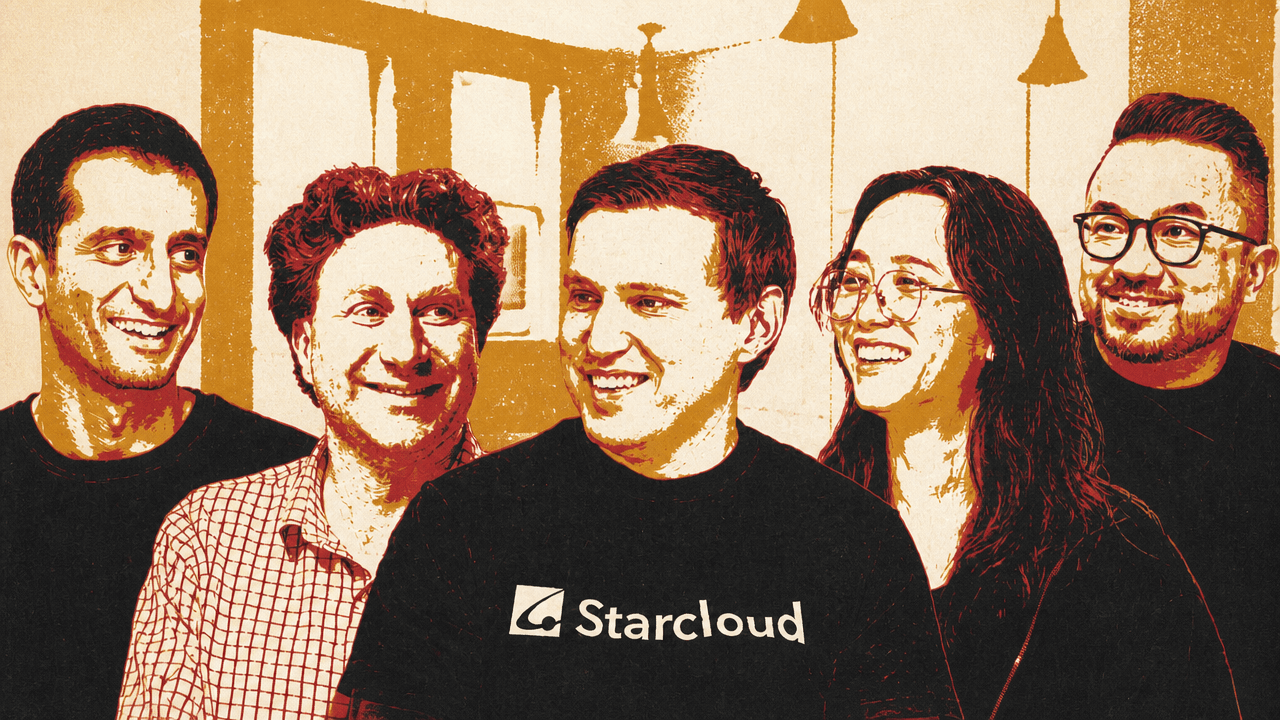
The bet is that launch gets cheap before terrestrial power gets easier
Philip Johnston’s case for putting data centers in orbit begins with two constraints moving in opposite directions. On Earth, he says, it is becoming harder to site new energy projects and data centers. In space, solar energy is abundant; the missing condition is cheap enough access to orbit.


Johnston began pursuing that condition after working with government space agencies at McKinsey and watching launch costs fall. A 2023 trip to SpaceX’s Starbase in Texas made the capacity question feel concrete. He saw facilities intended to build Starships at a rate of roughly three per day and reasoned that reusability, if it arrived at scale, could produce vastly more launch capacity than exists today.
His question was not which existing space business to copy, but what becomes viable when launch is both cheaper and more plentiful. The company considered in-space manufacturing, asteroid mining, and space hotels. Data centers emerged as the first plausible application partly because they do not require returning a physical product to Earth. Compute can remain in orbit; only results need to come down.
The initial concept was instead space-based solar: collect sunlight in orbit, beam the electricity to Earth, then use it for terrestrial demand. Johnston says the economics broke on transmission losses. By his estimate, 95% of the energy is lost moving it from space to Earth. The company, then called Lumen Orbit, ran the calculation a different way: rather than beam power down, put the energy-intensive workload next to the solar panels.
That shifted the economic threshold. Johnston says space-based solar required launch costs of roughly $50 per kilogram to break even, while an orbital data center could make sense at about $500 per kilogram. The latter remains dependent on launch economics improving, but it was close enough to plausibility for the company to pivot.
The political case has strengthened alongside the cost case, in Johnston’s view. He says the company initially assumed it would have to beat terrestrial compute on a per-unit basis. But opposition to new AI data centers may itself become a reason to put capacity elsewhere. Johnston cited what he described as New York blocking data-center construction and predicted that regulation could make orbital deployment easier than building on the ground.
That does not mean Earth-based data centers are harmless or frictionless. Johnston agrees they consume substantial power, and says many new projects are being paired with natural-gas generation. But he pushed back on water as the central objection: water consumption is fundamentally a power-and-cooling-design question, he said, and data centers can use closed-loop approaches with no daily consumptive water use if operators supply sufficient power for cooling.
A launch booking turned an uncertain thesis into a deadline
Philip Johnston’s operational advice is unusually blunt: book a launch before the hardware is defined. StarCloud was founded on January 1, 2024; the following day, Johnston says, it booked the first available SpaceX rideshare launch. It was initially 18 months away, later pushed to 21 months, and cost about $300,000.
The first thing every space company should do is book the first available launch they can.
The company had not settled its design. That was the point. A launch date imposed a non-negotiable delivery constraint: “something is going to be on that rocket,” Johnston said, even if the team did not yet know what.
The original payload was modest. StarCloud planned to fly NVIDIA Jetson chips that had already been used in space and run edge-processing workloads on them. That changed when Addie, a co-founder Johnston said came from SpaceX, joined the company and pushed for a data-center-class NVIDIA H100 GPU instead.
The H100 became the central demonstration on StarCloud-1, alongside other NVIDIA and ARM GPUs. The decision brought the two constraints that still define StarCloud’s engineering program into immediate focus: removing heat in a vacuum and operating commercial chips in a high-radiation environment.
StarCloud-1 was deliberately improvised in places. To test whether its phase-change cooling material would damage the system through repeated heating and cooling, Johnston said team members worked overnight before shipment, dunking hardware in an ice bath and reheating it with hot-air guns. The phase-change material immersed the satellite’s electronics, including power delivery and memory, absorbing heat as it changed state.
That approach was not intended to scale. The material must melt and then resolidify, giving the system a low duty cycle. But it was sufficient for the narrower test: whether an H100 could operate in orbit. Johnston contrasted the project with a quote from an established aerospace prime contractor that estimated StarCloud-1 would cost $75 million to $100 million. StarCloud completed the satellite and launch for roughly $2 million, he said.
The source’s separation footage shows the small StarCloud-1 satellite drifting away from its host spacecraft above Earth. It is a useful image of the program’s current maturity: StarCloud-1 was a hardware demonstrator, not the large, continuously operating commercial platform Johnston describes as the eventual product.
After launch, StarCloud made first contact in about 12 hours, Johnston said. Commissioning included diagnosing a satellite restart every two hours: the team had to disable one of roughly 20 failure triggers at a time, wait for a ground-station pass, and identify the culprit over several days. Once commissioned, the system trained what Johnston described as the first model in orbit, ran a version of Gemini, fine-tuned a model, and performed high-power inference on satellite imagery.
Heat and radiation determine whether the demonstration can become infrastructure
Diana Hu framed the trade-off directly: space offers solar energy and room for large systems, but no atmosphere to carry heat away. It also exposes electronics to radiation that can flip bits, while creating a need to move data between orbital hardware and users on Earth.


Philip Johnston said StarCloud’s engineering effort is divided roughly evenly between thermal management and radiation tolerance. Interconnect matters, but he regards it as a problem that other infrastructure can address. StarCloud has contracted with SpaceX for Starlink laser terminals on its next 20 satellites, which he says will provide high-bandwidth, low-latency connectivity.
For heat, the company is developing a large deployable radiator connected to a liquid-cooled loop. The underlying physics is established: the International Space Station already uses radiators to dissipate heat. The problem, Johnston said, is producing a system light and cheap enough for a compute deployment rather than a legacy space platform.
Johnston claimed StarCloud’s radiator is at least 10 times lower in mass per watt of heat dissipation than the ISS radiator and 500 times cheaper per watt. The intended production design would replace StarCloud-1’s phase-change approach with direct-to-chip liquid cooling that can operate continuously.
Radiation requires a different testing program. Johnston said StarCloud has tested equipment at Brookhaven National Laboratory’s particle accelerator for heavy ions and at a Knoxville cyclotron for high-velocity protons. The company exposes hardware over 24 hours to what he described as the radiation dose of a five-year mission, then uses the telemetry to choose shielding and software mitigations for bit flips.
StarCloud is not trying to solve the problem by buying conventional radiation-hardened parts. Instead, Johnston said, it tests commercial components—SSDs, power-delivery systems, and converters—and selects the best performer. The preference is for off-the-shelf, automotive-style parts with existing supply chains and lower costs.
That philosophy also informed the H100 adaptation. Johnston said StarCloud removed components including AC-to-DC converters and cold plates, then stiffened the board for radiation tolerance. The company is working with NVIDIA on what he called a “Space Rubin-1” chip designed for the orbital environment. Because its solar panels produce DC power directly, StarCloud can use DC-to-DC conversion rather than convert power to AC and back again for GPUs.
The first sellable service is processing data that is already in orbit
Jared Friedman pressed Johnston on the difference between proving that one GPU can run in orbit and building a commercially viable data center. Johnston’s answer is a staged product plan rather than a single leap to hyperscale capacity.

StarCloud-1 established that data-center-grade GPU hardware could operate in orbit and exposed the failures that would shape later systems. StarCloud-2 is intended as a 10-kilowatt spacecraft selling compute to government and military satellite customers. Johnston said StarCloud has won four contracts with Department of Defense and government entities for the next two or three years.
The near-term use case is processing data that is already in space. Many satellites are constrained by how much data they can downlink, Johnston said. StarCloud-2 would receive raw imagery and synthetic-aperture-radar data through optical terminals, process it on orbit, and return a much smaller result—such as the coordinates of a vessel—instead of sending the full dataset to Earth.
StarCloud-3 is the later system intended to serve hyperscale-data-center demand. Johnston described it as a 200-kilowatt, three-ton spacecraft about six meters long. He said a single Starship could carry 50, or roughly 10 megawatts of new compute capacity per launch.
- January 2024StarCloud is founded and, according to Johnston, books its first available SpaceX rideshare launch the next day.
- November 2025StarCloud-1 launches as a technology demonstrator carrying five GPUs, including an NVIDIA H100.
- Planned next stepStarCloud-2 is intended to provide 10 kilowatts of orbital compute for government and military satellite customers.
- Planned later systemStarCloud-3 is intended as a 200-kilowatt spacecraft for hyperscale-data-center demand.
- Around end of 2028, conditionallyJohnston estimates a terrestrial-competitive deployment ramp if Starship and other launch capacity develop as expected.
| System | Planned role | Capacity or scale |
|---|---|---|
| StarCloud-1 | Demonstrate orbital GPU operation | Five GPUs, including an NVIDIA H100 |
| StarCloud-2 | Sell compute to government and military satellite customers | 10 kilowatts |
| StarCloud-3 | Serve hyperscale-data-center demand | 200 kilowatts per spacecraft; 50 per Starship |
The company has filed with the FCC for a constellation of 88,000 StarCloud-3 satellites. At 200 kilowatts each, Johnston put the capacity on the order of 20 gigawatts. He also said a dawn-dusk sun-synchronous orbit could accommodate as much as 10 terawatts, which he compared with 20 times the entire U.S. power grid.
Johnston tied the timetable directly to launch economics. He said Starship’s deployment and launch cadence are central to the terrestrial-facing business, while also naming Stoke Space’s Nova, Rocket Lab’s Neutron, and Blue Origin’s New Glenn as potential new launch capacity. His estimate was that StarCloud could begin ramping the business that competes with terrestrial data centers around the end of 2028, if launch costs and cadence develop accordingly.
The eventual constellation would operate in a polar, dawn-dusk sun-synchronous orbit to remain in sunlight continuously. StarCloud-1 does not: it flies in a mid-inclination orbit and passes through Earth’s shadow. Johnston described that limitation as acceptable for a hardware test, not representative of the end-state system.
The execution model is a small team willing to work before consensus
Harj Taggar asked why an idea that later attracted major funding had initially been difficult to finance. Philip Johnston said investors had trouble treating cheap launch as a credible economic input. That skepticism was not irrational, he added: the company still needs the Starship program and other launch developments to deliver. The thesis became more fundable, in his view, as belief in falling launch costs grew and terrestrial power, siting, and permitting became more visibly constrained.

The fundraising history was difficult. Johnston said the company spent three months trying to raise $2 million at a $10 million post-money SAFE valuation, receiving at least 100 rejections. After YC Demo Day, he said, it received at least 20 more rejections before its first check. The later Benchmark round was also complicated, he said, by firms with SpaceX positions after SpaceX announced it was pursuing the same broad category.
For Johnston, the relevant response to unresolved technical risk was not to wait until every question had been settled. It was to recruit engineers capable of settling them. He had a background in math, physics, software engineering, and later consulting work with national space agencies, but not in spacecraft engineering. Before the company had a final concept, he approached potential co-founders with a question: what would make money if launch costs fell by 10 times?
He knew Ezra from growing up in the same part of the UK and met Addie through an introduction. Of roughly 10 space engineers who took calls, Johnston said, two became his co-founders. After YC, he said, StarCloud had raised about $11 million at a $40 million valuation but still took six months to make its first hire. Even after later fundraising, it had roughly 20 engineers and one commercial employee.
The point is not merely a preference for small teams. StarCloud’s plan requires a sequence of hardware, thermal, radiation, networking, launch, and customer milestones that cannot be outsourced to an abstract conviction that space compute should work. Johnston’s claim is that technical-team quality is “the whole game”: the condition that lets a company take a contrarian launch-cost thesis and turn it into a series of testable systems.