AI Makes Choosing What Matters More Important Than Working Faster

As the 20th anniversary of *The 4-Hour Workweek* approaches, Tim Ferriss argues that AI makes the book’s first steps—defining what matters and eliminating low-value work—more important than automation. In his view, AI accelerates whatever people direct it toward, so speeding up tasks that should not be done can produce more work, not more free time. Automation, he says, is useful only after people have identified the work worth doing and set rules to protect it.
AI makes choosing the work more important than doing it faster
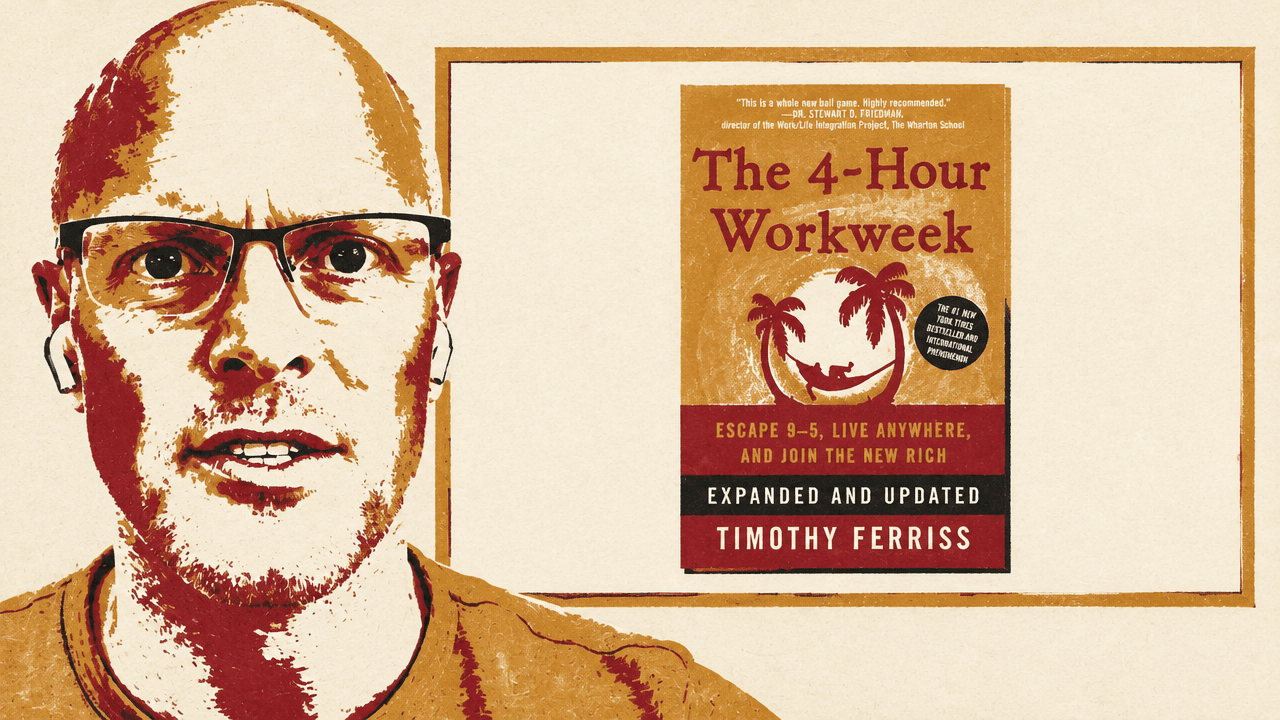
Tim Ferriss frames the coming 20th anniversary of The 4-Hour Workweek—in April 2027—as a chance to revisit its central method in a world of AI agents. The book organizes that method as DEAL: definition, elimination, automation and liberation. Ferriss’s argument is that AI changes the tools, but makes the first two steps more important, not less.


Definition means deciding where you want to go and calculating the monthly income and other requirements of the life you want. Elimination means using 80/20 analysis and related methods to remove the “trivial many” and concentrate on the “critical few.” Only then comes automation: using processes and technology to carry out work that has already been judged worth doing. Liberation is making purposeful use of the time and space those steps create.
The distinction matters because, in Ferriss’s view, AI is an accelerant: it multiplies what is already there. If the work is unimportant, automating it does not make it valuable; it makes more of it happen faster.
If you do not first identify the critical few, the very, very limited set of things that stand a chance of making a huge difference, AI and so on simply multiplies the useless.
Ferriss says that in more than 90% of the AI use cases he has seen, people are speeding up tasks that probably should not be done at all. The result, he argues, is often more work rather than less. He rejects the promise that AI will naturally produce endless leisure: previous technologies, he says, have arrived with similar promises without delivering them. Used as a blunt instrument, AI could instead generate more work and stress, leaving people buried in distractions they have not first chosen to remove.
Automation depends on rules that protect the critical few
The automation in The 4-Hour Workweek is often associated with virtual assistants, but Ferriss describes them as a means to an end, not the principle itself. He says he still uses plenty of humans. The more durable idea, he says, is to establish the rules and policies that govern work and life: define what you will and will not do, identify the few areas worth optimizing, and leave room to breathe around them.
That last point is part of the method, not an afterthought. Ferriss’s account of automation is not simply about delegating more tasks. It is about setting categories in advance—what belongs in the work, and what does not—and optimizing only the activities already identified as important. Without those boundaries, new tools can increase the volume of activity without creating more time for the things that matter.
Ferriss presents these steps as fundamentals rather than inventions. The book, he says, collected practices with a much longer history; his role was to curate them in a form he expected to last. Tools change, but the underlying principles do not. As an example, he recommends Peter Drucker’s The Effective Executive, which he calls short and dense with tactics and principles. Outdated details can be updated, he says, while the underlying guidance remains useful.
Advice changes meaning as the reader’s life changes
Asked which advice from his work he wishes people would stop following, Ferriss did not identify a blanket answer. He says he tries to make his books durable by cutting material that is too tied to the moment. But he adds a qualification that applies to any author: consider the stage of life in which the book was written, and the stage of life in which you are reading it.
Ferriss wrote The 4-Hour Workweek at 29; he is now 49. Responsibilities and experience alter what people value, he says. Having a spouse or family, approaching retirement, or losing friends can change how the same advice looks. Reading a book well, on this account, means attending not only to its principles but also to the circumstances of the person who wrote it—and to your own.
Ferriss says readers should give more attention to the book’s chapter “Filling the Void,” which he considers important for heading off digital malaise, overwhelm and a sense of meaninglessness. In his account of DEAL, liberation is using the time and space created by definition, elimination and automation in enjoyable and high-leverage ways. Taken together, those points suggest that “Filling the Void” addresses a question liberation leaves open: how to use the time you have made. That connection is a synthesis of Ferriss’s remarks, rather than a direct claim he makes about the chapter.