Sarno’s Mind-Body Approach Helps Some, But Not All Back Pain
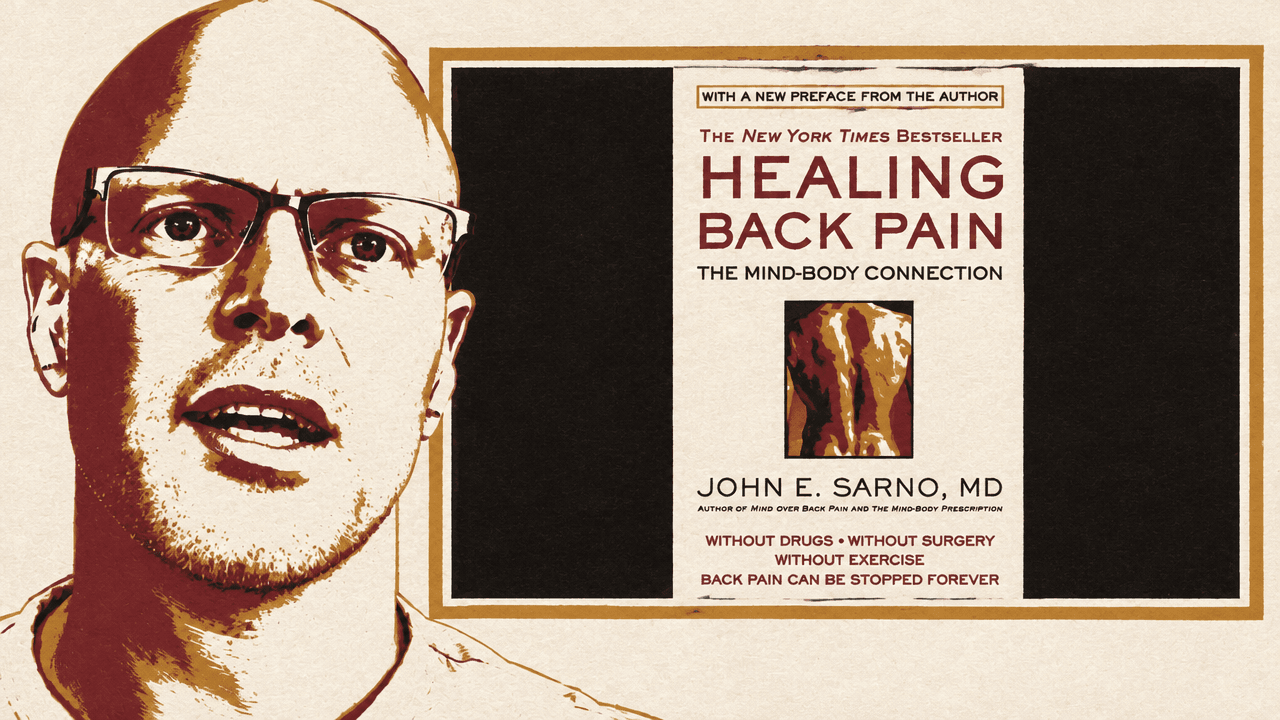
Tim Ferriss says John Sarno’s mind-body approach to back pain has helped people he knows, but argues against treating it as a near-universal explanation that makes mechanical causes largely irrelevant. In a discussion of Sarno’s book *Healing Back Pain*, Ferriss says pain can reflect both physical factors and differences in sensitivity, belief and behavior—and that the right response depends on the cause. He also describes using Egoscue exercises nightly and recommends Stuart McGill’s *Back Mechanic*, without presenting either as a remedy for everyone.
Sarno’s approach has helped people, but Ferriss rejects it as a universal explanation
Tim Ferriss says several friends plagued by low-back pain—including some who could not walk several blocks—credit John Sarno’s Healing Back Pain with fixing them. Some, he says, have had durable results without the pain returning. Ferriss calls that significant and says Sarno’s work is valuable for many people.
His objection is to what he describes, while acknowledging the summary may sound unfair, as the book’s broader claim: that almost all back pain is psychosomatic, that people should resume activities they have stopped doing, and that mechanical explanations are largely irrelevant. Ferriss says Sarno discusses ruptured and bulging discs, then uses MRI comparisons: some people with pronounced findings have no symptoms, while others with less apparent deterioration experience pain. Ferriss questions whether that comparison rules out mechanical causes.
His counterexample is deliberately blunt: if he repeatedly struck someone’s L5 vertebra with a ball-peen hammer, he says, it would cause pain, possibly lasting pain. Not all pain, in his view, originates in the mind. He also knows people who have had life-changing, durable effects from interventions including physical therapy, fusion, and procedures such as Intracept. Those interventions carry risks, he says, and what helps depends on the nature of a person’s low-back pain.
I think John Sarno’s work is very valuable for a lot of people. But I take major issue with any type of largely one-size-fits-all remedy which implies that in this case, there are almost no mechanical causes of pain.
Pain sensitivity varies from person to person
Ferriss argues that MRI comparisons need to be considered alongside differences in how people experience pain. He compares variation in pain sensitivity with differences in sensitivity to smell and light, and points to differences in people’s composition of nociceptors. People may also differ in how they magnify or interpret pain, and in the roles played by their beliefs and the activities they avoid.
For Ferriss, those influences are real parts of how a person experiences pain, but they do not establish that mechanical causes are irrelevant. His objection is to treating Sarno’s account as a near-universal explanation, not to acknowledging that mental and physical factors can both matter.
Specialists can mistake their tool for the whole diagnosis
Ferriss calls the low back the “Bermuda Triangle of effective diagnoses.” He contrasts it with an elbow injury he attributes to a clear physical event: his elbow was forced backward during jiu-jitsu, tearing the extensors. He describes that as a comparatively straightforward repair. The low back, he says, is a trickier problem.
Ferriss cautions that he is not a doctor, but says that specialists tend to approach problems through the tools they know. A physical therapist may see a muscular problem and prescribe exercises; a neurosurgeon may look for a surgical solution; an acupuncturist may turn to acupuncture; and someone working in psychotherapy may focus on mental or emotional factors. He says these practitioners need not be wrong. Their expertise may still be siloed and limited.
He compares the situation to the parable of blind men describing different parts of an elephant: one feels the trunk, another the tail, another a leg, and each describes the whole from a different part. In a complicated medical problem, Ferriss says, there may be a sliver of truth in several accounts without any one account being sufficient.
He says it took him six years of due diligence to land on converging diagnoses, and that he plans to pursue that path. He says he will be transparent about how it turns out, without presenting his own case as settled.
His own routine includes McGill and Egoscue exercises
Ferriss calls Stuart McGill’s Back Mechanic a great book and says he is a fan; he has spent time with McGill and considers him very smart. Ferriss also says he has flat feet and uses the Egoscue method.
The on-screen Egoscue demonstration shows a woman lying on her back with her lower legs supported on a padded block and another block between her knees. Ferriss says he wrote an entire chapter about the method and does Egoscue exercises every night before bed. He finds them very helpful and says they give him a better chance of sleeping through the night. He describes them as practices that continue to help him, not as a universal remedy.