Ferriss Still Uses The 4-Hour Body, but Offers No Age-Specific Evidence
Tim Ferriss says he still uses most of the methods in *The 4-Hour Body*, including the Slow-Carb Diet and intermittent fasting, and would stand by nearly everything in the 2010 book. But his case for applying its advice after 40 rests on his continued use and personal results, not on an age-specific assessment: he offers no comparison of outcomes by age or distinct protocol for older adults. His main caveat is the book’s supplement stack, particularly policosanol, whose evidence he says he would need to revisit.
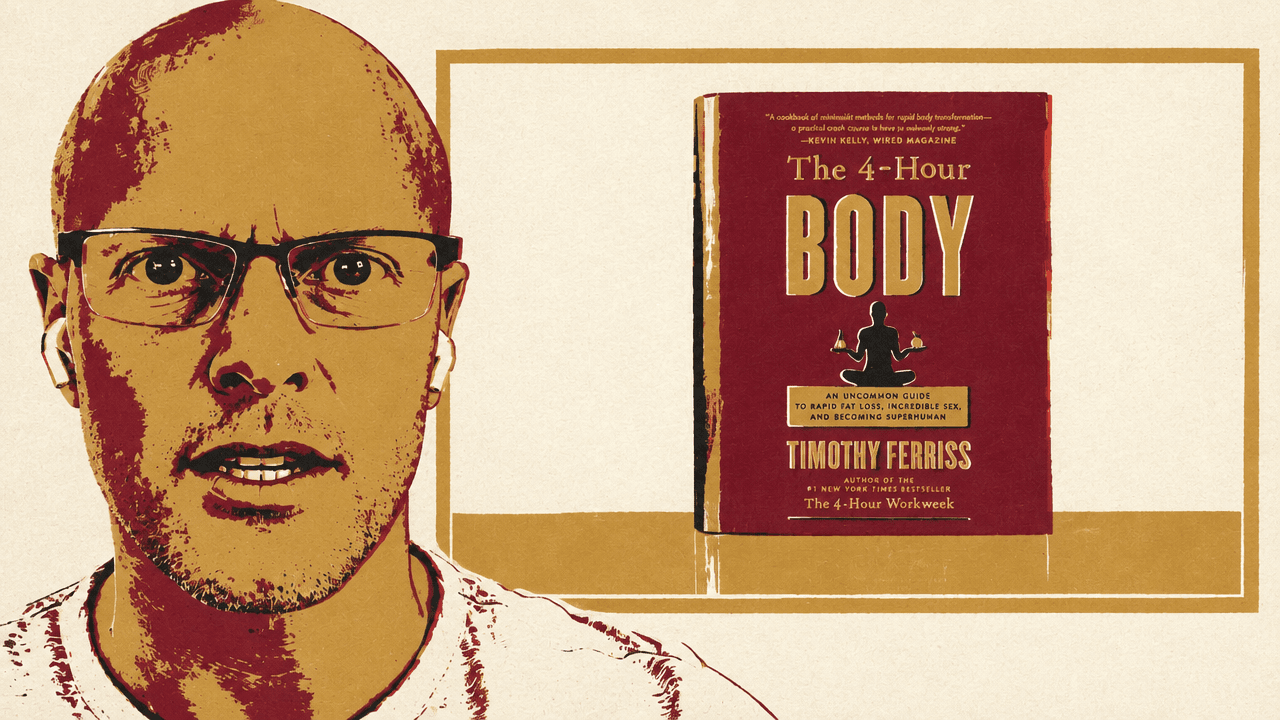
Ferriss still uses the book, but does not offer age-specific evidence
Tim Ferriss says he would stand by nearly everything in The 4-Hour Body, published in 2010 and based on work he began around 2008–09. He names the Egoscue Method and the Slow-Carb Diet as approaches he still uses, including slow-carb when he wants a “reboot.” But his answer to whether the book’s principles apply after 40 or 50 is an endorsement of the book, not a separate account of how those methods perform with age. He does not compare results by age or describe a distinct older-adult protocol.
He says much of the book has become mainstream and calls its recommendations “shockingly stable and highly predictive.” His own continued use is the basis he offers for standing by them. He sometimes alternates slow-carb with a ketogenic diet, which he finds helpful for what he calls “optimizing state” and stabilizing energy production. His usual pattern, though, is a hybrid: slow-carb eating combined with intermittent fasting.
On most days, Ferriss fasts for at least 16 hours and eats within an eight-hour window, sometimes less. He typically begins eating around 1, 2, or 3 p.m. and finishes dinner within that window. His practical instruction is to start counting the fast when eating ends, not when dinner begins.
Ferriss says that after four to six weeks of this pattern, his oral glucose tolerance and insulin-sensitivity tests were “a world apart.” He describes intermittent fasting as helping him become “fat and keto-adapted,” with slow-carb shaping what he eats during the window. Those are his reported results; he does not present them as evidence that the same changes occur for everyone over 40 or 50.
He calls slow-carb one of the simplest and most reliable options, in his view, for changing body composition and performance. Its value, he says, partly lies in whether someone can stick to it: “The best diet that you follow is a lot better than the perfect diet that you quit.” He points readers to a free post on his blog for the diet’s rules and reader stories. One story described in the post concerns a woman in her late 60s who reportedly lost 40 pounds in about three months and stopped taking blood-pressure medication she had used for more than 20 years. Ferriss offers it as a reader success story, not as a controlled comparison or proof of an age-specific effect.
The supplement caveat is narrow, but not settled
The main qualification Ferriss adds to his endorsement is the book’s PAG supplement stack: policosanol, alpha-lipoic acid, green tea, decaffeinated green tea extract, and garlic. Policosanol is the ingredient he is least certain about. He says he was slightly persuaded by the case for it when the book appeared, but would need to revisit research not funded by industry before assessing it fully.
He says he could have made money from the recommendations but chose not to launch a sports-nutrition company alongside the book. That explanation does not resolve the policosanol question: Ferriss describes it as an asterisk and says he could be missing something. He does not identify other parts of the book that he would retract.
His current use of the book extends beyond diet. While preparing for surgery, he says he is using Occam’s Protocol to build muscle, anticipating substantial atrophy during the four to six weeks after surgery. This is another example of his continued reliance on the book, rather than evidence in the source about how the protocol works specifically for older people.
The separate new-parent question leads to low-cost fitness options
In response to a new parent with limited money and little family help, Ferriss shifts from the book’s age question to what he would prioritize for family, personal, and marital well-being. He identifies relationships and health or fitness as the two levers he would invest in.
For relationships, he recommends Fierce Intimacy, an audio program by Terry Real, saying he finds Real clear and useful. He favors the audio format partly because a new parent may have more time to listen than read, and also mentions Crucial Conversations.
For fitness, Ferriss recalls Richard Branson answering “Exercise” when asked for one productivity tip. Branson said daily exercise gave him three to four more hours of focused productivity; Ferriss suggests that for a new parent the relevant benefit may instead be energy. He then names two approaches he says require little money and no gym membership.
The first is The Happy Body, a book and program by Jerzy and Aniela Gregorek. Ferriss points to Jerzy’s ability to perform a barbell snatch while standing on a balance board as an example of the couple’s strength and balance. He says they credit much of their ability to a daily exercise sequence. Equipment can be minimal: a yoga mat and a couple of dumbbells, which he estimates should cost no more than $50; he suggests water-filled jugs as an improvised alternative.
The second is Gymnastic Strength Training, or GST, associated with coach Chris Sommer. Ferriss describes it as body-weight training that can require little more than a floor. He says he was in the best shape of his life in recent decades when combining GST with The Happy Body and AcroYoga, while noting that AcroYoga is more involved.
These suggestions answer a different question from whether The 4-Hour Body still applies after 40. On that central point, Ferriss’s position is clear: he continues to use most of the book and would not broadly revise it. What he does not provide is a separate age-based assessment of its methods.