AI Game Creation Shifts From Coding to Taste and Iteration


Astrocade CEO Amir Sadeghian argues that generative AI can lower the cost of making interactive experiences, but cannot replace the human judgment required to make a game worth playing. His company pairs natural-language generation with an editor for tuning mechanics, pacing and other precise choices, on the premise that “taste is the new programming language.” As more people publish AI-made games and other interactive content, Sadeghian says discovery and recommendation will determine whether creators can find an audience.
The product is an authoring environment, not a prompt-to-game machine
Amir Sadeghian describes Astrocade as a platform for making and publishing interactive experiences through natural language. Games are the largest category, but he also names educational content and companions. A creator can describe an idea, have the system generate an experience, and publish it into a scrollable feed of work from other creators.


That framing can make Astrocade sound like a simple prompt-to-game product. Sadeghian’s more consequential claim is different: the useful unit is not an AI-generated game alone, but a working environment in which AI creates both a playable draft and controls for changing it.
Game development has traditionally required several forms of expertise at once, Sadeghian says: coding, asset creation, mechanical tuning, and an understanding of what makes players want to continue. The barrier is not only producing a game that runs. It is producing one that feels good after people play it, then revising the choices that make it too easy, too difficult, or simply uninteresting.
Astrocade tries to remove much of the production burden. Sadeghian says its creators can begin by describing an experience in ordinary language rather than learning a game engine or assembling a studio. He compares the product thesis to a small experiment from Astrocade’s early office: when the team replaced easy-to-grab small watermelon-juice bottles with larger bottles, consumption fell until cups were placed beside them. The underlying demand had not disappeared; the friction had increased.
The company’s claim is that interactive creation has a similar latent demand. Lower the effort between an idea and something playable, and more people will make games, gifts, jokes, educational experiences, and other forms of interactive content.
The only barrier right now is taste. And I call actually, I say taste is the new programming language.
Sadeghian does not mean that technical constraints have vanished. He means that once a system can produce the initial implementation, the scarce work shifts toward deciding what the experience should be: its rules, mood, pacing, visual identity, and the small choices that distinguish a familiar game from a compelling one.
AI supplies the draft; creators still have to tune the game
AI can reproduce familiar formats more readily than it can originate a successful new one, Amir Sadeghian says. He uses Flappy Bird as the straightforward case: a model can generate that kind of game because there is extensive related code and many examples available in its training material. But a creator who wants a new experience—or even a meaningful variation on an existing one—quickly encounters the model’s limitations.
The strongest work on Astrocade, he says, generally emerges through repeated revision. Creators make multiple “wishes,” the company’s term for prompts that modify the experience, rather than accepting a first output as a finished game.
The demo of Arrow Storm Survivor made that workflow concrete. The game places the player in a labyrinth, fighting enemies and selecting upgrades as they progress. Its Studio interface put a conversational AI pane beside a live game preview and a settings panel. The visible chat history included requests to update a shop, change the close button to a blue arrow, move the currency display, add an “Unlock all Levels” setting, and add an “enderman pet.”
The control panel handled a different class of decision. It exposed settings for cell size, flower and weed occurrence, walls, wall height, camera angle, player health, and player speed. In Astrocade’s workflow, rather than asking a model repeatedly to slightly alter a numerical value, the creator can change a parameter directly and see what happens.
That distinction is central to Astrocade’s product design. Natural language handles broad changes such as adding a feature, moving an interface element, changing a color, or introducing a character. Direct controls are intended for repeated, precise balancing work. A creator deciding how often objects should appear, how fast a player should move, or how much damage an enemy can take can manipulate those values explicitly.
Jason Calacanis describes the reason in terms of the probabilistic behavior of language models. Models are valuable partly because they can infer missing details. Games, however, often rely on fixed relationships: a specific number of lives, a boss with a known quantity of health, or a weapon with a predictable damage value. Those numbers need to work together, not merely be plausible individually.


Sadeghian’s example is a setting that changes from 25% to 50%. Such a shift can make a game boring, he says, because the player starts winning too easily. The system may offer gamification ideas, but a person must select among them, play the result, and revise it.
AI can give you suggestions, but I think the best way that works is like your own taste and choosing it.
Astrocade therefore generates both a game and an editor for that game, according to Sadeghian. The editor is not an ancillary feature. It is the answer to the gap between a model’s capacity to create a plausible draft and a creator’s need to shape exact behavior.
That gap also explains why generic outputs tend toward familiar patterns. Calacanis notes that a model asked to create a game or a website can revert toward the most common design choices in its training material. Familiarity may help when a creator wants players to immediately recognize a genre. It is a liability when the goal is an unusual art direction, a distinctive theme, or a new mechanic. Specificity and iteration are what pull the output away from the average.
Sadeghian says Astrocade plans to retrain models on data from its own interactive content, with the aim of improving generation over time. But his account of the present product does not depend on waiting for a fully autonomous game-design model. It depends on building a faster loop between generated possibilities, explicit controls, playtesting, and human judgment.
Personalization makes small, specific experiences worth creating
Jason Calacanis asks whether he could make a game about a family vacation using his daughters and three bulldogs as characters. Amir Sadeghian says users can upload images as assets, subject to the platform’s safety controls, and personalize an experience around a particular scenario.
Sadeghian says creators have already made interactive birthday cards that incorporate a friend’s image and can be sent as a greeting. That use case was not one he says Astrocade anticipated when it began building the technology.
The point is not that every personalized experience becomes a durable game product. It is that the cost of making an interactive artifact falls far enough for projects that would not justify conventional development: a private family game, an in-joke, a greeting, a companion, or a small shared activity.
That breadth changes the economics of what can be made. If interactive creation requires a professional production pipeline, it remains largely limited to teams able to justify the cost. If a creator can begin with a description, upload personal material, and tune the result through an editor, interactivity becomes available for more fleeting and specific purposes.
A flood of creation makes discovery the operating problem
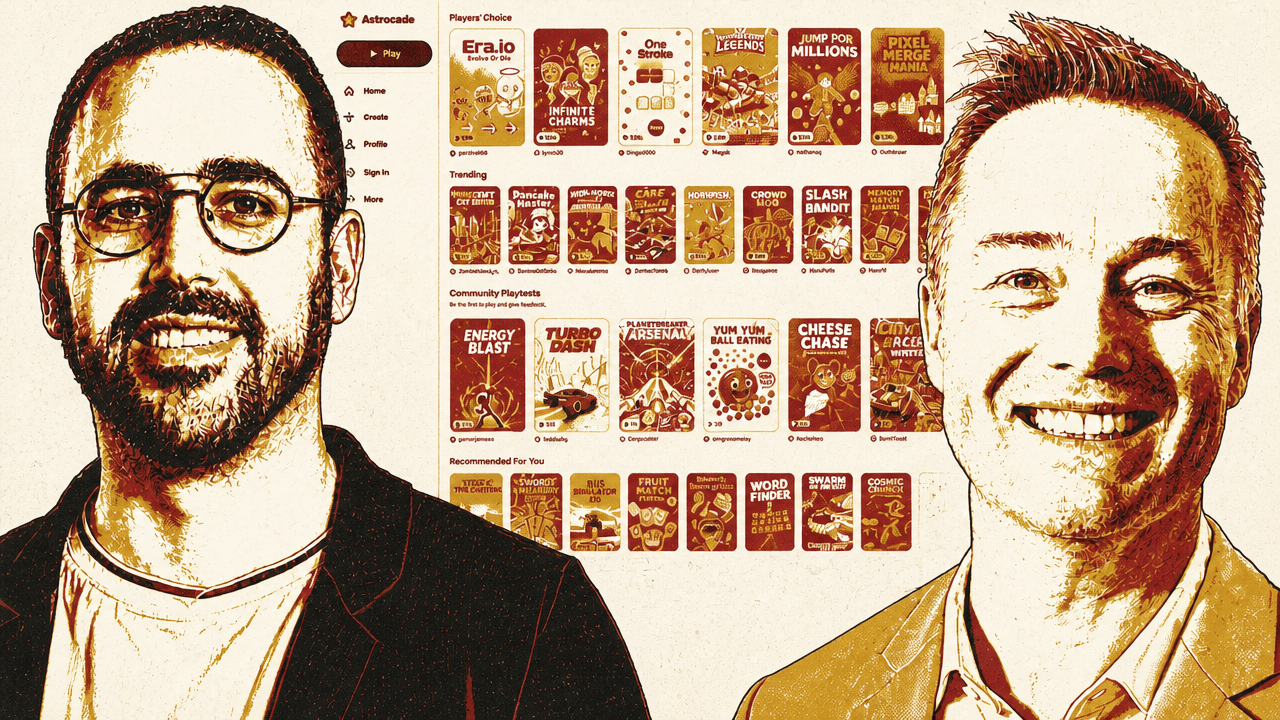
Amir Sadeghian says Astrocade has more than 100,000 creators in more than 100 countries making and publishing interactive content. It presents those creators’ work in a feed rather than a conventional storefront, with categories including tactics, farming, cooking, sports, arcade, educational games, merge games, and platformers.
For Sadeghian, that feed is not simply a distribution channel after creation. It is part of the product’s economic logic. He says Astrocade has a creator fund that pays creators based on the number of plays their work receives, and that some people are building games and interactive experiences full-time while earning thousands of dollars per month on the platform.
The unresolved challenge Sadeghian identifies is discovery. Reducing the barrier to creation can produce a large supply of content; it does not determine which work reaches players. Once a platform contains hundreds of thousands of experiences, recommendation becomes the mechanism that decides whether creators get plays and whether players find work worth returning to.
Sadeghian calls recommendation systems a major hiring priority for that reason. Astrocade is also hiring for AI agents and post-training roles, aiming to develop stronger models for interactive experiences. The two problems are connected: better generation can increase the volume and quality of available work, while better discovery determines whether that work finds an audience.
Sadeghian compares the intended market dynamics to a creator economy such as YouTube’s, where distribution and audience attention enable creators to earn. The comparison highlights the harder part of the business model. A prompt can produce another playable experience. A feed must learn which experiences should be shown to whom, and do so well enough that creators have a reason to keep improving their work.
Play is the behavior Astrocade wants to make authorable
Amir Sadeghian says Astrocade began with an ambition to build a consumer product that could reach a billion people, in contrast with what he sees as AI’s heavy concentration in business-to-business products. His rationale is that a product at that scale has to connect with something innate. He places play alongside communication as one of those basic human behaviors.
Sadeghian calls play a universal human language. People learn through it, communicate through it, and socialize through it, he says. Watching his young children reinforced that view for him. Astrocade’s mission, in this framing, is not merely to automate production of casual games; it is to let people create play and share it with others.
The ambition also clarifies why the company treats creation and recommendation as linked systems. Making play authorable can expand the supply of interactive experiences. Whether that produces a durable creator economy depends on whether good experiences can be found, played, and improved through feedback from an audience.