Divergent Says Software-Defined Factories Can Build Drones in 71 Days
 Jason Calacanis
 Mark Horowitz
 Jordan CrookTyler Dyck
 Lukas CzingerThis Week in StartupsFriday, May 22, 202618 min read
Lukas Czinger, co-founder of Divergent Technologies, argues that the bottleneck in defense hardware is not design but the tooling and fixed production lines that make iteration slow once a product leaves prototype. In a livestream interview, he said Divergent’s software-defined factory can move autonomous aircraft and other complex systems from digital design into production without rebuilding the supply chain around each change, citing a 71-day clean-sheet build of a flyable small uncrewed aircraft as proof of the model.
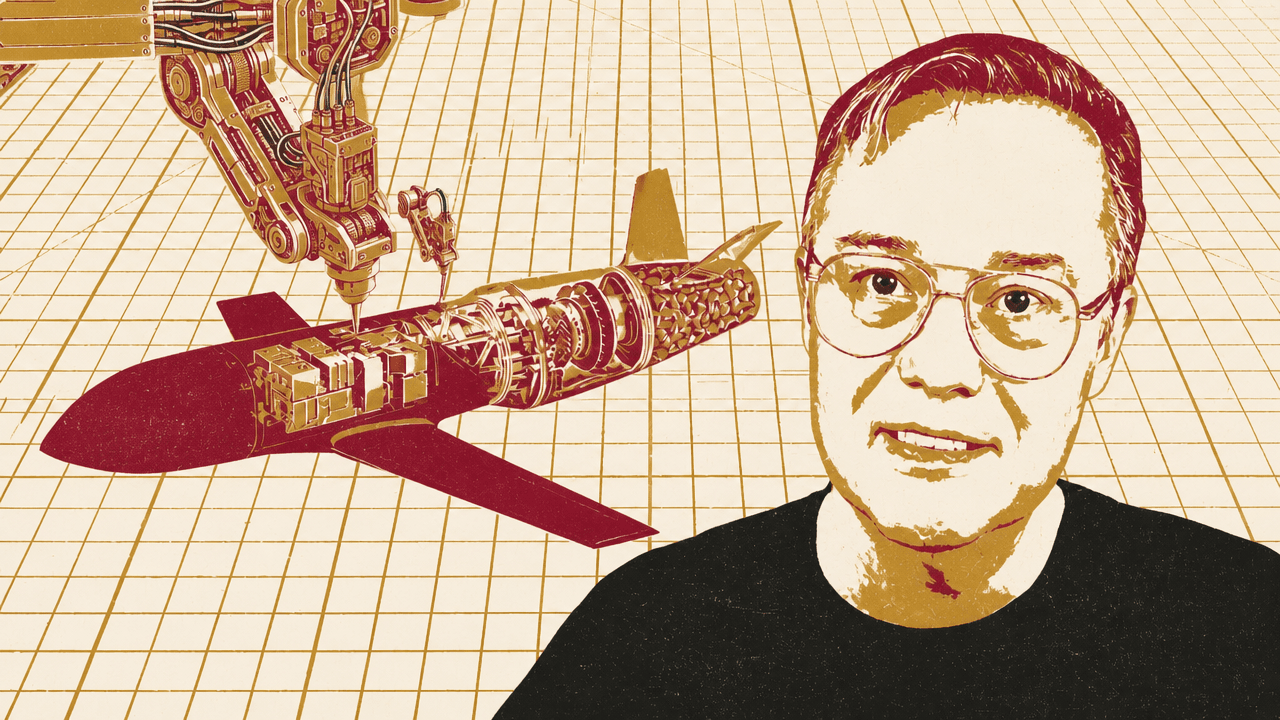
Divergent’s bet is that defense hardware should lose its tooling lag
Lukas Czinger described Divergent Technologies as a manufacturing platform built to remove the part of hardware production that usually makes physical products slow: the tooling, fixtures, and fixed production lines that lock a design in place before it can scale.
The company’s claim is not simply that it can 3D print parts. Czinger said Divergent has built a “software-defined factory” in which printing, post-processing, assembly, metrology, and factory execution are all run as general-purpose nodes. In that setup, the design file is the thing that changes, not the factory. The result, he argued, is that autonomous aircraft and other defense systems can be iterated more like software products.
That distinction matters in the markets Czinger emphasized: unmanned and uncrewed systems across air, ground, and sea. He pointed to the Middle East, Russia-Ukraine, and U.S.-China tensions as environments where the rate of innovation in unmanned systems has become central. The systems are “primarily software,” he said, but still carry a hardware component. Divergent’s argument is that the factory should be structured around that reality.
A software-defined factory happens to be a wonderful pair for a system that’s primarily software, but still has a hardware component.
In conventional drone or aerospace manufacturing, a team may use additive manufacturing while prototyping, then freeze the design and move into a production process based on composites, CNC machining, casting, forming, and dedicated fixtures. Czinger framed that step as the delay that kills rapid iteration. A tool is “a physical instantiation that tells a machine what to do”: how to press, form, machine, cast, or lay up a part. Getting those tools can take 12 to 24 months, he said. Once they exist, changing the design becomes economically and operationally painful.
His example was deliberately simple: if a production team discovers that a slightly larger battery and longer chassis could add ten minutes of flight time, a conventional fixed tooling line makes that change difficult. In Jordan Crook’s shorthand, there is no equivalent of “push a software update and make a change.”
Czinger said Divergent’s cells are “completely fixtureless” and “non-part-specific.” Because the printing and assembly nodes are general-purpose and software-defined, a customer can move from a design to the first unit, and then to the first thousand, without rebuilding a supply chain around a frozen configuration. He allowed that it may take a week or two to develop processes inside the factory for full automation and scale, but said the company is “basically wiping away the supply chain build out and factory scaling phase.”
The headline demonstration was a small uncrewed aerial system, or sUAS. Czinger said Divergent went from clean-sheet design of a group two drone to a fully integrated, flyable system in 71 days. Crook pressed him on what that meant: not a prototype shell, but “finished integrated components, basically everything to complete the system,” in Czinger’s words.
He contrasted that timeline with normal product cycles in defense. What Divergent did in 71 days, he said, would usually be closer to five years in the defense ecosystem, or two to three years on a “super fast track.” In commercial settings, he put the normal lifecycle for a new product at roughly two to four years.
| Process | Typical timeline described by Czinger | What changes |
|---|---|---|
| Defense product lifecycle | Closer to five years; two to three years on a super-fast track | Clean-sheet system development compresses when tooling and supply-chain buildout are removed |
| Commercial product lifecycle | Roughly two to four years | Iteration is less constrained by fixed production assets |
| Divergent sUAS demonstration | 71 days | Clean-sheet design to fully integrated flyable form |
Czinger was careful to separate Divergent from a drone company. Divergent is not primarily trying to become the maker of a branded drone fleet, he said. It operates factories and a design software interface for customers. In automotive, he said the platform is already used by roughly a dozen “top-tier, global 500 equivalent” automotive companies that design through Divergent’s software interface and use its distributed nodes to assemble vehicles. Over the last 36 months, he said, Divergent has applied the same model inside defense and aerospace supply chains.
The drone demonstration was therefore framed as proof of the factory, not proof that Divergent intends to own the drone category. Czinger said the company will sometimes build complete systems to pressure-test the end-to-end design tool, factory execution nodes, and manufacturing ecosystem. The 71-day drone was such a test: a way to show what the platform can do when it controls the full process.
The business model follows from that technical architecture. Customers do not buy the factory and move it somewhere else. Divergent builds the footprint, including within U.S. or allied defense contexts, and keeps the assets on its own books. Czinger described the company as both a true supplier and a design software vendor. If a customer changes a design, he said, they do not incur non-recurring engineering or fixed costs just to make that change. If they reduce demand from 100 units in one year to 10 the next, they do not carry the overhead of underused production capital. Divergent takes that risk because, as Czinger put it, “it’s our technology end-to-end.”
The hard part is not printing a shape; it is making printing behave like industrial production
Lukas Czinger pushed back on the idea that Divergent is merely applying ordinary 3D printing to aircraft. He described today’s common uses of additive manufacturing as narrow: printing one-off widgets, prototyping brackets before redesigning them for casting, or producing a small number of high-value aerospace components such as turbine-related propulsion parts.
Divergent’s claim is more ambitious. Czinger said this is the first time additive manufacturing has been designed to replace “full system level assembly logic.” In that model, the printer is not a standalone tool but an intelligent node inside an integrated digital manufacturing system.
The 3D printer contributes what additive manufacturing is good at: making complex geometry accurately and repeatedly from a digital file. But Czinger said Divergent had to build around the weaknesses that have kept 3D printing from becoming a scalable industrial manufacturing process.
First is economics. He said ordinary 3D printers do not have good economics “out of the box.” Divergent developed its own laser powder bed fusion hardware and is now on generation four. Czinger said Gen 4 is multiple orders of magnitude faster in laser productivity and was designed for high-scale manufacturing with a favorable economic trade against casting, forming, or comparable processes.
Second is material robustness. Commercial 3D printing has typically involved printing one uniform material across a set of prints, he said. Divergent is trying to print different kinds of things at the same time in the machine. Czinger said existing materials in commercial 3D printing supply chains often lack robust process capability, making it difficult to guarantee specification targets such as ductility. Divergent therefore synthesized new metal alloys internally across aluminum, titanium, and Inconels to make them process-robust.
Third is post-processing. Czinger called this an “un-talked-about element” of 3D printing. A printed part comes out in rough shape; it cannot simply be installed into a precision assembly. It will not sit accurately against mating components. In small numbers, that may be manageable. In a large system-level assembly, tolerance build-up becomes a quality-control problem. If ten imprecise parts stack together, the tenth may not mate to its final connection point.
Divergent’s answer, Czinger said, is automated post-machining. The system takes rough printed parts, automatically fixtures and measures them, defines the machining required, writes G-code for CNC, creates precise locators down to micron or sub-micron levels, and passes those parts downstream.
Fourth is assembly. Metal laser powder bed fusion printers are constrained by build volume. Czinger noted that a group two drone may be roughly half a meter by a meter, or up to a meter and a half. Those structures do not fit neatly into normal commercial 3D printing platforms. Divergent’s solution is to print parts and then assemble them through a software-defined assembly platform with automated adhesive application, optical metrology verification, and real-time closed-loop control on robot arms inside the cell.
That full stack — printing, materials, post-processing, assembly, metrology, robot control, software, data architecture, and factory execution — is what Czinger said the company had to build over ten years. He also referred to “10 other unsexy” manufacturing supply-chain pieces that had to be replaced to make the digital node-based system work.
Crook’s reaction captured the gap between the familiar idea of 3D printing and Czinger’s actual claim. “It hurts to think about what is happening on that factory floor,” she said, because the system requires robots to communicate and execute differently depending on the design moving through the cells.
The cost claim depends on whether the system is simple or deeply integrated
On cost, Lukas Czinger did not claim that every Divergent-built product is immediately cheaper than every conventionally manufactured equivalent. He separated lower-end applications from more integrated, complex systems.
At the low end, he said, a product may be roughly equivalent in cost to today’s product when viewed at the system level and fully amortized over its required fixed capital. The advantage is not necessarily a lower unit price on day one. It is the absence of non-recurring engineering, the ability to scale without a 12- to 24-month lag, and the lack of fixed capital required to stand up full production capacity across a wide range of demand.
In other words, if a defense customer orders ten units, the order can go directly into an existing platform. The customer does not spend two years engineering, tooling, and capitalizing production before learning whether the order will remain at ten, expand to a thousand, or collapse.
The bigger cost claim appears in complex integrated systems. Czinger said additive design can radically reduce part count where conventional systems require many stamped, formed, cast, machined, and assembled components. His clearest analog came from automotive: a rear subframe in a mid- to high-luxury vehicle may involve around 150 parts moving through sub-tier suppliers into a central OEM final assembly process. Divergent can consolidate that logic into “low single digit” integrated component structures, he said, with prints driven by digital tool paths rather than dedicated tooling.
The savings, in that argument, come from reduced part complexity, lower supply-chain complexity, less risk to program delivery, and less engineering across the program life. For high-end integrated uncrewed systems, Czinger said there is “almost certainly” a direct margin improvement over conventional components.
Jordan Crook summarized the implication for startups in defense, aerospace, and space: a company building physical products through Divergent could act more like a software startup, iterating without first owning the full capital base of a production system. Czinger agreed. The platform, he said, creates a hardware equivalent of the software iteration cycle in sectors where production has historically been slow, capital-intensive, and concentrated among the largest aerospace integrators.
He described the outcome as a democratization of access to complex hardware production: not only for top global companies, but also for “top tier” venture-backed entrants that otherwise could not finance the full production infrastructure required to compete.
Antidepressant prescribing has an on-ramp but no reliable off-ramp
Outro Health’s starting point is a mismatch between how easily psychiatric drugs are started and how poorly patients are often supported when they try to stop. Jason Calacanis framed the problem as people becoming trapped on SSRIs, then accumulating additional prescriptions to treat side effects or adjacent conditions. Tyler Dyck, one of Outro’s co-founders, introduced the medical term “deprescribing”: actively managing which medications should no longer be there.


Calacanis was surprised that deprescribing is a formal field. Tyler said it is an “entire field of medicine” focused on managing removal, not just addition. His criticism was that guidelines teach primary care doctors how to put patients on psychiatric medications and how to titrate up, but often do not provide adequate guidance for getting them off. When they do, he said, they may recommend a rapid one-month process: cut the pill in half, then into quarters, then stop.
Outro’s claim is that this approach ignores the pharmacological curve. A chart shown on screen, attributed to “Meyer et al. 2004 Am J Psychiatry,” was titled “Serotonin Transporter Occupancy by Citalopram Dose.” It showed a hyperbolic curve: serotonin transporter occupancy rises sharply at very low citalopram doses, then flattens at higher doses. The visual called out a 20.8% difference between 0 and 2 mg, compared with a 4% difference between 15 and 20 mg.
Tyler explained the chart as a proxy for how intensely the medication is affecting the brain. At high doses, a reduction may look large in milligrams but small in effect. At very low doses, a reduction may look tiny in milligrams but enormous physiologically.
Calacanis interpreted the curve aloud: at 2 or 3 milligrams, the brain may already be heavily occupied by the drug; increasing from 2 mg to 20 mg produces a much smaller incremental effect than the raw dosage change suggests. Tyler named the shape as hyperbolic.
That curve is central to Outro’s product. If the effect curve is hyperbolic, then a linear taper — 20 mg to 10 mg to 5 mg to zero — imposes the largest physiological changes at the end, just when the patient and doctor may think they are nearly finished. Mark Horowitz, the other co-founder, gave the conventional pattern: a doctor tells a patient on 20 mg of citalopram to cut to 10 mg, then 5 mg, perhaps take 5 mg every other day, and then stop. The patient may tolerate the first step because 20 to 15 or 20 to 10 is a small change in brain effect. But 2 mg to zero can be a profound drop.

| Dose change discussed | Effect described by Outro’s founders | Why it matters |
|---|---|---|
| 20 mg to 15 mg citalopram | Small percentage change in effect on the brain | A large milligram reduction can feel manageable |
| 15 mg to 20 mg citalopram | 4% difference on the chart shown | Higher-dose changes sit on the flatter part of the curve |
| 2 mg to 0 mg citalopram | 20.8% difference on the chart shown | The final step can be one of the largest physiological drops |
Outro’s answer is personalized hyperbolic tapering. Mark said a doctor evaluates each patient and calculates what percentage reduction in effect the patient can tolerate at each step. The patient then receives custom doses, organized and shipped, to flatten the curve rather than “falling off a cliff.”
The discussion repeatedly returned to the mismatch between available pill sizes and the precision required near the end of a taper. Tyler said patients who need sub-milligram doses may be told to buy a scale, crack tablets, weigh fragments, or divide beads manually. Calacanis called that “imprecise medicine.”
This would be imprecise medicine.
Tyler added that the patients being asked to do this may already be in withdrawal: sweating, anxious, experiencing “brain zaps,” and trying to avoid another wave of symptoms with a razor blade and jewelry scale.
The founders’ frustration was not only that patients suffer, but that withdrawal is often misread as relapse. Calacanis described a doctor seeing a massive headache or anxiety and telling the patient they are depressed or anxious again. Tyler agreed: patients are told “you’re relapsing” or “your anxiety’s back,” which he said invalidates what they know is happening physiologically.
Outro turns tapering into a wrapped digital health service
Outro’s commercial model is a direct-pay digital health service. Mark Horowitz described the company’s goal as becoming the “digital front door” to deprescribing in this area. A patient signs up through the website, is connected with an expert practitioner, receives an evaluation, and is placed on a custom hyperbolic tapering plan. The service includes clinician check-ins, coaching, fulfillment, shipping, and prescription delivery to the patient’s door.
Jason Calacanis described the model as customized tapering through blister packs or exact milligram dosages that decrease precisely. Tyler Dyck confirmed that the dosing is guided by an algorithm that enables precision titration. The system also includes remote patient monitoring, clinical assessments from the phone, withdrawal scales, and anxiety measures. If a patient feels terrible after a reduction, the clinician can adjust the taper, hold at a dose, or step slightly back up before continuing.
Tyler gave an example: a reduction step may have pushed the patient over a roughly 5% threshold in effect. The clinician can then hold the dose or take a half-step back so the patient feels stable, and resume tapering more gradually.
The founders positioned this as both medical precision and psychological validation. Calacanis suggested that part of the benefit may be that patients regain a sense of control after feeling led into long-term medication use without a way out. Tyler said the first appointment often ends with patients breaking down because, after years of being told stopping was impossible or that their symptoms were relapse, their experience is finally validated.
On cost, Mark said Outro is currently cash-pay and typically costs “a couple hundred” dollars per month, depending on the case. Calacanis compared it to the pricing structure of standard digital health services such as Hims, Ro, or Truepill-backed care. Mark credited the algorithm and platform with making clinician monitoring efficient enough to keep the price low relative to bespoke medicine.
On taper length, the founders resisted a single answer. Duration depends on starting dose and individual physiology. Tyler gave nine months as a rough average for a standard case, while saying some patients complete a taper in six to seven weeks because they tolerate reductions well.
The company is venture-backed. Tyler said Outro initially received backing through Diagram, a venture studio in Canada, then moved into the U.S. market and was pursuing an institutional seed round. He said traction had been strong without marketing spend, with waitlists of thousands after word of mouth began, and “90% plus retention” on a monthly basis.
Calacanis pressed on the business outcome: whether Outro could be acquired by Optum, United, a payer, an employer-benefits platform, or a direct-to-consumer healthcare brand such as Hims or Ro. Tyler said the model could fit with large payers and employers, and also with the newer generation of D2C healthcare. But he drew a sharp contrast between Outro and much of digital mental health. In his view, D2C mental healthcare has largely meant putting millions of new people on prescriptions. Outro exists as the antithesis: a company built around reducing unnecessary prescribing and helping people return to normal emotional regulation.
The founders also described limits. Mark said Outro currently focuses on mild to moderate anxiety and depression. Patients with suicidality, severe ongoing depression, or complex psychiatric conditions do not pass screening into the service. Those patients are referred back to primary care or appropriate clinicians. Mark said Outro provides education and tapering information freely because the core point is to help patients understand that discontinuation can be possible and should not be attempted by crudely quartering pills at low doses.
The economics of SSRIs create neglect more than a simple pharmaceutical conspiracy
Jason Calacanis asked whether Big Pharma benefits from keeping people on SSRIs. Mark Horowitz answered that SSRIs are “dirt cheap,” and Tyler Dyck clarified that many are generic but still profitable for pharmacies, mail-order pharmacies, and pharmacy benefit managers because tens of millions of people refill them every 30 days. The drugs cost very little to supply and can support attractive spreads.
Tyler’s account was not that branded pharmaceutical companies are making their largest profits from old SSRIs. He said many of the patents are long gone; pharma has moved on to newer drugs. That, in his view, is one reason a company like Outro has to exist. The original drugs are old, generic, and embedded in the system, while the research, services, and operational focus needed to get people off them are underdeveloped.
Mark added that 25 new psychiatric drugs are currently under development, many targeting depression and anxiety. That reinforced the founders’ broader point: the healthcare system remains much better at adding medications than subtracting them.
Calacanis asked about prevalence, estimating 35 million to 40 million Americans on SSRIs or similar antidepressants, roughly 12% of the U.S. population. Mark said younger groups over-index and described “huge growth” in college-age prescribing, saying he thought the rate of being prescribed these drugs had doubled over roughly a decade. The phrasing was tentative, but the point was central to the founders’ argument: antidepressant discontinuation is being treated as a niche problem even as long-term prescribing has become common.
The personal texture of the discussion came when Mark described reviewing his own medical records. He said his doctor’s notes did not show a severe psychiatric situation, but he was still given Lexapro to “get through things.” He did not present the doctor as malicious; he said the doctor was “fantastic.” The critique was of clinical norms and guidelines. In other areas, he said, such as opioid prescribing, standards have shifted to reduce overprescribing. Antidepressant discontinuation has not seen the same level of attention, even though he claimed that a very large number of Americans will experience significant withdrawal when they stop.
The shorter news items stayed closer to provocation than analysis
The remaining stories were brief and comparatively underdeveloped. They functioned as news prompts rather than sustained arguments.
Meta’s employee-monitoring system was framed by the company as data-loss prevention, but Jordan Crook treated it as a surveillance story. A Verge article shown on screen carried the headline “Meta is spying on its employees” and said the company had begun logging when and what workers copy-paste. Crook said the system tracks what employees type, copy-paste, print, send in chat, upload, and download.
Her objection was the setting. She distinguished extreme monitoring inside an intelligence agency or a company such as Palantir from monitoring inside a “regular-ass company.” A later item said Meta fired employees for using meal credits on household items, and a displayed X post claimed 24 employees had been fired for buying toothpaste with meal credits.
The Waymo item was narrower. One visual attributed to Local News 4 showed a white Waymo Jaguar driving into deep floodwater and getting stuck. Another, attributed to @LosAngelesTraffic, showed a Waymo navigating a flooded Los Angeles intersection with water reaching the lower bumpers. Jason Calacanis reacted that the car appeared to be “plunging” through the water. He called it impressive and terrifying at once, then asked whether water can blind or confuse the sensors.
Spotify’s AI podcast tool was described briefly as automated media generation. A TechCrunch screenshot said, “Spotify launches AI tool to generate podcasts.” The accompanying description said the product can generate hosts discussing a user’s playlists and “basically synthesizes voices.”
Christopher Nolan’s flip phone served as a short counterpoint to the week’s automation and surveillance stories. A Getty Images photo showed Nolan holding a classic flip phone, and the discussion said he still uses a flip phone and avoids smartphones on set or while writing to avoid distraction. Calacanis treated the habit as a practical discipline against email and doomscrolling, saying more founders should try “the flip phone life.”
The AI-policy segment was messy and partly interrupted, so the claims are necessarily narrower. A Truth Social post shown on screen from Donald J. Trump said he was proud to stop the “Radical Left’s” attack on free speech, including what he called the “ridiculous ‘AI Executive Order’” and a “Global ‘Censorship’ Regime.” The post said AI under his administration would be governed by “Common Sense” and “FREE SPEECH,” and that his administration would reverse Biden-Harris policies and protect First Amendment rights.
Calacanis interpreted Biden-era AI policy as an attempt to regulate AI systems above certain compute or training thresholds, with particular concern for open-source models. He also brought in California’s SB 1047, describing it as an effort to subject models above roughly $100 million in training costs to rigorous testing and disclosure obligations around what the model could do. His view was that these approaches risked making it harder to build AI in the United States.
A later TechCrunch screenshot said, “Trump Cancels AI Executive Order Hours Before Signing. The administration cites concerns over stifling innovation.” Calacanis attributed the last-minute cancellation to tech founders warning that the order could crush open-source AI and benefit China. The source does not develop that claim beyond his account and the displayed headline, so the safest reading is simply that he presented Trump’s posture as anti-regulatory, framed in free-speech terms, and responsive to concerns about constraining open-source AI.