Meta’s Compute Sales Plan Exposes Its Missing AI Product Strategy


John Coogan and Jordi Hays argue on Diet TBPN that Meta’s reported plan to sell AI compute is less important as a potential cloud business than as a signal about its AI product strategy. Selling excess capacity could be a rational way to monetize a massive infrastructure buildout, they say, but it also raises a harder question: why Meta’s own apps are not yet producing enough obvious AI demand to use that compute internally. The debate turns on whether Meta Compute is a bridge to future products, a hedge, or evidence that the company has built ahead of its consumer AI strategy.
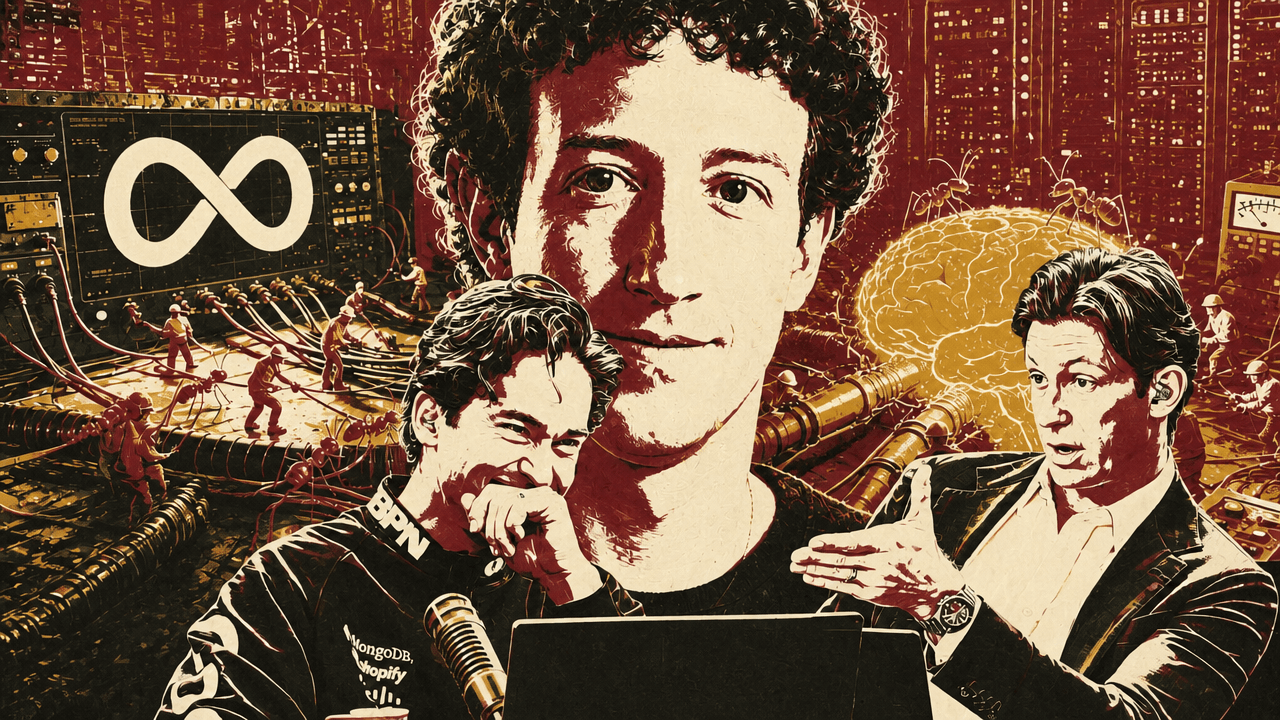
Meta’s reported compute plan raises a product question, not just a cloud question
Meta’s reported plan to sell AI compute landed as more than a possible new revenue line. For John Coogan, the practical logic was easy enough to understand: if Meta has excess capacity after committing hundreds of billions of dollars to data centers and chips, selling some of that capacity can look like the best available near-term return on investment. The harder implication is what it says about Meta’s own AI products.


Jordi Hays framed the news as a reported story about Meta developing a cloud infrastructure business that would sell access to AI computing power and models, competing with providers such as AWS and Google Cloud. In Hays’s description, the reported “Meta Compute” initiative would include selling access to AI models hosted on Meta’s infrastructure as well as raw computing capacity. He said reactions had been broad and somewhat strange: some neo-cloud companies were selling off because Meta could become both a buyer of their capacity and a competitor, while investors were also trying to understand whether this helped justify Meta’s massive capital expenditure.


Coogan’s concern was not that selling compute is irrational. It was that the move does not create confidence in the strategy Meta has been describing. Meta’s stated AI ambition has been personal superintelligence, not becoming a cloud provider. If the company is signing large neo-cloud contracts, spending hundreds of billions on infrastructure, and then looking to sell that infrastructure externally, he said, it suggests that the near-term internal products able to consume that capacity are not yet obvious.
The examples Coogan and Hays cited were thin. Coogan said Meta’s MU Spark model was “a good model,” but not one he expected to generate large API demand. Hays noted that Meta had announced it would release the model through an API and said it was “good on benchmarks,” but both treated that as different from a product breakthrough inside Meta’s own apps. Coogan also pointed to Meta Vibes, which he characterized as a Midjourney wrapper.
The strongest version of the Meta bull case, in Hays’s view, was not API demand. It was the possibility that Meta could put capable AI directly into the products where people already spend time and where Meta already has the relevant social data. He imagined AI agents running on a user’s phone and across their social networks. But he said Meta has not meaningfully tried the applications he can imagine becoming daily drivers.
I keep going back to that idea of personal superintelligence. What do I actually want?
The tension running through their exchange was that a compute-selling business may be financially useful while still making the core AI strategy look less mature. If Meta has the infrastructure before it has the products, the cloud plan can be read as a bridge, a hedge, or a sign that the company has overbuilt for the demand it can currently create internally.
The missing AI product is already sitting inside Instagram
Jordi Hays’s most concrete example was not a frontier model benchmark. It was a failed product interaction inside Instagram.
He said he asked Meta AI in the Instagram app what he could do better to grow his following. Meta has granular data about every reel he posts, he argued: which posts do well, which posts convert viewers into followers, which formats work for a particular account. A useful AI feature would analyze that account-specific data and make tailored recommendations.
Instead, the response he received summarized generic advice from Buffer, a social media management company. The on-screen Instagram screenshot showed the prompt asking what he could do better to grow his following and Meta AI replying that Buffer recommends “sustainable organic growth” rather than “quick hacks like follow trains.” It advised him to post Reels consistently, optimize his profile with clear keywords, maintain a consistent visual brand, use Instagram analytics, collaborate with micro-creators, respond to comments, and test content with Trial Reels. The screenshot also showed the response citing figures such as Reels getting “36% more reach than carousels” and “125% more than single photos.”
John Coogan found the source choice revealing: Meta AI was effectively referencing a blog post from a social media SaaS company while sitting inside the app that owns the user’s actual Instagram performance data. Hays’s objection was not that the advice was necessarily wrong. It was that it was generic, stale, and disconnected from Meta’s privileged data position.
“Use Instagram analytics to see which content converts viewers into followers and double down on it” was precisely the task Hays wanted the AI to perform for him. He did not want to manually compare a reel with 5,000 views against one with 50,000 views and infer the difference. He wanted Instagram’s AI to do that work.
The product he wants is an “Adam Mosseri brain” personalized to his account. Hays said the best source of practical Instagram growth advice today is Mosseri’s own front-facing videos, where the Instagram head answers common platform questions directly. Those posts are useful, but they are necessarily one-size-fits-all. Hays’s imagined product is a social media copilot: the platform’s own operational understanding, enhanced by AI and applied to a creator’s specific account.
That example became a proxy for the broader Meta AI gap. Hays said even if MU Spark is not at the absolute frontier, it should be good enough to support useful workflows inside Meta apps if wired to the right user data. The failure, as he described it, is not necessarily model capability. It is productization.
Coogan extended the point to shopping. At Meta Connect the prior year, he said, they had asked Mark Zuckerberg about agentic shopping through Meta Ray-Ban displays: a user could look at a pair of shoes and say, “order me those.” Zuckerberg gestured toward that as a possible future, but Coogan said Meta still does not appear to have removed even one click from the shopping funnel.
The opportunity, in Coogan’s telling, is straightforward. Meta could store more relevant data, shorten the path from ad impression to purchase, and increase conversion rates. That would benefit brands, advertisers, Meta, and users. Instead, he said, the company does not seem to be aggressively experimenting with AI inside commerce flows: for example, a button on an ad that lets an agent handle checkout and then confirm details inside the Meta app rather than opening a Safari window.
Hays said the gap makes the compute-selling plan feel like a wind-down of the superintelligence ambitions Zuckerberg had gestured toward. Coogan was more cautious. Meta could simply be using a temporary commercial outlet while products ramp. But both returned to the same absence: Meta’s apps have not yet shown a killer AI feature that makes the company’s massive infrastructure plan feel self-evidently necessary.
Selling compute can be prudent even if it signals excess capacity
John Coogan gave the most sympathetic interpretation of the reported plan: Meta may have more capacity than it can use today, while still expecting to need it later. In that case, short-term compute sales could be a way to monetize idle infrastructure and reassure investors that the capital expenditure is not entirely detached from revenue.
He compared the possible structure to recent SpaceX compute deals with Google and Anthropic, which he and Hays characterized as shorter-term arrangements rather than five-year commitments. Meta could similarly sell excess capacity while retaining the ability to reclaim it when its own products are ready. In Coogan’s phrasing, the company could say it has more capacity than it needs right now, expects to use it fully over time, but wants to earn revenue while products ramp and signal to the market that it is “not entirely irrational.”
That argument depends on the duration and identity of the buyers. Coogan said the market’s reaction would differ depending on whether Meta signs buyers that investors find exciting or tries to compete directly as another cloud provider. Hays contrasted the reported Meta leak with the way he described SpaceX’s Anthropic contract: in his telling, that was presented as a clear, high-profile customer commitment and was received positively. A report that Meta is merely planning to sell compute produces more ambiguity.
Hays also read from investor Amit’s framing of the bearish and bullish cases.
| Interpretation | Implication for Meta | Implication for the broader AI supply chain |
|---|---|---|
| Bearish | Excess compute suggests Meta may not need as much capacity as it bought and could cut capex. | Bad for neo-clouds if Meta becomes a competitor; bad for semis if lower capex follows. |
| Bullish | A cloud business could become a larger revenue opportunity than merely monetizing idle compute. | More capex could follow if Meta tries to compete with AWS, Google Cloud, and Azure. |
The bearish case: if Meta has excess compute to sell, perhaps the market is not as compute-constrained as assumed. That would be bad for neo-clouds because Meta could stop being only a customer and become a competitor. It could also imply Meta should reduce capex, which would be bearish for semiconductor demand.
The bullish case: if Meta turns this into a real cloud business, even starting with idle compute, it may ultimately spend more to compete with AWS, Google Cloud, and Azure. A serious Meta cloud would require ongoing infrastructure buildout and services layered on top. Hays said Meta does have significant capability in spinning up data centers and putting GPUs into service, even if he placed SpaceX and AWS ahead of it.
A post from Jay Yoon shown on screen offered a third framing: “We are still massively short compute.” The visible post said Meta and xAI selling compute is “a compute allocation problem,” not a surplus problem: too much compute sits “in the hands of players with no internal use for it.” Hays used that view to distinguish between shortage in the system and shortage of useful demand inside specific companies.
That distinction matters for Meta. If there is broad external demand for compute but Meta lacks internal AI products, selling compute is a rational allocation. If Meta is forced to build a cloud business because its own models do not create inference demand, the plan looks less like strategic expansion and more like an outlet for stranded capacity.
A Meta cloud would not be as unnatural as it first sounds
Jordi Hays kept returning to the idea that Meta is a consumer company, and that the most satisfying residue from an abandoned superintelligence push would be a consumer product: AI-enabled glasses, a ring, voice models, image models, or a narrow capability the company could dominate. He compared it to Meta’s metaverse cycle. If the broad VR strategy was mothballed, the Ray-Ban smart glasses remained as a narrower, viable product.
John Coogan proposed a less consumer-friendly answer: perhaps the thing that remains from Meta’s AI push is the neo-cloud business itself.
Hays found that less fun, but Coogan argued that Meta may be better positioned for an inference business than the “consumer company” label suggests. Meta already serves many businesses through advertising. It has sales teams, account managers, and established customer relationships. The company knows how to get in front of business customers and sell performance-based products.
Hays was skeptical that the relationship automatically transfers. The fact that mobile gaming companies and direct-to-consumer e-commerce brands buy Meta ads does not necessarily mean they will buy tokens from Meta. Coogan acknowledged that cloud is closer to a commodity business than Meta’s social networks, but he thought the company’s business-facing machinery should not be dismissed.
They did not resolve that disagreement. Hays wanted Meta’s AI efforts to produce a product that feels native to the company’s consumer identity. Coogan was more open to the idea that a compute or inference business could be viable even if it does not resemble Meta’s historical strengths. But both treated the reported plan as unresolved until Meta itself clarifies whether this is a temporary utilization strategy, a full cloud ambition, or a hedge around slower-than-expected product development.
Prediction markets pose the same question in a different form
A separate Meta report sharpened the same strategic issue: when a company with massive distribution sees a new market, should it enter simply because it can? According to a tweet from Bobby Allyn at NPR shown on screen, Meta considered buying Kalshi before developing its own prediction market app.
For Jordi Hays, the Kalshi detail mattered because it pointed away from a purely reputation-based prediction product, like Manifold, and toward a financially incentivized model closer to Kalshi or Polymarket. That would fit a certain business logic. Hays described prediction markets as consumer, profitable, and growing very fast.
John Coogan focused on the risk side. The question, he said, is whether the potential profit pool is worth the regulatory and political attention that would come from integrating betting-like mechanics into products already under attack on many fronts globally. With broader scrutiny around Meta, he said, the company would be “jumping straight to the final boss.”
Hays described Meta’s core business as a golden goose. The goose is already valued and already producing golden eggs. A prediction market might be another golden egg, but a “poison golden egg” that could kill or spoil the main goose if brought onto the farm.
The metaphor was reinforced visually by a printed meme held up on screen: a goose, three eggs, and the text “Shareholder Value = 3 eggs” and “Goose was not valued.” The joke captured Hays’s concern that Meta could over-focus on incremental monetization while underpricing the value of not endangering the core asset.
The parallel to compute is not that cloud services and prediction markets carry the same risks. It is that both ideas test whether Meta’s next businesses strengthen the core company or create new exposure around it. Compute sales may be a practical way to monetize infrastructure that products are not yet using. Prediction markets may be a fast-growing consumer category. In both cases, the existence of an opportunity does not settle whether it is the right one for Meta.
The broader AI market makes Meta’s demand problem more visible
The Google AI Overviews data appeared only briefly, but it supplied a useful contrast. A visible post from Eric Seufert summarized a paper by researchers at Carnegie Mellon and the Indian School of Business finding that Google’s AI Overviews were triggered in roughly 41% of observed Google searches and, when triggered, reduced outbound organic clicks by about 40%. The same post said AI Overviews increased the likelihood of a zero-click search by roughly 35%.
The paper, as summarized in the visible tweet, used a field experiment with a custom Chrome extension. Users were randomly assigned to experience normal Google Search, Google Search with AI Overviews dynamically removed and the remaining results shifted upward, or Google’s AI Mode when they attempted to use Search. Coogan’s read was blunt: “Everyone is going Google zero at this point.” He also referenced Josh Marshall of Talking Points Memo writing about “Google AI oligarchy and the end of the open web,” though he said they would go through that another time.
The contrast is that Google’s AI surface, as described in the post, is already changing behavior inside a core product. Meta’s unresolved question, as Coogan and Hays framed it, is where the comparable native AI surface emerges: Instagram creator tools, shopping, glasses, image features, voice, or something narrower.
A final financing anecdote underscored how different the current AI cycle is from the earlier one. A visible post from Tanay Jaipuria quoted an excerpt saying that in December 2010, Founders Fund wired $2.3 million to DeepMind and received a little less than half the company on roughly a $5 million post-money valuation. Hays said that kind of financing would be almost inconceivable to founders who started their careers in the recent AI market. In his shorthand, a modern founder might hear “a couple million bucks” and assume “two on fifty,” not half the company for a $5 million post-money valuation.
Read against the Meta compute debate, the DeepMind anecdote was a reminder of how much AI company formation has changed. DeepMind in 2010 had elite technical talent and scarce capital. Meta now can commit hundreds of billions to AI infrastructure and still face questions about whether it has the products to use it.