Bring Your Own Compute Could Make AI Apps Viable for Small Developers
OpenAI’s “Sign in with ChatGPT” could let apps use a customer’s existing AI allowance instead of paying model costs themselves, TBPN hosts John Coogan and Jordi Hays argue. They see the feature as a potential way to make compute-heavy products viable for small developers, but say it also raises a question of control: whether OpenAI is offering a useful integration or laying the groundwork for an app-store model that could leave developers with less leverage over customers and billing.
Letting users bring their own AI allowance could change app economics
OpenAI’s “Sign in with ChatGPT” drew attention from Jordi Hays and John Coogan not because it settled the contest over personal agents, but because it addresses a nearer-term problem for developers: the cost and friction of running models inside a product.
Hays recalled the early wave of apps built around the best models available at the time. They could attract users quickly, only to discover that usage had left them with API bills as high as $30,000. Sign-in with ChatGPT could let an app draw on a user’s existing plan rather than making the developer pay for every model request and then persuade the user to buy a separate subscription or API credits. Coogan called the arrangement “bring your own compute,” or BYOC.
The distinction matters for small teams. A service may charge a user $10 a month, but an inference-heavy feature can make that price hard to sustain. Coogan used Notion as an example: people already pay for a Notion seat, and may want AI features within the product. Rather than requiring Notion to cover all the additional model costs through its own credits, an authorized app could use the user’s ChatGPT allowance. The user signs in and permits the app to make model requests against the plan, without handling an API key.
Coogan cited developer Peter Yang’s example of a live language-learning app that he had not planned to launch because of API costs. Letting users sign in with ChatGPT, Yang said, could make it viable. Hays also pointed to compute-heavy headshot apps and to an enterprise partnership with Base10, through which customers could access open models against an existing OpenAI commitment, with the integration available in Codex.
But the feature transfers tokens, not money. Coogan separated model inference from other costs in a hypothetical AI book-publishing service: a user might spend OpenAI credits generating a manuscript, but those credits cannot pay to print and ship the book. He suggested that a broader AI “front door” could eventually consolidate more of the billing relationship. His own experience with video-generation credits illustrated the messier present: he had bought both consumer and API credits, and found that using the consumer balance would require a different workflow from calling the API.
That leaves a larger question: is this a convenience for discovery and distribution, or the beginning of an AI app-store economy in which OpenAI takes a share? Coogan said a model provider might accept losing control of the customer billing relationship if integration with a large platform brought substantially more demand. But if an app store emerges, developers could face a familiar platform trade-off: reach and utilization in exchange for less leverage over the customer—and potentially a platform fee.
For users, one consolidated billing relationship could be useful even if computer-use agents can already navigate websites and set up API keys or credit cards. Coogan said those workflows remained awkward: models often hesitate to handle sensitive information, and his attempt to get an agent to send an iMessage consumed many tokens as it worried about making a consequential mistake. A direct integration could reduce that friction. Coogan also noted that users sometimes value app-store billing because it makes subscriptions easier to cancel, rather than requiring a call or a retention pitch.
OpenAI introduced GPTs and a GPT Store at its first Dev Day in 2023, Coogan noted, but the idea seemed to languish for years. Integrations can fail when the companies involved have little incentive to make the user experience seamless. He described the Siri–ChatGPT handoff as a broken flow: Siri might ask whether the user wanted to ask ChatGPT, then open ChatGPT without carrying over the earlier context.
The new feature raises the prospect that independent developers could become the tool an agent reaches for. But it also creates a conflict for companies competing to own the underlying product. A business struggling to secure compute might benefit from letting customers bring their own—while fearing that doing so gives up the chance to own the central experience. Coogan wondered whether a small developer might find a breakout distribution channel this way; he also suggested that a company trying to compete directly for the same core feature could be reluctant to hand over that position.
The argument over AI consciousness is also an argument over who gets to define it
A post from Pope Leo XIV drew a distinction between human art and what machines generate through statistical calculation. “Algorithms lack the spark of humanity,” the pope wrote, arguing that the Church should renew an alliance with artists and cultural institutions. Coogan read the statement alongside reports that Anthropic had pressed Vatican advisers to take the possibility of model consciousness seriously.
A post by Christopher Hale summarizing a New York Times report said Anthropic co-founder Chris Olah threatened to leave the launch of the pope’s AI encyclical in May after the pope rejected the idea that machines could be conscious. The post said Olah’s team later lobbied the pope’s advisers “to take the possibility of model consciousness seriously,” and that Anthropic had spent months meeting theologians and religious scholars under nondisclosure agreements, hoping they would endorse the possibility that Claude has moral standing. Coogan relayed those claims as the report’s account, not as an independently established description of what happened.
The hosts discussed sharply different readings of that account. Neal Khosla characterized Anthropic’s posture as trying to build a conscious god while warning that AI could end the world. Hays pushed back on the wording: Anthropic was not claiming that it would end the world, he said, but that there was a real possibility. Coogan saw a tension between the prospect of a benevolent, godlike creation and the risk framing that accompanies it. If the system is imagined as a creator that will save people, he asked, what kind of god is it?
The dispute was not simply whether Claude is conscious. Coogan said he had not found an Anthropic representative asserting that models already are conscious; he understood Olah’s position as raising the question without claiming certainty. He cited Byrne Hobart’s objection to confidence on either side: consciousness remains difficult to explain, and it is hard to say which kinds of systems can experience it when each person’s direct evidence is limited to their own experience.
The reporting also prompted disagreement over Anthropic’s conduct. Hays suggested the Vatican visit happened while the company was growing at extraordinary speed and said it was reasonable to think the business might have influenced the calculation. Coogan framed the implication as putting money ahead of God; Hays clarified that he was describing a possible calculation, not saying he would make it. A post by Aidan Gomez, shown on screen, criticized what Gomez described as Anthropic’s effort to lobby religious institutions to adopt its interpretation of AI rather than seek their guidance. Gomez also objected to the reported threat to leave an event that did not align with that view.
The exchange left the underlying question unresolved. It also exposed a more immediate tension: whether a company should try to shape religious and philosophical judgments about a technology it is building, especially when the claims at stake—consciousness, moral standing, and potential harm—remain uncertain.
The paid-AI market may be larger than a narrow subscription count suggests
Coogan cited a figure circulating in a post from CoFounders Nik: only 2% of U.S. households pay for AI, compared with 25% for SiriusXM, 55% for cloud storage, and 91% for at least one streaming service. A chart attributed on screen to PNC Research showed paid AI subscriptions rising to 2.2% of U.S. households by July 2024.
Both hosts questioned what such a count includes. SiriusXM subscriptions may be bundled with car purchases, and free trials may convert to paid accounts after a credit card is entered. AI access is also increasingly bundled: a subscription to a larger service might include some access to a model. Coogan asked whether users on X Premium accounts with Grok, or Google subscriptions that include some Gemini access, would count as paying for AI. The figure, then, could describe a narrow category of direct subscriptions rather than every household receiving AI as part of another product.
Hays noted that SiriusXM generated about $8.5 billion in revenue the previous year and had a market capitalization of roughly the same amount, despite what he described as a business generally on the way out. Their discussion treated the comparison less as a precise forecast than as a reminder that a small reported paid-AI share leaves room for growth—and that the measurement depends on what counts as an AI subscription.
Autopilot changes the car from something to drive into something that drives you
Jordi Hays linked Tesla’s delivery report to his own recent experience: he had ordered a car about two months earlier and received it that week. As the hosts described the report, deliveries were down 2% from a year earlier but higher than the preceding period, exceeding expectations; Tesla shares rose 5%. Coogan said the apparent mismatch between reports of unsold vehicles and long waits to buy one was hard to square. Hays had even tried to configure his order to reduce the wait, based on owners’ discussions of which versions were more readily available.
For Hays, the stronger point was what happened once he drove the car. Autopilot worked for about 50 minutes before he had to intervene. The handoff back to manual driving felt jarring, he said, because it made him notice how much of ordinary driving the system had taken over. He described the experience as magical and unusually easy to recommend, especially for people who commute. His enthusiasm was explicitly personal: he said he had always enjoyed driving, but found the experience of letting the car handle a journey striking.
Coogan noted that automakers had promised more advanced autonomous driving years earlier, including expectations of level-five autonomy by 2020. Hays’s claim was narrower: Autopilot was already changing how a driver experienced a journey, even if the drive still required intervention. That could matter for competitors whose vehicles may be better built but whose executives, when asked about autonomous driving, seemed to regard it as many years away. Hays said he was happy with his Tesla while readily spotting build-quality problems; Coogan pointed to the Lucid Air and Rivian as exceptionally well-built vehicles.
The hosts also described a split in what people want from a car. Coogan invoked the distinction between an “appliance car,” valued for getting someone from place to place or allowing them not to drive, and a car chosen for the pleasure of driving itself. Automakers, he suggested, may increasingly have to decide which of those needs they serve.
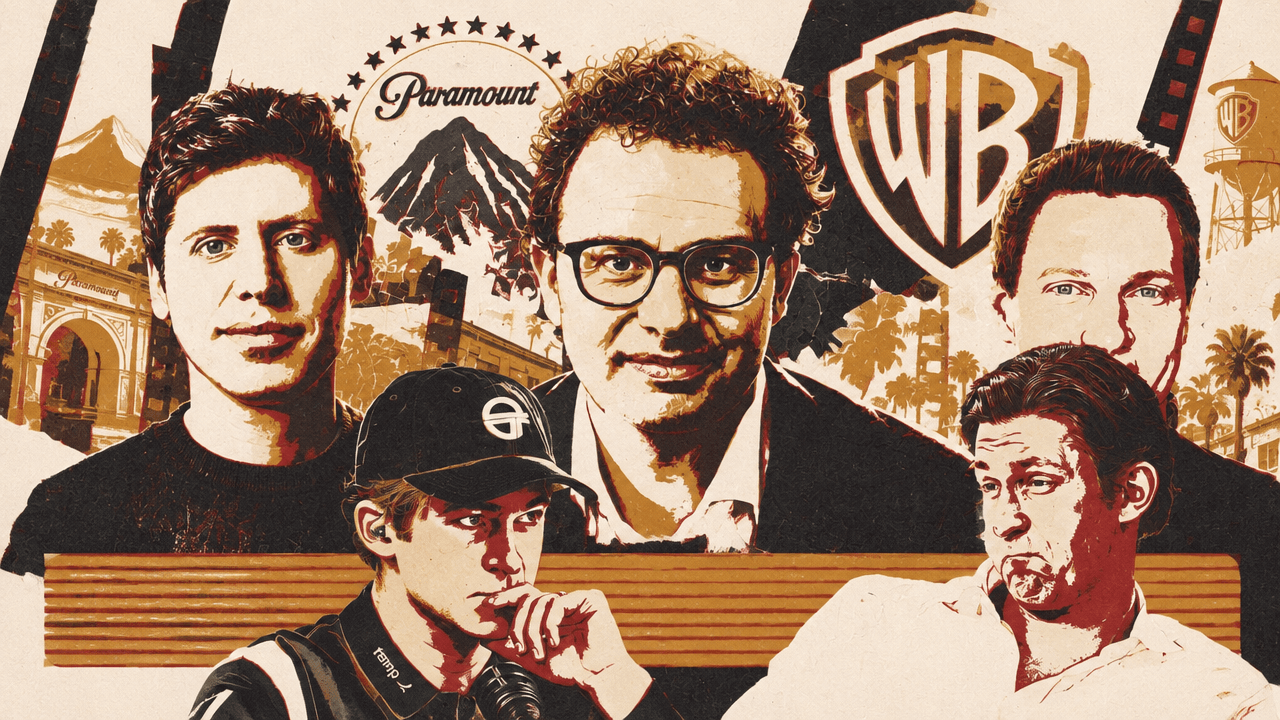
The Skydance merger combines a broad catalog, not just a few prestige titles
John Coogan and Hays discussed the announcement that the combined Skydance, Paramount, and Warner Bros. Discovery business would use the name Skydance. In the promotional video, David Ellison said the combination would give the studios a more powerful engine and help them reach broader audiences. Coogan and Hays joked about whether streaming might eventually be called “Skydance Max,” but set aside the company’s debt to argue that the combined assets were compelling.
Coogan said the value was not limited to marquee titles such as The Dark Knight. The bundle could include live programming, news, and the kind of serialized shows people leave on in the background—what he called “laundry television”—as well as major films. He saw the combination as a meaningful challenge for Netflix, while allowing that consumers might subscribe to both services. The point was the breadth of the programming portfolio, not simply a handful of prestige titles: in Coogan’s view, CBS had background viewing and serialized programming of the sort Netflix had become good at offering.
Ben Affleck’s account of video models turns on the filmmaking workflow
In a clip from a Bloomberg event, ? ben-affleck described video-model development as a sequence. Models first learn broad visual categories, such as what red is, and only later acquire more specific cinematic understanding. Affleck said he had been concerned that existing models were trained on work by filmmakers he knew, and that he was uncomfortable with that as the basis for a viable business.
His proposed approach was to take open video models that had learned from social-media footage and other material but lacked cinematic quality, then continue training them toward specific cinematic standards. He described a workflow intended to learn from a filmmaker while a movie is being made, so the filmmaker could retain the proprietary nature of the work and benefit from what the process learns.
Coogan joked that Affleck was speaking fluently about model weights and training. But the substance of the account was practical: the final layer of a video model, in Affleck’s telling, is not only a matter of accumulating more footage. It depends on understanding cinematic components and fitting training into the filmmaker’s production process.
A domain-name rush does not make .si a better default than .com
A post urging people to register .si domains prompted a counterargument from the hosts. The speaker, whose identity is not established in the source passage, said the rush was not worthwhile: rebranding around “super intelligence” struck them as corny, and they would put the effort into securing a .com instead. They described .ai domains as inferior to .com for the use cases under discussion, and saw .si as a further step down. The speaker also praised domain broker Rob and the Snagged team, who had helped TBPN obtain tbpn.com.
Hays cast the choice as a third option in a political argument over whether the country should emphasize “AI” or “SI”: simply choose the commercial address. The speakers briefly wondered what “.com” stood for, settling on commercial or company. The practical advice was more definite than the terminology: the novelty of a new extension is not, by itself, a reason to prefer it over .com.