Nvidia’s Cloud Strategy Shifted From GPU Marketplace to Infrastructure Software


Nvidia’s DGX Cloud Lepton began as a bid to give developers a single front door to GPU capacity, potentially putting the company in competition with major cloud providers. John Coogan recalled that Jensen Huang framed the opportunity as a way for Nvidia to compete with those providers; Coogan argues that Lepton instead evolved into software for managing AI infrastructure across them, extending Nvidia’s reach without requiring it to become the cloud. The article also examines separate debates over executive conduct in the Factory–Cognition dispute and the role of shopping recommendations in AI assistants.
Nvidia moved up the cloud stack without becoming the cloud
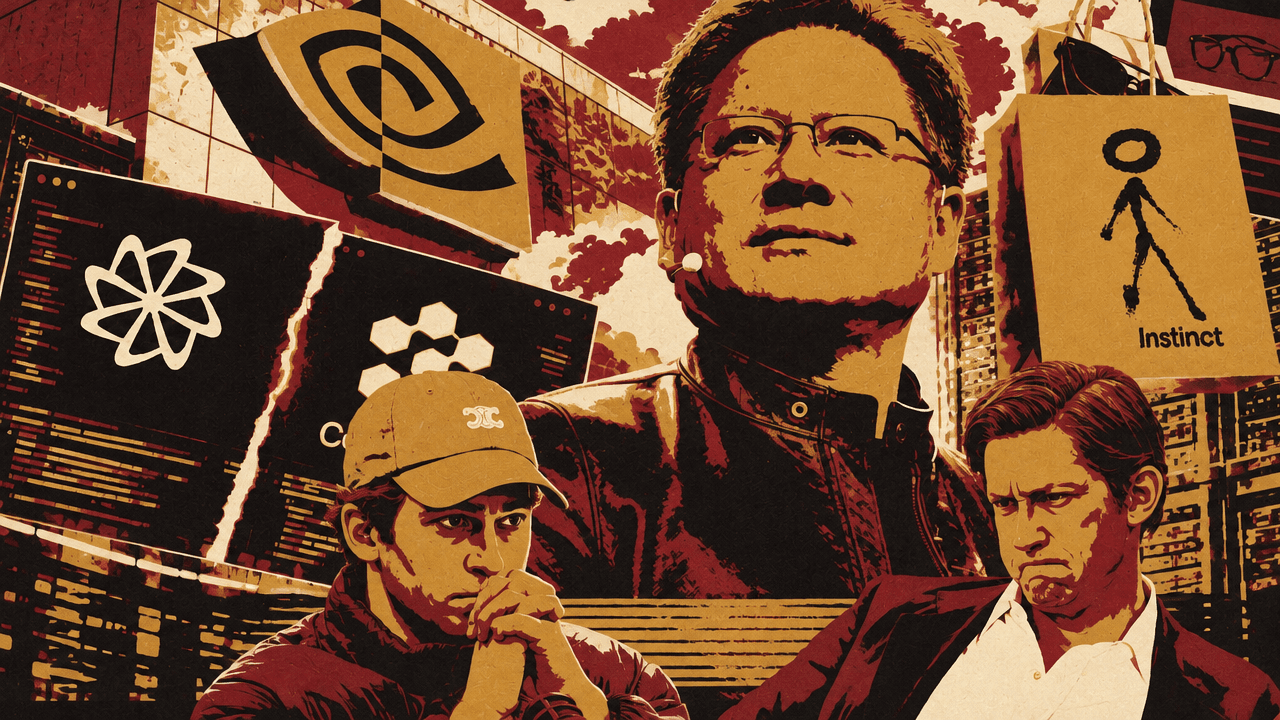
Nvidia’s early pitch for DGX Cloud Lepton was more ambitious than the product that emerged. As John Coogan recalled, Jensen Huang framed the post-ChatGPT opportunity as an “iPhone moment”: Nvidia could aggregate GPU capacity across providers, give developers one place to deploy it, and compete with AWS, Azure and Google Cloud as a front door to compute.


That plan put newer cloud providers in a bind. Joining Nvidia’s platform could mean losing direct customer relationships and facing pressure on margins. Staying out carried its own risk: Nvidia might steer workloads toward providers that did participate. Coogan said the tension was especially visible after Nvidia acquired Lepton in April 2024. He described the purchase price as a reported range of $300 million to $900 million, and recalled Huang describing a “planetary-scale AI factory.”
The outcome was less like an Expedia for GPUs than a software layer for managing AI infrastructure. Lepton evolved into what Nvidia calls a unified AI platform: tools for GPU node groups, development environments, batch jobs, inference endpoints, storage, observability and reservations. Customers can use their own hardware and retain their relationship with the underlying GPU provider.
It’s between an actual like Expedia for GPUs and just a set of standards.
That distinction matters. Coogan said the product did not initially offer a better experience than going directly to providers such as CoreWeave or Nebius; he recalled that testing by SemiAnalysis found Nvidia’s system lagging other options. The platform’s role, then, is not necessarily to own demand or displace cloud providers. It is to extend Nvidia’s software presence across their businesses.
Jordi Hays saw strategic value in Nvidia working with dozens of capable teams, each with an incentive to grow its business and buy more Nvidia products. Coogan’s example was CoreWeave Forge, which he described as adding CPUs, storage and management tools to CoreWeave’s offering. He argued that the announcement primarily pressures direct competitors: suppliers can gain a new customer, and CoreWeave customers gain more services. CoreWeave is still competing with a crowded field of neo-clouds, but the move is not automatically a threat to every company around it.
Coogan also connected the cloud providers’ prospects to the economics of running infrastructure. He described CoreWeave as having a “remarkable margin expansion story,” and said it had quickly answered concerns about depreciation. In his account, the value generated per watt was increasing rapidly. He pointed to the economics associated with Elon Musk and Huang—“$60 billion a gigawatt”—as a benchmark CoreWeave could try to match, while characterizing the business as already exciting. These were Coogan’s assessments of the company’s trajectory, not a claim that every provider would achieve the same economics.
The Factory–Cognition dispute made executive conduct a public test
A dispute over an executive’s move between AI software companies became unusually personal when investors entered the public argument. Hays described the immediate spark as Factory CEO Matan Grinberg saying the company was terminating Chris Degnan for unethical conduct involving Cognition. Vinod Khosla responded by calling Factory a “struggling second tier competitor” and accusing Grinberg of lying about Degnan’s firing.
Khosla Ventures had exposure to both Factory and Cognition, a fact that quickly became part of the public debate. Hays noted that venture firms can use firewalls, and that people with exposure to one company may still act in ways they consider ethical when another company is involved. Coogan speculated that Khosla’s criticism could carry more weight because his firm had exposure to Factory: perhaps Khosla was willing to oppose a company in which his firm had invested because he believed its founder was wrong. Hays raised another possibility—that Khosla may not have had the fund’s exposure in mind when he posted.
The disagreement was over what the post amounted to. Coogan suggested that an investor might have access to internal information and know whether a claim was true. He also wondered why the response had gone straight onto the timeline rather than arriving first as a private warning to Grinberg. If an investor believed a portfolio-company founder was in the wrong, Coogan said, a text urging the founder to take down the post and apologize might be the responsible first step. Hays objected that Khosla’s public post did not address the underlying facts; it attacked Grinberg personally. They agreed it was a “nuke,” but not on whether it was a truth-based one. Their joking term for it was “ad hominuke.”
The underlying question was what Degnan’s role and conduct had been. Hays said his understanding was that Degnan’s technical title was adviser, and that the firing happened days after Factory was told he was leaving for a competitor. Coogan cited Keith Rabois’s argument that interviewing with a competitor while attending a company’s board meetings and dinners was unethical. Coogan found the principle persuasive but wondered what responsible conduct would require in practice: would someone have to resign before even interviewing? The exchange left that practical question open.
They invoked other cases involving people connected to competing companies, including Eric Schmidt’s role at Apple while Google was developing Android, and Mike Krieger’s resignation from Figma’s board shortly before launching a competitor. Hays argued that an adviser’s move seemed relatively minor beside the movement of research talent, where employees may bring years of technical knowledge to a competitor. Coogan’s distinction was that the Factory–Cognition dispute felt more personal partly because advisers and investors interact directly, unlike researchers, who may have less contact with board members.
The Rippling–Deel dispute offered a different comparison. Hays said that case appeared to involve stronger evidence and was being worked out through the courts; Coogan recalled the “honeypot” framing. Their point was that the two stories should not be treated as equivalent simply because both involved accusations of misconduct.
A post by investor Miles Clements offered a contrasting model: a company loses a valued executive to another firm, tries to retain him, then wishes him well and starts recruiting a replacement. Clements described investors thanking the departing executive rather than dragging him publicly. Martin Casado replied, “Boooooring!!” The exchange set a restrained professional response against the attention generated by public conflict.
That spectacle continued in a post by Shaun Maguire, who wrote that “we’re sitting on a nuclear weapon to end” Cognition and hoped it would not be necessary to use it. The post raised the prospect of more evidence without providing it. The hosts also pushed back on Maguire’s description of Cognition as “Infosys masquerading as Anthropic,” arguing that Cognition presented itself as an enterprise software company, not a research lab pretending to be one. They left open the possibility that Factory and Cognition were pursuing different directions.
Instinct’s shopping test depends on recommendations earning trust
Instinct’s shopping experience prompted a familiar objection: a personal assistant that understands you should not turn into another advertising channel. A screenshot shown during the discussion depicted recommendations for luggage and other travel items. One user complained that Instinct had become an Amazon recommendations app and asked for a list of things she actually needed. Dave Morin called the experience “shop slop.”
Hays distinguished the experiment from a mature monetization strategy. He said Instinct had been explicit about wanting deals with retailers and platforms, but argued that a useful shopping assistant first has to create demand rather than merely capture a purchase someone already intended to make. If a user has already decided what to buy because of an ad or other content, a retailer has less reason to pay a large referral fee for an agent to complete the transaction.
Instinct’s more interesting test, in his view, is whether it can use what it knows about a person to suggest something they had not been considering. Coogan agreed that the company might earn referral commissions, as product-review sites do, but suggested that monetization may not be the immediate point. A small company can use shopping to test how consumers respond and show investors whether its recommendations convert.
One example shown on screen involved Instinct finding a hard-to-find pair of The Row shoes in the user’s size. Hays’s formulation was that someone might dislike the experience until one recommendation lands, then decide the tool is worth using. Another example went the other way: Coogan described Instinct recognizing that a user owned a Porsche 911 Targa and recommending a trickle charger and an indoor car cover. He argued that the system had made a crude inference—this person likes cars—without knowing what an informed car owner would want. Personalization can look specific while still missing the mark.
The interface itself also raised concerns. A screenshot displayed several products with repeated “Let’s buy this” buttons. Coogan said the recommendations were not necessarily the problem; the repeated calls to action made the page feel clumsy. Hays connected that pushiness to a broader worry about AI assistants: a tool people trust for information and help could start urging them to buy things.
That risk is especially acute in text messages. Hays said he was much more likely to unsubscribe from text marketing than email marketing. Coogan warned that assumptions about text-message open rates may not hold if an assistant starts to look like a promotions sender and gets sorted away from personal messages. The channel that makes an assistant feel close to its user can also make unwanted sales pitches feel more invasive.
Coogan offered a different example of proactive help. While testing another assistant, Dot, he asked it to find a pair of pants he had purchased through Gmail in a different color. After it reported that the item was out of stock, he asked it to check again daily and notify him if it returned. He wanted one useful alert at the right moment, not a steady stream of unsolicited products.
Their disagreement was about how broadly to interpret the backlash. Coogan said many people enjoy browsing sales emails and seeing products in Instagram ads. Hays suggested that some users might welcome a daily message with a product they are likely to want. Both views leave the product with the same task: make suggestions useful enough that the user welcomes them.
Hays described Instinct as a team of roughly 13 or 14 people, shipping quickly and experimenting. He said the company had hired Ben, formerly at Coatue and Snapchat, as chief business officer, and thought he could help make the product feel more like an elevated, user-first commercial service. For the experiment to work, both the recommendations and the way they are presented have to earn the user’s attention.
Personal conflict drew attention away from model news
The Factory–Cognition dispute competed with Google’s Gemini 4 Argon launch for attention on the tech timeline. Coogan called the model’s benchmarks impressive, while noting controversy over how much Google employees were using it internally for coding. A meme shown during the discussion depicted Google announcing a frontier model as observers turned back to the fight between “factory guy” and “cognition guy,” and to enterprise model-agnostic tools. Coogan’s point was not that model competition had stopped mattering, but that the interpersonal board dynamics were proving more engaging than model news that day.
The naming drew its own scrutiny. Coogan contrasted OpenAI’s celestial names—Luna, Terra, Sol and Astra—with Anthropic’s literary sequence of Haiku, Sonnet, Opus and Fable. A post shown on screen connected “Argon” to the Greek argos, meaning “lazy” or “inactive.” Coogan thought Google was more likely drawing from the chemical element, perhaps as the start of an element-based naming scheme, but said technology leaders should think carefully about the meanings and associations their project names carry.
The show’s closing brand-collaboration aside was shorter: the hosts noted that Pop-Tarts had ended its BuzzBallz partnership amid concerns about underage drinking, while Feastables and Liquid Death had partnered on a peanut-butter-cup-flavored sparkling water. Hays called the trend effectively “net neutral”; Coogan described the new combination as the BuzzBall’s reincarnation.