GPT-5.6 and Muse Spark Show a More Fragmented AI Frontier
John Coogan and Jordi Hays treat the latest AI launches from OpenAI, Meta and xAI as evidence that the frontier is becoming harder to rank, not easier. Their central argument is that models such as GPT-5.6, Muse Spark 1.1, Fable and Claude Mythos are increasingly differentiated by working style, price, speed, coding ability, agentic behavior and internal deployment, rather than by a single benchmark hierarchy. Meta’s move to a paid Muse Spark API, they argue, also turns model performance into a broader question of compute allocation and business strategy.
The frontier is getting spiky, not settled
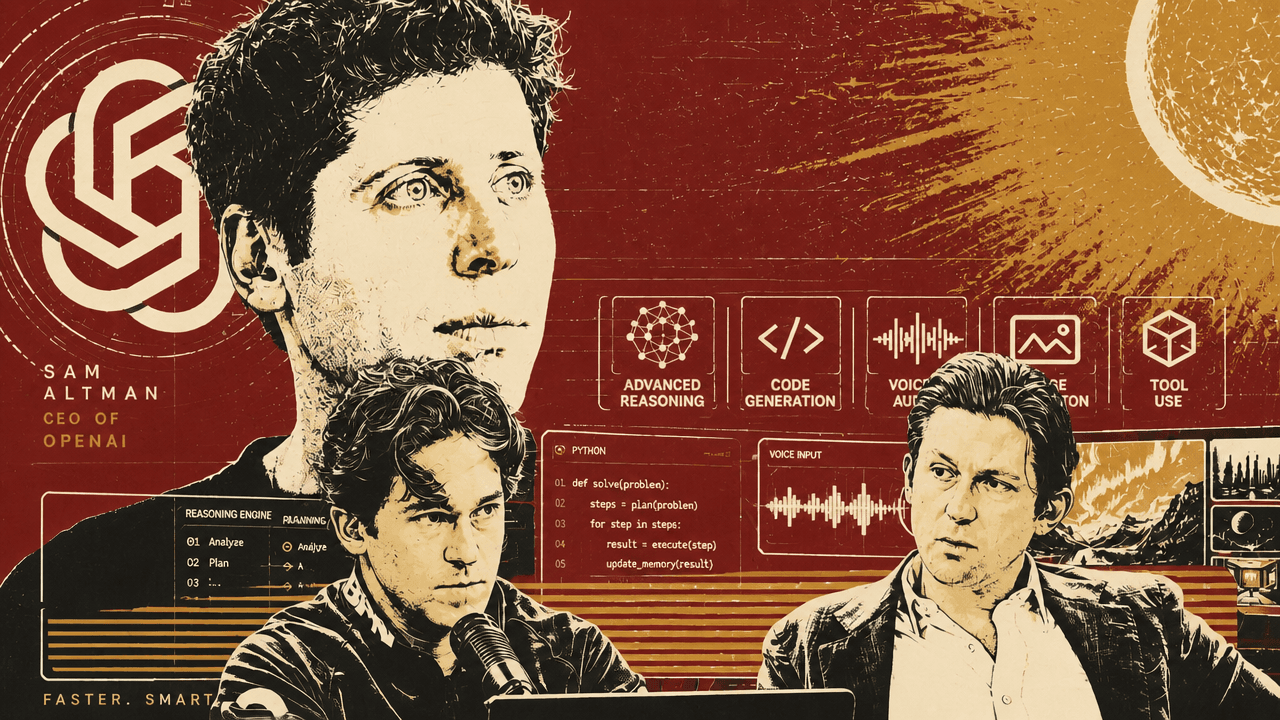
John Coogan framed the day’s AI launches as “model mayhem”: xAI with Grok 4.5, Meta with Muse Spark 1.1, and OpenAI with GPT-5.6. His more substantive point was not simply that more models are arriving. It was that the frontier is no longer legible as one clean ranking. A small set of companies may be competing at the edge, but that edge is “spikey,” with different models developing different strengths and giving users different reasons to pull one tool rather than another.

The OpenAI release drew the most attention in that respect. Coogan described GPT-5.6 as a new general-purpose model with expanded coding and agent capabilities, alongside GPT Live, the real-time interactive voice experience the show had discussed previously. He said reactions to 5.6 were strong, but the interesting distinction was qualitative: users were comparing Fable 5 to a “recluse genius” and GPT-5.6 to a collaborative coworker. Jordi Hays put the same point in a more idiosyncratic register: “Fable 5 is like Kendrick on Good Kid, M.A.A.D City, and 5.6 Sol is like Chief Keef on Finally Rich.” Coogan joked that the analogy clarified things only for a very small audience, but the underlying claim was serious: models are becoming differentiated by working style, not only by benchmark position.
Coogan singled out ARC-AGI V3 as the benchmark he finds most interesting. Unlike evaluations built around “crazy math projects,” “crazy hard programming projects,” or hacking tasks that are economically valuable but specialized, he said ARC-AGI tries to ask a more basic question: what can almost any human do that AI still cannot? He described the benchmark as a true AGI test in that sense, built around puzzles that humans should be able to solve at essentially 100%.
On that test, GPT-5.6 Sol scored 7.78%, which Coogan emphasized is both tiny and meaningful. It is nowhere near saturation. But against Opus 4.8 at 1.5%, he called it “a huge jump,” evidence of more generalization, more spatial reasoning, and stronger puzzle-solving ability. His point was not that the benchmark had been solved. It was that progress was now visible on a test designed to resist the usual specialized performance spikes.
A benchmark screenshot shown during the discussion compared GPT-5.6 Sol, GPT-5.6 Sol Ultra, GPT-5.6 Terra, GPT-5.6 Luna, GPT-5.5, Claude Mythos 5, and Claude Mythos Preview across coding evaluations. The visible chart, attributed on-screen to Lisan al Gaib, listed an “Artificial Analysis Coding Agent Index v1.1” score of 80 for GPT-5.6 Sol, 77.4 for GPT-5.6 Sol Ultra, 74.6 for GPT-5.6 Terra, and 76.4 for GPT-5.6 Luna. It also showed SWE-Bench Pro scores including 64.6% for GPT-5.6 Sol, 63.4% for GPT-5.6 Sol Ultra, 62.7% for GPT-5.6 Terra, 59.4% for GPT-5.6 Luna, 80.3% for Claude Mythos 5, and 77.8% for Claude Mythos Preview. On Terminal-Bench 2.1, the same visible chart showed GPT-5.6 Sol at 88.8%, Sol Ultra at 91.9%, Terra at 87.4%, Luna at 84.7%, Claude Mythos 5 at 85.6%, and Claude Mythos Preview at 88%.
The chart supported rather than resolved the hosts’ point. OpenAI’s models looked strong in the screenshot, but not uniformly dominant across every task. The frontier was contested, with different systems occupying different parts of the capability surface.
GPT-5.6 is being judged by how it works, not just what it scores
Coogan was unusually interested in the GPT-5.6 launch assets because OpenAI’s blog included playable games. He called the sailing mini-game “high fidelity” and “delightful to actually play.” The source showed its menu: “Saltwind,” described on-screen as “A wind-powered time trial” with the prompt, “Read the wind. Thread the gates. Chase a faster line across a sunlit sea.”
The point of playing it was not that the game itself mattered as a product. Coogan treated it as a demonstration of what improved coding models make cheap to produce. While Hays played, Coogan explained the game mechanics: the player has to steer while trimming sails into the wind’s sweet spot, adjusting as the boat turns. The result screen showed a personal-best time of 0:32.5, seven out of seven gates, a “Gold wake” medal, and a top speed of 15 knots.
Coogan said the apparent idea was that users could “vibe code” something like this in GPT-5.6, deploy it, and let someone else play it. That led into a broader claim about software and entertainment: generative AI lowers the cost of making small interactive artifacts that previously would not have justified the work. He referred to mini-games and simulators that start as jokes — a Capybara simulator, a Coconut simulator, “data center simulators” — and said these are the kinds of things that once might have existed only as a tweet or a Photoshop meme. Now they can become browser games, and eventually perhaps Unreal Engine projects or Steam-distributed games.
Hays connected that to Dylan Abruscato’s title, “The Future of Entertainment is Interactive,” and said part of what he likes about AI is that it changes the economics of small creative ideas. Something that would have taken four days and been good for a small laugh can now be made in four minutes. Coogan extended the same logic to business software: if a company needs small custom functionality, improved coding models create a large opening for building more of it.
The hosts also treated GPT-5.6 as a live object of social evaluation. Hays read a tweet from Stanley Tang, co-founder and CPO of DoorDash, claiming he had an “insane magic trick” that no prior model, including Mythos, could figure out; he had shown it to more than 100 people, including magicians, and said the trick was not on the internet and could only be solved through first-principles reasoning. Tang’s punchline, as read by Hays: “Well... GPT 5.6 just did.”
Coogan’s response was skeptical in the practical sense. He wanted Tang to disclose the trick now that a model had cracked it. He wondered whether the task involved a video or description, noting that many magic tricks depend on sleight of hand. Hays then read a parody from John Palmer, structured around a joke that no model had found funny until GPT-5.6, mocking the shape of the AGI anecdote. The exchange preserved both sides of the current evaluation culture around models: users are reporting striking private tests, and other users are immediately parodying the evidentiary standards.
The clearest user comparison came from Siqi Chen, whose tweet Hays read. Chen rejected a simple Fable-versus-5.6 comparison, describing Fable as an F1 car and GPT-5.6 Sol at Ultra as a Tesla Model X Plaid. In Chen’s account, 5.6 often finds things Fable misses during planning and coding, while Fable still routinely finds things 5.6 misses on the hardest problems. Chen’s practical conclusion was that 5.6 is faster and more affordable, and that with an unlimited token budget he was using GPT-5.6 more than 95% of the time.
Coogan took that as further evidence that the Pareto frontier is active rather than settled. Companies can be growing at extraordinary rates and still losing share if competitors are growing even faster. In a market expanding that quickly, he said, a company growing revenue 300% could lose market share to one growing 400% while still looking like “one of the greatest businesses by modern metrics.”
Model numbers have become marketing signals for frontier status
The hosts treated the proliferation of model names as partly comic and partly strategic. Hays referred to jokes about OpenAI’s “lead” widening because its version numbers appeared higher than Anthropic’s. A chart shown on-screen from Liron Shapira plotted OpenAI and Anthropic version numbers over time, with labels such as GPT-3, GPT-4, GPT-4.5, GPT-5, GPT-5.5, a predicted GPT-6, and Anthropic labels such as Claude 2, Claude 3, Claude 3.7, Claude 4, Claude 4.5, and Claude 5.
Hays asked whether model numbers mean anything in particular anymore. Coogan said they used to have a rough technical meaning: the main model number corresponded to pre-training, while the version number corresponded to post-training. But he said that relationship has been disrupted. Now the number is closer to a market signal: whether a model feels like it is competing in the “4-class” or “5-class.”
An unidentified speaker added that post-reasoning models introduce another scaling path beyond pre-training, making it hard to compress multiple development dimensions into a single number. Coogan agreed, saying the number is becoming closer to a model year. If a model is on the frontier in 2026, he suggested, it may make sense for leading systems to carry a “6” by the end of the year.
The practical consequence is that naming is no longer trivial. Coogan said he would not be surprised if Meta skipped a sequential Muse Spark 2 and jumped to Muse Spark 5 or 6. He compared the dynamic to car manufacturers, where a “5-series BMW” also has a model year. The number may not mean much technically, but it sticks in people’s minds.
Google’s naming strategy was the example Coogan found odd. He said the rumor was that Gemini 3.5 Pro would arrive the following week, while the Gemini app currently showed 3.5 Flash and required users to go back to 3.1 Pro for the more advanced model. He said he expected Google to jump to 4, even while acknowledging that these numbers are marketing terms. The point was not that numbering determines capability. It was that in a market where buyers and developers form quick impressions, names become part of competitive positioning.
Meta is moving from open model posture to paid API competition
Meta’s Muse Spark 1.1 announcement carried two different signals. The first was cultural: Mark Zuckerberg returned to posting on X, at least for this announcement. A tweet shown on-screen from Zuckerberg said, “Today we’re releasing Muse Spark 1.1 — a strong agentic and coding model at a very low price. It’s available through our new Meta Model API and in Meta AI.” Coogan joked that Zuckerberg had not been an active poster for years, while Hays countered that he might be an active user — “a lurker,” as Coogan put it. Hays called him “absolutely glued.”
The second signal was commercial. Coogan read from Bloomberg’s framing that Zuckerberg was pledging aggressive pricing with Meta’s first pay-to-use AI. Coogan found the phrase funny because, in substance, it meant an API for a model. But the business shift mattered: Meta was unveiling a version of Muse Spark 1.1 with a paid tier for developers, marking the first time it had charged businesses for access to its models and creating a new revenue stream.
Coogan quoted Zuckerberg’s explanation: “Since this is not an open source model, this is I think the first time that we’re doing a real serious API. And the pricing is going to be very aggressive and attractive.” Coogan said that made sense because Meta owns data centers and is efficient at building them, so it should be able to serve models efficiently.
Zuckerberg, as read by Coogan, described Muse Spark 1.1’s standout improvement as agentic capability. Agents were defined in the Bloomberg excerpt as systems that can complete multistep tasks on behalf of users. Zuckerberg said Muse Spark 1.1 had “state-of-the-art, or very close to it, agentic reasoning and tool use,” and that it was greatly improved at coding. He also said Meta employees were using it internally to build products and features for the company’s apps.
That internal usage became Hays’s main question: how quickly can Meta move its own workloads onto its own models? Hays said Meta had been buying access to models through Google, Anthropic, and OpenAI. He argued that companies will look to Meta’s own behavior as validation for whether they should use Muse Spark themselves. If Meta keeps relying heavily on outside models, that says one thing. If it moves internal workloads onto Muse Spark, that says another.
Hays also noted that Google had recently said it did not have enough capacity for Meta’s demand for its models. If Meta cannot get enough AI capacity elsewhere, at least from some providers, then the company’s ability to serve itself becomes strategically important.
Coogan added that Meta had reportedly been one of the first companies to “token max,” with a leaderboard encouraging employees to use a lot of model tokens. If a company owns both the model and the data centers, he said, the incentive to push usage is much higher: it is paying electricity on cards it is already depreciating rather than paying another provider’s margin. In that setting, broad internal rollout is not only cheaper experimentation but also a way to improve the model.
The compute allocation problem is now a business model problem
The Meta discussion opened into a broader question facing every AI lab: how to allocate compute among research, internal use, API customers, subscriptions, and free plans. Hays stated the tradeoff directly. Labs must decide how much compute goes to improving the next model, how much goes to employees, how much gets sold through APIs, and how much supports consumer access.
Coogan connected that to Ben Thompson’s argument, which the show had not fully covered the prior day. The relevant dynamic, as Coogan described it, is that when a company is willing to sell API access, sell compute directly, and also use the same capacity internally, it must continuously choose where the marginal unit of compute creates the most value.
The hosts briefly detoured into Anthropic-related financial modeling and the phrase “E B T I T.” Coogan said Ed Zitron had criticized the appearance of the new non-GAAP metric, comparing it to “community adjusted EBITDA.” The hosts unpacked the acronym as “earnings before training, interest and taxes,” with some joking confusion around training and inference. Coogan said it is always odd when a new non-GAAP metric appears, but in this case he thought there was an argument for treating training runs differently because they fit something like a depreciation profile. His objection was more accounting-language-oriented: he wondered why training runs would not simply be handled through a depreciation schedule, perhaps as a non-GAAP depreciation metric, instead of introducing a new phrase that investors have to learn.
Hays then read from Thompson’s imagined earnings script for Mark Zuckerberg. In that “fan fiction” version, Zuckerberg would argue that Meta is well placed for the AI era because humans remain obsessed with other humans and want to connect with them. AI may make people more productive, but productivity is not the entirety of human experience. Meta’s advantage, in Thompson’s imagined formulation, is giving people off-the-clock experiences: connection, entertainment, and shopping. The striking line Hays emphasized was that Meta’s investment in AI while not selling business solutions could be one of its biggest advantages.
The irony, Hays noted, is that Meta is now in fact selling to businesses through paid model access. The unresolved question is how large that API business can become relative to the value Meta can unlock across its existing consumer and advertising businesses with the same infrastructure spend.
Meta’s workplace data experiment shows what agent training may require
Coogan also discussed Andrew Bosworth’s recent interview about Meta’s workplace keystroke logging experiment. He said the interview had been framed around workplace surveillance and generated scary headlines, but he was not sure where he landed because he already assumes much of what employees do on work computers is logged. Web traffic goes through company networks. Code, emails, and documents are stored in shared systems. Against that backdrop, he said moving to keystrokes did not seem as categorically different as the headlines suggested.
Still, the details mattered. Coogan said Bosworth framed the project as an experiment whose value Meta was not sure of. Some parts of the workforce were opted out by default, especially people working on confidential or sensitive information. Bosworth himself, according to Coogan’s summary, was opted out because he is under legal holds, given the amount of litigation involving Meta. Coogan joked that if every keystroke were retained, opposing lawyers could ask not only what an email said, but what sentence Bosworth typed and deleted before sending it.
The reason for collecting the data, as Coogan relayed it, was to understand how skilled work unfolds over 12 to 18 months. Meta could not get that from ordinary data labeling, because it needed high-skilled workers “actually chopping wood on projects” over long periods. The target was not a single coding chain but the full sequence of meetings, decisions, tradeoffs, and revisions that produce real white-collar work.
Coogan’s key distinction was that real product development is not pure software engineering. Code may be written a certain way because a lawyer required it, a marketer needed an activation integrated, or business people determined margins would be better with a different implementation. If the goal is to train agents to operate in real workplaces, observing only final code does not capture the reasoning process that led there.
That claim linked back to Muse Spark’s agentic ambitions. If Meta wants models that can perform multistep work across tools, teams, constraints, and business objectives, then the training signal it wants is not merely “what code was written.” It is how work actually proceeds inside a company over time. The surveillance concern and the agent-training objective are therefore not separate issues; they are two ways of looking at the same data hunger.