AI Growth Is Running Into Power, Memory, and Inference Bottlenecks
 John Coogan
 Jordi Hays
 Joanna Stern
 Rowan Trollope
 Dean Leitersdorf
 Mike IsaacTBPNMonday, May 18, 202624 min read
TBPN’s discussion recast the AI boom around physical and economic bottlenecks — power, cooling, chip scarcity, inference cost and memory — rather than model ambition alone. Mike Isaac, Rowan Trollope and Dean Leitersdorf described an industry where local utilities, low-level inference optimization and fast state management are becoming central constraints, a capacity problem the hosts also saw in the whey protein shortage. Everlane’s reported sale to Shein pointed to a different limit: Hays argued that venture-backed ethical basics struggled against price pressure, brand preference and the demand for sustained growth. Joanna Stern supplied the adoption constraint, arguing from her reporting that AI’s progress will be judged through trust, job anxiety, children’s safety and whether new devices ease or deepen phone dependence.
AI’s bottlenecks are moving beyond the model
AI’s constraints are increasingly physical, economic, and institutional. The limits described here were not only model quality or GPU access, but power and cooling for data centers, chip supply for inference, memory for long-running agents, interfaces that ordinary users can trust, and social systems that can absorb the tools without breaking.
Mike Isaac, discussing data center buildouts, framed the immediate infrastructure problem as power and cooling rather than GPUs alone. The chip-shortage story, in his telling, is incomplete. Some of the “massive clusters” being built for AI have to be powered and cooled, and the limiting factor can be local governments trying to supply enough gigawatts without browning out the surrounding towns.


That pressure turned the energy debate into a question of policy design. Mark Cuban had proposed a federal tax on AI tokens “at the Provider level,” at less than 50 cents per million tokens. Cuban’s stated goal was to push major AI companies to optimize tokenization, caching, routing, and localization, thereby reducing energy use and grid strain.
John Coogan rejected the proposal on unit economics. He argued that some open-source inference is already priced below 50 cents per million tokens, citing Llama 3 8B at roughly 10 cents per million tokens in some cases. A 50-cent tax, he said, would effectively become a 500% tax on some current usage.
The defense of Cuban’s argument was that large model providers may be running near break-even on token generation while prioritizing growth and market share over efficiency. Jordi Hays rejected that premise. Compute cost, he argued, is already central to the economics of AI companies and cloud providers; they do not need a tax to care about inference efficiency.
Palmer Luckey’s objection, quoted in the discussion, was that “there are already massive economic incentives to optimize,” and that a token tax would make foreign models and products more attractive while creating infrastructure for government tracking of AI usage and punishment for non-reporting. Cuban replied that incentives change over time and that current incentives favor growth and spending over optimization. Coogan and Hays sided with Luckey.
The dispute was not whether AI data centers consume resources. It was whether a token-level tax would produce better efficiency than the incentives already embedded in the market: inference margins, chip scarcity, power availability, and the need to serve customers reliably.
Coogan’s broader claim was that large hyperscalers are already economically forced to optimize energy and water use. He described Microsoft and Meta as deeply focused on data center efficiency, including PUE ratios and water evaporation, and argued that there is no hidden efficiency breakthrough that appears only after a large tax is imposed.
The cultural version of the same fight appeared in anti-data-center content circulating online. One post read, “Not a single square inch of Wisconsin is worth giving up for an AI Data Center,” over what Hays described as an AI-generated image: a picturesque cabin by a river, ducks without faces, an American flag, and a cabin that appeared to lack a door. The irony mattered to him because it captured an incoherence in some of the backlash: anti-AI engagement content being made with AI.
The practical question remains narrower than the rhetoric. Data centers need power, cooling, land, grid interconnection, and local permission. But Coogan and Hays treated Cuban’s proposal less as climate policy than as a misunderstanding of AI unit economics. Their view was that the strongest efficiency incentives already exist, because wasteful inference is expensive and constrained inference limits revenue.
Redis sees agent memory as the state layer for long-running AI work
Rowan Trollope described Redis as infrastructure many developers know well but many business people do not. His short version: almost any application that needs to feel fast uses Redis under the hood. Redis is an in-memory database, which is why it can serve fast-changing application state quickly. Trollope gave familiar examples: ride-sharing apps, dating apps, and the moving dot showing a car approaching in a map interface.

That history matters because Trollope’s argument about AI agents was not abstract. Redis is positioning itself as a state and memory layer for agentic systems — the place where an AI system stores the fast-changing information it needs while it works across steps, tools, and time.
Trollope framed today’s AI economics as an inference-cost problem. Claude and ChatGPT, he said, are expensive to use at scale when millions of users can demand unbounded compute. But he expects inference costs to keep falling rapidly. As those costs fall, he argued, developers will spend more compute not on answering immediately, but on letting agents work longer.
His analogy was human work. If someone asks him a question live, he answers immediately with a stream-of-consciousness response. But if someone asks him to research a hard problem, he may go away, work on it, and return later with a better answer. In his view, agents will operate more like the second case: they will not have to answer immediately. They can “think,” in the operational sense of running long chains of model calls and intermediate steps.
That model creates a memory problem. A long-running agent must preserve state while it works. It has to remember goals, intermediate outputs, tool calls, context, and messages exchanged with other agents or systems. Trollope said builders of early agentic systems are discovering that they need a fast database on the back end to store that state as agents communicate and iterate.
In order to do that, you've got to have memory that sits inside that that holds that state while they're working.
Trollope connected this to Decart’s Oasis, which he described as a new kind of game where the engine itself is an AI model rather than traditional coded logic. Coogan summarized the concept as “Minecraft where the game engine itself is actually an AI model.” Trollope agreed and broadened it: if code can be replaced by neural nets, then software can move from explicit rules to trained behavior.
His claim was that traditional software resembles a rules-based expert system: code is a collection of if-then statements written in languages such as C++, Java, or Python. A neural-native application, by contrast, uses training data as input and lets the model infer the relationships that would otherwise be coded manually. Trollope argued that this makes it possible to build some kinds of software “a hundred times, a thousand times faster” than hand-coding.
That is the architectural bet behind Redis’s agent memory platform. If applications become more agentic and more neural, they need a fast state layer. Redis is presenting itself as foundational data infrastructure for “this next generation of the internet,” with Trollope saying that “almost virtually every agentic framework” is leaning heavily into what Redis is building.
The key distinction is between memory as a user-facing feature and memory as an infrastructure requirement. In Trollope’s telling, memory is not just a chatbot remembering preferences. It is the substrate that lets an agent hold state while it executes a long process. If inference becomes cheap enough, the scarce resource becomes the ability to coordinate and persist the work.
Decart is betting that inference efficiency determines who can scale world models
Dean Leitersdorf said Decart had raised $21 million and was announcing updates across three product lines: Lucy, Oasis, and DOS. Each product occupies a different part of the company’s thesis about real-time AI systems.


Lucy is Decart’s real-time video model. Leitersdorf said it can take a video stream and edit it live, with use cases including gaming, live streaming, e-commerce, ads, and virtual try-on. He said Decart had seen significant usage for Lucy on Twitch, TikTok Live, and YouTube Live, and pointed to delulu.ai as a consumer-facing way to plug live AI video effects into OBS. In recent weeks, he said, streamers had used it for eight-hour sessions, and the product’s subscription service was growing quickly.
Oasis is the company’s real-time world model for “physical AI”: robotics, autonomous vehicles, drones, and manufacturing. Leitersdorf described it as letting AI interact with the real world through real-time pixels rather than only through text or virtual environments. In Coogan’s framing, Oasis is part of the emerging category of playable or interactive world models — systems that produce a simulated world directly rather than rendering one through a conventional engine.
DOS, the Decart Optimized Stack, is the inference engine underneath both products. Leitersdorf said DOS can run LLMs, agentic models, video models, audio models, and world models more efficiently than other systems on the market for the fast-model categories Decart supports. He said DOS 2.0 was already being used by some hyperscalers.
The economics of DOS were the most consequential claim. Leitersdorf said Decart commercialized DOS first, closing its first multimillion-dollar licensing deal less than 100 days after the company was founded. DOS 1.0, he said, was licensed to neoclouds and younger AI labs. DOS 2.0, he said, is now used by “all the players,” including tier-one players and hyperscalers. For fast agentic and live video models, Leitersdorf claimed Decart is “anywhere between five to eight X more performant than anything on the market.”
The reason Decart accelerated DOS 2.0, Leitersdorf said, was chip supply. It had been planned for August, but customer pressure pushed the company to launch earlier. According to Leitersdorf, customers are saying there is effectively no chip capacity left until 2028. If that is the constraint, he argued, getting more performance out of existing chips becomes the only way for AI companies to grow revenue and adoption.
Coogan pressed on how tightly linked Decart’s products are. For real-time world models, optimization is not merely a cost reduction. It directly affects the product. Video models still need higher resolution, better frame rates, lower latency, and more stability. A text model may already be superhuman for many questions, but a real-time world model still has obvious room to improve. Leitersdorf agreed and argued that the infrastructure problem is changing too quickly for model teams and infrastructure teams to stay cleanly separated.
His view of the AI stack was more granular than the usual model-software-hardware diagram. The common picture, he said, is model layer, software layer, hardware layer. Coogan and Hays called the broader version a “five-layer cake,” adding the data center below and application layer above. Leitersdorf’s correction was that the software layer itself contains many layers. Decart sits inside that complicated software middle, mapping model requirements directly onto chip capabilities.
That mapping is low-level. Leitersdorf said Decart supports all three major hardware platforms and writes close to the metal for them: ALU-level work for TPUs, assembly for Trainium, and SASS and PTX for Nvidia chips. The point was not just technical signaling. His argument was that model workloads are changing so quickly that the software system must be able to route and optimize across hardware based on the specific workload.
The real-time video premise was illustrated with Decart-generated filters. A person became Albert Einstein in a bright pink tuxedo, then a golden retriever, then a muscular humanoid horse. Coogan noticed that when the person touched his face, the horse hand appeared to hit the correct part of the face, suggesting the system was not merely overlaying a static mask but tracking pose and contact in a more physically coherent way.
Leitersdorf’s own milestone for the company was delivered as a joke but also as a measure of ambition: he said he would cut his hair when Decart reaches $1 billion in ARR. The humor sat on top of a serious infrastructure claim. If chip supply is fixed, inference efficiency becomes a growth lever. If real-time world models are to become consumer products rather than demos, the system has to generate convincing worlds cheaply, quickly, and continuously.
Joanna Stern’s AI year was built around what is real, not what executives promise
Joanna Stern described I Am Not a Robot as an attempt to test AI’s everyday claims by living with as much AI as possible during 2025. The scope included generative AI, self-driving cars, medical AI, humanoid robots, and broader robotics. The project grew out of her long-running technology column work, but she said a book let her connect themes that are harder to develop in individual columns or newsletters.
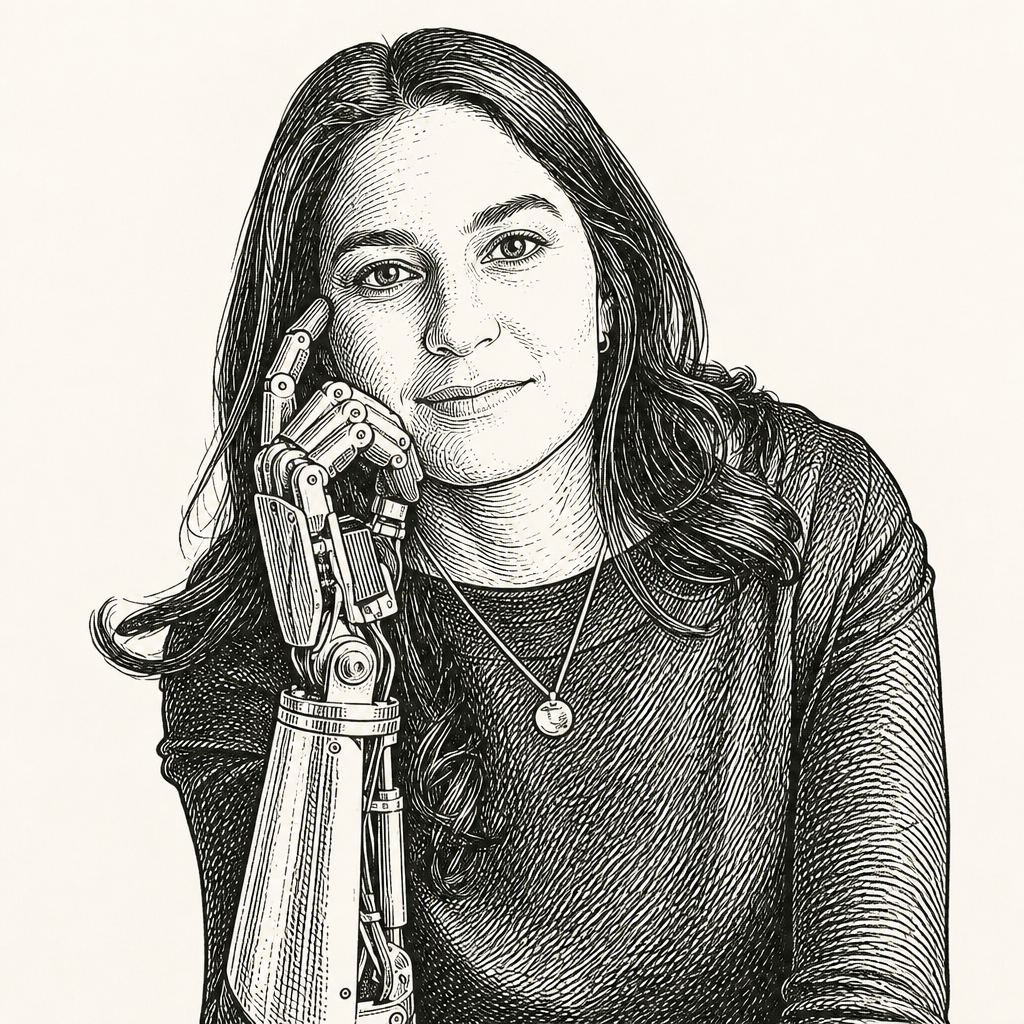
Her starting posture was skepticism toward executive hyperbole. At the end of 2024, she said, tech leaders were promising that AI would change eating, education, healthcare, longevity, and nearly everything else. Her question was simple: what are they actually talking about, and how will life be different, better, or worse?
I want to know what's real. I want to find out what's real here.
The book’s structure followed seasons, with each part oriented around a theme. Stern said the winter section focused on health. As the year progressed, she realized the technology was moving too quickly for a conventional static narrative, so she incorporated journal entries to show how fast the tools were changing week by week. The book was also designed to be “bite-sized,” reflecting her belief that many readers no longer sit with a long, continuous book in the old way.
AI did not write the book, Stern said. She emphasized that the writing is “very me.” But AI helped make the book possible on the back end: organizing notes, managing timelines, and handling endnotes and other process-heavy tasks. Coogan connected that to the surge of Kindle releases after ChatGPT, and Hays cited a rise from 100,000 Amazon Kindle releases per month before AI to 400,000 after. Stern’s example suggested one reason output can rise without every book being a single-prompt artifact: AI can accelerate the scaffolding around writing.
Stern also tested AI-generated books directly. She read AI-generated fiction from Amazon and said, reluctantly, that some of it was “not terrible.” One book she mentioned, Variant, imagined a world where AI had taken over radiology and then stopped spotting cancer. Stern contacted the author, who told her he had to keep prompting chapter by chapter because of output limits. The example connected two of Stern’s major themes: AI as a creative tool and AI as a medical system.
On medicine, Stern rejected the simplistic “AI replaces doctors” framing, especially around radiology. Geoffrey Hinton has said for years that radiologists would be replaced by AI, she noted, but that did not happen. The more realistic and already visible pattern is AI assistance: tools that summarize doctors’ notes, help with imaging, or spot cancers humans may miss. Patients may already be having mammograms or breast ultrasounds read with AI support without knowing it.
Hays described the mismatch as “capability overhang”: impressive model capabilities exist, while many doctor’s offices still use paper forms and slow workflows. Stern agreed that some of the most meaningful AI in healthcare may be invisible and incremental. A doctor may see seven patients instead of six, make 5% fewer mistakes, or catch a pattern in notes earlier. That is less emotionally satisfying than “AI cures cancer,” but it may be how much of the benefit arrives.
Stern said Bill Gates framed healthcare for her in two lanes: every doctor and every patient may eventually have an AI assistant, while AI also works externally on drug discovery or cancer research. The first lane is already visible in medical notetaking and patient-facing bots. The second is the bigger promise.
The problem is that back-end AI gets little public credit. Hays observed that people notice AI when they see an annoying slop image or fake content, but they do not notice when AI deeper in a supply chain catches a problem before it reaches them. Stern’s view was that this nuance is central: people may want to reject AI broadly, but they may also already benefit from it in places where it is quiet, bounded, and useful.
The next AI interface is ambient, but the phone does not disappear
Joanna Stern was less focused on raw model improvements than on interfaces that let ordinary people use AI. During her AI year, she felt progress through tools such as Claude Code, AI browsers, and Perplexity Copilot. She said Perplexity Copilot made the “agentic life” feel real for the first time because it could perform multi-step browser tasks.
At the start of the year, Stern said, booking a flight through such tools did not work. By the end of the year, it could. She used agentic browser tools for food shopping and school-supply shopping, even if the final purchase still required confirmation. The pattern matters: the agent may not yet fully own the transaction, but it can assemble the cart, navigate the steps, and hand the user a final checkpoint.
Hays asked whether she trusts such systems with a credit card. Stern said the systems she used still ask for confirmation at purchase, often passing the user to Walmart or Amazon to review and approve the cart. The trust boundary remains at checkout.
The same interface shift shaped Stern’s view of AI hardware. She believes another computing form factor is coming — not replacing the phone, but sitting alongside it the way smartphones joined laptops rather than eliminating them. Her reason is that she spent much of the year talking to AI in glasses, cars, and wearables, and found the experience compelling when it worked.
She was clear that current AI wearables are not yet good enough. Humane’s pin, in her view, was held back by poor hardware and did not do enough. But she said she wore devices such as the B bracelet and Limitless alongside an Apple Watch, and found moments where those AI-first wearables made the watch feel dumb. Stern said B was acquired by Amazon in August 2025 and Limitless was acquired by Meta; those acquisition claims were presented as part of her remarks.
The use case that stood out was persistent recording and synthesis. Stern said these devices could listen through the day, detect commitments, and turn them into reminders. Her example was needing to call the plumber. She kept telling her wife she would do it; the B bracelet kept adding it to her list. The joke was that artificial intelligence had created “more to-do lists,” but the next step is obvious: the agent should not merely remind her to call the plumber; it should call the plumber, schedule the appointment, and close the loop.
Stern said that level of autonomous action still feels far away, though Hays noted that “far away could be a year.” She expects whatever OpenAI and Jony Ive are building to be worth watching, especially because Ive likely has ideas about phone dependence and post-phone interaction. But she emphasized again that the phone does not disappear.
Coogan framed the opportunity less as replacing the iPhone and more as relieving phone fatigue. A device that lets a user stay connected without being pulled into inboxes, notifications, and app loops could be valuable. His example was sending a lightweight instruction — “let such-and-such friend know that we should think about doing something on Saturday” — without opening the phone, getting distracted, and falling into a larger attention trap.
Stern’s chart in the book, as she described it, moves from home computers to smartphones to another layer of wearables. Nothing fully replaces the previous layer. The question is whether the next layer can become ambient, voice-first, and useful enough to justify itself.
Stern draws a hard line around AI companions for children
Joanna Stern’s strongest policy view was about AI companionship. She experimented with AI therapists, including one called Ash, which she said she still sometimes talks to. She also tested an AI boyfriend through Fling, whom she later “ghosted.” The experiments were part of a broader attempt to understand companionship, emotional attachment, and the blurred line between tool and relationship.
Her conclusion for children was categorical: companionship chatbots, bots, and toys for kids should be banned. Not all AI for children, she clarified. Educational AI, digital literacy tools, Khan Academy-style tutors, and classroom products are different. Children need to learn AI literacy. But she saw no good reason for children to turn to chatbots with their personal problems.
We should just have a ban on companionship chatbots and bots and toys for kids.
Coogan compared the possible regulatory pattern to cigarettes: ban them for kids, restrict marketing, and over time younger generations stop picking them up. Stern agreed that children’s AI companionship is a category where society does not need to wait for every harm to be proven. OpenAI, she said, has already faced problems from teens talking to chatbots about their problems.
The analogy to YouTube also came up. Coogan argued that YouTube eventually built stronger guardrails around children’s content after years of problems. Stern said she can see those guardrails when her own children watch YouTube, even though the system is not perfect. She suggested AI companies may have to self-police because government is unlikely to act quickly enough.
For adults, the question is murkier. Character AI, Replika, Meta’s bot experiments, and xAI’s romantic companions all came up. Coogan and Hays discussed whether romantic-companion products might be large businesses or whether the market had already shown limits. xAI, they noted, seemed to find a more functional business in areas such as code completion through Cursor rather than leaning entirely into romantic companion characters.
Stern was not denying that companionship markets exist. Replika and Character AI demonstrate demand. Meta has experimented with celebrity companions and user-generated bots. Mark Zuckerberg’s language about personal assistants and personal superintelligence suggests a future where everyone has some kind of bot-mediated relationship with AI. Stern’s objection was to the emotional and developmental implications, especially for children.
The discussion also touched on etiquette toward AI. Stern said she had cursed at AI systems and felt bad enough to consult a manners expert. The expert told her AI does not have feelings, so politeness is not required for the machine’s sake. But the behavior may affect the human. Coogan agreed: repeatedly screaming at an AI could shape one’s habits, even if the target is not sentient.
Stern’s Waymo anecdote captured the ambiguity. She thanked a driverless car when getting out, then realized she had thanked a robot. Hays joked that because Waymo has teleoperation, maybe a human heard it. Stern’s point was simpler: human social reflexes attach to systems that behave socially or serve us physically, even when no human is directly present. That reflex becomes more consequential when the system talks back.
The AI backlash is becoming a jobs story
Joanna Stern argued that public AI anxiety has intensified in the past year because students and recent graduates increasingly see job effects as real. Commencement-speech booing was treated as a signal. Eric Schmidt had been booed while talking about AI, and Stern pointed to another commencement speech at the University of Central Florida where a real estate executive was booed after describing AI as part of the next industrial revolution. Her interpretation was that the reaction is not only about Schmidt personally, or billionaires generally; it is also a backlash to AI itself.
Stern had given a commencement speech a year earlier about AI and was not booed. Her thesis then was to “lean into humanity”: learn AI, but also lean into human creativity. She played a Suno-generated song and then had a human perform the same song, with the human version clearly better in her telling. But she said she would give a different speech now, because the mood has changed.
The reason is jobs. Students graduating into 2026 are talking to peers who graduated a year earlier and did not find the jobs they expected. Hays described the post-global-financial-crisis tech industry as a strong upward-mobility track. A graduate could enter law, finance, sales, or tech, find a path into a major technology company, and do very well. Stern added that before the pandemic, big tech companies were on campus with thousands of openings; top students from strong schools could slot into Google, Microsoft, or similar employers. That track now feels more fragile.
Coogan questioned whether there was ever a good time in the last 20 years to simply apply randomly to jobs online. Hays distinguished that from structured recruiting pipelines in finance, consulting, and big tech — the routes through which ambitious graduates could reliably enter elite institutions. If those routes narrow, the anxiety is not irrational.
Stern’s advice to young applicants was pragmatic. They need to do more to get in front of people. As a “business owner,” the title the hosts jokingly insisted she adopt, she said she has seen many applicants for her new company, The New Things. The candidates who stand out are the ones who know the mission, understand the company, and can explain how they will bring human strengths — creativity, writing, reporting — while using AI tools for other tasks.
Hays summarized the practical version: instead of applying to 100 jobs in a week, spend a week on one job, understand the company, and do something useful that makes the application stand out. That alone puts an applicant above the many who click “apply” without context.
Stern also emphasized mentorship. She said she could not do what she is doing now without years of human mentorship in companies and newsrooms. That creates a new problem if AI removes or narrows entry-level roles: if young workers do not learn skills on the job, where do they learn them? The anxiety is not only about lost income; it is about the apprenticeship structure that produces experienced workers.
Everlane’s reported sale to Shein exposed the limits of venture-backed ethical basics
The reported sale of Everlane to Shein for $100 million was both an ironic brand reversal and a case study in venture-backed consumer strategy. Everlane was described as “the anti-SHEIN”: a millennial, minimalist, transparent-pricing apparel brand built around ethical and sustainable basics. Shein was described as the fast-fashion giant. A post quoted in the discussion called the reported sale “brutal.”
The post, from an account displayed as Michael, argued that Everlane had raised about $145 million from investors including Kleiner Perkins, Khosla, Maveron, and others, and that the original bet was that consumers would pay more for ethical, sustainable basics. The author’s conclusion was that such a consumer “may not really exist at venture scale.” Low-end customers want price; high-end customers want brand, taste, and status. Everlane, in that framing, was stuck in the middle: selling “smart basics” at a premium while competing with Quince, Uniqlo, and Amazon.
Hays gave Everlane more credit than the acquisition headline suggests. Founded in 2011, he argued, it met its moment. Consumer concerns about sweatshops and sustainability were prominent, legacy brands such as Gap and Old Navy were not moving quickly, and Everlane’s clean website, minimalist photography, and direct-to-consumer execution felt modern. It became a D2C darling and, in Hays’s account, reached a couple hundred million dollars of annualized revenue, built retail stores, and became a household name.
The problem was durability under venture expectations. Hays argued that sustainability-driven apparel brands broadly suffered as consumer preferences shifted over the following decade. Allbirds was cited as another example of a sustainability-centered consumer brand that encountered limits. Everlane’s initial wave of demand was real, but the customer base was also attracted to newness, and apparel loyalty is fragile.
The hosts contrasted Everlane’s model with long-lived apparel brands that are tightly held, often family-controlled, and not under venture pressure. In apparel, Hays argued, the path can be uneven: revenue may dip, supply may be deliberately constrained, and the brand may choose scarcity or taste over constant growth. Venture capital changes the obligation. A venture-backed apparel company signs up for continuous year-over-year growth, but apparel lacks the network effects that make that logic work cleanly in software.
Coogan’s comparison of the Everlane and Shein websites underscored the culture clash. Everlane presented a simple model wearing a small number of items. Shein, in his description, hit the visitor with cookie banners, discounts, registration prompts, and multiple pop-ups. The brands did not just occupy different price points; they represented different internet retail philosophies.
The transaction details, as Hays described them, suggested a poor outcome relative to capital raised. He said Everlane had raised more than $100 million in equity, that L Catterton invested $85 million in 2020 when the brand had $200 million in revenue, and that revenue was now down to $170 million. He also said there was $90 million in debt. Hays stressed that the structure was unclear: Shein may have paid $100 million to preferred equity holders and assumed the debt, or the $100 million may have effectively covered the debt. His inference was that common shareholders were probably wiped out, but he treated that as likely rather than known.
| Metric or term | Value discussed |
|---|---|
| Reported sale price | $100 million |
| Equity raised | Over $100 million; cited post said about $145 million |
| L Catterton investment | $85 million in 2020, according to Hays |
| Revenue at time of L Catterton investment | $200 million, according to Hays |
| Revenue discussed at sale | $170 million, according to Hays |
| Debt discussed | $90 million, according to Hays |
Hays did not frame Everlane as an execution failure. He called the team’s decade of execution “pretty impressive.” The business built a real brand and sold products people still own years later. The failure, in his view, was more structural: ethical basics were a compelling wedge in 2011, but not necessarily a venture-scale, durable, high-growth apparel category.
Isaac earlier called the deal a “classic consolidation play”: Shein wants to move upmarket and acquire Western brand cachet; Everlane gets access to Shein’s operational efficiency and supply chain. The irony is that Everlane’s original ethos made it an unlikely Shein asset. The business logic is that the ethos did not produce a strong enough standalone outcome.
The side signals pointed to rotation and slow-moving constraints
The 13F review highlighted a narrower market point: some prominent investors appear to be changing the composition of their technology and AI exposure rather than abandoning the theme.
Stanley Druckenmiller’s Duquesne Family Office filing, as presented through WhaleWisdom, had Broadcom as the top position “by far,” which was read as a continued heavy AI bet. The filing also had a large buy in Natera, making NTRA almost 8% of the portfolio, according to the discussion. At the same time, Duquesne had sold completely out of Microsoft and Apple, continuing a trend of trimming Microsoft from the prior quarter. SMCI was also described as having been dumped completely.
David Tepper’s Appaloosa filing showed a different theme: China. Tepper was described as someone who “loves China,” having gone heavily into Alibaba in earlier quarters. Alibaba remained his top position, but he had trimmed it while buying more China exposure through JD, PDD, FXI, and KWEB. The posture was described as “extremely bullish” on China.
Michael Burry’s Scion filing added a third version of the same point. He had increased bearish bets against the market, but his top pure long stock positions were Alibaba, JD, and Baidu — again, all China.
The filings were not presented as proof of a broad market turn. They were treated as signals of rotation. Druckenmiller’s portfolio, in the reading offered, moved out of Microsoft and Apple while keeping a large AI-linked position through Broadcom. Tepper and Burry showed China exposure in different ways. The common theme was not “tech is over,” but that the most visible megacap holdings are no longer the only way prominent investors are expressing macro, AI, or China views.
A separate birth-rate discussion treated fertility as a long-horizon macro constraint. A World Bank-attributed chart displayed global and U.S. birth rates falling over decades, with visible labels for the replacement level at 2.1 and the U.S. birth rate at 1.6.
The argument attached to the chart was brief: a U.S. birth rate below replacement changes the macro environment over time, including growth, labor shortages, and consumer markets. The topic was also described as one that keeps coming up in technology circles, with Elon Musk mentioned as someone who talks about it constantly.
Those side discussions were not developed into the same depth as the AI infrastructure and interface material. They served as signals of the same broader pressure: capital, demographics, energy, and supply chains are all moving into the foreground as technology narratives become more dependent on real-world constraints.