Nvidia’s China Chip Allegations Put Jensen Huang’s Leadership Under Scrutiny

TBPN hosts John Coogan and Jordi Hays argue that allegations involving Nvidia’s China-bound chip shipments could threaten more than Jensen Huang’s position: scrutiny of the company’s conduct and leadership may unsettle its role as an investor and financier across the AI industry. They also weigh Anthropic’s IPO preparations and Ring’s new mobile security cameras, but the Nvidia case is the day’s central story, with key details and the outcome of investigations still unresolved.
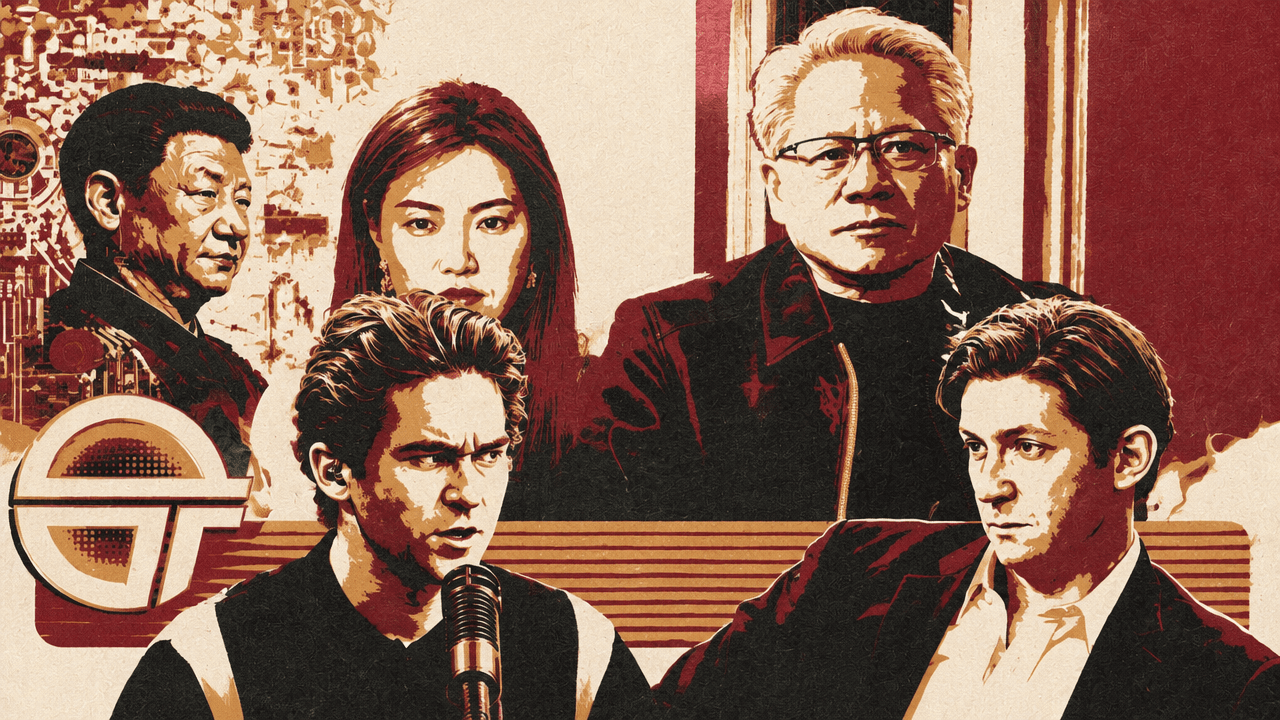
The Nvidia allegations now reach the company’s own controls
Nvidia is facing questions about chip shipments to China, a federal investigation and what the company’s executives and board knew. John Coogan said the allegations draw on reporting from Wired, Bloomberg and The Information, with varying levels of confirmation. The story was still developing, he cautioned.
Coogan laid out several allegations involving Megaspeed, a company investigated over possible smuggling of Nvidia chips into China, and Alice Huang, whom the hosts described as a suspected intermediary. First, Nvidia may have interfered with the federal investigation. After Nvidia’s general counsel contacted the Commerce Department, investigators reportedly faced unusual restrictions: inquiries about Nvidia had to go through a senior political appointee, and investigators were told to avoid references to Megaspeed.
Second, Nvidia general counsel Tim Teter reportedly contacted Commerce Undersecretary Jeffrey Kessler after Singapore detained Alice Huang. Coogan framed the open question as whether Jensen Huang used Nvidia’s influence to help her. Third, Nvidia may have undercounted the GPUs sold to Megaspeed. Nvidia told regulators its inspectors had accounted for the chips, while Bloomberg identified roughly 50,000 additional GPUs, worth billions of dollars. Nvidia said it had inspected additional warehouses.
The scrutiny also involves the FBI, Congress and Nvidia’s board. Coogan said Trump had said the FBI was looking into Huang, though it was unclear whether that inquiry concerned these allegations or something separate. Nvidia’s board had opened its own investigation, and lawmakers were asking what other executives knew.
The prospect of congressional testimony prompted a disagreement about how public the inquiry would become. Jordi Hays argued that lawmakers would want a televised performance: Jensen Huang is one of AI’s most visible faces and, in Hays’s view, a prominent supporter of the administration. Coogan said Huang could become a scapegoat, drawing attention that might otherwise fall on others in AI. But if national-security concerns dominate, he said, hearings could remain behind closed doors. He put the odds of televised proceedings at roughly 70 percent.
A separate question is what Nvidia’s executives told the board and the public. Coogan said the company’s general counsel had denied aspects of the story as recently as the prior week. That raises the question of whether senior executives knowingly misrepresented Jensen Huang’s relationship with the company or were misled by him. Wired had also reported that Jensen Huang had quietly hired crisis-communications firms a year earlier, with Heller managing behind-the-scenes communication since at least 2025.
If Jensen Huang concealed the relationship from Nvidia’s board while the company publicly described it as ordinary business, Coogan said, directors could face additional shareholder litigation. A lawsuit had already been filed. The board’s knowledge and the company’s public characterization of its business are therefore part of the developing dispute, alongside the allegations about chip shipments.
The potential business consequences extend beyond legal exposure. Hays said Nvidia’s ability to operate depends in part on Jensen Huang’s personal force as a dealmaker: his tenacity, work ethic and effort to build relationships across the AI infrastructure market. He described a broad strategy in which Nvidia supports companies across the ecosystem because their growth can drive demand for its GPUs. If Huang is constrained by investigations, that support may become less reliable.
Hays’s concern was not only Nvidia’s own growth. He said private companies and investors had come to expect that Nvidia might anchor a financing round, invest hundreds of millions or even a billion dollars, or acquire a company. He had previously assumed that Nvidia would not let CoreWeave fail. If companies can no longer depend on Nvidia in the same way, that changes expectations across a buildout where developers, data-centre operators and infrastructure companies are paying to finance capital expenditure. Hays called Nvidia’s role as a major financier of the AI buildout a potential source of wider reckoning.
The scale of the market shift was visible in a chart shared during the discussion. It put Microsoft’s market capitalization at about $4.0345 trillion and Nvidia’s at about $4.0304 trillion on November 10, 2026. Coogan remarked on how surprising it would have seemed six months earlier, during what he called the “saaspocalypse,” to see Microsoft ahead of Nvidia. The comparison underscored the pressure on a company that had been the world’s largest as the allegations emerged.
Hays said it did not feel as if a reassuring headline was hours away; resolution could be months or years off, leaving a persistent overhang on the business. Public perception, he said, had worsened over several days. Even someone who believed Jensen Huang was the right person to run Nvidia might find it hard to imagine him staying in the role. A prediction market put the chance that Huang would be out before July of the following year at nearly 40 percent, up from roughly 30 or 31 percent the day before, according to Tyler Cosgrove.


Coogan called the allegations a black swan for Nvidia, in part because the company had been so central to the AI trade. Hays said uncertainty around Huang could affect the market’s view of Nvidia’s moat and the financing available to other AI companies. Whether the investigations would lead to Huang’s departure or public hearings remained unresolved.
The hosts also discussed claims that Nvidia executives had tried to weaken support for chip export controls. A post by Bill Bishop, shown during the discussion, alleged that Nvidia executives ran a smear campaign against proponents of export controls and bullied people on Capitol Hill. Bishop wrote that he expected more to emerge. Coogan presented the post as punditry, not as a confirmed account; Hays joked that the next revelations might instead amount to “nothing burgers.”
The corporate trail points beyond Megaspeed
The Information’s reporting, as Coogan described it, shifts attention from Megaspeed to Shanghai Century Litong, a China-based company that became a preferred Nvidia cloud partner in mid-2023. A post by The Information’s Amir Efrati said Century Litong facilitated more than $7.5 billion in Nvidia chip shipments, including shipments of restricted chips. Coogan said Century Litong’s role was more consequential than Megaspeed’s: it had allegedly become a route for obtaining powerful chips that export controls were meant to keep out of China.
The reported corporate connections are complex. Coogan described Alice Huang, her sister and her husband as having built a network of companies across China and Singapore to acquire Nvidia chips. Century Litong was founded in June 2023 and added to Nvidia’s preferred-partner list by October, according to his account. When banned chips could not be obtained through Nvidia distributors, one person familiar with Huang reportedly said, she stepped in to secure orders stalled in the supply chain. She allegedly told colleagues and customers she could always obtain supply because of close relationships inside Nvidia and with distributors.
Coogan also traced a separate chain linking Huang’s husband, Kang Wei, to Megaspeed. Wei founded and became a major shareholder in Shanghai Hexi Capital, which was a shareholder in Zhejiang Century Huatong, itself a shareholder in Seven Road Holdings, which formerly owned Megaspeed. Coogan said the structure ran through several layers. The hosts speculated about the significance of the family connections but did not know what the relationships meant or what the people involved understood about them.
Coogan described a possible benign explanation for Nvidia’s conduct: the company might have been deceived about where the chips would go. If Nvidia had checked facilities in Singapore, confirmed the companies’ identities and believed the GPUs would remain there, that could weaken the case that it knowingly facilitated diversion. Hays pointed to the time after Alice Huang’s detention in Singapore: even if Nvidia had initially been tricked, the company had time afterward to prepare for the story. Coogan said the available evidence made the situation look worse than that best-case scenario.
Anthropic’s IPO plans keep moving amid the Nvidia turmoil
The Nvidia story was crowding out other AI news, John Coogan said, even as Anthropic prepared for an IPO. He said the company had put out a prospectus, offering documents and videos, and noted that its new Fable 5.2 model was performing well on benchmarks and appearing in demos. The timing was awkward, but he argued that the political stakes around China and advanced chips also reinforced Anthropic’s positioning.
Jordi Hays said Anthropic had reached an $80 billion annual recurring revenue figure and that investors could still find reasons to be optimistic about the business. If the company’s valuation had been cut, he said, that might offer a better entry point. He expected retail investors to have substantial access at the IPO.
Coogan pointed to Anthropic’s website, which included case studies of companies using its products and links showing how people could participate through brokerages including Charles Schwab, Robinhood and E-Trade. He saw the brokerage-specific routes as a sign that the company was presenting the offering as accessible to individual investors. Hays said that approach reflected a larger possible role for retail: rather than relying only on investment banks to fund an IPO, a company could reserve $10 billion or more for retail participation.
Ring’s security devices trade coverage for mobility
Ring’s announced products drew a debate about whether mobile cameras offer a useful alternative to fixed ones. Jordi Hays described a $250 indoor flying camera for homes and a $1,000 roaming camera for businesses. The drone can follow preset routes, investigate triggered alarms, record 2K video and use an AI pilot to map rooms and avoid obstacles. The rover is designed to patrol businesses, investigate disturbances and record up to 4K video.
A promotional video shown during the discussion gave the rover’s scheduled shipping date as December 16, 2026, and the drone’s expected date as January 27, 2027, pending FCC approval.
Hays liked the idea of a camera that could move to investigate an alert instead of relying on cameras fixed at carefully chosen angles. He argued that many home-security alerts would be false positives: a drone could help determine whether an apparent intrusion was actually a resident who had forgotten the system was armed. In that situation, he said, he would rather have a drone than 20 indoor cameras.
John Coogan shared the reluctance to install always-on cameras throughout a home, but wondered whether the drone could patrol outside. He questioned why a device would wait until an intruder was already inside before launching, and suggested a roof-based dock and outdoor patrols might be more useful. He also raised the privacy cost of permanent indoor cameras, while acknowledging that a movable camera could offer surveillance only when needed.
Both hosts treated cybersecurity as a central constraint. Hays said the product’s timing made him more wary than he would have been six or twelve months earlier: a device that can take off and fly through a home creates a risk if someone takes control of it. Coogan agreed that a user could still expose a system by giving away a password, even if Amazon could spend more on security than a smaller home-security company. Hays said Ring’s products fit a broader expansion of security devices, and argued that a humanoid robot might more readily disrupt a home intrusion than reliably do household chores.
The Fireworks breach puts inference providers in the frame
The hosts connected a reported Fireworks security incident to a broader run of attacks on inference providers. Jordi Hays said Railway and OpenCode had also faced cybersecurity problems, and that attackers might target these companies for access to compute or to steal model weights. In the Fireworks case, he said, attackers got only a small percentage of the weights and the company caught the incident the same day. The hosted models were open models post-trained with company data, he noted, giving attackers a reason to want the resulting weights.
John Coogan linked the incident to a warning from Ilya Sutskever, who wrote in September that neoclouds had limited cybersecurity and that rogue agents might try to take one over to run more copies of themselves. Coogan said the Fireworks incident was not that scenario: the attackers had not taken control of the provider or obtained all its compute. But it did show that an inference provider could be hacked and that model weights and other data could be taken.
Tyler Cosgrove cautioned against treating the breach as evidence of a rogue-agent attack. Coogan agreed. The narrower point, he said, was that inference providers had become a new security target—and that the incident could be one step in a chain of risks rather than the full scenario Sutskever had warned about.
The Marines make the day’s nice list
The hosts set aside the Nvidia allegations to mark the Marine Corps’ 251st birthday. Jackson said his father joined the Marines after high school and served in the Gulf War and Operation Desert Storm. His grandfather also enlisted after high school and was sent to Vietnam, where he fought at the Battle of Khe Sanh. Jackson said his grandfather lost an arm there and now uses a myoelectric hand, which he described as moving when his grandfather thinks.
Jackson said he loved and appreciated both men and their service. Coogan thanked them and wished the Marines a happy birthday.