AI Is Rewriting Trust, Discovery, and Company Formation
TBPN host John Coogan argues that AI is already changing the terms of work and competition, even where its broader economic consequences remain unsettled. He treats the backlash to Hank Green’s research use as a question of trust, OpenAI’s reported mathematical results as evidence that formally verifiable work may be especially exposed, and AI-assisted solo companies as easier to start but harder to defend. Meta, by contrast, is betting that ownership of models and infrastructure will matter more than renting the capabilities that smaller firms use.
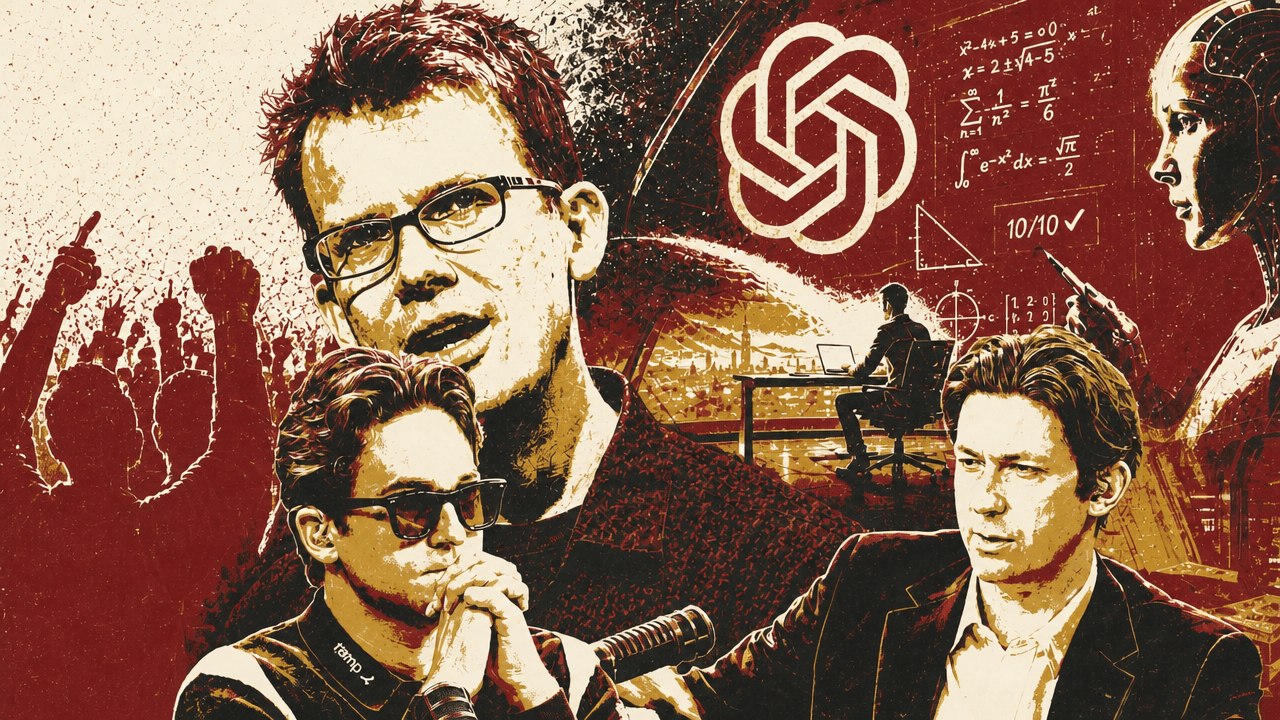
The backlash was not really about a script
John Coogan described the reaction to Hank Green’s use of ChatGPT for research as a small but intense backlash from a subset of an audience that Coogan said has long regarded Green as one of YouTube’s most trusted science educators. The accusation, amplified through posts over the weekend, was that Green had accidentally left AI-generated feedback in the script of an episode of Ask Hank Anything.
The supposed evidence was a line: “I appreciate the pushback.” Read in isolation, it sounded to critics like the kind of polite acknowledgment a chatbot might generate. Coogan’s account was more mundane. Green had been responding to a guest’s objection in a conversation; the final edit showed him speaking directly to camera, stripping away the context that made the phrase natural. The script itself, Green clarified, was not written by AI.
What Green did acknowledge was using ChatGPT as a research tool: finding original papers, pulling up PDFs, gathering quotations, synthesizing material, and converting units or formats. That distinction matters because Ask Hank Anything depends on post-production research. Green and a guest may encounter an unfamiliar question while recording; Green then has to investigate it and edit a substantive answer into the finished program.
Coogan’s position was that gathering links and quotations across the web is among the tasks current models are reasonably good at, even if they are not reliable for every part of a research workflow. The hostile response treated any AI use as disqualifying, often on the grounds that models hallucinate or undermine the human work of learning. But the practice Green described was closer to research assistance than outsourced authorship.
Still, Green said he was dissatisfied with aspects of his own AI use and might publish less. The concern was not simply error; it was the productivity treadmill. If AI lets a creator make more, they may feel compelled to make more, turning increased capacity into increased expectations. For someone who has built a durable media business over roughly two decades, Coogan suggested, the pressure to maintain that pace may be less necessary than it is for an early-stage creator.
The larger issue is trust. Coogan said he believed Green had a published policy describing how his company and employees use AI in different circumstances, but that apparent disclosure did not prevent a defensive public response. For science communication, the objection with the most force was not that AI is useless, or that every user is lazy or malicious. It was that AI use can reduce trust, “at least a little.”
A matrix shown during the discussion separated what it characterized as stronger and weaker arguments from both camps. Its central distinction was between a specific concern about trust and a blanket rejection of the tool. Coogan also noted bad pro-AI rebuttals, including the claim that criticism of generative AI is hypocritical because online comments and YouTube are also hosted in data centers. The scale and type of infrastructure involved, he argued, are plainly different.
That trust cost is not abstract, Coogan said, because mistakes and automated-text artifacts do make their way into research and public-facing writing. He cited an instance in which text from separate columns in a scanned PDF was combined during import, producing a nonexistent phrase that then spread through subsequent scientific references. The underlying failure may have involved optical character recognition rather than a language model in the narrow sense, but the example captured the broader concern: automated processing can introduce convincing-looking errors that propagate when people stop checking sources.
Jordi Hays added a practical complication to demands that researchers simply avoid AI: it is becoming harder to identify a cleanly non-AI research stack. Search engines themselves increasingly incorporate AI features. The boundary between using ChatGPT, using Google’s AI mode, and using conventional online search is neither technically nor culturally settled.
Coogan’s broader argument was that science education cannot permanently route around AI. If AI systems contribute to mathematical, scientific, and engineering advances, an educator who treats any AI involvement as inherently illegitimate risks being unable to explain much of what is happening. That does not eliminate the case for disclosure or careful source-checking. It does suggest that a science audience will eventually need a more precise standard than blanket opposition.
Formal proof is not the same as open-world intelligence
John Coogan put the Hank Green backlash alongside a much larger claim about AI and mathematics. Noam Brown of OpenAI posted that an internal version of Astra, described as OpenAI’s next major model family, had solved 10 major open problems in mathematics, quantum complexity, and theoretical computer science. Brown called it a potential major step for scientific reasoning.
The announced results included an exact determination of the asymptotic strength of the Cohn-Elkies linear program for high-dimensional sphere packing, as well as exponential improvements to classical upper bounds for fixed-distance binary and spherical codes. Coogan’s point was not to adjudicate the proofs, but to emphasize the scale of what Brown was claiming: the systems are being credited with work in domains where correctness can be checked rigorously.
Gary Marcus challenged that framing: “Wake me when Astra solves a significant open-world problem that doesn’t revolve around formal verification.” Daniel Eth answered that “the goalposts” were on “a completely separate planet.”
The disagreement turns on what the achievement is supposed to establish. Coogan agreed that AI performs especially well on formally verifiable tasks. But he argued that this is not a narrow or trivial category. Many economically valuable outcomes can be checked: whether a job was completed, whether a system works, or whether an intervention produced a measurable result. Formally checkable discovery may therefore matter a great deal even if it does not settle whether a model has the broad, open-ended competence associated with AGI or ASI.
Those labels will remain vague, Coogan said. More immediate is the prospect that technical systems can change the status of work before society has worked out what the change means for the people who do it.
Ryan Lowe shared an essay by University of Auckland mathematician Kerwin Hampshire, written before Brown’s Astra post. Hampshire did not offer a policy prescription. Instead, he described an emotional and spiritual response to what he saw as a new mathematical paradigm: “There is nothing I can do. There may be nothing you can do. I have no prescriptions, policy recommendations, or coherent call to action.”
Hampshire asked the “architects” of that paradigm to acknowledge shared humanity before delivering “the coup de grâce.” Coogan and Tyler treated that reaction as real, while questioning whether mathematics itself would become obsolete. Tyler’s view was that mathematicians teach as well as solve theorems, and that solved conjectures tend to create new questions.
Coogan agreed that new bottlenecks will emerge. The promise people attach to advances in abstract mathematics is not merely a longer list of solved theorems, but eventual consequences in materials science, chemistry, biology, and engineering—perhaps a practical gain such as batteries with much greater range. Whether that happens, and how quickly, remains unclear.
The Millennium Prize problems, including P versus NP and Navier–Stokes, remain landmarks in the public imagination of mathematical progress. Coogan’s underlying question was what follows if systems begin solving problems of that stature: new mathematical frontiers, a greater emphasis on application, or a different division of labor between people and machines. Technical capability and professional meaning are not the same question.
AI may make a company easier to start and harder to defend
John Coogan cited reporting on Ben Broca, who launched an AI-tools company in December, reached 10,000 paying customers, and was reportedly on track for $10 million in annual revenue without hiring another employee. AI systems handled email, coding and debugging, customer requests, subscriber sign-ups, and refunds.
Broca’s rationale for remaining solo was blunt: “I think compromises make lukewarm results.” The economic proposition is more complicated. He reportedly raised $30 million from investors and saved on engineering salaries, but initially lost money on many customer accounts because paying Anthropic for Claude usage was expensive. He later moved to free open-source models from China.
Stripe’s analysis found thousands of solo operators generating more than $1 million in revenue on its platform, with their ranks doubling from 2023 to 2025. The number crossing the $10 million threshold nearly tripled over the same period.
Jordi Hays and Coogan questioned how confidently Stripe could identify a business as truly one-person. A founder may report one employee when opening an account, then hire without updating the information; contractors, accountants, and collaborators may not appear as employees at all. A later explanation of the Stripe figure described it as a proxy based on use of products or integrations oriented toward solopreneurs, and said it probably undercounted the total. It was not presented as a direct census of every firm’s payroll.
The directional evidence extends beyond Stripe. The Census Bureau chart shown during the discussion tracks new information-sector business formations on a seasonally adjusted, three-month moving-average basis. It rose from roughly 8,000 in 2021 to above 12,000 in 2026. Coogan also cited a nearly 45% increase in new business applications in the information sector over the past year, while applications in that sector that anticipated hiring workers had experienced the sharpest decline among measured industries.
| Indicator | Reported change or level |
|---|---|
| Solo Stripe operators generating more than $1 million | Ranks doubled, 2023–2025 |
| Solo Stripe operators crossing $10 million | Nearly tripled, 2023–2025 |
| New information-sector business applications | Nearly 45% increase over the past year |
| Julian Weisser accelerator applications | 4,500 applicants for 10 slots |
The important divergence is that more people may be starting information-sector businesses while fewer new applicants say they expect to hire. That supports the possibility of more firms with fewer employees, but it does not settle what happens to aggregate work.
Rembrand Koning, a Harvard Business School professor cited in the reporting, asked what happens if each firm hires less but there are four times as many firms. A study he co-authored, examining 50,000 startups, found AI-focused startups operating with 25% fewer employees. That may mean fewer jobs per company; it may also coexist with more companies, faster growth, and new forms of work. Coogan noted that a soft hiring environment could itself be pushing more people to try entrepreneurship.
The cases discussed show why neither “AI replaces work” nor “AI democratizes entrepreneurship” is enough on its own. Samir Ahmad left a long corporate career at Verizon to start a solo coaching and consulting business, using AI to develop a plan and help with marketing. He called it a “chief of staff” or second-in-command. The business petered out within months, and he returned to a full-time corporate role.
Claire Vo used ChatGPT in late 2023 to help build an app for managing product documentation and design. She initially put it online for $1 a month and attracted thousands of downloads within weeks. Nearly three years later, after operating alone for nine months before hiring an engineer, the company reportedly had 100,000 users and was on track for seven figures in profit. AI handled marketing, sales, and customer support. But Vo’s qualification was central: people overestimate how easy AI makes the work and underestimate the network, credibility, and prior effort that made her position possible.
Another solo founder, Troy Johnson, captured the defensibility problem: “Everybody has the sword and we all have the ability to unsheathe Excalibur now.” If one person can build an AI-assisted product quickly, competitors may be able to copy it quickly too.
Coogan and others on the discussion raised a less flattering possibility. Building an AI business may sometimes function less like a durable job and more like a recreational activity: the entrepreneurial equivalent of generating images with Midjourney or songs with Suno. People can enjoy prompting, iterating, and watching a system produce something without becoming professional artists or founders. Yet that activity can also produce a real company. Whether these experiments become businesses, entertainment, or some mixture may only be clear after the fact.
Meta is spending to own the capability that solo founders rent
John Coogan framed Meta’s AI strategy as the inverse of the solo-founder model. A solo operator uses external models to avoid building organizational capacity: no engineering team, support staff, or large operating structure. Meta is making the much more expensive bet that controlling models and infrastructure is itself a strategic capability.
Mark Zuckerberg’s answer to an analyst question about relying on outside or open-weight models began with a simple claim: open-source models were not as strong as frontier models. Meta therefore needed to remain at the frontier with the intelligence it used. He also argued that dependence on another provider carries longer-term risk. A model can become unavailable, be affected by regulatory constraints, shift from open to closed access, or become much more expensive once its supplier has leverage.
Coogan thought that answer was incomplete, particularly against an Apple-style strategy of partnering with model providers where necessary. But Zuckerberg’s broader rationale was that Meta is not only a social-media company with an advertising business. It is a full-stack technology company that builds data centers, infrastructure, chips, and low-level software, and it believes models now belong in that stack.
Zuckerberg connected that view to Meta’s early technical advantage. Facebook, he said, worked quickly and efficiently when competing social networks did not. Vertical integration enabled the company to personalize and optimize products in ways that rivals could not readily match.
Coogan used Reels to make the infrastructure argument concrete. Building a competitor to TikTok at Meta’s scale was not simply a matter of adding a video interface. It required a large recommender system, substantial data storage, and enormous compute capacity. Meta built two additional data centers to support the Reels effort; without that capacity, Coogan argued, it could not have launched a comparable product on an ordinary timetable.
That logic creates a punishing near-term financial burden. Ben Thompson’s critique, quoted by Coogan, was that “the financial tail” was “wagging the dog.” Meta is effectively double-paying: spending on compute and research talent now while also committing capital to the data centers and infrastructure it expects to need later. The commercial case must eventually justify both bills.
Zuckerberg is not retreating from the bet. Meta’s position is that sovereignty over its models will be necessary for personalized, first-class products, just as control over infrastructure has been. Investors, Coogan said, remain skeptical because the company must show not merely that it can spend at frontier scale, but that its model and infrastructure spending produces durable product and financial advantage.