Google’s AI Assets Are Becoming a Product Coherence Problem
 Jordi Hays
 John Coogan
 Dylan Field
 Immad Akhund
 Brian CheskyMarcus Milione
 Feross Aboukhadijeh
 Tae KimTBPNWednesday, May 20, 202632 min read
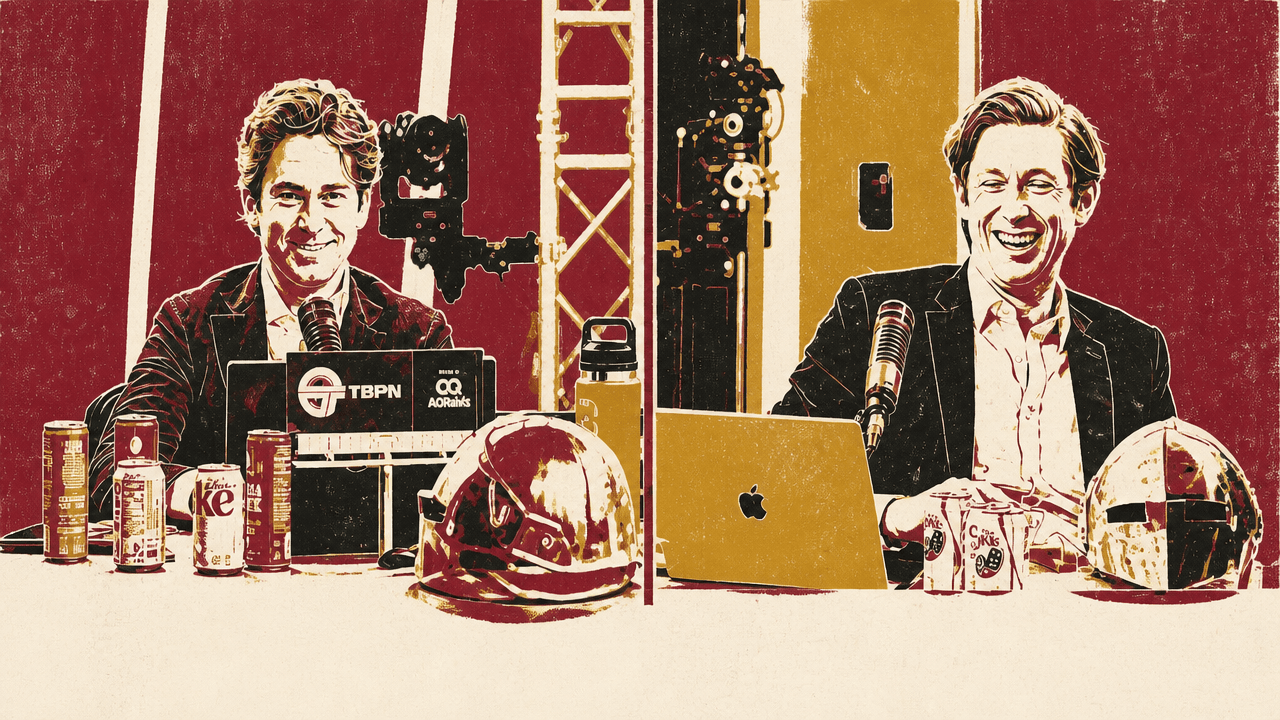
John Coogan and Jordi Hays read Google’s I/O as evidence that the company’s AI advantage is becoming a product-navigation problem: it has data, distribution, models and hardware partnerships, but its demos and product names left questions about coherence and pace. Across the source, that same pressure appears in more operational forms, as AI pushes companies to turn technical capability into usable workflows, secure software dependencies and faster product systems. Tae Kim’s Nvidia argument and the expected SpaceX IPO make the capital-market version of the question explicit: whether investors will keep paying for scarce infrastructure, extreme scale and growth curves that may take years to prove out.
Google’s AI advantage is turning into a product-navigation problem
Google’s I/O announcements produced two competing readings from John Coogan and Jordi Hays. Coogan saw Google showing real surface-area advantages: glasses that could eventually sit on top of Gmail, Docs, Drive, Workspace, and Android; generative video and simulation products that can draw on YouTube and Street View; and voice-driven AI experiences that point toward a less screen-centered interface. Hays saw strong demos, but also signs that Google’s research cadence and product cadence are not aligned cleanly enough.


The smart-glasses announcement made that tension concrete. Google said it was partnering with Samsung, Gentle Monster, and Warby Parker on “new intelligent eyewear,” with collections coming in the fall. The designs shown were black Gentle Monster sunglasses and thick-framed Warby Parker glasses branded with “Google | Samsung.” One reaction called the Warby Parker design “horrific looking compared to the Meta Ray-Band,” while Sheel Mohnot asked why Warby Parker’s stock was down nearly 14% after the announcement.
Coogan was less dismissive than the harshest timeline reactions. Meta’s Ray-Bans, he argued, have already done “the hard work of becoming the first face computer,” training people to look for a camera lens in thick frames. By contrast, the Gentle Monster silhouette did a better job hiding the camera and did not immediately read as wearable technology. That made the glasses more discreet, and potentially more socially complicated. The Warby Parker camera bump looked less integrated: the lens appeared to protrude from the frame rather than sit flush.
Hays treated eyewear partnerships as necessary because glasses are fashion objects, not just devices. Google and Meta need silhouettes other people already understand. Apple, in his expectation, would be more likely to make “Apple glasses” in its own design language, though Coogan noted a joke circulating that Apple had Carl Zeiss while Meta had Ray-Ban and Oakley, and Google had Gentle Monster and Warby Parker. The joke asked which company would be bold enough to put wearable technology into 3M safety glasses. Hays said he might prefer that direction: if he were going to wear a face computer, he would rather “commit to the bit” and go “full Cyberpunk.”
The deeper product question was not the camera bump. It was ecosystem access. Meta’s glasses have useful integrations with WhatsApp, Instagram DMs, and Messenger, but they do not sit on top of a full personal-productivity substrate in the same way Google or Apple can. Google has Gmail, Docs, Drive, and Workspace. Apple has Mail, iMessage, Files, camera roll, and device-level control. For an AI agent that is supposed to “run through your life,” those systems matter. Meta, in Coogan’s view, runs into more walled gardens when trying to do things beyond social communication.
The keynote’s most applauded glasses demo, according to a tweet from Allie K. Miller, involved Nishtha putting on Gentle Monster + Gemini glasses, tapping the side to summon Gemini, and giving one prompt: “take a photo and put a cartoon blimp in the sky that says Google IO 2026.” Within seconds, a preview of the edited image appeared on her watch. Hays called it “very cool” and “impressive technology,” especially as a voice-AI interaction. But he also preserved the criticism from Greg’s Gadgets that companies “truly have no idea what regular people want.” The demo illustrated the feature, but it did not obviously show a regular use case that people were already waiting for.
Google’s data advantage came up again with Genie 3. A tweet from Bilawal Sidhu said users could now simulate real-world places by grounding Genie 3 experiences with Street View imagery, adding that Google was sitting on “the mother lode of real world data.” Hays said he had already thought YouTube would be valuable for Omni and future Veo models, but had not fully considered Street View as a data trove. He described Demis Hassabis and several large technology CEOs as increasingly “data pilled,” and compared Street View to other valuable reservoirs of activity data.
The question for Genie 3 was what it becomes after the demo. Hays connected it to Hassabis’s background in games and to the broader return of simulation as a product category. But he separated graphics from game mechanics. Some games with AAA graphics hold attention; others with 2D graphics do the same. What matters is the mechanic. Genie 3’s Street View grounding could be a striking demo, but it was not yet clear what it would take to build a game on top of it, or whether Google would allow that.
The most damaging I/O reactions were around models and developer products. A tweet from Tenobrus called Gemini Flash 3.5 “pretty neat and extremely fast,” but “largely the sort of incremental progress we’ve come to expect from google,” and described I/O as “generally pretty disappointing.” Hays said Gemini 3 had felt like a new base pretrain, with “big model smell,” and many people seemed to expect Gemini 4 or at least a more meaningful model step. Instead, Google appeared to be dealing with a mismatch between conference scheduling and model readiness. Independent labs can launch when the training run is done; a large annual conference is fixed years ahead.
Developers’ reactions, Coogan said, were “not good at all” from what they were seeing. A Cursor Bench table from Theo placed Gemini 3.5 Flash at 49.8%, below Composer 2 at 52.2%, while costing $1.94 on the benchmark versus $0.56 for Composer 2. Coogan highlighted that it underperformed Cursor’s older Composer 2 while costing roughly four times more. Hays said Google had long seemed positioned as frontier or near-frontier with best possible pricing, and that this looked like a potential shift.
| Model | Score | Average cost |
|---|---|---|
| Composer 2 | 52.2% | $0.56 |
| Gemini 3.5 Flash | 49.8% | $1.94 |
That fed into a broader question: why Google has put so much capital and resources behind Anthropic. Coogan said the I/O reaction made that decision “make more and more and more sense.” Hays cited a post arguing DeepMind might be constrained by data rather than compute for what it wants to do, and that the rest of Google was “shipping their org chart.”
The confusion was not only technical. A widely shared Nathan Clark post, read aloud by Coogan, mocked the number of overlapping Google AI product names: Gemini, AI Studio, Gemini Business, AI Pro, AI Ultra, Spark, Gemini API managed agents, Jules, Anti-Gravity, Gemini CLI, Flow, Veo, Nano Banana, NotebookLM. Coogan called it a typical Google meme, but the critique was substantive. Google has enormous assets, but the user-facing map of those assets is hard to understand.
Anti-Gravity, Google’s agentic desktop product, became the clearest symbol of that problem. Gergely Orosz posted that the second minute of the Antigravity 2.0 launch video appeared to show a “Codex” folder in the Google team’s Finder window, asking whether anyone had double-checked the launch video. Coogan said it was not a huge surprise: Google uses a range of models and products internally, including Anthropic models, and many people thought Anti-Gravity looked like Codex. Hays said it looked more like Codex than Windsurf.
The resulting picture was not that Google lacks assets. It has distribution, data, models, hardware partners, and internal AI talent. The issue raised throughout the source was whether those assets are being converted into coherent products at the pace and clarity the market now expects.
SpaceX would make every other IPO look small
SpaceX’s expected IPO sat behind the market discussion as a test of how much public investors are willing to underwrite narrative, scarcity, and Elon Musk’s track record. A zerohedge tweet said a SpaceX prospectus could come “as soon as tomorrow” and that Goldman had the “lead left,” citing The Wall Street Journal. Hays noted that Michael Grimes had long worked with Musk at Morgan Stanley, making Goldman’s role notable. There had been speculation that such a large IPO might not have a traditional lead-left structure because all banks would want a share.
Katie Roof’s scoop said Founders Fund and Valor were set to make more than $60 billion each in gains on the SpaceX IPO, and Sequoia more than $20 billion. Hays emphasized how early and non-obvious those investments were. Founders Fund and others backed SpaceX in periods such as 2004 and 2010, before the Starlink narrative and before any “space data center” story. At that time, SpaceX was a rocket company blowing up rockets and not yet obviously becoming a massive business. “You really had to be a believer,” Hays said.
Coogan connected the story to a broader venture debate. Packy McCormick had quote-tweeted the return numbers with a mocking line about “mega funds” being too big to generate returns and merely collecting fees. In this case, the large funds were producing exceptional returns.
A Wall Street Journal visualization attributed to Nate Rattner made the IPO scale concrete. The screenshot carried a May 20, 2024 date, although the source context is 2026. Its text said SpaceX was looking to raise as much as $80 billion or more, making it the biggest IPO ever by funds raised. If the market value at offering reached $1.75 trillion, it would top the prior record for valuation of a newly public company, set by Saudi Aramco. The chart compared global IPOs since 2019 and showed ordinary blockbuster IPOs such as Airbnb, Arm, Rivian, Uber, and Porsche becoming visually small once Saudi Aramco and expected SpaceX numbers appeared.
Coogan said SpaceX would “dwarf them all” and make everything else look like a flat line. Tae Kim later supplied the skeptical counterweight: the IPO may be historic and still leave less upside for retail investors if the entry valuation is extreme. The market may be willing to underwrite Musk’s record of delivering for shareholders, but Kim wanted to see the S-1 before treating the valuation as justified.
Kim said the expected valuation looked “extremely, extremely high.” He acknowledged that early SpaceX investors saw things others did not — falling launch costs, Starlink’s emergence, a huge telecom opportunity — but questioned a $1.5 trillion to $1.75 trillion valuation based on the known Starlink revenue numbers. He said an Anthropic IPO would be easier to underwrite because the revenue numbers are more visibly scaling.
The tension was therefore not whether SpaceX is an exceptional company. The source treated that as almost assumed. The question was whether a public-market buyer entering at the expected valuation is buying enough upside, or mostly buying the privilege of owning a company whose private investors already absorbed the highest-risk years.
Figma is positioning design as the control layer above commoditized code
Dylan Field framed Figma’s new AI design work around a simple discipline: staying sane. The pressure around AI and design has produced what he called “rolling stages of AI psychosis.” Equity researchers see a model produce something that looks like days or weeks of work and panic. Designers and web designers see a prompt produce a site that looks superficially good and go through the same cycle. But, in Field’s telling, that first shock fades. AI-generated design is becoming easier to identify, just as AI text became easier to identify.


The entire market is just going through rolling stages of AI psychosis.
That observation is central to Figma’s product posture. A one-shot prompt can be useful for certain assets, but if a startup’s website clearly came from a one-shot prompt, Field said, that now communicates something about the company. The point is not that AI output has no value. It is that the cheap surface impression of competence becomes less differentiated as more people can produce it.
Figma’s Design Agent is meant to fit into that post-shock world. Field described two core uses: spawning agents to do explorations and variations, and offloading rote tasks such as design-system maintenance, variable-name changes, component updates, and text translation. The goal is not to replace taste with generated output, but to remove enough repetitive work that designers can “push aesthetic past AI slop,” push past cliches, and focus on real UX problems.
The analogy to coding agents is useful but incomplete. Software engineers using agents often get overcomplicated code, shaky foundations, or excessive scaffolding that may become hard to maintain later. In design, agents could theoretically generate large numbers of viewports, components, or variants that fall out of sync and become impossible to manage. Field acknowledged the risk but distinguished codebases from design files. In code, models can overclaim, make things up, and overcomplexify. In a design file, exploration is already part of the mode of work.
That does not mean design generation is free of structure. Design semantics matter: how a component is represented, how auto layout is applied, and whether generated work is clear and opinionated without getting in the user’s way. Figma has had to build evals around those questions. “The word of the year for us has been evals,” Field said, and probably for the industry.
He also resisted the idea that AI inevitably creates a pile-on effect. In products like Weave, AI outputs can be treated like clay. A one-shot generated output may begin weakly, but users can apply multiple models in a pipeline, use a canvas directly, define workflows, or collaborate back and forth with an agent to shape it. The tool creator’s responsibility, in his view, is to offer the right modes rather than forcing one interaction pattern.
The deeper creative opportunity is brand-building. Hays framed the hard part as the underlying idea: the concept and look that make a brand like Linear, Cursor, or Figma stand out. Once a system exists, AI could make it easier to apply that system across digital products, web, email, ads, and other surfaces. Field said Figma has done more so far on design-system maintenance than execution, but sees major work ahead in helping teams productionize the systems they create.
Field also described an “idea bank” or “content bank” that can grow over time and involve more people across an organization. Figma’s recent results, he said, showed more people using Figma inside organizations. He did not claim that non-designers will suddenly produce the final idea a company should ship. But he argued that bringing more voices and viewpoints into a canvas can improve the conversation, especially when designers and design leaders can still steer the process.
That steering function matters because people trust AI outputs more in domains they know less about. Coogan and Hays connected this to Gell-Mann amnesia: ask AI for something about a topic you know deeply and the flaws are obvious; ask about a topic you are just learning and the same output can feel authoritative. Field said people build judgment through comparative cases. Seeing strong examples next to weaker outputs, and understanding why one is better, helps build taste.
Organizations will also need to understand what is happening as more people prototype more things. A random exploration can look real. Teams need to know what has gone through a proper cycle and is ready to ship. Field warned against AI-induced tunnel vision: some models, especially for engineers, can become sycophantic and latch onto a user’s idea until the user feels they are making massive progress. But progress in the wrong direction is still wrong. “It’s really important to steer,” he said, “and to actually be building what you need to build.”
That is why Field did not present Figma as the only possible starting point for building. People should talk to users, clarify goals, understand the problems they are trying to solve, and sometimes begin in a sketchbook, a document, or a live conversation. Figma is useful because exploring an idea is a way of thinking it through. Once direction is clearer, Figma’s MCP can bring work into code or Make, and teams can move back and forth as building reveals more design questions.
The larger strategic claim was that, as code commoditizes, design becomes the layer where differentiation moves. “Design as the layer above code,” Field said, has become something of a meme, but he believes it is increasingly literal. The world Figma is building for is one where design representations and code representations live together, and teams do not have to choose between direct manipulation and AI or between broad exploration and fast progress.
AI is increasing software supply-chain risk faster than maintainers can absorb it
Feross Aboukhadijeh announced that Socket had raised a $60 million Series C at a $1 billion valuation, led by Thrive Capital with participation from a16z, Abstract, and Capital One. He described the company’s current position as an “overnight success that took four years,” driven by the convergence of AI, cybersecurity, and a rising wave of attacks.


The business, he said, has inflected sharply: more than 500% ARR growth over the prior 12 months. The reason is not one trend but three reinforcing forces.
First, AI is generating more code than ever. Developers and increasingly non-developers are pulling in open-source dependencies and third-party code at unprecedented speed. Counterintuitively, Aboukhadijeh said, more AI-generated code often means more third-party code, and that code is being vetted less thoroughly than before.
Second, frontier AI models are finding large numbers of high-severity vulnerabilities across major operating systems and open-source libraries. The vulnerabilities were often already there, but the models are surfacing them at scale.
Third, attackers have realized that the software supply chain is an efficient entry point. Instead of breaking into one company directly, they can compromise an open-source component and reach thousands of organizations that depend on it.
The burden falls heavily on open-source maintainers. Aboukhadijeh has maintained open-source packages for more than 15 years and said the community was already under-supported before AI. Maintainers now face low-quality AI-generated pull requests and issues, plus vulnerability reports from frontier labs. He credited the labs with often providing patches along with the bugs they identify. But even a patch is work. Accepting a pull request is not a one-time act; it means accepting responsibility for that code indefinitely.
That creates a failure mode: a vulnerability may be publicly visible, with code sitting on GitHub that can be used to generate an exploit, while the maintainer has not accepted the patch. Companies depending on the library may have no version they can safely upgrade to.
Socket’s answer is “certified patches,” which Aboukhadijeh described as a deterministic, one-click way to remove vulnerabilities in open-source dependencies without forcing developers to wait for upstream maintainers or change the rest of their application. Socket uses AI to produce patches that make the vulnerability go away. He said the company is giving critical patches to the community for free in an effort to disseminate them widely.
Companies are no longer broadly ignoring the issue. Aboukhadijeh said there are exceptions — he joked that Socket met one company that produced toilet paper and had no software product — but the issue has become nearly universal for software companies. Crypto companies were early adopters because supply-chain hacks can lead to irreversible loss of funds. AI labs and San Francisco technology companies followed. Now, he said, software supply-chain security is a top one or top two concern at nearly every company Socket talks to, often at board level.
The frequency of attacks has changed the sales dynamic. Aboukhadijeh said that at the end of Socket’s most recent quarter, the company was already busy, and then three major software supply-chain attacks happened on the same day. “It’s like more than we’ve ever seen,” he said, “and it’s totally unprecedented.”
On a reported GitHub issue, Aboukhadijeh declined to speculate. He said GitHub had not released enough information, though the timing of attacks means people now ask first whether a source-code leak or company breach came through the supply chain. A group called Team PCP had claimed responsibility for many attacks, but Aboukhadijeh was careful not to assert that connection for the GitHub incident. He also cautioned that many attacks still involve social engineering; attackers do not necessarily need huge compute resources or a nation-state-scale technical operation.
The Nvidia debate is less about this quarter than how long the growth curve lasts
Tae Kim argued that Nvidia and the AI memory supply chain remain structurally underestimated. When he was last on, around the market bottom in late March, he had “tripled, quadrupled down” on a CPU shortage thesis and named five CPU stocks and five memory stocks. Those ideas, he said, were up 50% to 150%, with 13 of 14 solidly in the green.


Kim’s memory-stock argument centered on high-bandwidth memory. He cited Michael Dell saying “25 times 25”: future Nvidia AI accelerators would have 25 times more memory per GPU, and there would be a need for 25 times more GPUs. Multiplying those two numbers, Kim said, implies a massive revenue opportunity for memory. Four years earlier, memory companies saw revenue cut in half and did not expand capacity; because adding capacity takes three to four years, he expects “mega pricing power.” He said people should not make fun of Korean retail investors buying memory stocks at single-digit P/E multiples while the companies grow at triple digits.
On Nvidia itself, Kim expected another strong quarter. Jensen Huang had said AI demand was far exceeding supply and capacity. Kim emphasized the scale: roughly 80% growth on an approximately $80 billion quarterly revenue base. He argued that Nvidia was trading at about 19 times forward earnings, below the S&P 500, despite growing vastly faster.
The market’s skepticism, in Kim’s view, comes from two beliefs: that AI demand is near a peak, and that competition from TPUs, Trainium, AMD, Intel, or other accelerators will erode Nvidia’s position. He said the competitive numbers people cite are “a rounding error” compared with Nvidia’s expected growth. Nvidia, according to Kim, has locked down memory, wafers, optical capacity, and other supply components. He said he met an optical startup founder at GTC who told him Nvidia had locked up laser and optical capacity. If customers want AI GPU capacity at scale, Kim argued, Nvidia remains “pretty much the only game in town.”
The “Nvidia is a car” analogy — whether Nvidia could eventually face automotive-style competition and margin pressure — did not persuade him. Even if Nvidia loses 10 percentage points of share, he said, it can still be 80% to 90% of a market growing 50% to 70% annually. Kim said hyperscaler capex numbers are moving from roughly $780 billion toward $1 trillion next year. Nvidia’s valuation, he argued, implies growth stopping within a year or two; he expects the overall market to keep growing fast enough that Nvidia’s numbers remain “insane.”
The upside catalyst he emphasized was buybacks. Kim compared Nvidia to Apple during the large-screen iPhone cycle, when Apple traded at a low earnings multiple because investors feared Android competition. Apple’s stock rerated as it began buying back stock in size. Kim said Nvidia had hinted it would return 50% of free cash flow over the next 12 months, though he wanted clarity on whether that was before or after supplier prepayments. If Nvidia puts a specific large number on buybacks, he believes the P/E multiple could rerate materially.
On supply constraints, Kim said TSMC’s tone had changed. Reading the company’s latest earnings transcript, he thought it was “pretty obvious” TSMC would raise capex at a different order of magnitude over the next few years. He also said Huang had sounded more confident that component issues would ease over two to three years. Hays pushed back that even if capacity triples over two years, that may still be a speed bump if people expect 10x growth or half an order of magnitude annually. Kim answered that the market is not pricing 10x growth; it is pricing something closer to 10% growth. If Nvidia grows 50% for the next two or three years, he said, the stock can go much higher even without fantasy numbers.
China, Kim said, should be treated as incremental upside, not a core part of the thesis. He had “given up on China” after repeated back-and-forth over export approvals and bans. The status quo, in his telling, is that Nvidia cannot reliably sell to China. Even if restrictions ease, he said, the allowed volume is no longer the huge number it once might have been.
Kim was negative on Google after I/O. His key criticism was that Google is nearly absent from the coding-agent market, which he described as the segment growing exponentially and doing real enterprise work. In his telling, Anthropic and OpenAI are getting the attention and revenue while Google Anti-Gravity is “nowhere to be found.” Google Cloud may be doing well, but strategically he warned that Google risks letting Anthropic and OpenAI become the power centers.
Kim compared the dynamic to Yahoo using Google for search and Netscape sending traffic to Yahoo. In both cases, a distribution partner helped create the company that later became more powerful. If Gemini loses the market while Anthropic and OpenAI get the revenue, usage, and feedback loops, Kim said, Google loses power in the tech ecosystem.
On Meta, Kim was more constructive. He said the company’s core advertising business remains durable, with strong growth and profits, and may be more durable than Google Search as search quality declines and more traffic shifts to AI chatbots. Even if Meta falters in frontier models, he said, there is enough demand in the AI cycle that a fallback could be selling compute capacity to the highest bidder. He would not count Meta out.
Nvidia’s results landed inside the source as the financial version of Kim’s argument. Coogan read that Nvidia revenue rose 85% to $81.62 billion from $44 billion a year earlier, and net income rose to $42.96 billion from $18.8 billion. Huang described the AI-factory buildout as “the largest infrastructure expansion in human history” and said agentic AI had arrived, doing productive work and generating real value. Coogan objected to the “AI factory” terminology but not to the substance: Nvidia had delivered another enormous quarter.
Mercury is building for a world where the business interface may be an agent
Immad Akhund announced that Mercury had raised $200 million at a $5.2 billion valuation in a Series D led by TCV, with a16z, Coatue, and Sequoia participating. The company’s recent growth, he said, was driven by a large increase in business formation and by companies using AI to start or operate more efficiently. Applications in Q1 were about 2.5 times the prior year’s Q1.


Mercury’s growth remains mostly organic, and Akhund said the organic share is increasing even as the company scales. One new channel is LLM recommendations. If someone asks a model what bank they should use for a startup, Mercury is often the answer. Akhund said there is now a field called GEO, focused on optimizing for LLMs, but he thought the main driver was simpler: if people recommend Mercury on Reddit, X, and elsewhere, that content feeds the model.
The more interesting question is what happens after recommendation. Mercury launched an MCP in December and a Mercury CLI about a month before the interview. Akhund said usage of those tools is “through the roof,” with people connecting Mercury to Claude Code, ChatGPT, and another AI tool or workflow whose name was unclear in the transcript. If someone is running a business through AI, being able to create an invoice or approve a payment within that workflow is powerful. Akhund argued there may be a flywheel: if a company builds tools that AI can use well, AI recommends those tools more often.
Mercury is not choosing between polished dashboards and APIs that let users pull their own data into custom interfaces. Akhund said the answer is both. Mercury is improving its API and CLI surfaces while also building first-party AI products. Mercury Insights summarizes transactions, gives AI insights, and lets users talk to their transaction data. Mercury Command, planned for later in the year, is meant to handle complex workflows such as: “I just hired someone, set them up in payroll and create a card.”
Akhund said he does not know exactly where interfaces are going. Maybe everyone will use AI assistants for everything; maybe the future is a combination. But if expectations change, Mercury wants to widen the gap between its experience and incumbent banks. AI, in his view, has a “decluttering effect.” Interfaces tend to accumulate complexity over time, but an AI layer can personalize around the user’s problem rather than forcing them through feature-specific menus. The future interface is less “click this payroll feature” and more “help me make payroll.”
Stablecoins, Akhund said, are most important for global payments rather than replacing the U.S. banking system domestically. Within the United States, wires, ACH, cards, and bank accounts work reasonably well. Internationally, or for users outside the U.S. who want a stable currency, USDC and other stablecoins are more compelling. Mercury does not currently support stablecoins natively, but many customers use stablecoin services, and Akhund expects Mercury to add at least payment features based on stablecoins for international use cases.
Payroll fits Mercury’s broader ambition to become the place businesses run most of their finances. Mercury is best known for banking, but it also has a corporate card, bill pay, and invoicing. The company acquired Central, an AI-first payroll company with workflows in Slack, and plans over time to make payroll a fully integrated Mercury product. Akhund said payroll is a large category and that current providers often require money to sit around for days before reaching employees.
He was more restrained on using AI as an excuse to expand into every financial product category. AI accelerates software development, but it does not automatically make lending or underwriting dramatically faster. Mercury wants to talk to customers and build what they actually need rather than inventing products in theory. Still, he said AI is already accelerating new software launches inside the company.
On angel investing, Akhund rejected the idea that a hype cycle should cause him to speed up deployment. He said he may be “old school,” but when valuations and hype are highest, investors should not accelerate. There are real reasons for excitement and real companies being built, but he expects it will be more fun to deploy after valuations come down. He pointed to 2022 and 2023, when many investors stopped deploying even though the same companies were available at large discounts.
Airbnb wants to become the operating layer for travel, not just the booking layer
Brian Chesky presented Airbnb’s new releases as the beginning of a faster product era, not a collection of travel add-ons. Grocery delivery, airport pickups, car rentals, boutique and independent hotels, a hotel price-match guarantee, luggage storage, and other services all sit under the same thesis: Airbnb should expand from booking a place to stay into coordinating more of what happens around the trip.


The operational claim underneath that strategy is that Airbnb rebuilt its foundation. Chesky said the app consumers see is maybe 20% of Airbnb; most of the work happens in the real world and in host-side systems. The original company was built for homes, not for a broader set of travel services. He compared the work to Amazon moving beyond an ISBN-based bookstore into primitives that could support many product categories.
The payoff is speed. It took Airbnb 16 years to expand beyond homes. It took two years to develop services and experiences. It took eight months to develop groceries. It took two months to develop luggage storage, airport pickups, and car rentals. Chesky said Airbnb can now sometimes take an idea from conception to market in weeks. Eventually, that should mean announcing dozens of things a year rather than one or two.
Car rentals show both the obviousness of the strategy and the difficulty of executing it. They are a natural extension of a trip booking, but Chesky said Airbnb had tried multiple times to expand beyond homes: in 2012, again in 2016, and then in 2019 before the pandemic forced the company back to its core business after losing 80% of revenue in eight weeks. The issue was not lack of ideas. During hypergrowth, most of the organization was occupied keeping the lights on.
The supply model will vary by category. Car rentals will involve multiple partners because no single provider covers every geography Airbnb serves. Chesky said Airbnb is in nearly every country except places such as North Korea, Iran, Syria, Russia, Belarus, and perhaps one other. For luggage storage, Airbnb can integrate with providers such as Bounce, which has 15,000 locations. For some other services, Airbnb may need to build first-party supply with its own hosts because the service does not exist.
Chesky framed Airbnb as a way to increase utilization of underused assets. Homes were the starting point: he originally could not afford rent, so he shared space. But the same logic can extend to cars, boats, equipment, and people’s time. Coogan noted that cars are financially different from homes because they depreciate rather than appreciate, making car sharing a different supply-side equation. Chesky agreed that the point was important, but said the broader thesis remains: empty capacity can be monetized, and ownership can become cheaper when assets are shared.
Services and experiences have power laws by category and geography. Chesky said three service categories have been breakout hits: photography, chefs, and massage. Vacation photography solves a simple problem: families want everyone in the picture and do not want to hand a phone to a stranger. Chefs work especially well in places like Tahoe, where houses have large kitchens and restaurants may be limited. Massage is popular in vacation and villa destinations. Beyond those, demand varies by location.
Experiences depend on how familiar the traveler is with a city. First-time visitors want landmarks. Second-time visitors want food. Third-time visitors want inside access. Locals want something different still. Chesky said Airbnb did not fully appreciate that nuance the first time around. He now believes services and experiences become much larger when people book them in their own city; that could expand the addressable market by a factor of 10.
Airbnb’s advantage is partly that many local-service marketplaces struggle to become global. A massage app in the United States may not help a traveler in Korea or Brazil. A chef marketplace may face both local fragmentation and disintermediation once a customer trusts a provider. Airbnb can aggregate demand and, in Chesky’s framing, become an international expansion strategy for service providers that would otherwise have to build country by country.
That does not mean every interaction must be heavily monetized. If someone books a repeat local service, Chesky said Airbnb may not want to charge a 15% or 20% commission. Maybe the commission is very low, or nonexistent. Airbnb can add value, deepen the relationship, and make money on higher-value assets elsewhere. Coogan called the concept a “concierge for the world,” a phrase Chesky immediately liked.
Events remain central to Airbnb’s growth. Chesky said the 2024 solar eclipse produced a visible heat map of bookings along the eclipse path. The Taylor Swift Eras tour could be followed through Airbnb data. The Paris Olympics brought 700,000 Airbnb stays, and Milan-Cortina brought 200,000. The coming World Cup in Mexico, the United States, and Canada is expected to be the biggest event in Airbnb history.
Events also create hosts. Chesky said many people list their homes for a single event, intending to host once. About half continue hosting. That phenomenon was crucial to Airbnb’s existence: people who do not think they want to host try it, make money, discover it is not strange, and keep doing it.
Personalization is the other layer of the travel operating system. Chesky argued that the current internet model is mostly inference: apps watch what users click, book, and view, then predict what they want. He expects agents to change that because agents ask questions. A travel concierge that did not ask questions would be strange. The social contract changes when the app becomes conversational.
But he also wants a clearer preferences system. Airbnb is designing a preferences panel that shows users what the company knows about them, lets them edit or add information, and specifies who can see it. Some information could be shown to hosts, some only to an agent, some vaulted so no human can see it, and eventually some encrypted. Chesky said most companies neglect or obscure privacy pages, but that erodes trust. Airbnb wants users to understand why information is collected, where it goes, and how it is used.
A bootstrapped running brand is trying to keep scarcity human
Marcus Milione described Minted New York as a company that began from boredom, taste, and repetition rather than a traditional DTC playbook. During COVID, while working in commercial real estate debt at a regional bank, he started posting on Instagram and TikTok about fashion and fitness. TikTok was still largely a dancing app, he said, and he stood out by trying to provide value rather than follow dance formats.
The growth came from reps. Milione told himself he would make three short-form videos a day for 365 straight days. With enough volume, analytics began to show what worked, and he iterated. Instagram was more outfit photos; TikTok was more phone-in-front-of-face talking. The brand grew out of that audience.
The business became real when a drop compressed three months of planned validation into five minutes. About eight months after starting in January 2021, Milione and his father agreed on a revenue target for the next three months. If Minted hit it, he would quit his job. The next release hit the target almost immediately.
The model was still precarious. It was drop-based, so revenue arrived in spikes rather than paychecks. Milione said every drop involved running the bank account down to zero on production and hoping it worked. The following Christmas, 12 months in, Minted had its largest release to date. The number on the screen stunned him, but the inventory was in his parents’ garage. He expected shipping to take two days. With his parents and siblings helping pack orders, it took six days and may have ruined Christmas.
Running became both a personal discipline and a brand axis. Milione said he started running like many people do: by signing up for a half marathon, setting a time goal, and getting pulled deeper into the “sickness” of racing. Because Minted makes performance running apparel, he felt he needed “half respectable times.” He does not expect to be elite or sub-elite, but he wants to show he puts in the work.
The brand’s Saucony partnership began in late 2022. Jason at Saucony reached out about a lifestyle shoe, because Minted at that point still sat more in menswear, jewelry, and lifestyle than performance running. When Milione visited Saucony in Boston, he pitched the idea that they should also do a running shoe because Minted runs and makes performance apparel. The relationship produced lifestyle work first, then running shoes, including two performance releases.
Minted remains bootstrapped in year five. Milione acknowledged that bootstrapping caps what the company can do and how big certain moves can be, but he wants the brand to be as big as possible globally. Going slowly and building a strong foundation, he said, is not bad. The lack of outside funding may even be a useful handicap.
The contrast with earlier DTC brands was explicit. Coogan mentioned Allbirds pivoting into a neocloud structure and Everlane selling to Shein as examples of the limits of venture-backed, high-growth consumer apparel. High growth, he suggested, may be at odds with building a lasting consumer lifestyle brand. Milione said Minted does very little advertising — “99.5 percent organic” by his estimate — and that feels like a stronger foundation than turning on the Meta ads faucet. Paid advertising can come later, when there is already brand awareness and real affiliation.
The latest drop also showed the operational burden of hype. The shoe release attracted bots, as the prior Speed 4 release had. This time Milione asked current or former botters on Twitter to help him understand how to jam them. He created two decoy product listings with the correct naming structure and metadata that bots would look for. The real listing, marked visually with a green border, contained none of the real terminology associated with the shoe in the listing or metadata. The decoy shoes were set to weigh 10,000 pounds, causing checkout to fail because no shipping rate could be generated.
He estimated that 99% of orders were manual, and bot orders were easy to catch and cancel. The problem is structurally strange: scarcity and resale demand are a blessing for a brand, but the company captures no benefit from shoes reselling at two or three times retail. The goal is to get product to the people actually building the brand. Milione said raffles are an option, but sneaker buyers often find raffles less fun. First-come, first-served releases preserve the feeling that if a real customer enters card information and gets through the captcha quickly, they earned the shoe.
Minted’s team is still only three full-time people, with Milione’s sister part time on customer service. Manufacturing is distributed: performance product in China, Saucony shoes through Saucony’s Indonesia factory, jewelry in Italy, and other partners elsewhere. Milione would like to bring more production to the U.S., but switching factories is not agile; it requires resampling and reproduction.
The more immediate goal is to catch up to the fashion calendar. Minted has been behind since day one, sometimes releasing hoodies in August. Milione said it feels bad, even if it means less competition for attention. For performance running, the calendar is less rigid than fashion’s runway cycle, but seasons and events matter. Spring, summer, fall, and winter releases are enough for much of the business, but products tied to World Marathon Majors require planning around October and November. The company is still learning to align product, weather, training cycles, and demand without losing the organic scarcity that made people care.