Anthropic’s S-1 Shows $67 Billion Revenue Run Rate and Rising Margins
Anthropic’s S-1, as described by TBPN hosts John Coogan and Jordi Hays, shows a fast-growing company whose improving margins and falling compute costs are set against hundreds of billions of dollars in long-term capacity commitments. The hosts argue that the commitments are less alarming when viewed across their multiyear terms, but say the filing leaves unresolved questions about demand, the sources of revenue tied to terms-of-service violations and the founders’ plan to retain 50.1% of voting power after an IPO.
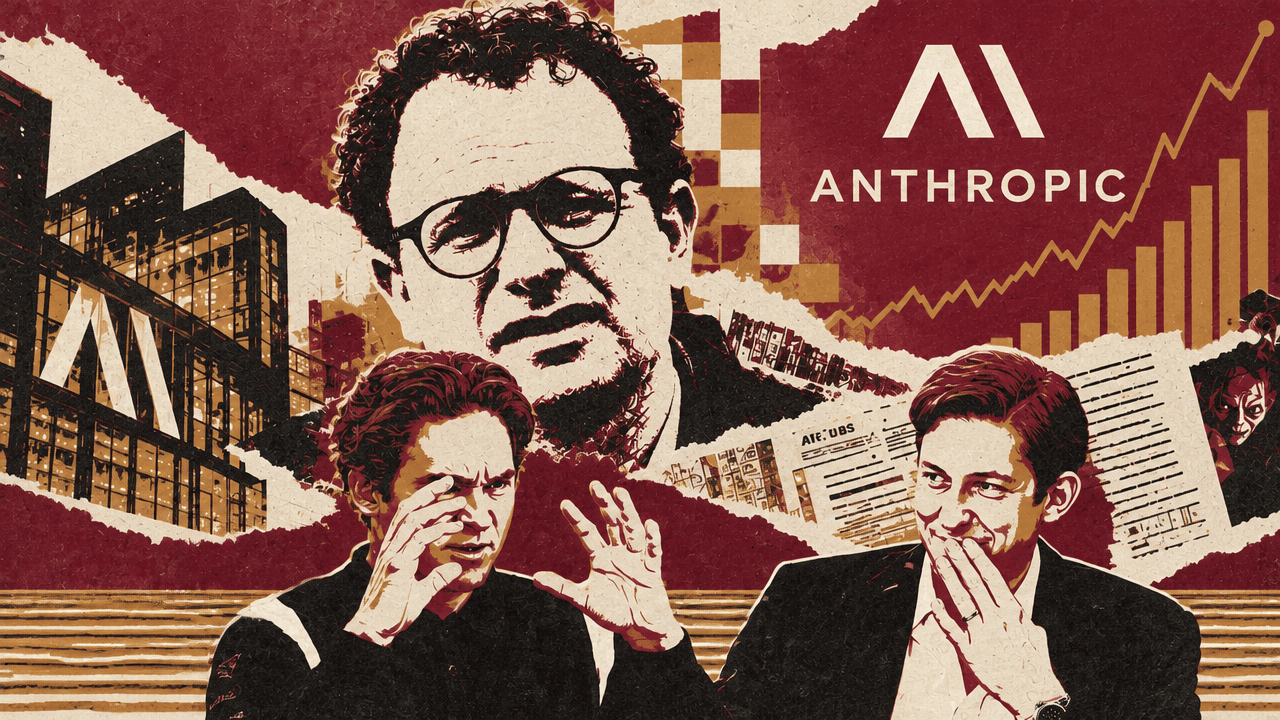
Anthropic’s growth is outpacing the cost of serving it
Anthropic’s S-1 puts large numbers behind a fast-growing business. John Coogan said the filing reports $67.2 billion in annualized revenue, up 45% quarter over quarter, and $131.7 billion in cash on hand. The exact size of the IPO raise was not disclosed; a roughly $100 billion offering was speculation reported by the Wall Street Journal.
The financial picture looked stronger than some investors expected. Jordi Hays said a leak a week or two earlier had focused attention on an $80 billion accounting charge, but the filed numbers gave people a chance to look past it. Coogan said the filing appeared to meet or slightly beat expectations: it did not reveal a radically different business, but showed continued growth and a company performing well. Hays also noted that investors and analysts were pulling details from the filing in real time, rather than waiting for a conventional analyst review.
Compute costs were falling as a share of revenue. Coogan said they had declined from 72% to 48%, while adjusted operating margin rose 32 percentage points quarter over quarter, from negative 13% to positive 19%. He also cited nearly $1 billion in GAAP profit. The hosts connected the improvement to Anthropic’s rental-first approach to compute. Coogan said the company spent $482 million on capital expenditures in the first half of the year—less than half a billion dollars—while renting capacity from cloud providers and taking on large multiyear spending commitments.
The scale of those commitments drew attention, though the total was not consistent across the discussion. Coogan initially referred to about $690 billion, then later added commitments across Google, Amazon, Microsoft, SpaceX AI, Nscale, Lambda and Broadcom to reach $637 billion. The discussion did not resolve the difference between those totals. Coogan emphasized that the arrangements extend over years, with some running to 2036. He cited Google Cloud at a minimum of $114.5 billion through July 2033, AWS at $110 billion through 2036, and Azure at a minimum of $45 billion through 2033. The hosts argued that the duration matters: the headline totals are not all immediate spending, and Anthropic has time to grow into the capacity it has contracted for. Coogan asked whether the company could find demand to use roughly $20 billion in compute spending each year over the next six or seven years; this was a question, not an established annual spending figure.
Customer figures suggest that spending has expanded within Anthropic’s existing base. Coogan said more than 10,000 customers spend over $100,000 a year, and net revenue retention among those customers is 900%. He described that as organizations that adopted early increasing their spending roughly tenfold as use spread from individual adopters to marketing, operations and other teams. More than half of the Fortune 500 spend over $100,000 annually with Anthropic. Coogan said he had expected that share to be higher.
Hays recalled hearing from a senior person at one Fortune 500 company that employees had access to a basic Gemini product as the organization’s standard AI tool. Large companies may therefore be using AI without spending heavily across every provider. The hosts’ surprise at Anthropic’s Fortune 500 figure reflected that distinction: broad use inside a company does not necessarily mean broad spending across vendors.
The filing narrows the distillation estimate without identifying its source
The S-1 also sharpened debate over revenue associated with violations of Anthropic’s terms of service. Coogan said a figure of 5% to 7% had circulated after the investor day as an estimate of revenue from distillation: using one model’s outputs to train or improve another. Hays contrasted that with online claims that distillation accounted for half of Anthropic’s revenue, which he dismissed as implausible.
But the filing, as Coogan described it, groups distillation with a broader category: revenue associated with terms-of-service violations. That category could also include prohibited uses such as adult content, cybercrime, hacking or biological-weapons development. Coogan thought distillation likely accounted for most of the amount, given the volume of tokens involved, while noting that the filing does not break out the sources.
Even at the lower estimate, the hosts found the scale notable. Coogan described organized operations spending heavily to obtain model access and resell or use the outputs, rather than isolated individuals abusing a few accounts. The figure they discussed indicates meaningful revenue associated with prohibited use; it does not identify how much came from any one activity.
A different operating detail cuts against the growth story: a seasonal dip. Coogan said Anthropic expects API consumption—and therefore revenue—to fall about 20% in the last two weeks of December as engineers, startups and other customers take holidays. The Christmas framing was a running joke, but the seasonal reduction in token use was presented as a real business effect.
Seven founders would hold a majority of voting power
Under the voting structure described in the S-1, Anthropic plans to issue one share of Class F common stock to a limited liability company whose seven co-founders would initially be its sole members. Hays read the filing’s statement that the founders, as a group, are “distinctly equipped to be stewards of our mission.” The filing says the share would carry 50.1% of total voting power on general stockholder matters, including the election of directors other than the Class T directors, and would have no economic rights.
| Structure | What the filing says |
|---|---|
| Class F share | One share issued to the Founder LLC |
| Initial members | Anthropic’s seven co-founders |
| Voting power | 50.1% on general stockholder matters |
| Economic rights | None |
The arrangement would allow the founders to retain collective control even if their financial ownership fell. Hays compared the logic with Mark Zuckerberg’s position at Meta: founders could sell down their economic stakes without giving up the decisive vote. He described the structure as allowing the founders to retain control even if they eventually owned very little of the company.
The single share also obscures how the founders reach a decision. Hays noted that the outside world might see one vote even if the founders were divided internally, perhaps by a four-to-three split. Coogan raised questions about the Founder LLC’s internal voting rules and succession. The filing details they discussed did not explain how the LLC would handle a founder’s death, divorce or inheritance, or how it would interact with an independent board that Coogan said includes Ben Bernanke. The hosts did not settle how the arrangement works in practice.
They also wondered about the Class F share’s value. Coogan reasoned that a share with no economic rights could still confer control over a valuable company, and asked whether it could have a market value despite being described as having no economic rights. Hays suggested the operating agreement might prevent the share from being transferred or sold; Coogan raised the possibility of a forward contract. Those were questions, not details the hosts said were answered in the filing.
The IPO’s scale remains uncertain, while $2 trillion is in the conversation
The ticker is ANT, but the raise and valuation were still uncertain. The IPO was rumored to be seeking around $100 billion, while estimates of valuation ranged from $1.5 trillion to $2 trillion. Coogan said $2 trillion seemed possible, though the number could still change. He said the offering should happen the week of November 16. At that scale, he argued, whether existing holders were diluted by 5% or 7% would matter less than the size of the raise and the cash it would add to Anthropic’s balance sheet.
A figure cited by SemiAnalysis prompted a discussion of capital efficiency. Hays read from the account that, as of June 30, 2026, Anthropic had raised $141.1 billion and held $112.4 billion in cash and cash equivalents plus $19.3 billion in short-term investments. Separately, Coogan had cited $131.7 billion in cash on hand. The hosts did not reconcile the figures. Hays said the SemiAnalysis figures meant Anthropic had burned $9.8 billion; the displayed post put the figure at $9.7 billion, while the hosts also cited operating profitability in the June quarter. They described the company as scaling rapidly without consuming most of the capital it had raised, but did not settle on a single burn figure.
The filing also included a risk factor concerning catastrophic outcomes from advanced AI. Coogan said the market appeared to have digested it: investors had discussed these scenarios for a long time, and he did not think the disclosure changed how they would underwrite the company. Hays noted that the risk was not presented as a cost line. Coogan said he did not see a line item for AI safety spending, while allowing that he might have missed it. He wondered whether safety costs or staffing commitments were reflected elsewhere in the figures, given that the filing raised catastrophic scenarios as a risk. The hosts could not identify a specific line item in what they were discussing.
The marketing line offered another measure of the company’s expansion. Coogan said Anthropic spent $2 million on marketing in 2023, $568 million in 2025 and $3.17 billion in the first half of 2026. He wondered what the earliest spending had paid for. Hays pointed to the contrast between a company often described as opposed to advertising as a business model and one spending billions to market its own products.
One early investor’s position stood out in the $2 trillion scenario. Hays cited a breakdown of Spark Capital’s investments, from a $75 million Series C investment in 2023 through later rounds, including $440 million in Series H. The total was about $777 million. At a hypothetical $2 trillion valuation, the position was estimated at roughly $18 billion; the Series C investment alone was marked at 131 times. Hays called it an exceptional return built on early conviction and follow-on investments, and noted that Yasmin was the only venture capitalist on Anthropic’s board.
A reported white-hat effort raises questions about vulnerability rewards
Hays summarized a Washington Post report that a group of former Department of Government Efficiency cyber researchers used AI agents to access Anthropic systems in less than 12 hours, including Slack channels where sensitive models were discussed. He said the group, known as Cathedral, appeared to have intended to publish the finding around the IPO. Coogan called it an important story but said the S-1’s financial disclosures were overshadowing it.
Coogan characterized the effort as a white-hat, safe-harbor hack, distinguishing it from a malicious attack. That led to a debate about whether bug bounties should be much larger. Coogan said he did not fully understand the scale of potential economic damage from vulnerabilities, but argued that if a failure could take down the grid or disrupt banking infrastructure, the resulting losses could reach billions or hundreds of billions of dollars. He compared the possibility of a major disruption to a COVID-like economic shock and said the incentives to find and disclose vulnerabilities should reflect the potential damage.
He floated a government-backed bug bounty in the range of $10 billion to $20 billion, invoking the scale of a government technology deal as a comparison. He also said the AI labs already had an incentive to compete to be seen as protectors, citing their security efforts as a way to help address vulnerabilities and earn public-relations benefits. A much larger program, he suggested, could move the needle further.
Hays warned that a bounty on that scale could create hazards of its own. He pointed to people selling courses on how to get a first white-hat bounty and raised the prospect of inexperienced researchers using poorly constrained models to probe sensitive systems. More testing could find more vulnerabilities, Coogan countered, but Hays emphasized the risk of exposing sensitive data to people with little experience handling it. They did not settle the question. Coogan suggested limiting eligibility to big companies; Hays’s concern was that broad incentives could bring unpredictable participants into the process.
Smart TVs are hard to defend when the basics are already frustrating
The Samsung TV discussion began with a preference for a product that Hays said was difficult to find: a television that is simply a display. He wanted a panel that turns on, looks good and offers essential picture controls, without built-in streaming, ads or features most owners do not need. Smart TVs, he argued, are often slow and burdened by updates.
The privacy concerns came from posts by an X account, log4j, describing an examination of a Samsung TV. In one post, the researcher said the TV loaded a region-specific neural network that tracked in-app activity, including which YouTube videos a person watched, which ads they skipped and how far they progressed. Another post described facial-recognition code and software scanning app windows for bounding boxes. Hays said it was unclear whether the facial-recognition code identified people appearing in content or served another purpose. Coogan thought it might be watching the people in the room.
Hays argued that television makers face less privacy scrutiny than companies such as Apple or Meta, even as televisions gain connected features and collect information about viewing. For him, the problem is not only data collection. A device meant to display a picture can also be slow, ad-supported and dependent on ongoing updates. A simpler TV, he said, would avoid much of that.
Instagram wants clips to lead viewers into the full video
Instagram’s test of longer horizontal videos, called Features, points toward competition with YouTube over viewing time. The announcement described a platform that wants users to watch both 90-second and 90-minute videos, with Live content in the Reels tab and a hub for episodic Series. Coogan welcomed the competition and said he would be interested to see how YouTube responds.
The more consequential idea, in the hosts’ view, is linking a short clip directly to the full-length video at the point where the clip occurred. Coogan said clips can prompt an emotional reaction without sending viewers on to watch the full program. Hays put the conversion rate at “two basis points.” Coogan said the hosts had seen a similar pattern in their own work: clips could circulate without creating a corresponding jump in viewership for the full shows.
A direct link into the longer video could let viewers see the context around a moment instead of encountering a detached excerpt. The hosts said that matters because clips can misrepresent an exchange when the question or preceding discussion is omitted. Hays recalled an instance in which a clipped answer made it appear that he had missed a point, although he had asked about it immediately beforehand. Instagram’s approach could make clips a route into a larger conversation rather than a substitute for it. The hosts left open whether people will watch Instagram on television and whether YouTube will adopt a similar feature.