OpenAI’s $750 Billion Cloud Bet Raises the Stakes of AI Scaling

Jordi Hays argues that the AI industry is turning belief in continued model progress into unusually large, long-term commitments to cloud capacity, chips and integrated software systems. OpenAI’s projected $750 billion cloud spend and Google’s infrastructure-heavy quarter illustrate the financial burden, while AMD’s Anthropic and Cerebras deals show that competing with Nvidia will depend on deep deployment and software collaboration, not accelerator sales alone.
The AI buildout is becoming a capacity race
Jordi Hays framed the day’s infrastructure news as evidence that AI companies are trying to secure compute at a scale that would have seemed implausible not long ago. OpenAI, according to a Wall Street Journal report shown during the discussion, has lifted its projected cloud-computing spending through 2030 to roughly $750 billion, from an earlier projection of about $600 billion. The increase reflects new agreements with cloud providers as the company seeks the capacity required both to train and operate its models.
The immediate new commitment cited was $20 billion for Project Camilla, a data center in Effingham County, Georgia. Hays described the larger figure as enormous but said the recent momentum around coding agents has led many observers to read the spending as continued confidence in model progress and scaling, rather than merely an uncontrolled cost escalation.
That optimism does not remove the organizational pressure. The report described cloud spending as a central focus for Sam Altman’s leadership team and a source of internal tension. The underlying problem is straightforward: frontier-model development is not only a research program but a long-term procurement exercise, requiring companies to make commitments far ahead of demonstrated revenue.
Google’s quarter illustrated the same tradeoff on a different balance sheet. Alphabet reported $119.8 billion in second-quarter sales, up 24% year over year, with Google Cloud contributing $24.8 billion and Search contributing $63 billion, Hays said. He also cited $112 billion in net income for the April-to-June period, noting that gains in other companies’ stocks owned by Alphabet were a major contributor. The company beat expectations, but spending on AI infrastructure pushed cash flow negative, according to the Wall Street Journal report Hays referenced.
Hays’s view was that this should not have surprised investors. Hyperscalers have been signaling that debt, equity, and other financing mechanisms may be needed to sustain the AI buildout. Google, in this framing, has the financial muscle to keep making the investment even while the near-term capital burden becomes visible.
AMD is trying to turn hardware access into a software partnership
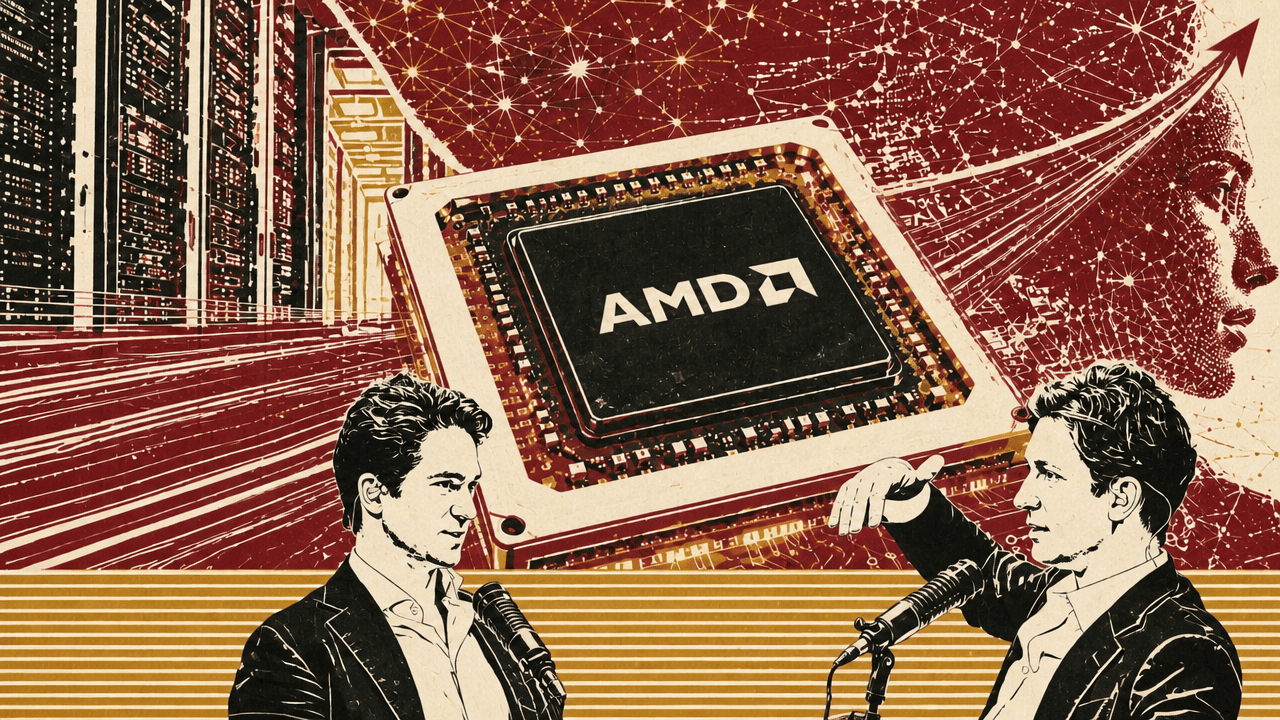
At AMD’s Advancing AI event, Jordi Hays identified three announcements that matter to the company’s effort to compete with Nvidia: Helios, a rack-scale AI system powered by AMD’s MI450 accelerator; an expanded partnership with Cerebras around inference; and an agreement under which Anthropic could deploy up to two gigawatts of AMD Instinct MI450 systems.
Hays characterized the Anthropic arrangement as a $5 billion deal, with collaboration reaching beyond hardware into compute and the software stack. That detail matters because the recurring question around AMD has been whether its software ecosystem can match the ease and maturity of Nvidia’s CUDA environment.
John Coogan said speakers onstage had described Anthropic’s own models as helping accelerate the ramp-up of new hardware. For years, he said, people have expected increasingly capable software to make it easier to develop and optimize software for alternative accelerators. The event suggested that this possibility is beginning to produce practical movement against the perceived CUDA moat.

But Hays cautioned that better model-assisted development alone does not eliminate the need for close supplier collaboration. Some crucial packages remain closed source; fixing particular compatibility problems may require working directly with AMD engineers. He invoked George Hotz’s prior frustrations with small bugs and the eventual collaboration with AMD’s developer team as an example of how the feedback loop can tighten: a developer hits an obstacle, hardware-vendor engineers help resolve it, and the accumulated software support becomes more usable for subsequent customers.
The Cerebras partnership extends the same idea to inference architecture. Hays described the proposed system as a disaggregated inference solution that assigns different engines to different stages of an inference pipeline. The claim is not simply that one chip is faster than another; it is that agentic workloads may benefit from matching the execution engine to the relevant phase of the work.
The more consequential point is that AMD’s competitive path appears to run through integrated deployments rather than one-off accelerator sales. A frontier-lab commitment of this size creates a reason to co-develop, test, and optimize software deeply enough that the hardware can be brought into production at scale.
Google’s AI growth is large, but its revenue mix is being contested
Jordi Hays said Sundar Pichai’s reported second-quarter numbers were striking: Alphabet revenue grew 24% year over year, Google Cloud growth accelerated to 82%, and Google’s model APIs were processing 22 billion tokens a minute. Pichai also pointed to momentum across Search, YouTube, and the Gemini app.
Hays noted that token-throughput figures are now so large that they are difficult to interpret without a longer historical comparison. Still, he offered a reason that Google’s Flash models may account for a meaningful share of that volume: Google has emphasized efficient token generation because it can deploy models throughout its own products while monetizing much of the resulting activity through advertising rather than charging directly for every model query.
A separate disclosure drew scrutiny. A SemiAnalysis post shown on screen highlighted a change in Google Cloud’s SEC-filing language: Google Cloud product revenue was described as coming “primarily from the sale of TPU systems.” SemiAnalysis posed the deliberately provocative question of whether Google was shifting from a cloud provider toward a hardware vendor and Nvidia competitor.
Hays’s interpretation was narrower. Google Cloud has sold TPU systems to several labs, he said, and those sales have become meaningful. But the language does not mean Google Cloud has become exclusively a TPU-selling business or abandoned its broader cloud role. John Coogan added that, a year earlier, it remained an open question whether TPU sales could become material at all.
The discussion also surfaced a dispute over whether Google’s search growth is healthy. Max Anderson, described by Hays as a longtime large Google Ads buyer, argued that the reported revenue growth was artificial and strategically unhealthy. His allegation was that legacy search volumes were declining as non-monetized LLM queries cannibalized them, while Google was protecting revenue through more extractive advertising practices—charging for lower-quality clicks, including clicks advertisers did not want.
Eric Seufert directly rejected that argument in a post shown during the program. Seufert said every claim in the viral thread was false or mischaracterized Google policy. He pointed to Google’s statements that search usage reached an all-time high during the World Cup and that search queries had also reached an all-time high in the prior quarter. He further said ads in AI Overviews monetize at parity with ads in legacy Search, while Search revenue grew 19% in the first quarter of 2026 and 17% in the second.
The figures imply deceleration, Hays said, but not contraction. Seufert also disputed claims that Google had silently abandoned the generalized second-price auction for Search and that it had formerly offered the precise keyword-targeting controls described in the criticism.
The disagreement is useful because it identifies the actual question beneath an earnings headline. Strong reported Search and Cloud revenue does not settle whether AI-generated query behavior will alter the economics of ads over time. But neither does the existence of LLM query growth establish that Google’s core search volumes are already falling.
DeepSeek’s claimed economics point to a different operating model
Jordi Hays discussed details circulated from what was described as a leaked four-hour investor call with DeepSeek founder Liang Wenfeng. The figures, shared in a post by Zephyr, portrayed a company operating with unusually lean inference economics: around 85% inference margins, roughly 20,000 Hopper-equivalent chips through May, and a claim that $1 billion in API revenue would make the company cash-flow positive while funding research, development, and training.
The same account said DeepSeek depreciates hardware over three to five years, putting the claimed 10-month GPU payback period in especially favorable contrast. It also said DeepSeek had secured two Huawei Atlas Super Clusters—each described as containing 16,000 950DT systems—and planned to port TileLang to Huawei, with the aim of becoming independent of Nvidia’s CUDA and software ecosystem.
Coogan urged caution around the reported hardware footprint. A statement that DeepSeek had only around 20,000 Hopper equivalents did not necessarily mean it lacked access to additional global computing resources, he said; the provenance and completeness of that access were unclear.
Hays emphasized Liang’s stated strategic focus more than the financial claims. According to Hays, Liang said DeepSeek was not trying to build a broad Alibaba-like product empire and would not prioritize world models, image generation, video generation, or even a chat app. The company’s stated objective was the path to AGI rather than pure profit maximization—a formulation Hays thought resembled the language used by Western lab leaders.
DeepSeek has faced more competition from Moonshot’s Kimi and from GLM, Hays said. The investor-call attention therefore raised a practical question: whether the company’s efficiency claims and narrow research focus will be followed by another significant model release.
AI product strategy is moving toward agents, interfaces, and institutional trust
Jordi Hays highlighted Cognition’s acquisition of Interaction, the maker of Poke, as an unexpected combination. Poke had long seemed like an acquisition target, he said, because of its ability to produce novel, “delightful” consumer products. He had expected a larger consumer company—Apple, OpenAI, Amazon, or another platform player—to be a more likely buyer.
Coogan said an Apple acquisition would have been especially interesting. Hays agreed that putting the Poke team to work on Siri would have been compelling, but said the important unanswered question is how Cognition will merge the businesses: whether Poke will remain a standalone product or be folded into Cognition.
OpenAI’s announced product releases pointed in a related direction. Hays reported that ChatGPT Voice had arrived in the desktop app, allowing users to control their computer and direct multiple agents in ChatGPT Work or Codex through voice. The feature is powered by GPT Live, allowing it to speak, listen, and coordinate app-based work at the same time. OpenAI also announced Health for U.S. users, which can connect Apple Health and supported medical records so ChatGPT can understand a user’s information in context.
These releases place AI more directly inside personal workflows and sensitive domains. Hays also noted a newly introduced bipartisan “AI kill switch” bill following an OpenAI cyber incident, while acknowledging that the regulatory debate would require a fuller discussion. The juxtaposition was notable: companies are expanding models’ ability to act across desktops and personal health data while lawmakers remain divided over how aggressively the federal government should regulate AI.
Optimism is a positioning choice, not a resolution of the backlash
Jordi Hays described Mark Zuckerberg’s new AI-optimism campaign as an attempt to present Meta’s agentic future as an extension of its longstanding mission of connecting people. An Axios post shown during the discussion framed Zuckerberg’s position as a contrast with competitors that portray AI in fearful or dystopian terms.
Hays and John Coogan both liked the campaign video and its production, but Hays saw a vulnerability in the message. For people who experience Meta’s products principally as a way to exchange funny Reels and stay connected, the connection between social platforms and an optimistic AI future may be intuitive. For people who regard those platforms as “brain rot,” the promise that the same company will shape the next technology may provoke skepticism rather than confidence.
Coogan was nonetheless glad Zuckerberg was not adopting a fear-based posture simply because that framing works for some other players. Hays agreed that an optimistic orientation is preferable, while leaving open how the campaign will be received.
The tension is not whether AI advertising should be optimistic. It is whether Meta can ask people to trust its account of AI’s social benefits without reopening their judgment of what its existing products have done to attention, relationships, and public discourse.
The search-fund appeal is operational control, not easy money
Jordi Hays returned to a Wall Street Journal profile of Bakari Akil to describe the renewed attraction of entrepreneurship through acquisition. In 2015, Akil was a homeless college dropout focused on getting rich. He slept in WeWorks, on subways, and in airport waiting areas while consuming podcasts, videos, and personal-finance books. A Harvard Business School case study introduced him to search funds: vehicles through which individuals raise capital to acquire and operate businesses.
Akil, now 37, had bought two multimillion-dollar companies and was worth seven figures, according to the article Hays cited. He had also spent each of the prior three years living in a different country.
The broader cohort is pursuing HVAC contractors, plumbing businesses, specialized manufacturers, and other small and midsize companies. Rather than following the conventional private-equity ladder from associate to managing director, these buyers assemble financing deal by deal: Small Business Administration loans, specialized investors, family offices, private-equity funds, friends, and SBA-licensed small-business investment companies. The financing is only the beginning. They must persuade an owner to sell and then execute an operational improvement plan.
Hays said the appeal has grown partly because established private-equity firms are struggling to sell portfolio companies profitably, making compensation tied to successful exits less certain for mid-level employees. Researchers at Stanford counted 77 new search funds in 2025, though both Hays and Coogan doubted the number captured the full scale of the phenomenon. Some buyers may avoid calling themselves search funds even if they operate in essentially that way.
Hays connected the idea to Sal Khan’s suggestion that, instead of spending $200,000 or $250,000 on college, a small group of young people might use comparable capital as equity for a leveraged business acquisition. Four students with $1 million could, in this hypothetical, acquire a $5 million business producing $200,000 in net income, use its cash flow to pay themselves, and learn by running it from ages 18 to 22. The downside, Hays suggested, might be no worse than the cost of college; the upside would be ownership of a durable cash-generating company.
He did not present that as a universal replacement for education. The prestige and network of certain schools will remain the right choice for some people. But the idea captures the attraction of search funds: not a shortcut free of risk, but a way to exchange credentialed progression for direct responsibility, operational learning, and ownership.