AI’s Mathematical Breakthroughs Have Yet to Settle the Investment Case
TBPN hosts John Coogan and Jordi Hays said a claim that Anthropic’s Claude had helped prove the Riemann hypothesis could prove important to mathematics if experts verify it, but argued that the claim’s significance does not translate neatly into a commercial payoff or an immediate case for investors. Coogan cited reporting that the purported proof remains unverified and could take years to review, while distinguishing the claim from the technology-stock selloff unfolding at the same time. The discussion framed a broader tension: rapid AI progress may have far-reaching consequences, but investors still want evidence that companies can turn it into revenue and profit.
A claimed proof could matter to mathematics before it matters to markets
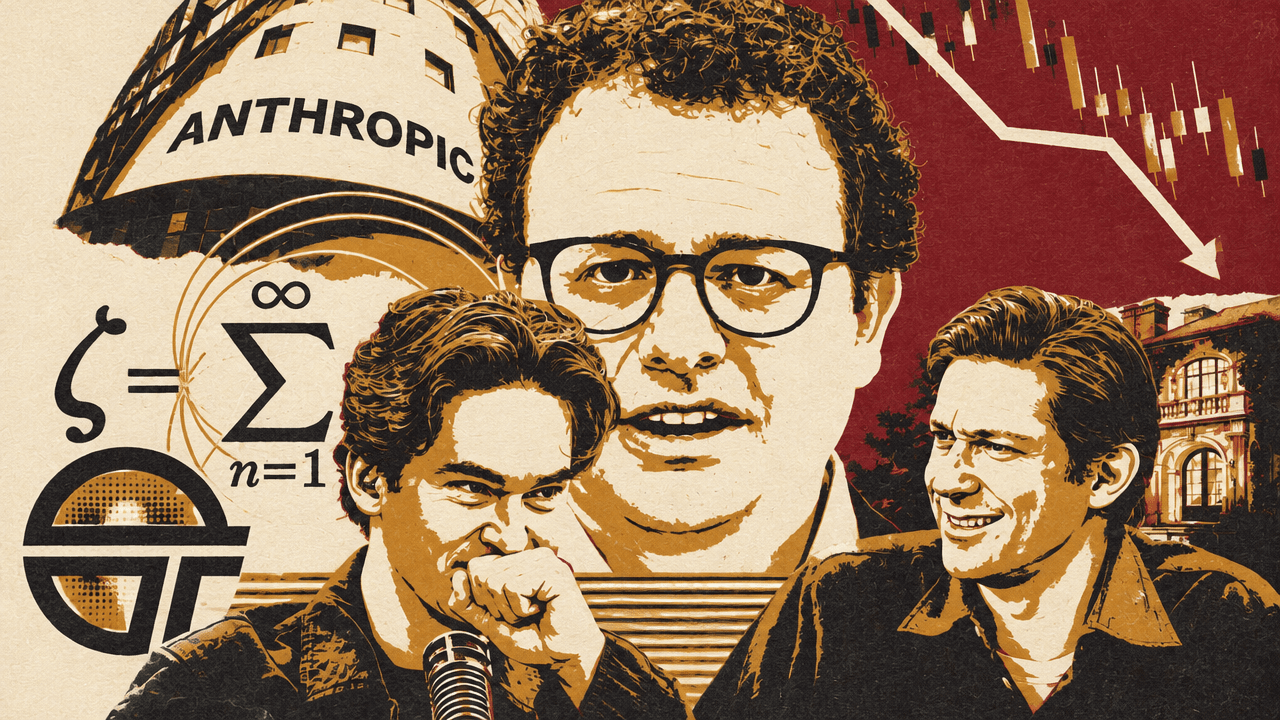
John Coogan said Anthropic was down about 10% as news circulated that Claude had helped produce a proof of the Riemann hypothesis. Coogan cited Scientific American’s report that the claim was unverified and still needed expert review, a process that could take years. He said the draft was reportedly about 250,000 pages, and noted that the Clay Mathematics Institute still listed the hypothesis as an unsolved Millennium Prize problem.
The scale of the claimed proof was hard to picture. Coogan compared it with a 350-page book he expected to discuss with a guest: 250,000 pages would be about a thousand books that length. The page count did not establish that the claim was correct.
A clip from Tyler Cowen’s interview with Terence Tao supplied context for why mathematicians care about the problem. Cowen asked Tao how he felt about the Riemann hypothesis. Tao called it a major prize in mathematics, then explained that it concerns prime numbers, which can appear to be distributed irregularly. The hypothesis gives a precise way to describe that apparently random behavior.
Tao also pointed to the reach of the problem. Prime numbers are used in cryptographic protocols, he said, and many areas of mathematics that touch primes would yield stronger results if the Riemann hypothesis were known to be true. Some number-theory results are conditional: if the hypothesis holds, a stronger conclusion follows.
The Riemann Hypothesis is a very precise way of quantifying this random-looking nature of the primes.
Coogan described a large body of mathematical work built on the assumption that the hypothesis is true. If the claim is verified, he said, mathematicians whose results rely on that assumption could build on them with greater confidence.
The immediate market reaction was a separate question. Coogan said investors were not trading public stocks on mathematical progress, and that the selloff appeared tied to broader weakness. He cited Nvidia-related turmoil, geopolitical uncertainty and cyberattacks, as well as the possibility that disruption could keep customers from spending in ways that move revenue and profit. The contrast was striking to the hosts: a result that could be consequential in mathematics was arriving while technology stocks were falling.
AI progress has not settled how investors should value it
The hosts’ larger question was whether public markets will eventually price AI as a technology that could reshape the economy, or continue to treat AI companies as businesses with high capital costs and uncertain returns. John Coogan described visible month-to-month progress in models, benchmarks and applications, including 3D modelling, video-game building and video editing. He said that improvement was apparent, but it had not yet persuaded investors to value companies on the basis of the most ambitious AI forecasts.
In Coogan’s account, some in Silicon Valley see the possibility of compounding advantages, rapid progress toward artificial general intelligence, or an extreme concentration of power in a single system. Those scenarios could be strongly bullish for a company that captures the gains. But whether a company can capture value over time is another question. Wall Street, he suggested, was more focused on whether a business could turn investment into revenue and profit.
That tension also shaped the discussion of Anthropic’s reported math result. Coogan joked that the million-dollar Millennium Prize for solving the Riemann hypothesis might add a modest amount to the company’s value. A post on screen asked who would pay for solving it. The joke pointed to the gap between an intellectually important result and an obvious commercial return: no one, Coogan said, was buying mathematical hypotheses.
A more substantial investment case came from a post by Nabeel S. Qureshi, which Coogan summarized. The argument was that the claimed result had arrived much faster than expected, even in light of earlier rapid progress in mathematics; similar acceleration might happen in AI research; and a company with an automated AI researcher ahead of competitors could find ways to make money. Coogan said there were leaps in that chain.
The market backdrop was not limited to AI. Jordi Hays described recent weeks as a repeated cycle of seeing red on a phone and then seeing news of another hack. Coogan cited Derek Thompson’s post joking that the Nasdaq being up only 5% year over year meant “it’s all over,” then said that the index had underperformed Treasury bills year to date. That comparison described the period Coogan was discussing, not a general claim about the relative performance of tech stocks and bills.
Coogan recalled expectations earlier in the year of a “SaaS-pocalypse,” with investment and value moving from software companies toward AI companies and infrastructure bottlenecks. That shift had included energy infrastructure, data centres and chips, he said, yet the Nasdaq had still underperformed T-bills over the period. The point was not that the AI buildout had stopped, but that spending on the parts of the stack did not guarantee that public-market investors would be rewarded in the near term.
Hays brought up Michael Burry’s claim that he had warned about CoreWeave, Nebius, Nvidia and semiconductors. Coogan joked that the hosts should say of any company they discuss, “I didn’t say short, but I provided the information one would need to sell.” He also noted that Burry’s “just sell” post dated January 2023, leaving years of market activity and gains between that warning and the present. Hays said the S&P 500 was close to double its level since the post. The exchange left the question of foresight unresolved: a warning can look prescient during a downturn without describing the returns available over the full period.
Space-based data centres put recovery of collateral in question
A reported $40 billion financing deal for SpaceX raised a practical problem for lenders: what happens to collateral if the company moves it into orbit? John Coogan said an Apollo-managed entity would buy Nvidia GPUs and lease them to SpaceX, which would pay over about five years. If SpaceX defaulted, lenders could take back the chips and sell them. But, according to the Financial Times report discussed on air, lenders worried that they might not be able to recover the GPUs if SpaceX sent them into orbit for planned space-based data centres.
The report said lenders were seeking legal protections to keep the chips on the ground. Jordi Hays joked that Apollo should not let its collateral be “yeeted” into space; Coogan imagined a “repo man for space” or a tow truck. The obstacle was concrete: a lender’s claim on an asset is less useful if retrieving it after default is difficult.
Coogan connected the issue to the shifting requirements of data-centre construction on Earth. Land, buildings, power and water rights, construction teams and chip allocations can change hands or be reassigned, he said. He also relayed a point from SemiAnalysis that some older data centres may not have floors strong enough for newer Nvidia racks. Coogan said the racks could weigh several times as much as earlier ones, meaning buildings might need retrofitting before they could take the latest hardware.
Hays raised a separate constraint: he said President Trump had been talking that morning about not allowing data centres outside the United States, while some US politicians were also objecting to data centres being built in the country. The hosts wondered where space-based facilities would fit. Coogan joked that building in the United States and then launching into space might satisfy both positions.
The deal, Coogan said, had closed in October, with leases due to begin in the first half of 2027. He said Elon Musk had described debt markets as largely closed to AI companies without other major revenue streams. In Coogan’s account, lenders are more likely to support large borrowing when a company can repay it from cash flow. He contrasted SpaceX’s position with that of the largest hyperscalers, whose cash flow is much greater, but argued that Starlink’s revenue gave SpaceX a basis for the financing.
Hays found the $21 billion annualized figure while Coogan was speaking; Coogan said it felt right. He noted that Starlink was being used on planes and had airline deals, and said he was a customer. He also cautioned that direct-to-cell service would not fully replace conventional mobile service and would not work indoors everywhere.
Coogan’s comparison focused on capacity as well as coverage. Mobile carriers have spent years addressing gaps and congestion, he said. At a crowded sports event, networks may need extra infrastructure and backhaul to keep many people connected; if a large crowd gathers somewhere unexpected, service can still jam up. A satellite network would also have to work out how to provide reliable service in those conditions.
A cluster of GTA coincidences becomes a comic conspiracy theory
John Coogan’s running theory linked Anthropic and Rockstar through names, dates and corporate connections. Its starting points were Claude Shannon, the namesake Coogan gave for Anthropic’s Claude model, and Grand Theft Auto III: Shannon died in 2001, the year Rockstar introduced the game, whose protagonist is also named Claude.
He grouped several later coincidences around GTA 6. Coogan said Anthropic released version 3 of its responsible scaling policy on February 24, 2026, the 25th anniversary of Shannon’s death. Version 3.3, he and Tyler said, came out on May 26—the game’s originally scheduled release date. Rockstar later delayed GTA 6 until November 19, 177 days after May 26. Coogan connected that interval to the $1.77 trillion value he cited for Anthropic when it went public, then added that its $83 IPO price echoed Dario Amodei’s 1983 birth year. Tyler pushed back that the birth-year link connected two Anthropic details, not Anthropic and Rockstar.
The hosts also connected the companies through their sibling founders: Sam and Dan Houser at Rockstar, and Dario and Daniela Amodei at Anthropic. Coogan pointed to Anthropic board member Reid Hastings, who founded Netflix, and said Netflix distributes Grand Theft Auto III. He then presented “Anthropic” as an anagram of “HIT COP. RAN,” and linked “Santos” in the ticker symbol to Los Santos in GTA V. The construction was knowingly strained: Coogan said “Jack Clark” could become “Car Jack” only by leaving letters out. The joke’s force came from piling up suggestive patterns while treating the objections as evidence of a cover-up.
Plaish Hall’s grandeur comes with a bill the owners know is too high
John Coogan described Joanne Hughes and Phillip Stepp’s search for a larger home for their blended family of seven children. They bought Plaish Hall, an almost 500-year-old Tudor mansion in England’s Shropshire Hills, nearly four times the size of their previous 3,000-square-foot house. The property sits on nearly 13 acres and has about 12,000 square feet, eight bedrooms and, when they bought it, only one shower. Photos shown during the segment gave a sense of its scale: a brick exterior, formal gardens, large rooms and substantial fireplaces.
The home was listed for $2.69 million. Coogan said it was built sometime between 1540 and 1580, a forty-year range that the hosts found amusingly imprecise. It was built for Sir William Leighton, a wealthy judge and politician. Coogan cited Historic England’s description of the H-shaped red-brick house, noting that red brick was an unusual and modern building material at the time.
The property’s size answered a practical need: the previous five-bedroom home had become cramped for the family, whose children ranged in age from 10 to 39 at the time described, and its backyard was a problem when the youngest was a toddler. Stepp had admired the Shropshire Hills and spotted the Plaish Hall listing. The new home also came with protected bats that had to be rehoused, and a major renovation that was still in progress several years later.
The financial trade-off was explicit. Coogan quoted Stepp saying, “It doesn’t make economic sense, we have overcapitalized on the house. We have to sell everything. But when you are living somewhere you want it to be done right.” That admission sat alongside the hosts’ appreciation of the house: Jordi Hays rated it S-tier for its character, fireplace and kitchen, while noting that it looked as if it might be cold. The appeal was clear in the rooms and grounds shown on screen; so was the cost of making such a large, old property work for a family.