Grid Storage Choices Turn on Efficiency, Cost, and Geography
Stanford instructors Matthew Kanan and Yi Cui argue that meeting rising electricity demand alongside variable renewable generation requires choosing among storage systems with distinct physical and infrastructure constraints. Kanan says the relevant trade-offs are efficiency, cost and geography: pumped hydro depends on reservoirs and elevation, while underground hydrogen storage converts electricity into fuel that requires a salt cavern and equipment to return it to the grid. Cui adds that AI data-center growth strengthens the case for storage, while AI-based materials prediction could accelerate battery development.
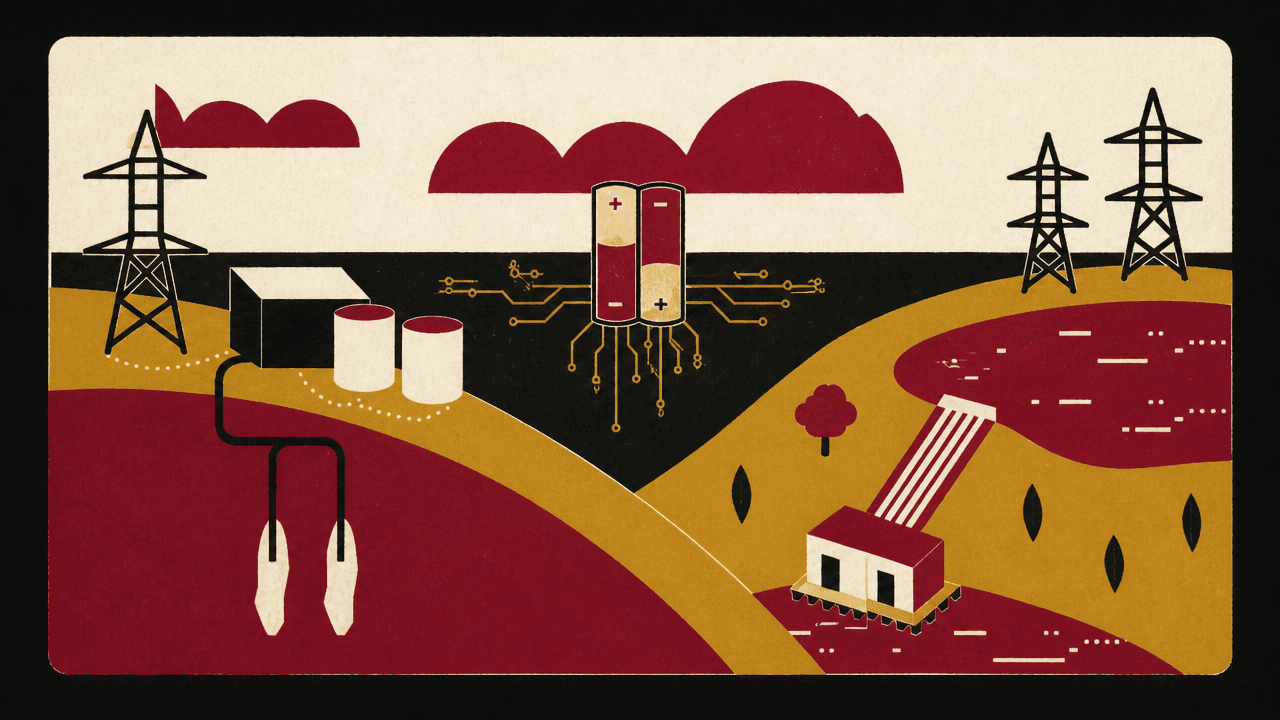
Storage is a choice among physical systems
Matthew Kanan frames energy storage as the answer to a timing mismatch: solar generation stops when the sun is down, wind generation varies, and electricity demand continues to rise, including with the buildout of AI data centers. But the storage options shown are not interchangeable containers for excess power. They follow different energy-conversion chains and require different sites and infrastructure.

Yi Cui puts the practical question plainly: which technologies make sense for different applications? Kanan identifies three criteria for answering it—efficiency, cost, and geography. The pumped-hydro and hydrogen diagrams make geography concrete. One depends on a water system linking reservoirs; the other on converting power to hydrogen and storing it in an underground salt cavern.

You'll gain critical insights by analyzing real-world trade-offs in efficiency, cost, and geography.
| Storage pathway | Energy route shown | Physical system required |
|---|---|---|
| Pumped hydro | Electricity pumps water to an upper reservoir; returning water drives a reversible pump turbine that generates electricity. | Upper and lower reservoirs, a tunnel or penstock, a powerhouse, substation, and connection to the transmission grid. |
| Underground hydrogen storage | Renewable electricity powers an electrolyzer; hydrogen is injected into a salt cavern, then withdrawn for a gas-combustion power plant to generate electricity. | An electrolyzer, injection and withdrawal equipment, a salt cavern in rock salt, and generating equipment. |
Energy storage is the solution to powering our planet around the clock, both now and for decades to come.
Pumped hydro stores electricity through water and elevation
Pumped hydro is depicted as a two-mode system. In pumping mode, electricity moves water from a lower reservoir to an upper reservoir. In generating mode, water flows back through a tunnel or penstock to a powerhouse, where a reversible pump turbine produces electricity for the transmission grid.
The relevant infrastructure is distributed across the landscape rather than concentrated in a single device: two reservoirs, the route between them, a powerhouse, a substation, and the grid connection. Kanan includes pumped hydro among the large-scale storage systems that can stabilize the grid.
That physical arrangement is why geography belongs alongside efficiency and cost in the comparison. The diagram presents pumped hydro as an integrated water, elevation, and grid system: storing electricity means moving water through that system, and recovering electricity means reversing its direction through the turbine.
Hydrogen storage turns power into fuel before returning it to the grid
Underground hydrogen storage follows a longer conversion route. Solar and wind power feed an electrolyzer in the diagram’s “Power to H2” stage. The resulting hydrogen is injected into a salt cavern. When power is needed, hydrogen is withdrawn and sent to a gas-combustion power plant in the “H2 to Power” stage.
Where pumped hydro retains energy in the position of water, this pathway stores energy as hydrogen fuel. Its site requirement is correspondingly different: the visual centers on rock salt and a salt cavern, together with the equipment needed to make hydrogen, inject it, withdraw it, and generate electricity from it.
Kanan presents underground hydrogen storage, like pumped hydro, as a large-scale route to grid stabilization. The comparison turns on the full system each option entails—not only how energy is stored, but how it is converted, where it can be kept, and what must be built to return electricity to the grid.
AI increases the storage case and enters battery discovery
Yi Cui gives AI two roles in the storage landscape. First, rapid growth in AI data centers adds to the demand that energy systems must serve, alongside expanding renewable generation. Cui says those developments create a business case for energy storage: demand is rising even as a larger share of generation comes from sources that do not deliver power continuously.
Second, AI appears as a tool for battery innovation. The visual accompanying Cui’s remarks describes using known material structures and known conductivities to predict whether a material may be “superionic.” Cui calls AI a game changer for battery innovation.
The two roles operate at different points in the system. Data centers affect the need for dependable electricity; material prediction concerns the development of battery technologies that may supply storage. Together, they connect the immediate grid problem Kanan describes—matching variable energy supply to around-the-clock demand—with the search for better electrochemical ways to store energy.