Factory-Tested AI Pods Could Cut On-Site Deployment From Months to Days
NVIDIA presents DSX as a full-stack reference architecture for designing AI factories as coordinated systems, with compute, networking, power and cooling validated in a digital twin before construction. The company says its DSX Max LPS can deliver the same output with 30% less power, while closed-loop cooling and outdoor dry coolers can save up to 54 million liters of water a day at a 2-gigawatt scale in suitable climates. Its DSX POD packages pre-integrated, factory-tested equipment to cut on-site deployment from months to days once utilities are ready.
An AI factory is a coordinated system, not a collection of chips
NVIDIA’s case for DSX starts with a constraint: the scale of AI infrastructure makes it important to design the whole facility around performance, power, water, and construction—not just compute. The company describes DSX as a full-stack reference architecture co-designed with infrastructure partners across compute, networking, storage, software, power, and cooling.
That systems approach begins before construction. DSX uses a digital twin to validate performance, power, water use, and scale virtually. The partner tools shown in the design process cover distinct parts of the job: PTC turns equipment designs into simulation-ready assets; Dassault Systèmes links rack and facility design through model-based systems engineering; Schneider Electric simulates power distribution and liquid cooling; Jacobs brings the work together in an Omniverse digital twin; Siemens evaluates thermal, acoustic, and grid impacts; and Procore supports construction-phase planning.
The point is to connect facility and equipment decisions early enough to test how they work together, rather than treating design, operations, and construction as separate problems.
Power and cooling set the factory’s operating limits
NVIDIA says power limits how much an AI factory can produce. DSX Max LPS is presented as an end-to-end control loop that dynamically steers power to match workload demand. The company claims it uses 30% less power for the same output.
Cooling is another part of the design. NVIDIA says Vera Rubin systems are designed for closed-loop liquid cooling with coolant temperatures up to 45°C. In suitable climates, outdoor dry coolers can release heat into the air without evaporating water. NVIDIA estimates that, at a scale of 2 gigawatts, DSX can save 54 million liters of water per day—an amount it compares with the daily water use of 180,000 households.
The water-saving estimate is tied to specific conditions: it depends on suitable climates and the stated 2-gigawatt scale. The accompanying demonstration displays liquid input at 45°C and output at 55°C. A 30-day chart shows 1.62 billion liters of accumulated savings alongside 10 million liters of consumption.
The POD moves integration work off the construction site
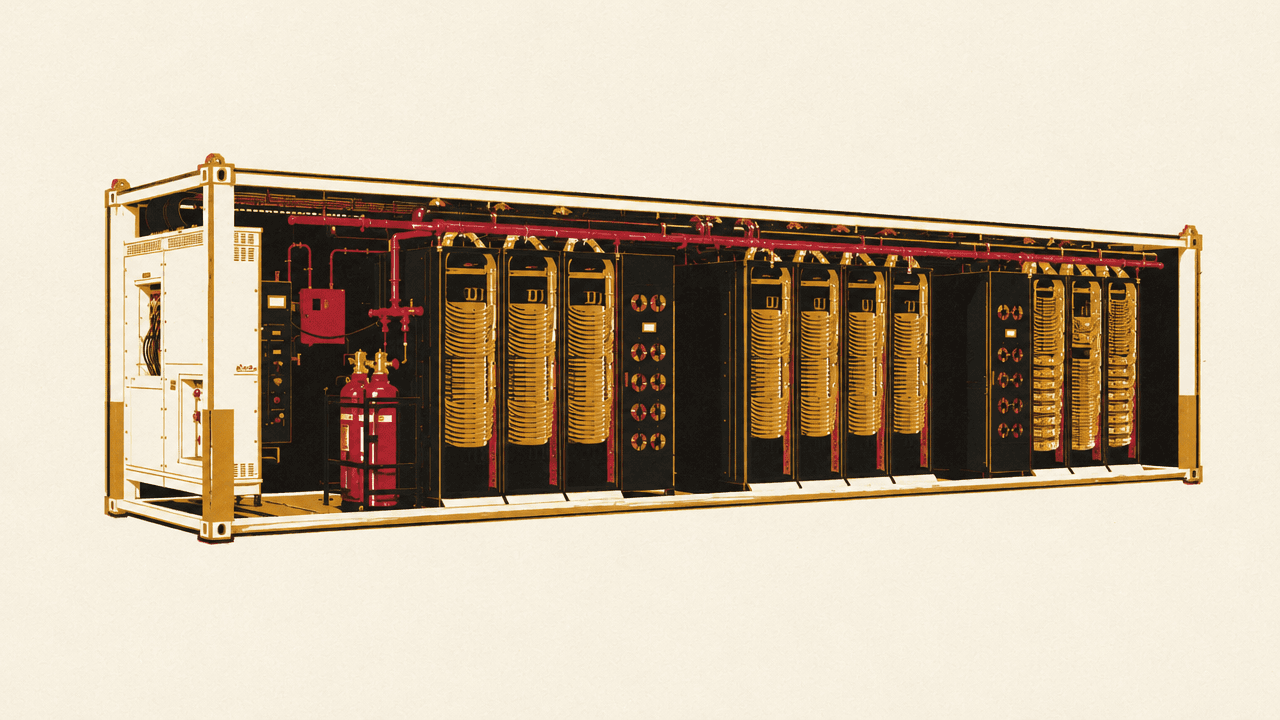
An AI factory can take several months to build, NVIDIA says. Until it is operational, it produces no tokens. DSX POD is intended to move more of the integration work into a factory-built system, reducing the work left to do on site.
The announced configuration starts with Vera Rubin NVL72. Seven liquid-cooled compute racks, connected by 17 kilometers of Spectrum-X cable, make up a Vera Rubin DSX POD. An on-screen specification describes the POD as delivering 25 exaFLOPS of AI. NVIDIA says the PODs are integrated, fully cabled, and factory-tested before they are delivered in transportable containers.
Those specifications describe a pre-integrated package, not a complete facility arriving ready to operate. The container is shown with a stated weight of 28,500 kilograms and 10 million components. The package also includes dry coolers, which replace traditional evaporative cooling, and an 800-volt DC power connection to the racks. An on-screen specification says the power center delivers more power with 45% less copper.
Days on site still depend on ready utilities
NVIDIA’s schedule claim is specific: once site utilities are ready, estimated on-site deployment goes from several months to days. The site must still be prepared; the claim concerns deployment of PODs that have already been integrated, validated, and tested, rather than construction of the entire AI factory from scratch.
The design ties together three operating goals: more output for the same power, lower water use where dry cooling is suitable, and less time spent integrating equipment on site. NVIDIA calls this “responsible by design” and frames the intended result as more intelligence per watt and less time to first token.