Arm Moves From Chip IP Licensing to Physical Products
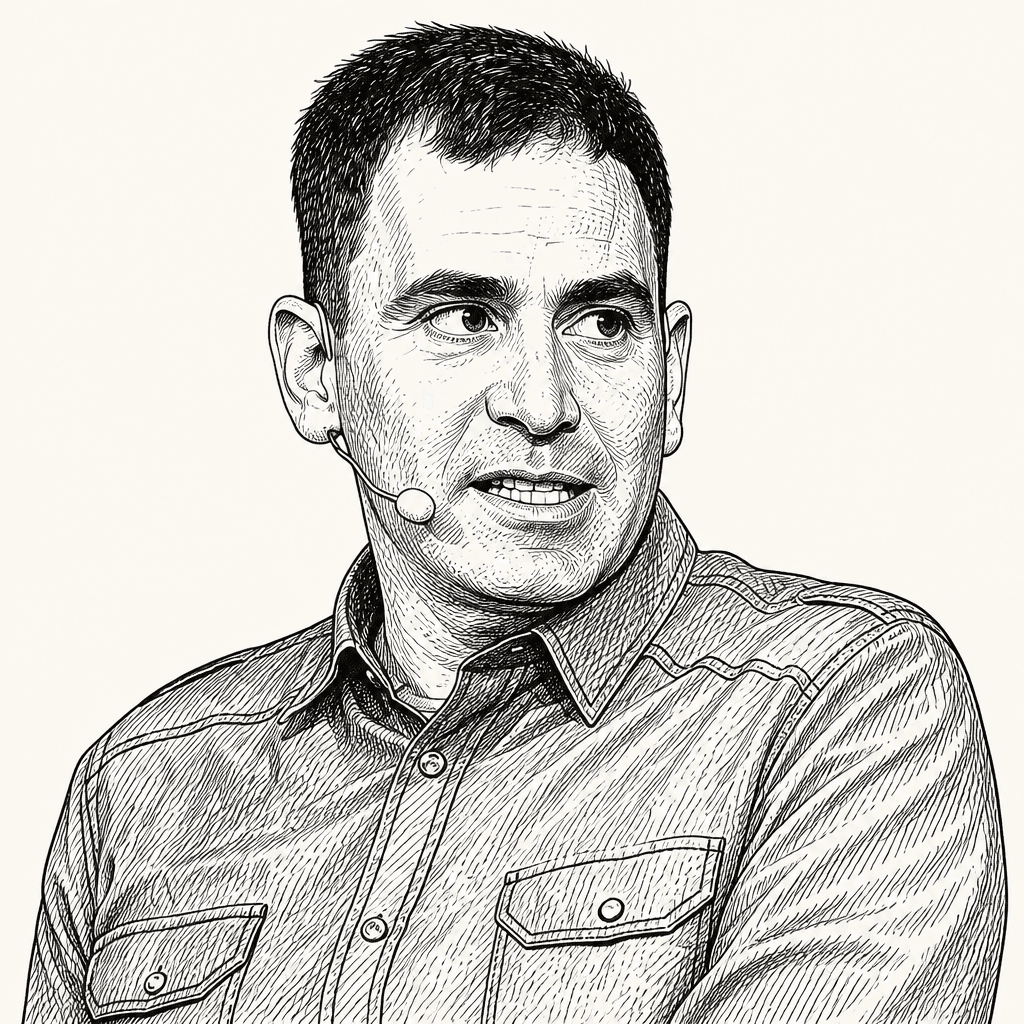


Arm chief executive Rene Haas argues that AI’s demand for accelerators has not diminished the CPU’s role as the system that schedules and coordinates computation. As Arm moves from licensing chip IP toward supplying more integrated systems and selected physical products, Haas says the company must compete not only on design but on access to wafers, memory, packaging, capital and deployment capacity. He also makes the case that US semiconductor manufacturing and data-center construction are strategic industrial assets, despite growing public resistance to their expansion.

The CPU remains the system’s coordinator
Rene Haas rejects the idea that the rise of AI accelerators has displaced the CPU. The surge around ChatGPT concentrated attention on GPUs and other accelerators because they perform the intensive computation that generates tokens. But an AI deployment is still a system: accelerators, memory, tokens, and software workloads must be scheduled, routed, and managed.


“Something has to do the orchestration, arbitration, decision around where those tokens go,” Haas says. “That’s what CPUs do.” His analogy is a token factory: accelerators produce the tokens, while CPUs are the trucks that direct them through the system and deliver them to users.
There's no computing problem that's ever been invented that doesn't utilize and can't utilize the microprocessor. It is the heart of everything.
That role extends beyond data-center racks. Haas describes the familiar CPU–accelerator–memory arrangement as persistent across servers, automobiles, robots, phones, and wearables. In smaller devices, he sees a particular opening for Arm. A CPU is already required for general device operations, but power and space constraints rule out simply attaching a high-power GPU. “You just can’t put a 50 watt GPU on your head,” he says; some AI processing will therefore need to happen locally within a much tighter power budget.
For Haas, CPUs do not compete with accelerators so much as remain indispensable alongside them. As AI work moves beyond training toward inference, recursive learning, and reinforcement learning, he expects demand to grow for the processors that coordinate how information moves through the system.
Arm is moving from components toward deployable products
Rene Haas describes Arm’s traditional business as IP licensing. It designs CPU cores, GPU IP, and system IP, then licenses those components to companies that either manufacture chips themselves or send their designs to foundries such as TSMC. That position gives Arm visibility across smartphones, automobiles, and data centers—and, Haas says, a view of supply-chain conditions from multiple directions.
The company’s first move beyond individual IP blocks was the compute subsystem. Rather than supplying disconnected components, Arm provides a blueprint for how to combine them. Haas compares the shift to offering not only Lego bricks but instructions for assembling them. Customers adopted the approach, he says, because faster product cycles and lengthening manufacturing timelines made time to market more valuable. Demand for the subsystems was “insane,” in his description, despite early assumptions that chip designers would want to retain the integration work themselves.
The Arm AGI CPU, introduced in March, takes the company another step toward a physical product. Haas says Meta wanted a general-purpose AGI CPU and could not find another supplier that could provide it, so the companies developed one together. He does not frame this as a replacement for licensing or a move into the broad merchant-chip market. It is a path for customers that want an Arm-based product but do not have an existing supplier serving a particular requirement.
That shift changes what Arm must do operationally. Its IP business had the appeal, Haas recalls, of “no inventory, no RMA, no scrap.” Physical products introduce precisely those complications. Arm now has to secure wafers, substrates, and memory allocations; work with foundries and memory suppliers; and build the engineering and operations capacity required to bring a chip into production.
Arm remains fabless and has no intention of building a fab. Still, Haas says it is now “up to our waist” in the physical supply chain. The company has added leaders with experience at Broadcom, Qualcomm, and Nvidia to build those capabilities.
The move also required ecosystem management. Haas says Arm consulted broadly with customers that build Arm-based server chips, including Nvidia, Amazon, Microsoft, and Google, and received less resistance than he expected. Their interest, he says, was that a larger base of proprietary and open-source software benefits the entire Arm ecosystem. IP remains central to Arm’s model, but the company is increasingly supplying integration and, in selected cases, a route to manufactured hardware.
AI’s near-term chip-design value is verification, not one-click invention
Rene Haas expects AI to change chip development, but he separates the work where it is already useful from the work where the tools remain immature.
A complex chip can take 24 to 36 months to develop. The architecture and RTL generation—the translation of that architecture into register-transfer-level design—are not necessarily the largest time sinks. Haas says verification, validation, debugging, and documentation consume more of the cycle, and those are areas where Arm is already seeing major benefits.
Haas says turning off those tools would resemble restricting internet access to a two-hour window and directing people to a physical library for the rest of the day. The point is adoption, not that AI has solved every design task: “The genie’s out of the bottle,” he says.
The limiting factor is proprietary information. Models are not yet best-in-class at RTL generation, physical design, or implementation, Haas says, because much of the relevant training material is not public. Arm is working with model makers to address that gap.
He sees an advantage in Arm’s IP portfolio not simply because it contains core designs, but because it includes documentation, test benches, and explanations of how to build and test the IP. Haas contrasts that with IP he encountered at other companies that was nominally valuable but not realistically licensable because it lacked usable documentation or testing.
If it’s unusable and untestable, it’s actually untrainable.
Haas will not predict that AI reduces the full 24-to-36-month cycle to six months within the next two or three years. Over five or more years, he considers it plausible that some straightforward designs could move from an idea to the GDS2 file sent to a fab. That could eliminate much of the design and verification burden. But he does not expect a tool to immediately satisfy an instruction to make a chip 10% faster than Vera Rubin, 20% cheaper, and 30% more efficient for a given model. In the five-to-ten-year range, he expects major changes in how chips are designed.
A good design cannot compensate for scarce inputs
Rene Haas says the expansion of AI chip startups does not make chip creation principally a design problem. It makes access—to manufacturing inputs, capital, and deployment capacity—more strategically important.
A company can have an innovative design and substantial funding yet still need memory allocations, substrates, advanced packaging, wafers, and access to leading process nodes. Haas expects this constrained environment to last at least three to five years, so long as the transformer remains the basis for AI training and inference. The workload is inherently compute-intensive and memory-intensive, he says.
The constraints are connected. Access to a three-nanometer or six-nanometer line does not solve a shortage of memory or packaging capacity; neither resolves the financing and supplier relationships needed to secure allocation. Haas’s point is that a young chip company needs supply-chain acumen as well as a design, because capital, wafers, memory, and the path into an end product all affect whether that design can be built.
He expects data-center construction to become another governor on AI capacity. Projects require labor and infrastructure, and proposed restrictions on development could slow the buildout further. If construction does not constrain capacity, Haas suggests, wafer and memory supply likely will. He does not see this as evidence that AI infrastructure has outpaced demand. Setting aside stock-market valuations, he says the answer to whether supply has exceeded demand is “not even close.” The likely outcome, in his view, is a series of throttles that limit how quickly capacity can expand.
SoftBank makes infrastructure strategy more operational for Arm
Rene Haas says Arm’s relationship with SoftBank gives the company an unusually large single shareholder with whom it can discuss strategy frequently and informally. The benefit is not simply access to capital. SoftBank’s businesses and investments give Arm a view across infrastructure, energy, robotics, and data centers—and potential places where Arm products could be deployed.
Haas describes SoftBank Neo as the group’s intended “neo cloud.” In that model, SoftBank could provide a home for portfolio companies with chip technology that might otherwise need to win deployment from a major cloud provider such as Microsoft or Google. For Arm, the same ecosystem could become a customer for products beyond its core IP licensing business.
That does not necessarily mean Arm will become a broad merchant-chip supplier, Haas says. Its announced Arm AGI CPU is the first physical product, but he suggests that Arm could build products specifically for SoftBank-related needs in robotics, energy, or data-center infrastructure. The shift into products makes those relationships more operationally material: Arm is no longer only licensing designs into an ecosystem, but may itself need access to the supply chain and deployment environments that turn a design into hardware.
Haas says he is involved in SoftBank’s work with Ampere, Graphcore, and Stack AV, while also helping Masayoshi Son formulate and execute strategy around robotics, OpenAI, infrastructure, and Arm. For semiconductor startups more generally, Haas advises forming strategic partnerships early. But his description of SoftBank is more specific: it is a potential source of backing, infrastructure, and demand within the same corporate orbit.
Robotics adoption depends on costs and proven economics
Sarah Guo characterizes generalized robotics as earlier in its development than large language models: demonstrations of task generalization, robustness, and in-context learning are becoming more compelling, but wide-scale deployment has not yet arrived. Rene Haas agrees.


Haas says robot costs remain high and the business model has not yet been fully established. Buyers need a credible answer to what a machine replaces and why owning it makes economic sense. Costs need to decline and the model needs to be validated before broad adoption follows.
He expects factory automation, distribution centers, delivery, and eventually aspects of autonomous transport to be among the first applications to automate. Distribution centers, he says, could ultimately become completely automated. He treats an autonomously operated truck, loosely, as a kind of robot.
The eventual market, in his view, will include both humanoids and specialized machines. Many jobs and workplaces are built around human dimensions, while other tasks will favor dedicated form factors. The shift from what he calls “robotics 1.0” is that machines optimized for a single task could require a production line to be reworked when that task changed. Robots that can learn from training or observation, paired with more general-purpose mechanics, could lower that barrier.
Arm’s commercial claim is that it can be present throughout this stack. Haas says Arm technology can support real-time sensing and perception in robotic extremities. He also says that the computing “brains” in humanoids using Nvidia or Qualcomm technology are today mostly Arm-based. Whether that becomes a broad robotics opportunity, however, depends first on machines becoming cheaper and economically legible to buyers.
Technology leadership requires factories and permission to build
Rene Haas argues that the United States needs more domestic semiconductor manufacturing for national security and supply-chain diversification. Speaking personally as an American citizen, he points to the earlier SEMATECH effort as an example of the United States treating semiconductor capacity as strategic. The subsequent focus on internet and SaaS companies, he says, obscured that importance.
He describes competition over critical technologies as an “infinite game,” not a contest with a final winner. But Haas argues that countries lose important capabilities when those technologies are no longer based domestically. In his view, leadership produces more than lower costs or strong company valuations: it creates the surrounding innovation and industrial ecosystem.
That logic informs his case for data-center construction. Haas rejects the view that data centers offer little local economic value because they appear to be lightly staffed buildings. Building and operating them requires work in energy, liquid cooling, and other supporting systems, he says. Electricians are his concrete example: the job requires training and certification, and data-center construction needs many of them.
Haas attributes much of the backlash against new data centers to fear that AI will eliminate jobs, a fear he says is not well-grounded. He also acknowledges that AI’s gains have not been evenly shared. People whose wages have not risen or who are struggling with mortgage payments can see AI as a development likely to make their position worse. That broader insecurity, he says, has made data centers a “boogeyman” for the risks associated with automation.
His response is that the industry must make the benefits of construction and technological leadership more legible. “There is no downside from being the leader,” Haas says, while allowing that second- and third-order effects may be unwelcome. Becoming a laggard, in his view, means having the terms of technological change dictated elsewhere.