SpaceX IPO Prices Starlink and Launch Against Starship and AI Risk


Sam Parr and Shaan Puri’s breakdown of a proposed SpaceX IPO argues that the company’s investable core is Starlink and launch, while its roughly $1.75 trillion valuation depends on much harder assumptions about Starship, orbital data centers, AI and Elon Musk’s execution. Puri frames the offering as a “price to Elon” bet: ordinary valuation math makes the company look extremely expensive, but investors may be underwriting Musk’s record of turning improbable engineering goals into businesses.
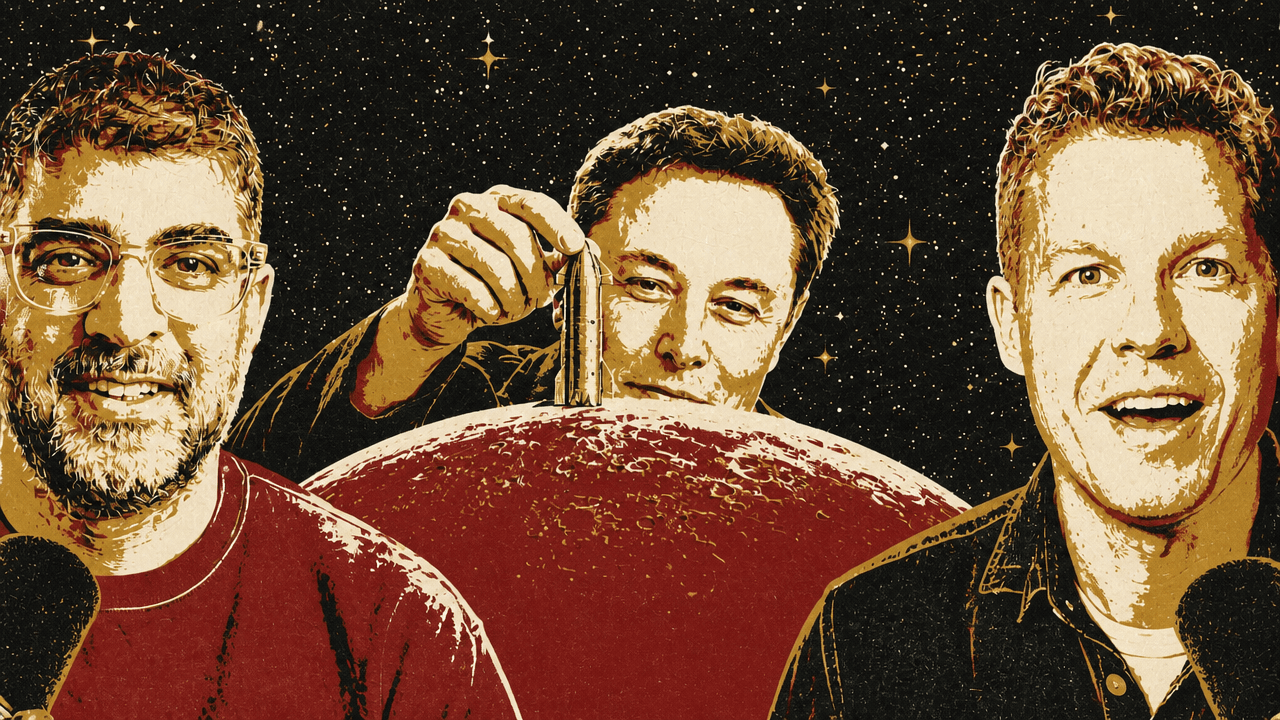
The investable core is Starlink and launch; the underwriting problem is everything bolted around them
Shaan Puri framed the SpaceX IPO around one central tension: at a proposed valuation of roughly $1.75 trillion, the company looks extreme under ordinary valuation math, but less obviously irrational to investors who treat Elon Musk’s execution history as part of what they are buying.

The simplified version is this: Starlink and launch are the operating core. Starlink is the cash-generating satellite-internet utility. Launch is the infrastructure moat that makes Starlink possible and keeps competitors at a distance. The rest of the public-market story — Starship, orbital data centers, xAI, X, Terrafab, Mars, and future resource extraction — is what turns a strong space-and-connectivity company into a trillion-plus-dollar security priced for several difficult things to work.
At the proposed valuation, Puri said, buyers are looking at something like 100 times revenue. In the Munger-style deck he built for himself, the price was shown as roughly 60–70 times forward revenue and about 107 times trailing sales, while the combined company still had operating losses. That framing matters because the price is not based on the 2026 business standing alone. It assumes a much larger 2030 version: Starlink has to scale materially, Starship has to become reusable at commercial scale, and orbital compute or Mars-related businesses have to become economically meaningful.
Sam Parr tried to make the word “trillion” legible by translating money into seconds. A million seconds is about 11.5 days. One hundred million seconds is about 3.2 years. A trillion seconds is about 32,000 years. At a roughly two-trillion-dollar scale, Parr said, the number becomes closer to 60,000 years. His point was not valuation precision. It was that “trillion” has become common in AI and frontier-technology discussions even though it remains almost impossible to intuit.


Puri said the IPO would make Musk the world’s first trillionaire “on paper,” because of his stake in the company. But the valuation question is not just whether SpaceX is a rocket company. Puri described the market as split between people who see a wildly expensive, loss-making company and people making what he called the “price to Elon” bet: an Elon company gets a multiple that the same assets might not receive under another founder.
That did not mean Puri treated the price as obviously justified. He repeatedly returned to a Charlie Munger-style checklist: is this in the investor’s circle of competence; how does the investor lose money; where are the incentives; what is the moat; and does the price leave any margin of safety? His answer was mixed. SpaceX includes assets that look exceptional on their own, especially Starlink and the launch business. But the public buyer, in his framing, is not buying those assets separately. The buyer is buying three businesses stapled together: space launch, satellite connectivity, and AI.
| Part of the company | How it was characterized | Key issue |
|---|---|---|
| Starlink | The part that makes money | Recurring, high-margin satellite internet, but growth and ARPU may be slowing |
| Launch / space | The railroad in between | Dominant moat, but Starship is still the hinge |
| AI / X / xAI | The part that burns money | Large compute ambition, but heavy losses and dependence on short-term contracts |
The bull case, as Puri stated it, is that the world will run on compute the way it once ran on oil. If SpaceX becomes the lowest-cost producer of AI tokens by putting compute infrastructure in space, it could become what he called “Saudi Arabia in space.” The bear case is that investors are paying a near-perfect-execution price for a conglomerate with operating losses, massive capital needs, governance controlled by one person, and technical milestones that have not yet been achieved.
Starlink is the cash engine, but its economics still depend on launch costs and customer mix
SpaceX’s launch business is the foundation that allowed Starlink to exist. SpaceX builds rockets, ideally rapidly reusable rockets, and uses them to take payloads into space. Puri said the company dominates launches to a degree comparable to Google in search. The slide analysis put the position at about 85% of global launches, more than 80% of mass to orbit, and a cost of about $2,700 per kilogram, around 85% below the industry.
That launch advantage matters because SpaceX is not only serving external customers. Puri said a large share of SpaceX launches carry its own Starlink satellites. The launch segment was described as a “genuine moat, hiding inside a loss”: about $4.1 billion in revenue and a $657 million operating loss, with the loss attributed largely to Starship R&D and with many launches carrying SpaceX’s own satellites rather than external customer payloads.
Starlink was presented as the cleanest business in the company. Puri described it as internet service from space, especially useful where traditional internet is poor: rural areas, remote areas, aircraft, boats, and countries where infrastructure has been damaged or blocked during wars. The deck showed about $11.4 billion in 2025 revenue, up 50%, roughly 61% of the whole company; about $4.4 billion in segment operating income; around $7 billion of EBITDA at about 63%; 10.3 million subscribers across 164 countries; and around 9,600 satellites.
Puri called Starlink the cash cow. It has recurring revenue, high margins, a cost advantage, and a product category — internet access — that is basic to modern life. He also said it has little direct competition. But the risks are not theoretical. The U.S. market could add tens of millions of subscribers, Puri said, but much of the larger global opportunity sits in lower-income regions where customers cannot pay U.S.-level prices. The deck showed average revenue per user falling from $99 in the second quarter of 2023 to $66 in the first quarter of 2026, with the explanation that growth is shifting to cheaper tiers and lower-income markets.
The same analysis listed three cracks in the Starlink story: ARPU down by a third, slowing subscriber growth, and a capital-expenditure treadmill because about one-fifth of the constellation must be replaced each year simply to stand still. It also noted that Amazon’s Kuiper was beginning to scale as a competitor. Puri’s own summary was that Starlink had grown from around two million subscribers to more than 10 million, but recent growth appeared to be slowing.
The next Starlink expansion Puri emphasized was direct-to-cell. Instead of requiring a Starlink dish for home internet, satellites would connect directly to a phone. He described the use case as eliminating dead zones: a phone could fall back to satellite service for texts, data, or calls. SpaceX could partner with carriers such as T-Mobile, or eventually become a cell-plan provider itself. The consumer proposition is simple: for a few extra dollars a month, a customer could have guaranteed coverage everywhere.
That possibility is why Puri treated Starlink as more than rural broadband. The market for mobile and home internet, he said, is on the order of two trillion dollars. Existing carriers offer little real differentiation beyond branding and advertising. Starlink’s differentiation would be coverage where others do not work, potentially at lower cost because it avoids some ground-tower buildout.
But the direct-to-cell and expanded Starlink opportunity still point back to launch economics. Puri said SpaceX had already reduced the cost of sending a kilogram to space by 50x or 100x relative to pre-SpaceX costs. The next major step is Starship. If Starship works, he said, it could halve SpaceX’s current launch costs again and dramatically increase payload capacity. Without that step, the broader Starlink, orbital compute, and Mars ambitions become much harder to underwrite.
Starship is the hinge between the current business and the science-fiction upside
Starship was treated as the single most important technical uncertainty in the IPO thesis. Puri described it as SpaceX’s “big ass rocket,” much larger than Falcon 9, with perhaps seven to 10 times the payload. If Falcon 9 could take 10 satellites at a time, he said by way of simplification, Starship could take 70. A SpaceX webpage shown on screen described Starship and Super Heavy as a fully reusable transportation system designed to carry crew and cargo to Earth orbit, the Moon, Mars, and beyond, with a payload capacity of more than 100 metric tonnes in a fully reusable configuration.
The problem is that Starship had not yet fully worked in the way the thesis requires. SpaceX had been building and testing it for years, and if it succeeds, Puri said, it will be one of the most impressive engineering feats in human history. But the key word was “if.” The Munger-style analysis called Starship “the hinge of the entire thesis” and described it as not yet having flown a paying customer. That same slide said SpaceX’s S-1 lists Starship as its number-one risk factor because V3 Starlink satellites, orbital AI data centers, the Moon, and Mars all require full, rapid reusability at commercial scale.
The ambition is not merely reuse, but aircraft-like reuse. Puri described Musk talking about 10,000 launches and implied launch rates of dozens per day. The mental model is not a rocket as a one-off machine; it is an airport. A rocket lands, is turned around, and launches again, in the way an airplane lands, gets cleaned, and is back in the air shortly afterward. Rapid reuse, Puri said, was the key to air travel becoming cost-effective, and SpaceX is trying to apply the same logic to rockets.
Parr’s immediate reaction was that betting against Musk’s technical ability tends to be foolish. Puri agreed in substance: betting against Musk on hard engineering has been an unprofitable bet over the last 20 years, even when critics are right for a year or two. The uncertainty is therefore not whether the vision sounds implausible. It is whether an investor can price both the history of Musk eventually solving engineering problems and the present fact that this particular system remains unproven at commercial scale. As Puri put it, everything depends on Starship, and Starship is not guaranteed.
The downside was stated more concretely in the deck. It noted 11 flight tests, with a 12th scheduled, and said the V3 maiden flight had multiple Raptor engine issues. It also said commercial payloads were targeted for the second half of 2026, but characterized that as “a classic Musk timeline.” The visible text cited analyst Tim Farrar’s view that without reusability, a Starship launch could cost about $100 million, or around $1,000 per kilogram, rather than delivering the dramatic cost collapse being sold. The same analysis said Musk himself had warned that SpaceX could go bankrupt without Starship cheaply replacing Starlink satellites.
That is why Starship is not just a Mars story. It is the infrastructure assumption underneath the entire SpaceX valuation: more satellites, lower launch cost, larger payloads, orbital data centers, and eventually the mission claims around the Moon and Mars. If Starship becomes rapidly reusable, Puri’s bull case becomes easier to understand. If it does not, the company is left with a very strong launch and connectivity business, but not necessarily a $1.75 trillion public-market story.
The AI segment turns a weak media asset into a compute-platform bet
The most surprising part of the combined SpaceX entity, for Parr, was that a rocket company owns X and xAI. Puri described Musk’s combination of assets as a “super company”: SpaceX, Starlink, launches, X, xAI, and a proposed Terrafab chip-manufacturing effort. Parr compared it to pushing two motel twin beds together and calling it a “super bed.” Puri extended the metaphor by saying Twitter was like an awkward extra piece added at the bottom — the part that has not worked as well as the rest.
The X numbers were weak compared with old Twitter. The deck showed X’s ad business running at about 40% of old Twitter’s scale. It listed X advertising at $1.8 billion, down about $100 million year over year and less than half of Twitter’s $4.51 billion in 2021. Subscriptions, including X Premium and SuperGrok, were shown at about $1 billion ARR across 6.3 million paying users. The whole “AI” segment — X ads, subscriptions, Grok API, data licensing, and compute sales — was shown at about $3.2 billion. The same material listed 550 million monthly actives and 117 million users touching Grok, with the note: “Engagement is there; monetization isn’t.”
Puri’s interpretation was that X as a media and advertising business had not really worked. Musk, in his telling, then “failed forward”: X’s data could help differentiate Grok. When Grok itself lagged Anthropic and ChatGPT, Musk used the AI effort to build Colossus, a massive GPU data center. Puri argued that Musk’s deeper advantage may be “building the machine that builds the machine” — factories, production systems, and now data centers.
The problem is demand. Puri said Grok has around 100 million users while ChatGPT has around a billion, making it roughly 10 times smaller by that measure. So Musk turned Colossus into rented infrastructure. Puri said xAI had announced major compute deals, including with Anthropic and Google, that together could be worth $20 billion or more, with payments around a billion dollars a month to use the data center. He stressed, however, that these were short-term agreements that could be canceled with roughly 90 days’ notice.
The deck labeled those deals “the bull’s rebuttal on AI.” It described an Anthropic cloud-services deal worth about $1.25 billion per month for Colossus capacity through May 2029, or about $15 billion annualized, roughly five times the AI segment’s trailing revenue. But the caveat was explicit: either side can walk on 90 days’ notice. The same analysis described a Cursor option: a compute deal plus a 30-day option to buy Cursor at a $60 billion implied value after the IPO, with coding data feeding back into Grok. Walking away, the analysis said, would cost roughly $10 billion, made up of a $1.5 billion fee and about $8.5 billion in deferred services.
| AI asset or deal | Upside described | Caveat described |
|---|---|---|
| X / Twitter | Data, users, subscriptions, and distribution for Grok | Ad revenue is far below old Twitter levels |
| Grok | AI product tied to X and data licensing | Behind larger AI products by usage, according to Puri |
| Colossus | Large GPU cluster that can be rented to major AI labs | Large customers may cancel on 90 days’ notice |
| Cursor option | Potential coding-data and AI-product asset | Option structure includes large walk-away costs |
Puri also described Terrafab as Musk’s attempt to get ahead of what he sees as the global chip bottleneck. If current chip manufacturers are booked out years in advance and the world needs more chips for AI, the simplified version of the Musk response is: build the largest chip factory in the world, preferably in the United States.
But the most ambitious AI idea was not terrestrial chips or rented GPUs. It was data centers in space. Puri said SpaceX’s investor presentation was “all about” orbital data centers. The idea sounded absurd to both hosts at first: why build data centers in space when Earth has room? Puri’s answer was that the constraint is less physical space than regulation, permitting, and anti-data-center backlash. He argued that it may be easier for Musk to solve the engineering problem of launching heavy rockets and building space infrastructure than to get local approval for a data center on land.
The physics argument, as Puri summarized it, is that the future economy needs enormous numbers of AI tokens. The production chain becomes: take energy from the sun and turn it into AI tokens. In space, a satellite can be powered by the sun, and the cooling problem may be simpler because of the environment and radiative cooling. Puri acknowledged that some people dispute this, but said Musk believes it is solvable and that streaming AI tokens from space could become cheaper and more effective than ground-based compute.
For Parr, the language itself was the point. The phrase “go to space to create AI tokens” sounded like a new language compared with the business vocabulary of only a few years earlier. He compared the scale of the audacity to Joey Chestnut eating 70 hot dogs when the previous record was 19: not just an engineering feat, but a personality feat.
The consolidated numbers show a strong utility inside a capital-hungry conglomerate
The high-level financial picture for FY2025 was large but not clean: $18.7 billion in revenue, up 33% year over year; a $2.6 billion operating loss; $6.6 billion in adjusted EBITDA; $20.7 billion in capital expenditures; $6.8 billion in operating cash flow; $15.9 billion in cash as of March 2026, down from $24.7 billion; $29.1 billion in total debt; and $28.4 billion in backlog. The “tell” was the gap between $6.8 billion of operating cash flow and $20.7 billion of capex — about a $14 billion hole filled with debt and preferred equity. The same slide said cash fell $8.8 billion in a single quarter.
| Metric | Figure shown | Why it mattered |
|---|---|---|
| Revenue | $18.7B | Large top line, shown as up 33% year over year |
| Operating loss | ($2.6B) | The consolidated company was still loss-making |
| Adjusted EBITDA | $6.6B | A favorable profitability measure that both hosts treated skeptically |
| Capex | $20.7B | Shows the scale of spending required by the combined business |
| Operating cash flow | $6.8B | Leaves a roughly $14B gap versus capex |
| Cash | $15.9B from $24.7B | Analysis said cash fell $8.8B in a single quarter |
| Total debt | $29.1B | Part of the financing picture behind the capex-heavy model |
| Backlog | $28.4B | Future contracted business shown in the analysis |
The framing was that Starlink is the strong business inside the structure, while AI consumes large amounts of capital. The AI segment was shown at about $3.2 billion of revenue, up 22%, against about a $6.4 billion operating loss, with R&D rising 331% to around $5 billion. It included Grok, X, data licensing, and Colossus. Of $20.7 billion in 2025 capex, about $12.7 billion — 61% — went to AI. In the first quarter of 2026 alone, AI capex was shown at about $7.7 billion.
Parr focused on adjusted EBITDA. He explained EBITDA as earnings before interest, taxes, depreciation, and amortization, then argued that “adjusted EBITDA” can become a way to remove expenses that keep recurring. His household-budget analogy was that a family might repeatedly dismiss vacations, gifts, or car purchases as one-offs, only to realize after several months that “one-off” expenses are simply part of the real budget.
Puri agreed with the skepticism. He said Buffett and Munger famously disliked EBITDA, calling it “bullshit earnings,” and argued that depreciation is especially real in a capital-intensive company. For software companies, he said, the logic might differ. But SpaceX is not a software company. It spent around $20 billion in capex over the prior 12 months, and depreciation reflects real economic cost. He also criticized add-backs for stock-based compensation: if stock is how the company pays people to do the work, he asked, why should it keep being added back?
Parr found other oddities in the filing. He said SpaceX owned around $2 billion of Bitcoin and suggested some adjustments related to Bitcoin price declines. Puri joked that he needed an “adjusted net worth” that excludes his bad investments. Parr also noted Musk’s recurring use of “420” references in share prices or valuations, calling out examples such as $42.20 and possible $42 billion references. Puri dismissed that as the “most try-hard” part of Musk.
The deeper issue was comparability. The deck said xAI, which had already swallowed Twitter/X, was folded into SpaceX in February 2026, and that under common-control accounting the company could recast all three businesses back to 2023 as if they were always one company. The warning was that headline numbers blend rockets, satellite subscriptions, X ads, and Grok. “There is no clean before-and-after,” the analysis argued, “to check the story against.”
Control, compensation, and founder risk are inseparable from the investment case
The IPO’s governance structure was presented as unusually founder-controlled. Shaan Puri said Musk owns about 42% of the economics and has roughly 85% of the voting control. He contrasted that with Aaron Levie at Box, who Puri said owned about 4% when Box went public, even though Box was far less capital-intensive than rockets. Musk’s retained ownership struck him as remarkable after two decades of building a business that required enormous capital.
The deck described Musk as holding 85.1% of the voting power through 10x Class B shares, while public shareholders buy Class A shares with one vote and no real control. It also said SpaceX would be a controlled company under Nasdaq rules and would opt out of the requirement for a majority-independent board. Musk was listed as CEO, CTO, and chairman of SpaceX while also running or being associated with Tesla, xAI before the merger, the Boring Company, and Neuralink. The analysis further noted that Musk had pledged Class A shares as collateral against personal loans.
The Munger-style critique was not that owner-operators are bad. The slide said Munger tolerated and even liked skin in the game. The issue was lack of recourse. With 85% of the votes and an opted-out independent board, the minority shareholder is a passenger.
Puri then turned to Musk’s compensation package, which he treated as both astonishing and consistent with Musk’s previous incentive structures. He compared it to Tesla’s once-mocked compensation plan, where Musk would be paid only if the company hit targets that many observers considered impossible. When Tesla did hit them, Puri said, critics objected to the size of the payout.
At SpaceX, one award is called the Mars Award. Puri said it would give Musk one billion shares, worth $135 billion at a $135 IPO price but far more if all milestones were achieved. The total grant value, as he described it, could be around $750 billion if the relevant milestones are met. The required milestones are extraordinary: SpaceX must reach a $7.5 trillion market cap and establish a permanent, self-sustaining colony on Mars with at least one million people.
The second award, the AI CEO Award, involves about 300 million shares. Puri described it as the “consolation prize,” though still enormous. The company would need to reach a $6.5 trillion valuation and deliver 100 terawatts of compute per year from non-Earth data centers. To put the figure in context, Puri asked Parr to guess current U.S. power capacity in terawatts. Parr guessed 50. Puri said it is about one. The award therefore requires something like 100 times the entire U.S. grid, delivered from space data centers.
Parr’s reaction was that the biggest risk might simply be Musk’s death. Puri agreed that, given their discussion, it was strange but revealing that the more salient perceived risk was not whether Starship or orbital data centers can work, but whether the person driving them remains alive and functioning. Parr said that as a shareholder, one would want Musk to have a dietitian and sleep coach. Puri countered with the possibility that the same wildness that creates the fighter may be necessary to the performance; if Musk were put on a controlled schedule, he might not be the same operator.
That founder-dependence cuts both ways. It is part of the premium, because investors are underwriting Musk’s history of eventually making hard engineering work. It is also part of the risk, because the company’s public valuation, governance, compensation, and strategic sprawl are all tied to one person.
The mission and cap table explain why the Musk premium persists
Sam Parr read SpaceX’s mission from the filing: to make life multiplanetary, understand the true nature of the universe, and extend the light of consciousness to the stars. He said the filing also describes species-level redundancy, so consciousness is not tied to one planet and humans do not share the fate of dinosaurs. Parr contrasted that with the ordinary mission of most businesses, which he reduced bluntly to moving money from the customer’s bank account into the company’s bank account.
He was not mocking the mission. Parr said he thought it was “awesome,” “inspiring,” and useful for recruiting and motivating employees. He invoked the story of a NASA janitor in 1968 who, when asked what he did, said he was helping get to the moon. Parr connected that to reporting he had seen about blue-collar SpaceX workers and the wealth the IPO would create for them. A tweet shown on screen said the IPO was expected to create 4,000 new millionaires, including some cafeteria workers whose compensation packages included employee stock options.
That wealth creation reinforces the company’s mythology: extreme mission, extreme technical ambition, and extreme financial outcome for people who joined the institution. Parr wondered what all the new wealth from SpaceX, Anthropic, and ChatGPT-related companies would do to housing prices, especially in places such as San Francisco.
The cap table also illustrated the premium attached to concentrated belief in Musk. Shaan Puri named Antonio Gracias as the second-biggest individual shareholder, with roughly 7% through Valor. He described Gracias as a long-time Musk ally who became valuable because he understood manufacturing and production bottlenecks. According to Puri, Gracias helped in the early days of Tesla and SpaceX and once personally loaned Musk about $1 million when Tesla was near the brink. At the IPO valuation, Puri said, Gracias could make around $90 billion.
Parr brought up Gigafund, which he described as effectively built around one idea: raise money and invest in Elon. Puri read from an email sent by someone formerly at Founders Fund, where Luke Nosek had worked before starting Gigafund. The email’s point, as Puri summarized it, was that Nosek recognized the optimal strategy was to back every Elon company and not overcomplicate the job. Puri drew a broader lesson: investors often seek sophistication and activity, but in many cases the powerful move is to pick the right horse and sit still.
Two other examples sharpened the same point. A tweet shown on screen estimated that if FTX had not liquidated its investments after collapse, it would still hold stakes in Solana, SpaceX, Cursor, Robinhood, Anthropic, and Genesis Digital worth an estimated $114 billion. Puri said Sam Bankman-Fried had a SpaceX stake that would have been worth about $15 billion and an Anthropic stake worth around $80 billion. The assets were liquidated in bankruptcy, so the winners were whoever bought them out of the estate. Another tweet said the Ontario Teachers’ Pension Plan invested $300 million in SpaceX in 2019, and at a $1.75 trillion IPO valuation that stake would be worth $11.6 billion, or about $33,500 for each of the plan’s 346,000 members.
Those examples were not just gossip about who gets rich. They showed why the valuation premium can persist. SpaceX is being priced not only on financial statements, but on a long-running pattern: people who concentrated behind Musk, tolerated implausible goals, and did not sell were rewarded at a scale that makes conventional diversification look, in hindsight, timid.
The bull and bear cases are both strong because the same facts cut both ways
Puri’s AI-generated Munger verdict was “too hard.” The deck called SpaceX a genuinely great business — Starlink — wrapped inside a capital-incinerating AI conglomerate, run with weak minority-shareholder protections, and priced for a flawless decade. It said Munger would admire Starlink’s economics and the launch moat, but would not underwrite a founder’s three companies at once, fund losses he cannot cap, accept 85% voting control with no recourse, or pay 70 times revenue. What would change the view: Starship reusable at scale, AI losses with a visible floor, multi-tenant compute demand rather than single-contract dependence, and a price closer to the cash-generating core.
| Bull case shown | Bear case shown |
|---|---|
| Starlink is a near-monopoly utility growing 50% at about 63% EBITDA margins | Consolidated operating losses and a roughly $14B annual cash gap funded by debt |
| Launch is a real moat, with about 85% of global launches | Starlink ARPU is down, growth is slowing, and the constellation requires ongoing replacement capex |
| The Anthropic deal could push run-rate meaningfully higher exiting 2026 | AI upside leans on a contract cancellable on 90 days’ notice |
| SpaceX may be the only entity plausibly able to build orbital compute and the space economy | Starship, the linchpin, remains unproven on rapid reusability |
| Betting against Musk on hard engineering has lost money for 20 years | Musk has overwhelming voting control, limited board guardrails, and a related-party maze |
| The company could become the low-cost provider of compute | The valuation prices near-perfect execution through 2030 |
Parr pushed back on the usefulness of ordinary logic. He said he did not think a traditional way of looking at the company fully applies. Puri agreed that an Elon asset is not a normal company and is hard to price. He described valuation multiples by changing “15 times earnings” into “15 years of payment upfront.” In this case, he said, the implied future period is hard to know — perhaps 50 years, perhaps 100 — and the bet becomes inseparable from Musk’s continued existence and execution.
To justify the price, Puri said an investor would have to believe several things at once. Starlink, now around $11 billion in revenue, must grow to $30 billion, $40 billion, or $50 billion over the next five years. Starship must work. Data centers in space must become real. And the world must indeed shift toward compute as a foundational input for every business, consumer, robot, car, and appliance. If those assumptions hold, the company could become the low-cost provider of compute, analogous to the lowest-cost oil producer in an energy-driven economy.
Parr added that the filing discusses future business lines such as mining asteroids, Mars, or the Moon for energy or resources. Puri’s reaction was dry: “Naturally. Mineral mining on the moon.” The exchange captured the central difficulty. The claims sound absurd until placed next to a founder and company that have repeatedly made formerly absurd engineering claims less absurd.
Puri closed the substantive analysis with a broader defense of optimism. In Silicon Valley, he said, pessimism is often a losing strategy around innovation. His phrase was that pessimists get to be right, and optimists get to be rich. Parr put the same idea in probabilistic terms. One of his biggest takeaways from living in Silicon Valley was to use “mostly” and “almost” more often: instead of saying something will never work, say it almost never works, but sometimes it does.
The investment judgment remained unresolved. The Munger-style framework says the IPO is too hard at the price: too many businesses, too much spending, too much founder control, too much dependence on Starship and orbital compute. Parr’s counterweight is that traditional logic may be badly calibrated for a Musk-controlled company. Both positions remain in force. SpaceX, as described, is simultaneously a remarkable business, a mission-driven engineering institution, a capital-intensive AI rollup, and a security priced as if several improbable futures arrive on schedule.