Making Soda, Not Gut Health, Poppi’s Customer Entry Point



Allison Ellsworth argues that Poppi became a more than $500 million beverage brand by treating awareness as its primary operating metric and positioning a low-sugar, prebiotic drink first as soda rather than as a gut-health product. The company accepted years of losses to fund retail expansion, social media, creators and Super Bowl advertising, while using digital demand to support national distribution. Ellsworth says Pepsi’s acquisition solved the remaining constraint: access to beverage channels and distribution systems Poppi could not build alone.
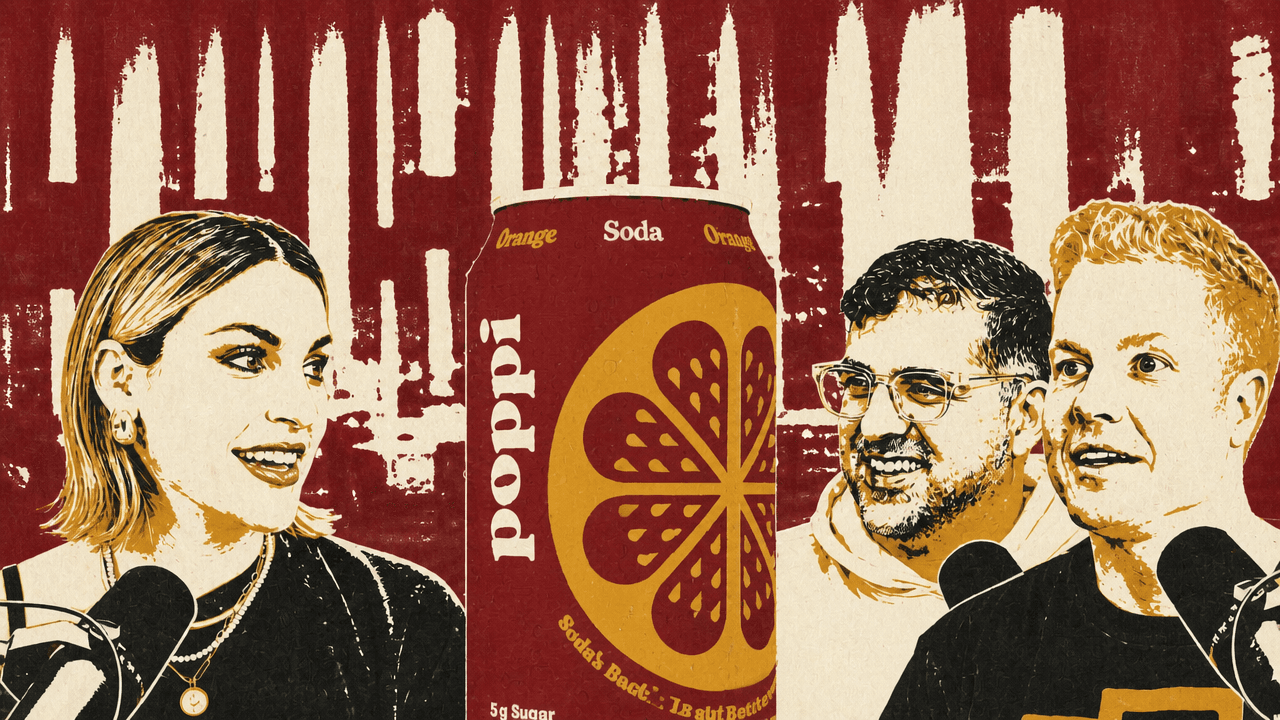
Poppi treated brand awareness as the operating priority, not early profitability
Allison Ellsworth describes Poppi’s growth as “lightning in a bottle.” The company launched under its current name on March 3, 2020, during the first week of COVID, and did roughly $3 million in revenue in its first year. It then grew through approximately $22 million, $50 million, $200 million, and more than $500 million in annual revenue before its sale.


Timing helped. Ellsworth says consumers were newly focused on health, ingredient labels, and what they put in their bodies. But Poppi’s response was not simply to ride a wellness trend. The company made a set of choices about what kind of business it was building: digital-first, retail-oriented, and brand-led.
The product began as Mother Beverage, an apple-cider-vinegar drink Ellsworth made after drinking vinegar for her own stomach problems and deciding it should taste better. For roughly two years, she and her husband sold it at farmers markets. By the time they appeared on Shark Tank, the company had done about $500,000 in revenue, but the operation was under strain. They were working 80-hour weeks, had a child and another on the way, and her husband Stephen held a second job to help pay their mortgage.
The Shark Tank deal gave them more than capital. It gave them time to stop selling, rethink the business, and relaunch. They changed the name from Mother to Poppi, reworked the packaging, and confronted questions that had been secondary while they were trying to manufacture bottles and secure the next sale: Who was the customer? What did the product mean? What category were they trying to enter?
Poppi’s answer eventually became soda. But the company also had to ensure that broad awareness could turn into availability. Ellsworth says Poppi was “100% on Amazon from day one,” despite the difficult economics of selling beverage there, because Amazon put the brand into households across the country. The company treated the channel as an awareness mechanism as much as a sales channel while building toward national retail distribution.
That logic shaped capital allocation. Ellsworth says brand awareness was Poppi’s number-one KPI. A Costco variety pack might have performed best in a spreadsheet with root beer, cream soda, and cola, but if its colors would not create a vivid shelf display, she would reject it. Buyers could find that logic unusual; Poppi treated it as central.
Poppi was not profitable until roughly the year before it sold, according to Ellsworth. That was intentional. The board, senior leadership, and founders chose to keep raising money and reinvesting it in marketing, retail expansion, creators, pop-ups, television, and Super Bowl advertising. A business can starve itself toward profitability, she says, but beverage brand-building is expensive.
If you want to be successful, you have to put your money where your mouth is.
This was not a claim that measurement was irrelevant. It was a decision about which measures mattered at Poppi’s stage. Shaan Puri notes that the company was not principally a direct-to-consumer business; it was retail CPG. In Ellsworth’s account, awareness was meant to support the practical work of getting a product noticed, tried, and pulled through a growing retail footprint—not merely to create a favorable daily acquisition-cost dashboard.


The breakthrough was making soda the front door
Poppi’s original proposition was functional: apple cider vinegar, prebiotics, and gut health. But Ellsworth says the founders were aiming at soda early. Kombucha was declining, she says, and sparkling water did not provide the full-flavor, nostalgic experience people associated with soda. The company had a category hypothesis; consumer behavior made the positioning clearer.
Allison Ellsworth says consumers began using Poppi in the same occasions where they drank soda. The brand’s packaging records the resulting shift. The earlier cans shown in the source led with “Be Gut Happy,” alongside “5g Sugar” and “Prebiotics For a Healthy Gut.” The later package design led with “soda’s back, but better,” while keeping low sugar, calories, and prebiotics as supporting information.
That was not a cosmetic line change. It reversed the order in which the company wanted a shopper to understand the product. Ellsworth describes the intended sequence as: see a can that is “cute”; drink it and think it tastes good; then turn it over and discover the lower sugar and prebiotic attributes. Health benefits remained in the proposition, but they were not meant to be the customer’s entry point.
Sam Parr says he began drinking Poppi more once the prebiotic or probiotic messaging became less prominent. Before that, he had seen it in a grocery store and could not tell whether it was simply another health drink. Ellsworth takes that as an example of the learning that changed the brand: “gut happy” did not establish a clear reason to care. Soda did.


The company’s positioning was therefore stable at one level and changeable at another. Ellsworth calls it an “ever-breathing document.” Poppi’s north star was to revolutionize soda for the next generation and let consumers enjoy it without “all the baggage.” But the expression had to adapt to changes in culture, consumer language, and actual usage occasions.
The root-beer relaunch captures the operating implication. Root beer was too important a soda flavor to ignore, but the brown package did not fit Poppi’s bright, rainbow-like shelf system. Worse, consumers said the flavor tasted bad. Poppi changed both formulation and packaging, then posted negative comments online and told consumers they had made the company change it.
For Ellsworth, this is a founder behavior as much as a branding practice: accepting embarrassment as information rather than treating it as a reason to retreat.
I think embarrassment is the most underexplored emotion when it comes to being successful in life.
The relevant question after criticism, in her telling, is not whether it feels humiliating. It is what the criticism reveals about the product, the message, or the customer’s actual priorities.
Digital demand let a beverage brand reach beyond the usual hubs
Poppi’s TikTok work was not merely creator marketing added to a conventional beverage launch. Allison Ellsworth says the company was among the early founder-led brands to take the platform seriously, when it still felt like the “wild, wild west” of dances, recipes, transition videos, and attempts to go viral.
Ellsworth spent nights and weekends experimenting with content. Rohan Oza, the company’s Shark Tank investor and beverage adviser, did not initially see TikTok as a central commercial platform; Ellsworth says he associated it with young kids and dancers. Poppi kept testing until it found traction.
The payoff, in her account, was a different demand map. Better-for-you beverages often take hold first in cities such as Los Angeles, New York, and Miami, then expand inward. Poppi’s digital-first approach let it develop awareness in markets including Fargo, Cincinnati, and Houston much earlier. At one point, Ellsworth says, Fargo was among the company’s major targets.
Her comparison is between limited in-person sampling and content that can travel. A founder can hand out 30 samples in a Whole Foods, she says, or make content, support it with paid distribution, and put it in front of hundreds of thousands of people through TikTok’s For You Page. That was Poppi’s operating bet: social demand could make a national retail brand feel locally relevant before the traditional sequence of market-by-market expansion.
The company’s cultural orientation extended beyond TikTok. Ellsworth says she does not draw her branding practice from books or self-help routines; she is severely dyslexic and does not enjoy reading books. Instead, she and her team watched social language, meme culture, and cultural “tentpoles” such as Coachella, the Grammys, and summer in the Hamptons.
That was also why Poppi favored hiring young people, particularly Gen Z employees. The point was not youth as a credential. Ellsworth wanted employees who were living inside the cultural moments the brand was trying to recognize—and leaders willing to trust their read of those moments.
A Super Bowl ad made the category unmistakable
The Super Bowl mattered to Poppi only because the product was already broadly available. Ellsworth says it would be pointless to run a Super Bowl spot while present in five stores. By the time of Poppi’s first ad, it was in almost every grocery store in the country.
Allison Ellsworth says Poppi bought its first Super Bowl placement five days before the game. Most advertisers buy much earlier. The company had developed a campaign about the future of soda for linear and streaming media, then saw the finished creative and decided that it belonged in the Super Bowl.
The footage shown in the source makes the intended framing clear: historical imagery, a rocket launch, old televisions, sports footage, and modern social clips resolve into Poppi cans. The creative placed the product inside a broad story of familiar soda culture before introducing its particular version of it.
There was no ordinary inventory left at that point. But large companies can reserve multiple placements and later release unused slots through a secondary market. At a dinner during a TikTok event, Ellsworth heard that one brand might have a slot available. She connected that person with Poppi’s CMO, Andy Judd, and the company bought it.
The timing prevented a conventional activation plan. Poppi could not prepare the usual store program, creator activity, website work, or retail surround. That is why Ellsworth resists offering a tidy all-in cost or return calculation.
The media buy alone can cost between $6 million and $11 million, depending on whether an advertiser buys a 30- or 60-second spot, she says. But that is only one cost. Production requires a director, crew, and other creative expenses; sustaining the impact requires further media. In Ellsworth’s view, people who see a Super Bowl ad should encounter the brand roughly seven more times in subsequent linear advertising.
The first commercial was built to resolve the category question. Shaan Puri reads the spot as positioning: it first placed Poppi within the idea of soda, then introduced the differentiator. Ellsworth says Poppi tripled its awareness overnight. More specifically, the ad used the word “soda” 17 times. Before it ran, consumers often classified Poppi as sparkling water or an ambiguous better-for-you drink. Afterwards, she says, they understood it as soda.
The second Super Bowl campaign, featuring Charli XCX, pursued a different creative effect. Ellsworth characterizes it as “Poppi vibes.” She does not offer a detailed performance calculation and says she does not know the full all-in number. Her account is not that metrics disappeared; it is that the company deliberately pursued category definition and cultural association alongside measurable response.
In familiar CPG categories, 10 to 15% better can be enough
Ellsworth is skeptical of entering a category simply because it is hot. Protein is crowded, she says. Creatine is attracting attention in powders, gummies, and products aimed at women. A late entrant can still succeed, but she believes it has to be better, smarter, or meaningfully different.
Her standard for food, beverage, beauty, and other hard CPG is more modest than Silicon Valley’s “10x better” maxim.
I think that you make the best brands and the best businesses are 10 to 15% better than the established norm.
The reason is emotional familiarity. Soda brings associations with movies, burgers, family, and late nights. Ellsworth says the marketer’s task is to shift buying power from the head to the heart—to make a customer emotionally connected to the brand. In a category with deep habits, a recognizable ritual made a little better may be easier to sell than an entirely new ritual.
That was Poppi’s formula. It did not ask consumers to care first about a long list of functional ingredients. It offered cola, root beer, cream soda, and other familiar flavors with substantially less sugar. Prebiotics were present, but the brand did not require a consumer to become invested in gut-health language before trying a soda.
Ellsworth uses Preston Lane cleaning products as a parallel case. In her description, the brand combines cleaner ingredients with fragrance, packaging, and an aesthetic meant to remain on a counter rather than be hidden under a sink. That is distinct from Blueland’s proposition, which she describes as reducing plastic through reusable tablets. Both operate in cleaning, but they solve different consumer problems.
The common thread is a personal need with mass-market potential. Allison Ellsworth says her undisclosed next company began with a personal need and will target a broad audience rather than a narrow niche. She also sees the GLP-1 era as an underappreciated opportunity, saying she lost 60 pounds on GLP-1s and sees needs that companies are not serving. She does not confirm that GLP-1s are the category of her next company.
The sale was about distribution access as much as price
At Poppi’s scale, the strategic question was not only what the company was worth. It was which partner could take the brand into channels it could not reach alone.
Allison Ellsworth describes beverage M&A as unusually constrained. A company can become too large to be easily acquired and face pressure toward an IPO. But a public beverage company may still need a distribution partner to reach its full potential. Ellsworth identifies Keurig Dr Pepper, Pepsi, and Coke as the three natural buyers in that system.
Poppi had assembled roughly 180 distributors across the United States in a direct-store-distribution model. Those distributors put Poppi on trucks and onto shelves. A deal with a major beverage company could consolidate that network into a single system—the “red,” “blue,” or “purple” truck—and open channels governed by incumbent contracts.
The constraint went beyond delivery. Poppi could be the official soda of the Lakers but still be unable to sell in the arena because of a Coke contract. Ellsworth says it could not enter Madison Square Garden, Taco Bell, Subway, Marriott, and other venues or accounts with established beverage relationships. International expansion would also require teams and systems Poppi would otherwise have to build.
Pepsi had approached Poppi about a year before the sale with an offer that Poppi declined. The companies stopped communicating for more than a year. Once Poppi passed $500 million in revenue, Ellsworth says, the founders reopened the conversation. If the company doubled again, it could become harder to buy because the pool of possible buyers would shrink.
Pepsi offered to purchase 100% of the business. Ellsworth contrasts that with a two-step transaction, in which a buyer acquires a minority stake first and buys the remainder only if future targets are met. The full acquisition was simpler for founders. Pepsi also offered jobs to Poppi employees who wanted them, and Ellsworth says 99.9% of employees held equity.
Due diligence took about six weeks, followed by a 30-day approval period. Ellsworth describes the negotiations as unusually straightforward because Pepsi understood the brand, the data, the story, and the team. The harder part was handing over a business she had built for a decade and waiting to see whether its new owner would protect it. She says she likes what Pepsi is doing so far, while acknowledging that she is still watching.
After the exit, the work became choosing another purpose
Ellsworth’s practical advice to founders begins well before an exit. At roughly $5 million to $20 million in company revenue, she says, founders should begin discussing estate planning, gifting exemptions, trusts, and ownership structure. She and Stephen received financial advice early and sold some shares before the final transaction.
That partial liquidity gave them a nest egg if Poppi never sold, but Ellsworth also says it made them freer to keep taking risks. Their adviser’s view was that they would not regret improving their life earlier if the business later became much more valuable.
The final proceeds did not immediately transform daily life. Ellsworth and Stephen refreshed their accounts, joked about whose payment arrived first, and then returned to Zoom calls. The material changes came gradually through help at home and more control over time with their children.
The more consequential adjustment was the loss of a 10-year mission. Allison Ellsworth says she found more purpose in friendships, wellness, and personal happiness after the sale, but still missed the team, the build, the drive, and the chaos. That is why her next company, in her account, has to be more than an attempt to recreate an exit. It must be a good idea she loves enough to pursue again.