Huang Says Export Controls Must Protect Technologies Without Shrinking U.S. Platforms
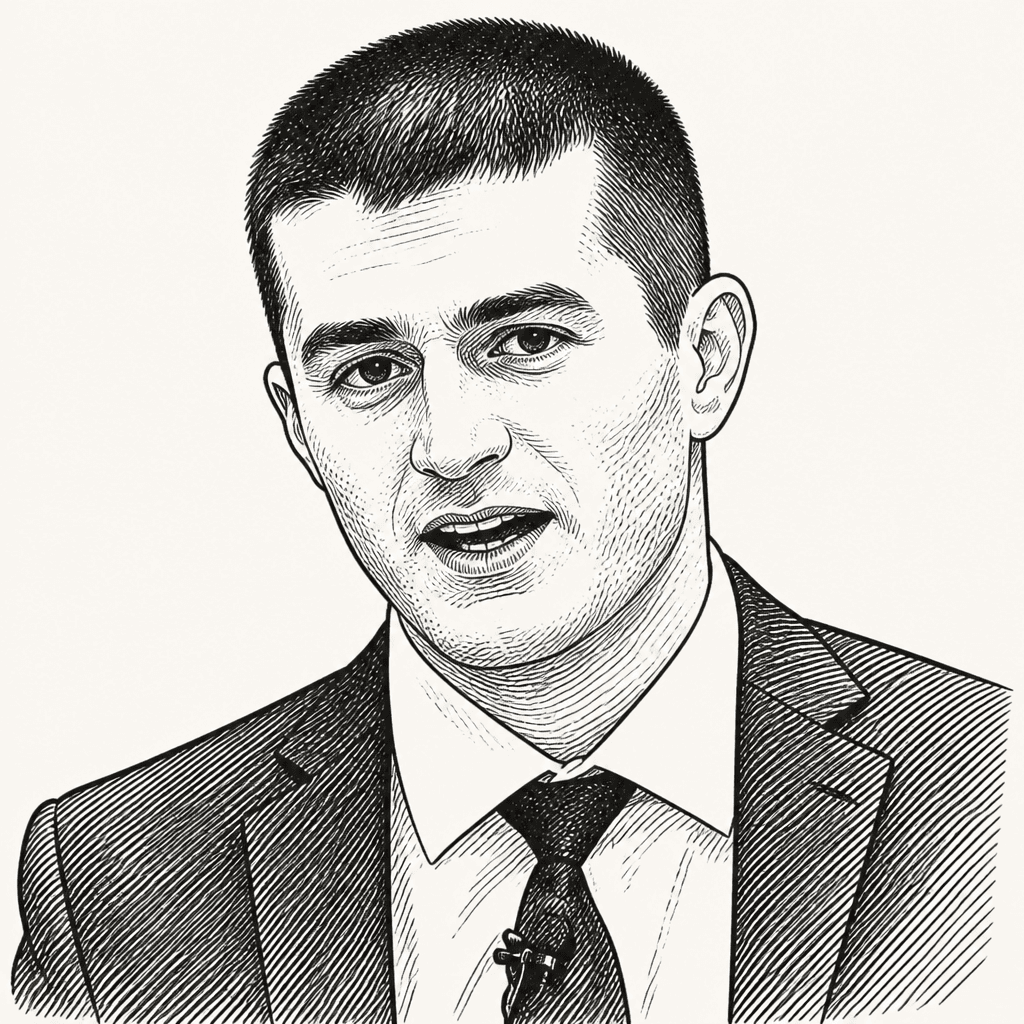
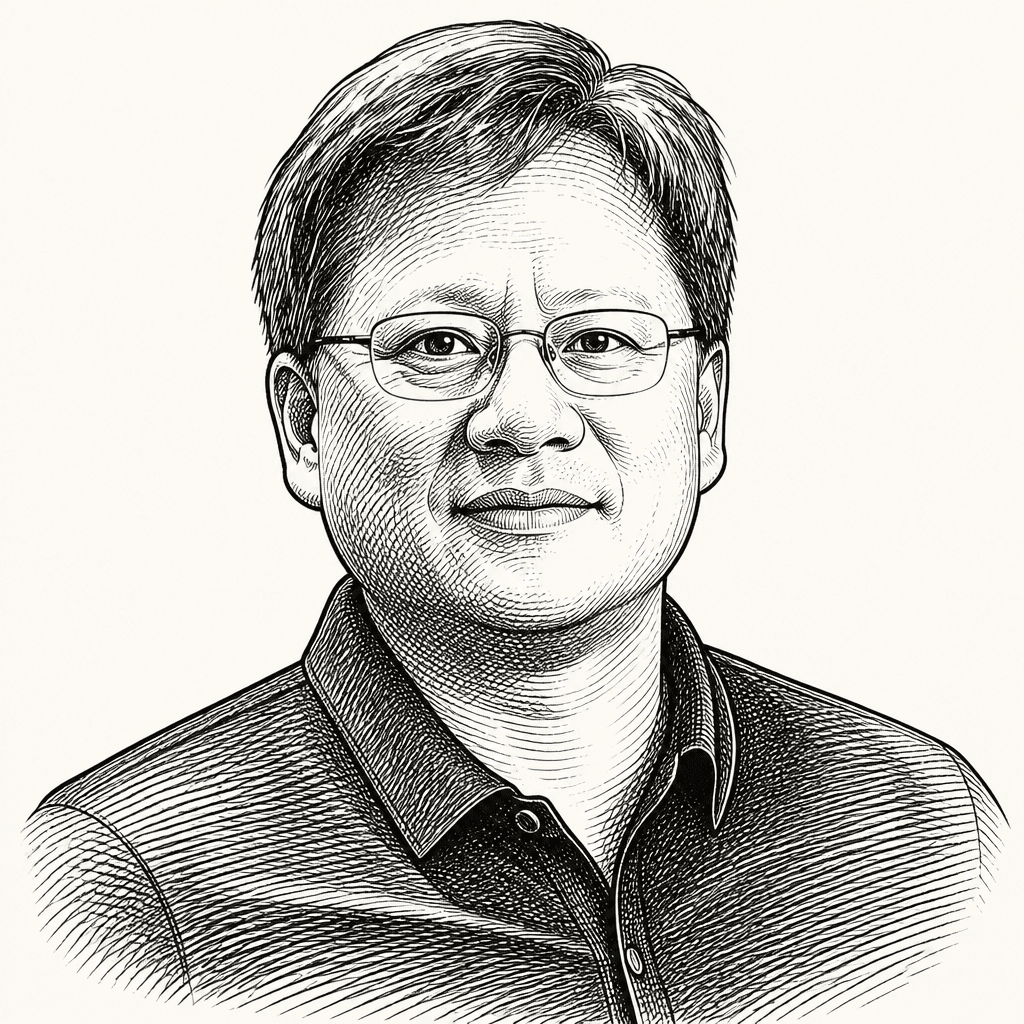
In his Taiwan travel video with Lex Fridman, NVIDIA chief executive Jensen Huang argues that technological leadership depends on more than controlling scarce capabilities: it also requires the customers, partners and industrial networks that help a technology platform grow. He applies that logic to export controls, making the case for selectively restricting technologies while preserving the reach that sustains innovation and prosperity. His account of Taiwan’s semiconductor ecosystem shows why, in his view, that reach depends on international relationships as well as domestic investment.
The export-control question is what kind of advantage the United States wants
Jensen Huang makes a case for restricting some technologies, but argues that restriction alone is not a durable strategy. His distinction is between withholding particular capabilities that matter to national advantage and closing off the broad platform reach that helps American technology companies grow.
Huang’s argument starts with the logic of denial. Rare earths, computer technology, knowledge and intellectual property can act as force multipliers, he said. If one country controls a useful resource, keeping it from another can strengthen the first country’s position. He said that reasoning can apply to some physical resources and to weapons. Lex Fridman summarized the logic as gaining a competitive edge by keeping valuable things out of other hands; Huang agreed.
His counterargument is about the source of lasting strength. Huang said prosperity supports national security and domestic stability, and pointed to the United States’ wealth and technological capacity as mutually reinforcing. A successful technology platform attracts customers. Their use creates an installed base and more demand for the technology, which can generate wealth and support further research and development. In Huang’s account, that feedback loop—not simply a rival’s lack of access—is what helps a country remain ahead.
Technology without customers is useless.
Huang was describing a commercial mechanism as well as a national one. Usage creates an installed base; the installed base creates further demand; and the wealth generated by that demand can support faster technology development. He contrasted that accumulating platform with a finite resource that has no comparable feedback loop. The strategic question, as he posed it, is whether policy is optimizing for a competitor’s lack of access or for the strength of the flywheel at home.
This distinction does not make denial irrelevant. Huang acknowledged that withholding a valuable resource can improve one’s position, and said the argument can hold for physical goods such as refined rare earths, bullets and bombs. But he sees a difference between denying access to a finite asset and limiting the reach of a technology platform that gains strength through customers and use. In the latter case, restriction may affect not only a competitor but also the adoption, customer relationships and wealth that help sustain the platform.
That is why Huang does not describe his position as unrestricted access. He argued for being “extremely selective” about which technologies to withhold, while also preserving the reach of American platforms. A country has the sovereign right to decide how to use the capabilities and resources it has developed, he said. The policy challenge is to exercise that right without sacrificing the customers, adoption and revenue that sustain technological leadership.
The exchange left open the central question of how that balance should be applied to China. Fridman put it directly: does the American flywheel benefit from including China, or from excluding it? Competition can remain a relationship between rivals, he said, but there is a point at which countries become enemies. If that happens, both sides may damage the economic and technological systems that support their strength. Huang agreed that countries should compete, but said they should do everything they can to avoid conflict. Some strategies, he said, push a competitive relationship toward conflict; others help prevent it.
The two described interdependence as one reason conflict becomes harder. Fridman pointed to shared hardware and software, universities, friendships and scientific collaboration. Huang agreed with the underlying point, while widening it: AI is not just a model, but a stack of technologies. Energy, chips, infrastructure, software, models and talent all contribute, and leadership differs from one part of the stack to another. As the discussion put it, no country is simply the sole source of every capability the stack requires.
Huang argued that the United States has an advantage in innovation and in the reach of its technology platforms. He named NVIDIA, Anthropic, OpenAI and Google as examples of American companies, and said that English-language platforms and American standards make those technologies deployable across much of the world. Fridman’s response was that the United States should not take that reach for granted. Closing itself off may bring some benefits, he said, but it also means losing access to global customers and the ecosystem those customers support.
For Huang, the flywheel is powerful but not invulnerable. A platform may take years to build before it reaches a tipping point, and can lose momentum quickly once conditions change. Export controls therefore involve a balance: keep some technologies for national advantage, but preserve enough reach to sustain the economic and research capacity that creates future technologies. The source does not settle how much access to China serves American interests. Fridman called that an open question; Huang’s claim was that denying a competitor access and strengthening one’s own position are not automatically the same thing.
The tension is between two kinds of security. One is gained by withholding a capability that could strengthen a competitor. The other is built through prosperity, technology leadership and the broad use of a platform. Huang’s position is that policy should protect particular technologies where the national interest calls for it, but should not confuse restriction itself with a durable strategic advantage. Fridman’s concern is that the boundary is consequential: once competition turns into enmity, the same interdependence that supports a technology flywheel may be damaged.
Taiwan’s role rests on a wide industrial ecosystem
The export-control debate depends on what the technology stack actually requires. At Computex, Fridman described Taiwan as an island responsible for more than 90% of the world’s most advanced semiconductors. He noted that Taiwan is mountainous and that its population is concentrated on a small share of its land. He also said the island’s semiconductor position has technological and geopolitical consequences that will last for years.
Fridman pointed to engineering’s place in Taiwanese culture and education as part of the explanation. A chart shown during his remarks compared the share of university graduates in engineering, manufacturing and construction: 21% in Taiwan, 13% in the international average shown, and 7% in the United States. For all science and engineering fields, the displayed figures were 34%, 24% and 22%, respectively. He presented those figures alongside culture and education as possible parts of an explanation, not as a complete account of Taiwan’s position.
The industrial network on display at the conference made the breadth of the ecosystem visible. An NVIDIA graphic placed the company among firms grouped by equipment, memory, packaging, interconnect, systems, power and cooling, cloud providers, AI labs and robotics. It named companies across those categories, including TSMC, ASML, SK hynix, Micron, Foxconn, AWS, Microsoft Azure, Google Cloud, OpenAI and several robotics firms. Huang’s broader claim was that the companies and capabilities around the island would need to participate in the next expansion of computing.
“If we’re going to go build and sell a few trillion dollars of computing over the next several years,” Huang said, “this entire island has to be part of it.” He said companies across the ecosystem would have to invest hundreds of billions of dollars over the coming years. The first requirement, in his account, was that they understand the opportunity, feel inspired to take part and see how they might benefit. His keynote was intended to compress that case into as few words as possible.
Huang traced the industrial history further back, while qualifying his recollection. He said Kwoh-Ting Li, a government minister, had a vision in the 1950s to bring science, technology and technology manufacturing to Taiwan, and that Li’s vision helped bring Morris Chang back to the island. Huang then said, “I forget exactly how the history went,” before recalling a connection to Philips. As he remembered it, Philips was the parent company that spun off the fab that became TSMC and the semiconductor manufacturing-equipment business that became ASML. He described Philips as a major consumer-electronics company—“the GE of Europe”—and said that somehow Li attracted it to Taiwan. Huang called that involvement the beginning, but explicitly did not claim to remember every detail.
The personal-computer industry created another opening. Huang said IBM published specifications for its PC-compatible chipsets. Taiwanese engineers could design chips to those specifications, and local foundries could manufacture them. In his account, that helped make components available to a wider range of computer makers. He gave Michael Dell as an example: Dell bought motherboards from Taiwan, assembled them into PCs and licensed an operating system from Microsoft. Taiwan’s manufacturing and the open specifications together gave new PC makers a way to enter the market without building every component themselves.
The history points to a wider pattern: Taiwan’s position depends on manufacturing, design, skills and business relationships, not a single company acting alone. Fridman recalled a Taiwanese woman telling him that, as a girl, she learned to spell “CoWoS” before “Gucci.” Huang said the line captured something about the value of engineering in the culture and about what people considered cool. CoWoS came up as one example of specialized packaging used in advanced chip systems. The diagram shown during the exchange depicted logic chips and high-bandwidth memory arranged side by side on a silicon interposer.
NVIDIA’s own work in Taiwan is one part of that network. Huang said the company had about a thousand people there, working in supply-chain and systems engineering, operations, packaging and testing. Fridman said they were building a local facility that could hold 4,000 people. Huang described the local workforce in practical terms: “A lot of systems engineering,” along with packaging and test engineers. The company’s Taiwan presence, as they described it, reaches well beyond chip design.
The US effort to expand semiconductor manufacturing at home was another example of interdependence. Huang said the AI boom could be an opportunity for the United States to invest in its grid, sustainable energy, manufacturing and robotics. With demand high enough, he argued, firms could manufacture in the United States as well as elsewhere. But he also said that building world-class semiconductor manufacturing in the US is difficult because there is not enough talent in the field.
Fridman mentioned that TSMC staff had urged him to visit Arizona. Huang said Taiwan was a strategic partner in US reindustrialization: as the United States tries to establish fabs, Taiwanese companies invest and send engineers to train local workers. A visual shown during the discussion described Taiwanese engineers moving to Arizona to train chip workers and pointed to plans for fabs, packaging and research and development facilities there. Huang’s emphasis was not that the US effort could be done without outside help. He argued that building domestic capacity and relying on an international partner could happen together.
Huang’s account makes the idea of a national technology base less self-contained than the phrase can suggest. Taiwan’s chip production depends on equipment, materials, packaging, memory, systems and customers; the AI stack in turn depends on energy, software and talent spread across different regions. His argument for US manufacturing was not that every part of that system should be brought within one country’s borders. It was that demand creates an opportunity to build capacity in the United States while working with a partner that has accumulated manufacturing expertise and is willing to help train workers.
Huang chose TSMC for its principles, then kept the relationship flexible
Huang’s account of NVIDIA’s early relationship with TSMC gives a specific example of the long-term ties behind the semiconductor ecosystem. In the mid-1990s, NVIDIA was a startup looking for a foundry. Huang recalled that many companies were entering the foundry business as the PC industry expanded, but capacity was scarce. Some foundries required companies to license their technology in exchange for access. NVIDIA approached SGS-Thomson and also learned about TSMC and UMC, which, he said, offered manufacturing without the same strings attached.
Huang found TSMC’s US office in the Yellow Pages and called. He reached a recording, left his name and number, and described NVIDIA as a new company building computer graphics chips. He called several times without receiving a response, then wrote Morris Chang a long letter. Eventually, Chang called him at the office. Huang remembered colleagues playing video games nearby and asking them to be quiet: Chang was on the phone. Huang was relieved that a foundry had called back, because, as he put it, “maybe we won’t have to die.” Chang invited him to Taiwan, and Huang said that visit began a partnership that would last for decades.
The two Taiwanese companies were near one another, Huang recalled, and he visited UMC before TSMC. He said both were gracious and both were strong companies. What distinguished TSMC for him was Chang’s willingness to be clear about what the company could not do, alongside his emphasis on governance, integrity, partnership and long-term thinking. Chang told Huang that if the companies worked together, TSMC would “jump through hoops” for NVIDIA. Huang said it had kept that promise for 30 years.
For Huang, the decision was about more than finding a factory with capacity. Building a chip with a foundry involves technical problems and choices that cannot all be anticipated at the start. “You really are choosing not what to buy, but who to work with,” he said. The relationship has to be able to adapt as the work develops.
He said NVIDIA and TSMC have worked together for 30 years. Trying to specify every possible outcome in advance, he argued, can make a partnership brittle. The more detailed an agreement becomes, the more easily it may fail to account for what the parties could not know at the outset. Huang prefers leaving room to discover how to work through problems. He called the result “rough justice”: at some points one party may benefit more than the other, but over time the balance can work out.
“Rough justice” is not the claim that each transaction is equal, or that the parties can avoid disagreements. Huang described an arrangement in which the outcome of any single decision may favor one side, while the parties continue working together through changing circumstances. In a long-running technical partnership, the next challenge is not always visible when the initial agreement is made. The relationship has to leave space for problems to be discovered and resolved, rather than treating every unknown as something that can be written into a contract in advance.
Huang compared an exhaustive agreement to an “ironclad pre-nup”: the more specific it becomes, the more brittle the relationship may be. His alternative is to keep the arrangement loose enough for both parties to adjust as they learn. That flexibility is not simply informality for its own sake. He said the parties are building a chip together, not buying an off-the-shelf product. Because it is difficult to know all the relevant details up front, the ability to work through unforeseen decisions is part of what makes the partnership valuable.
That approach depends on each side wanting the other to succeed. Huang said he wants NVIDIA’s employees, its suppliers and people at other companies to do well. Goodwill, he argued, is not a zero-sum game. In a partnership, he said, each side needs to know that the other wants it to win. He described that as something expressed in everyday business decisions and in efforts to help partners become stronger companies—not just in what the contract requires.
He also warned against trying to make every other company lose money so that one company can capture the entire benefit. On the island, he said, that kind of reputation is remembered. “Always leave something on the table,” he advised, and keep other companies’ sustainability and success in view. In his view, partners’ willingness to invest and perform is tied to whether they believe the relationship allows them to succeed too.
Huang used an example from the previous year to make his point. He said companies across NVIDIA’s supply chain had seen their stock prices rise 300%, while NVIDIA’s stock price had stayed flat. He said the relative performance was not something he was happy about in itself, but connected it to the scale of NVIDIA’s platform and its ability to create growth around it. His broader point was that a company’s success can allow its suppliers and partners to grow too.
That argument returns to the flywheel: a platform depends on its customers and partners, and its growth can create room for the surrounding companies to invest and expand. Huang said NVIDIA was built on top of TSMC’s platform and Taiwan’s broader platform. The relationship, in this account, is not merely a way of buying manufacturing capacity; it is part of the structure that makes the company’s products possible.
Fridman extended the principle beyond suppliers, saying that wanting partners, friends and employees to succeed over the long term can lead to one’s own success. Huang’s story gives that idea a specific business form: a company chooses a partner whose principles it trusts, makes room for uncertainty, and tries to ensure that the value created by their shared work can sustain both sides. That does not mean every outcome is even. It means the relationship is judged across time rather than by whether each individual exchange is perfectly balanced.
The AI buildout depends on physical infrastructure, not models alone
At Computex, Huang described AI as a five-layer structure: energy, chips, infrastructure, models and applications. The graphic presented those layers as a cake. Huang’s formulation puts energy and chips underneath the systems and software people more readily identify as AI. His accompanying argument was that AI requires the whole stack: “You can’t have AI without energy,” he said, and leadership and capabilities differ across the layers.
That framing also explains why Huang called for investment across Taiwan’s industrial base. He said the coming buildout would require companies throughout the island’s ecosystem to invest hundreds of billions of dollars over several years. He wanted those companies to understand the opportunity and how they could benefit from it. The keynote was a way to make the scale of the buildout legible to businesses that would have to contribute to it.
Huang told Fridman he was very nervous before the keynote, as he is before public speaking generally. He said he does not take the responsibility for granted and wants to do a good job. The keynote comes together late, he said, so he cannot practice it fully; he does not know exactly what he will say and does not use a teleprompter. The performance was therefore not, in his telling, a recitation of a fixed script but an attempt to convey a case he had to bring together under time pressure.
The product demonstration offered a concrete view of what the buildout involves. Huang showed Fridman NVIDIA’s Vera Rubin NVL72 rack and pointed to its cableless design. He said the rack was fully liquid-cooled, compared with 80% liquid cooling in the previous Grace Hopper generation, and that assembly time had fallen from two hours to five minutes. Someone with him confirmed that the system was in full production. Huang linked easier assembly to reliability: “Things that are easy to build are also reliable.”
The demonstration also touched on the CPU included in the system. Fridman referred to a displayed comparison showing Vera running an agentic sandbox workload 1.8 times faster than x86. The graphic identified the result as NVIDIA’s own test. Huang’s explanation focused on what he saw as a change in the economics of computing.
He said hyperscale x86 CPUs had been designed for a market in which computing was rented, making the number of CPU cores a central economic measure. In AI, he argued, customers do not rent cores; they generate and sell tokens. The goal is to move through the computing loop as quickly as possible and generate tokens faster. Fridman summarized the logic as “the more you buy, the more you make.” Huang agreed that it was a good line, while distinguishing the simple business model from the complicated technology behind it.
A presentation slide linked “useful life” and “tokens/watt” under the heading “Compute Is Revenue.” That pairing captures the business question Huang was describing: how much useful work a system can produce, and how efficiently it can produce it. His account treats computing capacity not simply as an expense or a stock of cores, but as infrastructure for generating output that customers can sell.
The conference also showed how the AI boom sits alongside older parts of NVIDIA’s business. Huang said the company’s roots were with gamers and recalled some of his happiest moments playing video games on NVIDIA hardware. Fridman saw the attention paid to Huang at Computex as a sign that engineers were being treated like rock stars. Huang’s answer was to emphasize the audience and the work: gamers are among the most passionate people, he said, and NVIDIA should not forget where it began.
A brief exchange about mechanical keyboards supplied a different note. Huang said he liked the feel of the keyboards on display and found typing useful for thinking. Fridman predicted that voice control would be more common in the future; Huang agreed that it might be, but said he had a hard time thinking when he was only talking. Fridman replied that speed was not everything and that sometimes a person needs to pause and think. The exchange remained a small conversation about their preferences, rather than a claim about how work should be organized.
The night market made engineering culture tangible
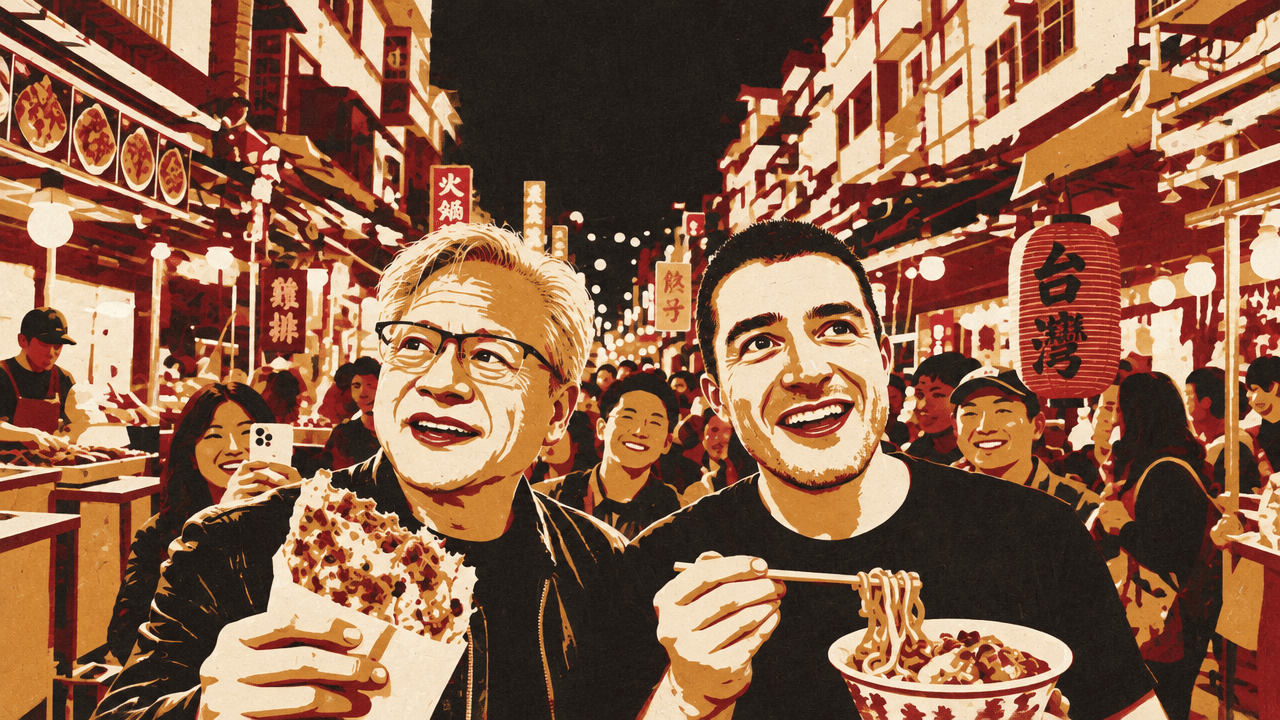
At Raohe Night Market, Huang and Fridman moved among stalls, sharing food as crowds recognized Huang. Fridman compared the attention to the Beatles in the 1960s. Huang joked that the Beatles had talent, but elsewhere described being overwhelmed when several thousand people lined up to see him. He said the crowd’s capacity for generosity, kindness and helping other people was one reason Taiwan’s companies were at the center of the supply chain. Fridman added the willingness to work hard; Huang agreed that the combination mattered.
That explanation echoed a point Fridman had made about engineering in Taiwan. He described meeting engineers as humble, despite the importance of their work, and said he had seen a similar quality among AI researchers he met in China. Huang agreed that humility mattered. The night market gave Huang a setting in which to describe what he valued: hard work, kindness and attention to craft.
One meal brought back a childhood memory. Huang said his parents took him to night markets because that was what going out to eat meant when the family did not have much money. When he was nearly five, he wandered away while looking for a restroom and cut his face on a cook’s knife. His father picked him up and ran him to the hospital. Huang said he still had fond memories of the market after the accident, in part because the food was so good.
The memory led him to talk about the people who prepare it. Huang described stallholders working hard for a living and offering something to customers even when their profit on an item might be very small. He saw kindness in that exchange, and he liked watching people practice their craft. Fridman compared the vendors to Jiro Ono, the sushi chef whose work was the subject of a documentary; Huang agreed that there were many “Jiros” at the market, people who had been making the same food for years.
Huang’s remarks about the market were not only about nostalgia. He noticed the repeated labor behind each dish: the vendors’ practiced preparation and their willingness to serve customers while working long hours. At the NVIDIA employee gathering, he made a related point about the people around the company. The press had been working through dinner, he said, and they needed care too; he was shown handing them food. Fridman noted that the crowd’s cheers came after Huang had spent many hours on booth tours. Huang described the generosity of the people around him as part of what made the island’s companies central to the supply chain.
The food itself sometimes became a way for Huang to explain what he liked about Taiwanese cooking. At one market meal, he pointed out the springy texture of a fish ball and used the word “QQ” for the chewiness he prized in foods such as fish balls, noodles and sesame balls. Earlier, he had described a similar quality in noodles and sweet potato balls. Fridman asked whether QQ was a compliment; Huang confirmed that it was. This detail mattered less as a catalogue of dishes than as an example of Huang’s attention to texture and to the local terms people use to describe it.
A different exchange about food came at dinner, when the number of dishes exceeded what the group could easily finish. Huang said that in some cultures, leaving food can be a way to show the host has been generous; eating everything may suggest that the meal was not enough. Fridman called it an optimization problem. Huang agreed: the right response depends on the culture and on whether the priority is showing appreciation for the food or allowing the host’s generosity to be visible.
That exchange offers a concrete point about cultural difference without requiring a broader conclusion: an apparently simple act—finishing a plate—can carry different meanings at different tables. Huang’s account of generosity at the stalls and hospitality at dinner was his own framing of what he was experiencing in Taiwan.