Reagan’s Defense Buildup Pressured a Weakening Soviet Union Into Concessions


In *Peace Through Strength: How Reagan’s Military Buildup Won the Cold War*, Reagan Institute director Roger Zakheim argues that Ronald Reagan’s defense buildup grew from a strategy he had developed years before taking office: military strength, he believed, could deter conflict and pressure the Soviet Union to negotiate. Zakheim says Reagan held to that course despite political and budgetary costs, and that the pressure helped push Soviet leaders toward concessions as their system weakened.
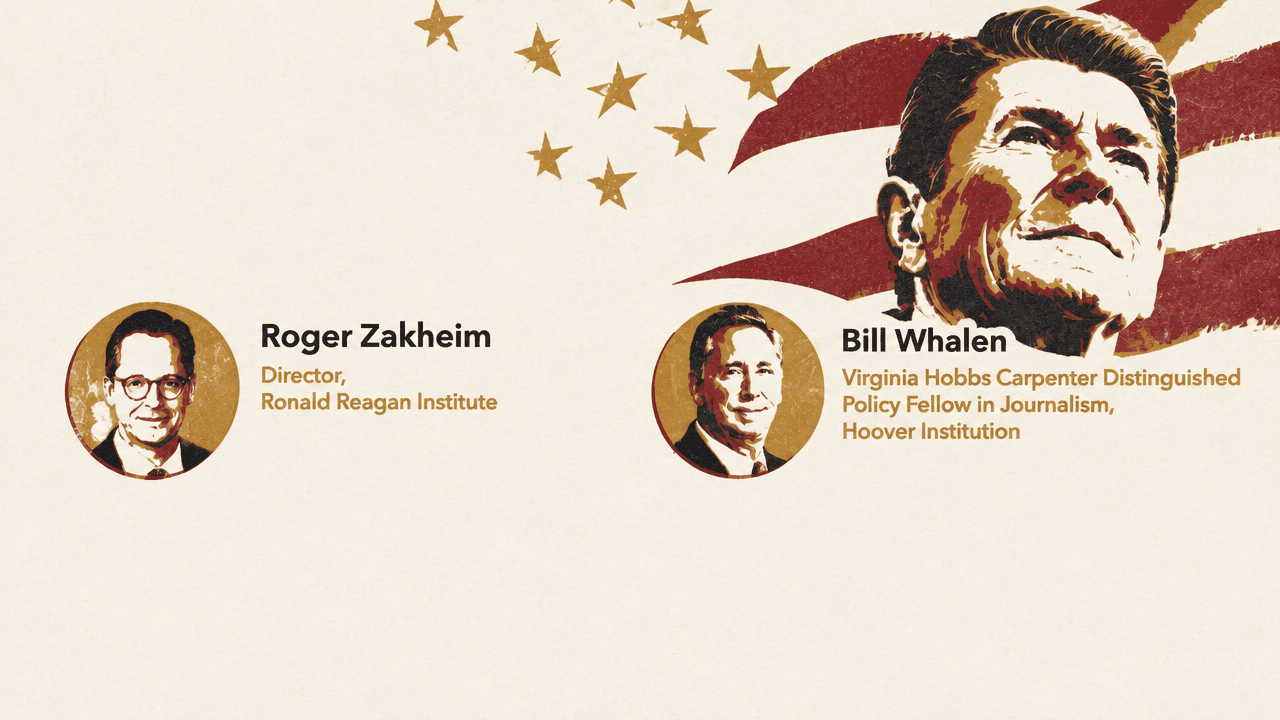
Reagan’s strategy began before he held office
Roger Zakheim argues that “peace through strength” was not a slogan supplied to Ronald Reagan by an adviser after he became president. Reagan had been working out the idea for years. Zakheim traces its early formulation to a 1962 speech Reagan wrote but apparently never delivered, then follows its development through the radio addresses Reagan wrote between his 1976 and 1980 presidential campaigns.


In that 1962 text, Reagan described the contest between the United States and the Soviet Union as a race between systems. He believed the American system would prevail—not only in an arms competition, but in a broader contest of political and economic models. Zakheim sees the later defense buildup as the practical expression of that outlook. Reagan told adviser Richard Allen, “We win, they lose,” a formulation critics dismissed as simplistic but Zakheim considers bold and consequential.
That outlook put Reagan at odds with more than the détente policies associated with Richard Nixon and Gerald Ford. Zakheim says it differed even from the bipartisan Cold War consensus around containment. He also contrasts it with Jimmy Carter’s view of military strength. As Zakheim characterizes Carter’s position, more weapons could make conflict more likely; Reagan believed strength could deter conflict and give the United States leverage.
The idea was Reagan’s, but its implementation depended on others. Caspar Weinberger, who had served as Reagan’s finance director in California and later as director of the Office of Management and Budget under Nixon, became the key figure carrying out the buildup from the Pentagon. Allen helped develop and support Reagan’s national-security outlook. Zakheim also names defense experts Fred Iklé and Bill Van Cleave among the advisers who helped shape the program, and points to Senator John Tower’s work organizing Republicans on the Senate Armed Services Committee around a buildup.
For Zakheim, this history changes how the Reagan program should be understood. It was not an improvised response to events after inauguration. Reagan had formed a view of the contest, spent years refining it, and entered office with a defense program that had already been developed among campaign advisers and party allies.
The radio addresses made the case to voters
Reagan’s weekly radio addresses helped him explain a difficult subject to a broad audience. In the years before his presidency, he wrote talks on policy, including national defense and arms control, that reached millions of Americans. Zakheim counts at least 24 addresses criticizing the second Strategic Arms Limitation Treaty, or SALT II, which Carter was trying to advance.
Reagan argued that arms-control agreements were weakening the United States while the Soviet Union was not complying in the same way. As Zakheim recounts it, Reagan observed that there was no arms race if only one side was racing—and, in his view, that side was the Soviet Union. The addresses let Reagan develop his analysis, but they also made the political risk plain. Zakheim says arms control was then an orthodoxy among Democrats and Republicans alike; Reagan’s criticism helped opponents portray him as reckless.
Bill Whalen recalled seeing a British poster depicting Reagan as a cowboy firing pistols from atop the globe, with nuclear symbols around him. Zakheim connected that image to the way Carter and his campaign caricatured Reagan as a warmonger who might lead the country into nuclear war. The criticism was not confined to opponents: some listeners also feared that Reagan’s willingness to challenge arms-control policy could bring the country closer to conflict.
The addresses did two jobs at once. They showed listeners that Reagan had a considered position on defense and arms control, while giving his critics material with which to portray that position as dangerous. Zakheim emphasizes that Reagan was not simply repeating a campaign line: he was refining his understanding of arms control, defense programs, and how the United States should compete with the Soviet Union.
The buildup had a political and budgetary price
Reagan entered office with priorities for modernizing the nuclear triad: land-based, sea-based, and air-delivered nuclear forces. He had opposed Carter’s attempt to cut the B-1 bomber program and had allies in the administration and Congress prepared to advance a broader program. Zakheim also points to the Heritage Foundation’s Mandate for Leadership and the Republican platform as places where the defense agenda had been set out in detail before the new administration took office.
Zakheim says Carter’s presidency helped make Reagan’s spending increases possible: without Carter’s approach to defense, he argues, Reagan would not have secured the more than $2 trillion buildup or the roughly 20 percent year-over-year increases in defense spending in 1981 and 1982. Zakheim characterizes Carter as an anti-defense president, while acknowledging that officials in his administration—including Defense Secretary Harold Brown and National Security Adviser Zbigniew Brzezinski—had their own views about what national defense required. His criticism is aimed at Carter’s governing view of military strength, which he says treated it as a potential cause of conflict rather than a basis for deterrence.
The spending program was not simply a matter of a president asking for a larger budget and receiving it. Zakheim describes a dispute over pace and affordability inside Reagan’s administration. David Stockman, Reagan’s budget director, supported an increase in defense spending but not at the pace Weinberger wanted. Stockman worried that investors would bet against Reagan’s budget, creating trouble in the bond market. He proposed what he called a “slow growth alternative.”
Zakheim describes a showdown between Stockman and Weinberger, with Reagan between them. Reagan had strong views and considered the buildup his top priority, but Zakheim also calls him a poor manager who disliked choosing sides among advisers. As deficits rose and the economic situation proved worse than the administration had anticipated, Stockman wanted a more cautious course. Weinberger argued for the larger buildup, and Reagan ultimately backed him. Stockman later acknowledged in his memoir that he had misunderstood the priorities of the Reagan revolution.
The buildup, which was Reagan’s number one priority, was a liability every step of the way, if you look through a political lens.
That liability recurred in different forms. During the 1980 election, Reagan’s opponents portrayed him as a warmonger. As the administration faced rising deficits and economic pressure, defense spending became an obvious target for those who wanted to slow the buildup. In the second term, Zakheim says, the same policy was criticized as an obstacle to summit diplomacy: Reagan was urged to abandon the Strategic Defense Initiative or scale back the deployment of Pershing II and ground-launched cruise missiles in Europe.
Zakheim says it would have been easy, beginning in 1983, to dial down defense spending and make it part of the response to economic and budget pressures. Reagan did not, because he believed military strength was necessary to gain leverage over the Soviet Union. The buildup remained politically exposed throughout his presidency, and he continued to treat it as a central priority.
Congressional support required persistence, not just a mandate
The Reagan administration began with a political opening for defense spending, but Zakheim’s account does not treat that opening as permanent. Whalen noted that two-thirds of Congress in 1981 had military experience, compared with about 70 members of the incoming Congress at the time of their discussion. Zakheim’s larger point is that Reagan also had support across party lines. Democrats such as Sam Nunn and Scoop Jackson had criticized Carter’s defense policy and, in Zakheim’s account, were relieved that Reagan would invest in the military.
That support did not mean Congress would continue to approve the buildup without persuasion. By 1983, Zakheim says, members were tired of it and wanted to focus on other issues, including debt. Reagan had to keep making the case and assembling votes. From 1982 through 1986, he asked for more than he could get, lost some ground, and still secured much of what he wanted.
The distinction matters to Zakheim’s comparison with Donald Trump. He describes Trump as the first president after Reagan to campaign on “peace through strength,” but says a president cannot obtain the appropriations and authorizations required for a military buildup by executive declaration. Congress has the constitutional role in appropriations. In Zakheim’s account, Reagan’s example is not just the size of the budgets he requested; it is the work of engaging legislators and building coalitions when their attention and appetite for spending began to flag.
Zakheim says Trump lacks the political environment Reagan had: he does not see the same cross-party group of Democrats prepared to support rebuilding the military. He argues that Trump would need to work with Congress, as Reagan did, rather than expecting a large defense budget to happen through social-media posts.
Zakheim also identifies a material difference between the two eras. Reagan could draw on a defense industrial base that, in his account, had not been consolidated after the Vietnam era. The later peace dividend and consolidation left less capacity to expand production. Zakheim describes three simultaneous demands for a present-day buildup: modernizing and integrating technologies such as autonomy and artificial intelligence; maintaining legacy systems that remain necessary, including aircraft carriers; and increasing the industrial base’s capacity to produce what the military needs.
The weapons mattered as signals as well as capabilities
Reagan supported a 600-ship Navy, including 15 aircraft carriers, as part of a strategy of military superiority. Zakheim describes Reagan’s goal as achieving a “margin of safety,” a phrase adviser Richard Allen recommended. Reactivating four battleships helped the Navy move toward its target without waiting for new construction. Navy Secretary John Lehman argued that the ships could still fight if equipped with modern weapons, and Zakheim says they were used repeatedly during Reagan’s administration.
The MX missile was a more difficult case. The land-based nuclear modernization program became a domestic political liability amid disagreement among the Joint Chiefs about whether to support it. Two possible basing plans—the mobile “racetrack” system and “Dense Pack”—became targets of public ridicule. Zakheim recalls Johnny Carson mocking Dense Pack on The Tonight Show, and Whalen remembered a Washington Post cartoon using the phrase to mock the senators considering the issue. Zakheim says Reagan failed early on to bring the Joint Chiefs together behind the MX program. He has seen no evidence that Reagan regretted the program, but says it caused political trouble.
Some programs that were liabilities at home also carried strategic weight abroad. Zakheim cites the MX, the deployment of Pershing II and cruise missiles in Europe in response to Soviet SS-20 missiles, and the Strategic Defense Initiative, or SDI. He says Reagan sought opportunities to negotiate with the Soviets during his first term. One obstacle, in Zakheim’s account, was that Soviet leaders were dying in quick succession; another was Reagan’s belief that the Soviets did not yet feel enough pressure to negotiate.
An ambassador returned to Reagan with an assessment that the MX was getting the Soviet Union’s attention. Zakheim uses this to illustrate a recurring tension: a program could be a domestic liability and, at the same time, an asset in Reagan’s strategy toward the Soviets. The same dual character applied to Pershing II and cruise-missile deployments in Europe. They were intended to counter the SS-20s, but their deployment drew criticism that the United States was being provocative.
SDI, in Zakheim’s account, was part of this broader pressure rather than a single “straw that broke the camel’s back.” It mattered partly because it embodied the American capacity for innovation. Zakheim says Reagan national security adviser Bud McFarlane explained that SDI captured the entrepreneurial spirit of the United States—and that Gorbachev understood his system could not compete with it. Secretary of State George Shultz, initially a doubter, came to see the initiative’s potential leverage.
The 1986 Reykjavik summit brought these tensions into focus. Gorbachev asked Reagan to give up SDI; Reagan refused. Zakheim sees the refusal as evidence of Reagan’s resolve and says it reinforced Gorbachev’s concerns about the Soviet Union’s ability to compete. Reagan could not have known that consequence at the time. In Zakheim’s telling, Reykjavik mattered because Reagan would not surrender what he regarded as a major advantage, and the exchange gave Gorbachev reason to confront the limits of Soviet capacity.
Zakheim argues the buildup made Soviet weakness harder to evade
The Soviet Union was already vulnerable. Zakheim describes an economy in decline, political weaknesses, Chernobyl, and a succession of aging leaders. But he argues that those conditions alone do not explain how the system came apart. In his view, without the military pressure Reagan applied, Gorbachev might have maintained the system rather than making concessions that allowed it to unravel.
The pressure had several parts: the scale of the American buildup, the willingness to use military strength, and actions that pushed into the Soviet near abroad. Zakheim points to Navy exercises conducted under Lehman as one example, alongside the weapons and deployments that made the contest harder for the Soviet leadership to ignore.
Zakheim describes Gorbachev as having been told in the Politburo that Soviet military spending was about 5 percent of GDP. Gorbachev assumed it might be 10 percent; later, Zakheim says, he thought it could be 20 percent. Once he became general secretary, he discovered that the figure was 40 percent. Zakheim also compared that figure with what he described as Russia’s current defense spending, saying it was likewise 40 percent.
He also says that, even in 1987 and 1988, the CIA assessed that the Soviet Union—despite its dysfunctional, deteriorating economy—could out-produce the United States. He discussed that assessment with former Defense Secretary Bob Gates. Reagan, Zakheim argues, did not expect to match the Soviets tank for tank, missile for missile, or ship for ship. The buildup’s effect was not that American production surpassed Soviet production in every category, but that it added pressure to a system already struggling to sustain its commitments.
If you remove the buildup, I don't think you would have had the pressure on Gorbachev to make the concessions he made, and sort of allow everything to unwind in the way it did.
China raises a different question: deterrence, containment, or rollback
Zakheim sees parallels between Reagan’s buildup and the case for rebuilding American military capacity today, but he does not treat China as a direct substitute for the Soviet Union. He calls China a formidable competitor, possibly more formidable in some respects, while noting that its economy remains robust even as it slows. The Soviet Union’s military spending was enormous, but its economic weakness was not fully visible to American observers at the time.
That uncertainty is part of Zakheim’s caution. He says the United States did not know how deeply the Soviet economy was corroding or how limited its innovation and technological capacity were. The Soviet Union was a closed communist regime, and China is too; Zakheim warns that observers could be making a similar mistake now in judging the capacity of a closed system. He also identifies a major difference: China has a thriving economy, unlike the Soviet Union as Reagan confronted it.
Zakheim suggests this difference may help explain why Condoleezza Rice resists treating the Soviet Union and China as an apples-to-apples comparison, and why she may see more opportunities for cooperation. He says he tends to side with historian Niall Ferguson’s “Cold War II” framing, but does not treat the label as sufficient to determine policy. If the analogy is adopted, Zakheim says, the next question is where in that history the United States is now.
He does not place the present at 1980. He suggests it may be earlier, perhaps closer to the containment problem of the Eisenhower administration. Asked whether a present-day buildup should seek to deter China or exhaust it, Zakheim says he sees no evidence that even a $1.5 trillion defense budget rests on a framework for rolling China back.
Zakheim also says China is not currently as expansionist as the Soviet Union was when Reagan took office. At the same time, he describes China’s military ambitions as extending beyond control of its immediate surroundings. He points to the development of a blue-water navy and says its ambitions reach beyond the first island chain. In his characterization, China’s military modernization has a global dimension.
The comparison has practical limits as well. Reagan could draw on an industrial base that Zakheim says had not been consolidated after Vietnam; today’s buildup must account for modernization, maintenance of existing systems, and production capacity. Zakheim’s comparison therefore raises two distinct questions: what strategic aim strength should serve, and whether Congress and the defense industry can provide the capacity needed to pursue it.
Reagan’s appeal rests on a politics larger than left and right
Zakheim argues that Reagan’s relevance to younger Americans is not simply a matter of exposure to his record. The Reagan Institute works with college students on ideas he identifies as central to Reaganism: peace through strength, individual liberty, economic opportunity, freedom and democracy, and American pride. Zakheim believes young people can respond to those ideas when they encounter them. But he also sees Reagan’s current absence from popular political culture as a reflection of the present political moment.
Whalen raised the contrast through a student who knew Richard Nixon from social-media clips and “Nixonmaxing” memes but knew little about Reagan. Zakheim’s response was that Reagan’s politics operated on a different axis from the usual left-right divide. In his 1964 “Time for Choosing” speech, delivered on behalf of Barry Goldwater, Reagan framed the question as whether the country was going up or down. Zakheim calls this an elevated politics that could build a coalition across conventional divisions. A movement focused only on the horizontal left-right axis, he argues, misses that feature of Reagan’s appeal.
Whalen suggested that Reagan transformed not only policy but American politics: after Reagan’s decisive victories, Bill Clinton drew on parts of the Reagan playbook, including welfare reform, middle-class tax cuts, and a tougher position on crime. Zakheim agreed that Reagan’s influence lasted well beyond his presidency, while noting that MAGA incorporates some elements of Reaganism and departs from others. “Make America Great Again,” he added, was a Reagan line before it became Trump’s.
Zakheim also argues that Reagan’s policy legacy cannot be separated from the purpose he assigned to the buildup. He admired Winston Churchill but believed Churchill had failed to persuade his countrymen to prepare for the rise of Nazi Germany. In a 1986 speech to midshipmen at the Naval Academy, Reagan said that people had died in the 1940s because people in the 1920s and ’30s had not invested in strength. Zakheim presents Reagan’s buildup as an effort to ensure that the United States would be strong enough not to have to fight a war like the Second World War.