The Somme’s 600,000 Casualties Show the Human Cost of Trench Warfare

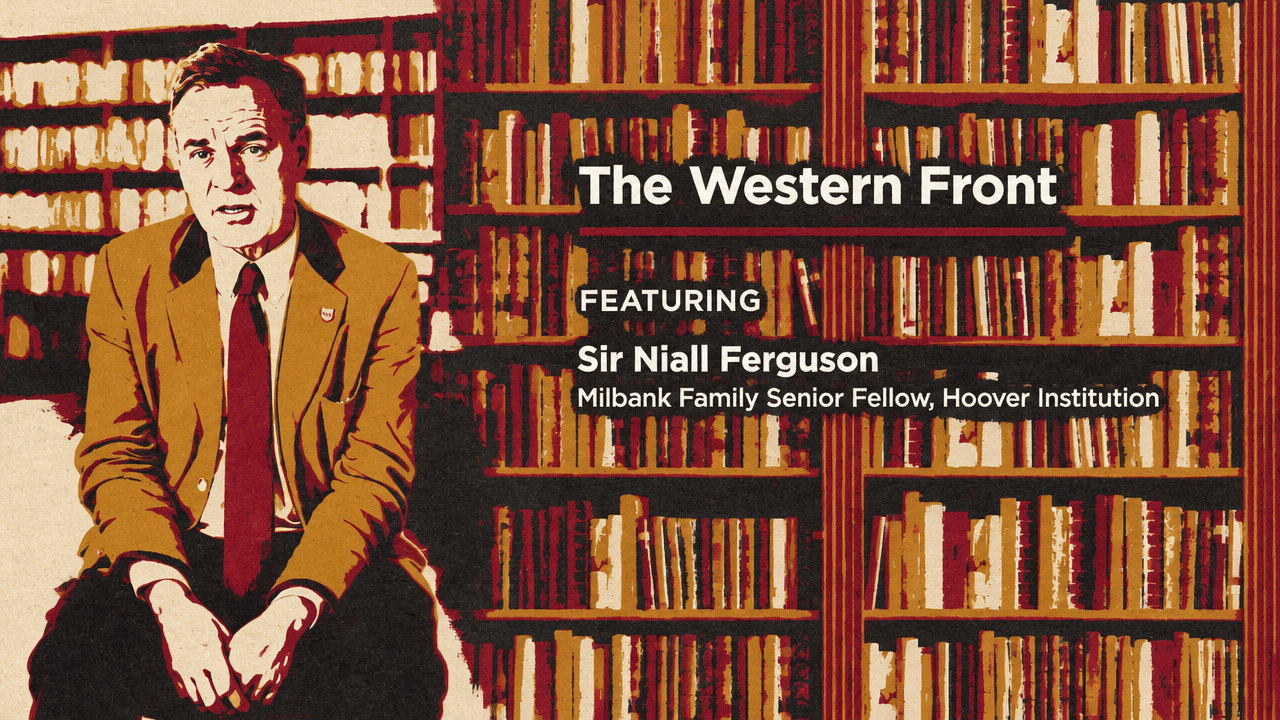
Hoover Institution senior fellow Niall Ferguson argues that the Western Front’s trench warfare made the First World War’s destructive power visible in its human toll: British forces suffered 60,000 casualties on the first day of the Somme, and British and French losses over the battle reached about 600,000. Ferguson connects that toll to his grandfather’s survival of a German gas attack and to Wilfred Owen’s phrase “the pity of war.” He also traces the Hoover Institution’s archives to Herbert Hoover’s wartime relief work and his effort to preserve records of war, peace and revolution.
Trench defenses protected soldiers but blocked breakthroughs
The Western Front became a system of trenches because soldiers exposed in open ground were vulnerable to howitzers and other artillery. After the German offensive failed to deliver a decisive blow against France, German forces and the British and French dug in during a race to the sea. The trenches eventually ran from the Swiss border to the North Sea. A map shown with Ferguson’s account traces the stabilized front through Belgium and France.
The defenses that protected troops from bombardment also made it extraordinarily difficult to break through. Once the lines were dug, neither side could readily turn an attack into a decisive advance. The result was a prolonged contest in which destructive weapons met entrenched positions. Photographs of soldiers moving along plank paths through trenches, and crouching behind barricades and barbed wire, show the constrained landscape created by those defenses.
Niall Ferguson describes the war as catastrophic in its death toll, far beyond what earlier conflicts had produced. By 1914, he says, war was being fought with weaponry of unprecedented destructive power. The Somme figures make the scale concrete: on the first day of the 1916 battle, the British suffered 60,000 casualties. Adding French and British casualties across the battle brings the total to roughly 600,000. Ferguson presents those numbers as part of the wider toll of a war in which artillery and other destructive weapons were used against entrenched forces.


The trenches made danger part of ordinary life
Ferguson’s grandfather served near Ypres, in Belgium. The trenches there were wretched places: winter mud rose above the ankles, filth made it hard to stay clean, and lice were a recurring problem. The danger depended partly on how close a soldier was to the front. A German shell or sniper could kill anyone unlucky enough to raise his head above the parapet at the wrong moment.
Ferguson’s description is not limited to the danger of being hit. The photographs shown alongside it include soldiers wading through a waterlogged trench and carrying a wounded man across deeply muddy ground. Others show men resting in the trench, crouching behind wooden barricades and barbed wire, or sleeping against sandbags while a fellow soldier stands watch. Together, they place the daily work of moving, sheltering, and recovering within the same exposed landscape.
A family memory gave “the pity of war” its force
As a boy growing up in Glasgow in the 1960s and 1970s, Ferguson was encouraged by an English teacher to read Wilfred Owen, Siegfried Sassoon, Robert Graves, and other writers who had served in the war. Owen’s phrase “the pity of war” stayed with him and later became the title of Ferguson’s book on the First World War, written in the late 1990s.
The war poets presented him with a shocking picture of combat, including the possibility of death from mustard gas. That danger was not only literary or historical for Ferguson: his grandfather had been gassed by the Germans. He survived, but the attack damaged his lungs. Ferguson remembers his grandfather wheezing and struggling for breath in later life. The memory connected the war’s violence to its consequences long after a soldier left the trenches.
Relief work led Hoover toward preserving records of war and peace
Ferguson describes the Hoover Institution’s World War I holdings as thousands of photographs and other records. He traces the institution’s origins to Herbert Hoover’s experience and involvement in relief efforts for occupied Belgium and Europe during the war. Ferguson says those experiences inspired Hoover to see the need for a collection of documents about war, peace, and revolution.
The images accompanying this account include a ship marked for Belgian relief, a warehouse filled with sacks, and children eating at long tables. They show the relief effort in material terms: supplies being transported and stored, and meals being served. Other photographs show men handling bundles of papers and reviewing a document in an aisle lined with shelves. The sequence links wartime relief to the later work of collecting and preserving records, without treating those records as separate from the events that gave rise to them.
For Ferguson, the institution’s origins make remembrance part of its purpose. He says it is important to remember what the institution inherited from Hoover and from the generation of World War I. The archive holds records of the conflict and relief work, as well as documents on war, peace, and revolution—the subjects Hoover sought to preserve.