Medicare’s Fiscal Burden Extends Beyond the Part A Trust Fund

Hoover policy fellow Tom Church argues that Medicare’s fiscal problem extends beyond the projected shortfall in its hospital trust fund: taxpayer subsidies for Parts B and D are adding heavily to federal debt. Incremental savings, he says, will not resolve the program’s broader design questions, including how much beneficiaries should pay and whether subsidies should be reduced for higher-income seniors. Church also contends that reform is unlikely without bipartisan action led by elected officials, even as current political incentives favor expanding benefits or postponing hard choices.
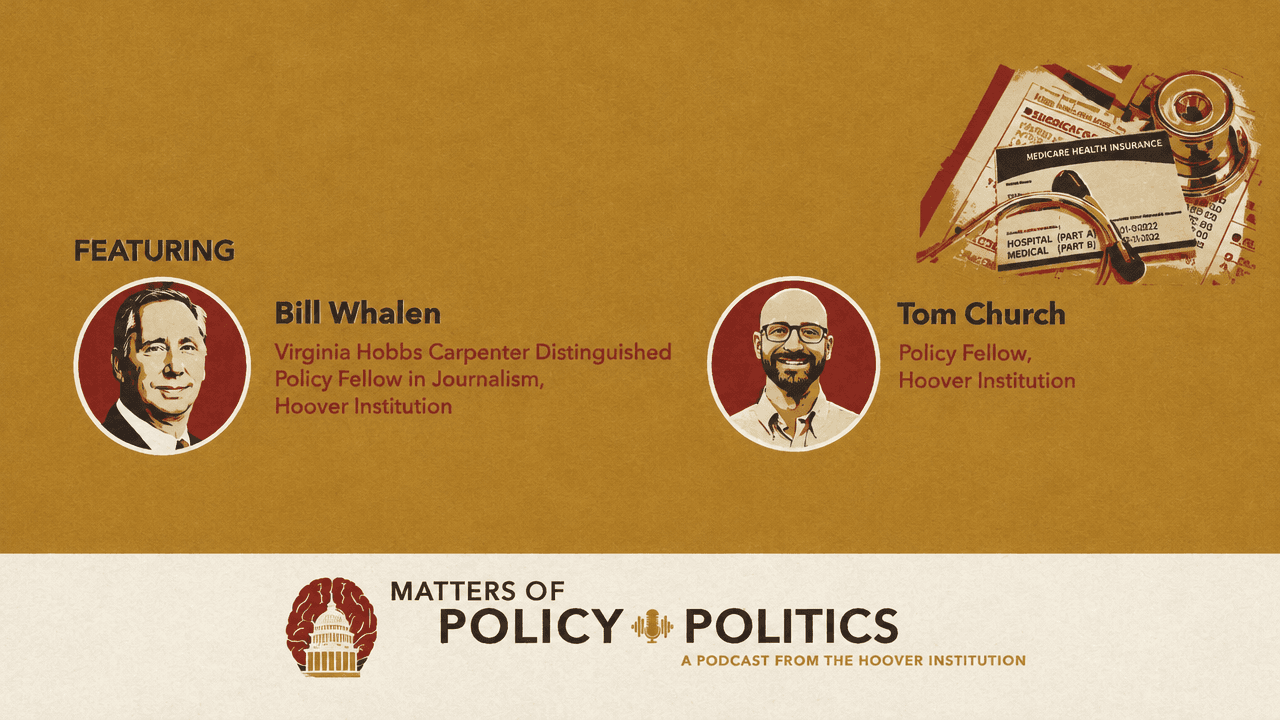
Medicare’s fiscal problem is larger than its trust fund
The projections and political references here are those discussed on October 8, 2026; they describe the outlook as presented then. Medicare’s projected trust-fund shortfall is only one part of the program’s financial problem. The larger issue, in Tom Church’s account, is how much taxpayers cover for benefits—especially in Parts B and D—and the borrowing that follows.


Using Congressional Budget Office projections, Church said federal deficits would total about $24 trillion over the next 10 years, including roughly $16 trillion in interest payments. Medicare, by his estimate, would contribute a little more than $10 trillion to new debt over that period. He emphasized that this was not total Medicare spending; it was the amount taxpayers would contribute toward the program’s costs.
The distinction matters because Medicare is financed differently across its parts. Church said payroll taxes cover close to 90 percent of Part A hospital expenses. Beneficiaries are legally responsible for 25 percent of Part B costs, with the federal government covering the other 75 percent. Part D beneficiaries pay about 12 to 15 percent of prescription-drug costs, he said. The balance comes from taxpayers and, in a government running large annual deficits, borrowing.
Church described two broad ways to reduce that fiscal burden: spend less, or have beneficiaries pay more through premiums and cost-sharing. In practice, that means either reducing payments for care or narrowing the subsidy the government provides. His point was not that Medicare recipients pay nothing: they pay payroll taxes, premiums, and out-of-pocket charges. Rather, those payments do not cover the full cost of benefits, particularly in Parts B and D.
That is why, in Church’s framing, repairing the Part A trust fund would not resolve Medicare’s overall fiscal trajectory. Parts B and D do not have the same trust-fund mechanism and cannot “run out” in the same way. Their costs continue to be subsidized. A fix for the trust fund could address one impending failure while leaving the broader borrowing problem intact.
Incremental savings leave the program’s design question unresolved
At a Medicare budget-options conference, Church and Hoover colleagues asked policy specialists to propose measures that could save at least $100 billion over 10 years. The options ranged from paying the same rate for the same service regardless of where it is provided—known as site-neutral payment—to changing bonus payments to insurers and reducing subsidies for higher-income seniors.
Church said some proposals were technically promising but faced political resistance. Site-neutral payment had bipartisan appeal, he said, but hospitals opposed it. He also focused on income-related premiums, known as IRMAA, which apply to some Medicare beneficiaries with higher incomes.
The scale remains the central constraint. Even three options producing $300 billion in savings over a decade would be small against the more than $10 trillion in taxpayer contributions Church projected. “There are really large changes that need to happen,” he said. A menu of discrete budget adjustments may help, but it cannot substitute for decisions about the program’s overall design and the share of costs borne by beneficiaries.
One design question is whether Medicare should rely more on competition among plans. Church contrasted Part D with Part B. In Part D, insurers submit competing bids and can offer different plan designs. He said insurers pushed patients toward generic drugs, and presented the program’s earlier cost performance as evidence that competition helped contain costs. Before the Inflation Reduction Act, he said, Part D was the only major program to cost less than projected; he noted that the law changed the context for that comparison.
That model informed former House Speaker Paul Ryan’s proposal to combine Parts A and B and introduce competitive bidding. Church said Ryan’s plan ran into opposition, including from AARP, and a broader presumption that changes to Medicare are unacceptable. He also suggested it may have come too early: in his view, major entitlement changes are more likely when a fiscal deadline makes inaction visible.
Church pointed to the early 2030s. As discussed in October 2026, he said the Medicare Part A trust fund and Social Security’s trust fund were both projected to face shortfalls around 2032 or 2033. If Social Security’s shortfall were not addressed, checks would be reduced to match available revenue, he said. Medicare Part A’s consequences would be different: doctors and hospitals could face payment cuts, potentially disrupting seniors’ access to care. Parts B and D would not experience the same trust-fund cutoff, but their costs would continue to add pressure to federal borrowing.
The distribution of subsidies is a central reform choice
The question of who bears the cost of reform is shaped by political precedent. Church said entitlement changes have generally protected people who are already retired or close to retirement, leaving people farther from eligibility with less certainty and more time to plan. He described himself as far enough from retirement to be affected by changes, but with time to adjust. For his daughter, he said, he would encourage saving and not relying on government programs.
For current beneficiaries, the choices are less abstract. Church argued that higher-income retirees receive substantial public support even though many are not poor. He cited research indicating that older Americans who are not working have, over the past 40 years, approached parity with working-age people in economic circumstances, in part because of retirement savings such as 401(k) accounts.
Medicare already charges higher premiums to some beneficiaries with higher incomes, but Church said the subsidy remains significant. He gave the example of a single beneficiary earning more than $112,000: that person begins paying a larger share of Part B and Part D premiums. At higher incomes, the share rises; even someone earning more than half a million dollars, he said, still receives a government subsidy for premiums. Church’s broader question was whether public subsidies should continue for people who can afford to pay more.
He favored reducing subsidies for high-income seniors while protecting people with low incomes. He also distinguished income from wealth: wealth can be difficult to measure and may not be liquid, while annual income offers a more straightforward basis for deciding when a subsidy should decline. Rather than treating means-testing as an all-or-nothing principle, he urged making the existing distribution of benefits visible and asking voters whether support for higher-income recipients should increase or decrease.
That approach might create an unusual area of political overlap, Church suggested. He imagined a future in which a Republican administration and a Democratic House could agree to reduce subsidies for affluent seniors as one way to ease fiscal pressure. But the immediate political incentives often run the other way. Bill Whalen noted that President Donald Trump had previously avoided entitlement reform and that a late-term push could face a hostile or changing Congress.
Church interpreted a proposed one-time $90 payment toward Part B premiums, announced by the administration ahead of an election, as part of a familiar pattern: presidents highlight benefits close to elections. He also cited checks sent to some people who had lost access to expanded Affordable Care Act subsidies. Drawing on historian John Cogan’s work on American entitlements, Church said benefit increases had repeatedly been timed to arrive just before elections. In his account, the political rewards of providing benefits are immediate, while the costs of restraint are harder to claim.
Medicare for All moves the dispute to financing and access
The discussion’s other major reform proposal was Medicare for All, as described by Whalen. The bill would establish a national health insurance program covering all U.S. residents, automatically enroll people, provide a broad range of services, and prohibit deductibles, coinsurance, and copayments. Private insurance could cover only benefits supplemental to, and not duplicative of, the public program.
Church argued that the proposal could lead to rationing and long waits. He said that, for the most part, the roughly 180 million Americans with employer-sponsored coverage would move to government coverage under the plan. In his view, eliminating cost-sharing and expanding the list of covered services does not eliminate the cost; it transfers responsibility for financing and allocating care to government.
Asked where the money would come from, Church said a universal system would require higher income and payroll taxes, potentially replacing what people currently pay for health insurance. His objection was to the assumption that a single-payer system could provide all promised services at acceptable prices. Governments, he argued, would have to set prices and decide which care to fund. If coverage promises exceed available resources, he said, rationing may take the form of waiting times or restrictions on treatment.
To illustrate the concern, Church contrasted Medicare with Medicaid, which he described as coverage for people with low incomes, jointly financed by federal and state governments. He recounted a doctor at a San Francisco safety-net hospital describing Medicaid patients waiting six months for a $20 DEXA scan. The example was meant to show that care can be rationed not only by charging patients money, but also by limiting the resources available to providers.
Church also argued that broad promises of “medically necessary” care leave a consequential decision unresolved: who determines what qualifies, and at what price? He said systems with more government-managed coverage can contain costs by declining to pay for some drugs, including new treatments. The tradeoff, in his account, is that broader public coverage may bring slower access to some services or treatments.
A reform process needs elected leaders as well as budget expertise
Asked how he would organize a serious reform effort, Church rejected sending an independent group of experts away to negotiate a package. Commissions made up of former officials and specialists can produce compromises, he said, but those who must vote on the recommendations may not be involved—and the result can be a proposal that goes nowhere.
A workable process, in Church’s view, would require bipartisan participation by current congressional leaders and the White House, along with strong presidential leadership. He said presidential leadership was the recurring ingredient in the entitlement changes he had studied. He also emphasized public understanding that a problem exists and direct involvement by the people who ultimately cast votes.
Church would set a savings target first, then ask policymakers to work within it. Medicare and Social Security should proceed on parallel tracks, he said, because their fiscal deadlines are close together, but each should be handled as its own program. The public conversation would need to be candid: beneficiaries have paid into these systems, but they have not paid the full cost of all promised benefits. Church said reforms should reduce subsidies for people who can afford to lose them.
That is where he sees a role for policy institutions such as Hoover: translating “reform Medicare” into specific, costed options. Church said congressional staff and members need to know not only the direction of a policy but its budget impact and who would bear the cost. One option might save $60 billion over 10 years, another $120 billion; the analysis should also show how much of the cost falls on higher-income beneficiaries while lower-income people remain protected.
Church described the Tannenbaum Program for Fact-Based Policy as a way to establish shared facts without requiring agreement on policy preferences. The program uses quizzes on topics including Medicare, Social Security, and the debt and deficit to test factual understanding. People may value tradeoffs differently, he said, but they should be able to examine the same numbers and give competing views a fair hearing. The program’s approach is to take up contentious issues, represent opposing perspectives fairly, and establish common ground about the facts before debating solutions.
Its planned work on disputes over data centers, including questions about water use and electricity, follows the same premise: identify what is known before debating what to do. For Medicare, that means building a menu of options with explicit savings estimates and distributional effects—not stopping at a broad call for reform. Church’s argument is that technical detail can give elected leaders something concrete to weigh, but it cannot replace their responsibility to decide who pays and how much the government will subsidize.