Russia’s Repression Reveals the Limits of Putin’s Claim to Popular Support
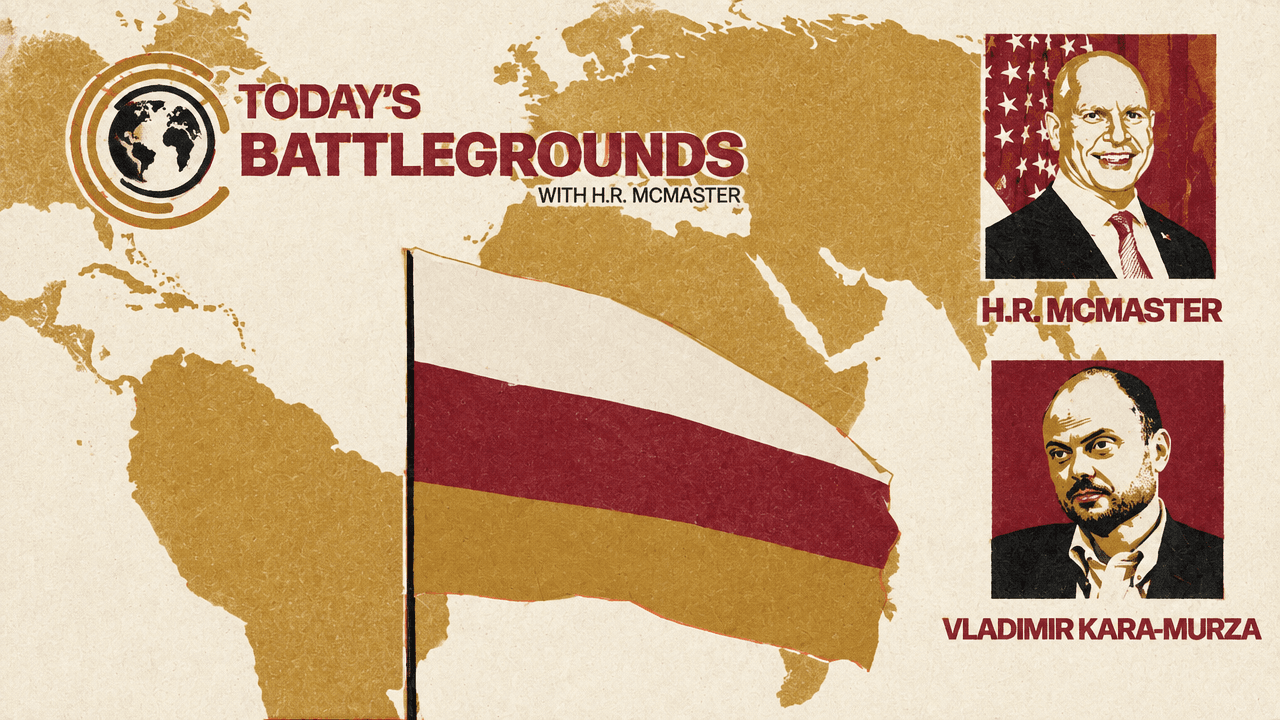
Vladimir Kara-Murza argues that the Kremlin’s repression of opponents undermines its claim that Russians support Vladimir Putin and the war in Ukraine. In a discussion with H.R. McMaster, he says Western governments repeatedly accommodated Putin as he tightened control at home and expanded aggression abroad, and urges them to target regime officials while supporting Russians who oppose the government.
Repression undermines the claim of national consensus
Vladimir Kara-Murza argues that the scale of political repression in Russia is itself evidence against the Kremlin’s claim that the country is united behind Vladimir Putin and the war in Ukraine. At a 1987 security conference, he says, the entire Soviet Union—then 15 republics—had about 750 known political prisoners. Russia alone now holds more than 2,000.
Claims of a national consensus, or opinion polls in Russia, cannot be taken at face value when people can be imprisoned for expressing opposition. Kara-Murza points to Yuri Kokhovets, who received a five-year sentence after telling a street pollster that he opposed the war. Kara-Murza himself was sentenced to 25 years for five speeches criticizing it.
Fear also makes it difficult to know what people think. Kara-Murza says that in countries without free elections, independent media or reliable opinion polls, “the only objective way to judge the state of public opinion is to actually look at what the regime is doing.”
Kara-Murza says tens of millions of people in Russia oppose the war and Putin’s dictatorship, even though the authorities have shut down opportunities to express that opposition through political competition. He cites the Kremlin’s decision to bar Yabloko, which he describes as the last remaining opposition party and the only party openly opposed to the war, from the September 2026 parliamentary election. Before it was removed from the ballot, the party had drawn substantial attention, particularly among young people.
Kara-Murza says polling agencies associated with the Kremlin showed Yabloko gaining support. An early-September poll by ExtremeScan put the party at 25 percent and United Russia at 32 percent. He cautions that respondents in an authoritarian society may be afraid to reveal their views. He argues that a secret ballot could have produced a very different result from what people felt safe saying publicly, and sees the decision to remove Yabloko from the ballot as evidence that the Kremlin feared what the party’s support might reveal.
Kara-Murza sees a parallel in Belarus in 2020. Alexander Lukashenko allowed Svetlana Tikhanovskaya onto the ballot, he says, expecting her to serve as a foil that would demonstrate his own popularity. Instead, Tikhanovskaya won by a landslide, exposing the gap between the regime’s claims and its support. Kara-Murza calls this the “Tikhanovskaya effect”: even a controlled political contest can give opponents a way to reveal the scale of dissent.
For Kara-Murza, the Kremlin’s actions matter because the state’s public claims are difficult to test independently. Why, he asks, would a popular leader need to keep society in a state of constant fear or bar opponents from an election? His argument is that repression itself gives reason to question the Kremlin’s claims of consent.
The democratic opening was real, but it was not secured
Vladimir Kara-Murza’s account of Russia’s political reversal begins with a democratic opening he remembers firsthand. In August 1991, when he was ten, his father spent three days and nights on the barricades defending the Moscow White House against a hard-line coup. The coup leaders had the Soviet state apparatus, the KGB, the army and tanks. They also moved to close independent media, ban opposition parties and prohibit demonstrations. What they lacked, Kara-Murza says, was a society willing to submit again to the Soviet system. Tens of thousands, then hundreds of thousands, took to the streets; people stood in front of tanks, which eventually stopped and turned away.
The lesson he drew was that a dictatorship’s apparent strength can fail when enough people refuse to accept it. The 1990s were economically and socially difficult, he says, but they also brought real elections, independent media and political pluralism. That experience is one reason he rejects the idea that democracy in Russia is foreign or impossible. He has seen it there.
The transition did not, however, dismantle the Soviet security apparatus or establish a reckoning with its past. Kara-Murza argues that Russian society’s failure to confront Soviet crimes was a root cause of Putin’s rise. He also rejects the idea that there was an early, reform-minded Putin who later changed. In December 1999, eleven days before becoming acting president, Putin unveiled a memorial plaque to Yuri Andropov, the longtime head of the Soviet KGB. Andropov had overseen the suppression of dissent and the use of punitive psychiatry against political opponents. For Kara-Murza, the gesture was a clear signal of Putin’s orientation from the beginning.
The consolidation that followed was gradual. Kara-Murza likens it to Benito Mussolini’s description of taking power by “plucking the chicken feather by feather to lessen the squawking.” Putin did not abolish every democratic institution at once. He started with independent television. Four days after his inauguration in May 2000, armed state operatives raided Media-Most, the parent company of the independent network NTV. The company was taken over within a year. By 2003, the last privately owned independent national television channel, TVS, had been taken off the air.
The next targets were political opposition, civil society and business leaders who might fund them. In 2003, the arrest of Mikhail Khodorkovsky, the head of the oil company Yukos, signaled that wealthy Russians could be punished for supporting opposition candidates, independent media and civic organizations. The parliamentary election that year was, in the words of the Council of Europe’s observation mission, “free but manifestly unfair.” Kara-Murza, then a candidate for the democratic opposition, came second in his Moscow district. But the opposition parties led by Boris Nemtsov and Grigory Yavlinsky were pushed out of parliament, while Putin’s party won a constitutional two-thirds majority.
The newly elected speaker of parliament, Boris Gryzlov, summarized the institutional change with a line Kara-Murza says became an epitaph for the regime: “Parliament is not a place for discussion.” The state had not simply restricted a particular party or election. It had emptied representative institutions of their capacity to challenge power.
The career of Nemtsov, whom Kara-Murza calls “the best president that Russia never had,” shows what was lost in that process. As governor of the Nizhny Novgorod region, Nemtsov pursued small-scale privatization—selling bakeries, transport companies and shops, and transferring collective farmland to private farmers—rather than handing large state assets to Kremlin-connected oligarchs. Kara-Murza describes the region as an unusual economic success in the difficult 1990s and says Nemtsov became Russia’s most popular politician for a time. In 1997, Yeltsin brought him to Moscow as first deputy prime minister, and he was widely seen as a possible successor. Had he become president instead of Putin, Kara-Murza says, “we would be living in a different world today.”
The point is not that Russia’s history was predetermined. Kara-Murza and H.R. McMaster emphasize the role of individual choices. The 1990s left a democratic possibility open; Kara-Murza argues that the failure to reckon with Soviet crimes and the choices made as Putin consolidated power helped close it.
Repeated accommodation left room for further aggression
Vladimir Kara-Murza argues that Western governments repeatedly treated Putin’s actions as negotiable episodes rather than signs of a consistent project. He describes the response to Russia’s 2008 war with Georgia, the annexation of Crimea in 2014 and later aggression in Ukraine as a pattern: Putin tested what he could do, encountered limited consequences, and tested further.
The map shown during the discussion marks areas annexed by Russia in 2014 and 2022, areas occupied by Russia in 2022, and territories retaken by Ukraine since the 2022 annexation. It identifies the annexed oblasts of Luhansk, Donetsk, Zaporizhzhia and Kherson, alongside Crimea and key cities. The changing lines of control make concrete the territorial steps Kara-Murza describes, from Crimea to the further claims and occupations in southern and eastern Ukraine.
The pattern began, in his telling, with the gradual destruction of Russian democracy. While Putin took control of television, weakened opposition and manipulated elections, Western leaders continued to pursue accommodation. Kara-Murza invokes George W. Bush’s statement that he had looked into Putin’s eyes and seen his soul, and the later “reset” under Barack Obama. In Europe, he points to former German chancellor Gerhard Schröder, who became chairman of the Russian state oil company Rosneft. Kara-Murza notes that Rosneft’s assets included much of what had been taken from Yukos after Khodorkovsky’s arrest.
For Kara-Murza, this accommodation was both morally wrong and strategically short-sighted. “A government that does not respect the rights and freedoms of its own people will not respect the borders of other countries,” he argues. He sees the connections in Russia’s actions in Georgia, Syria, Estonia and Ukraine, including the poisoning of a Ukrainian presidential candidate in 2004. Internal repression and foreign aggression are not separate failures of policy, in his account; they are expressions of a regime that faces few restraints.
The same logic, he says, applies to Putin’s more recent campaign of sabotage and political subversion in Europe. McMaster lists drone incursions, attacks on infrastructure, arson and other alleged operations. Kara-Murza’s explanation is not that each action is a departure from Putin’s behavior, but that the regime keeps probing how far it can go. After the 2008 invasion of Georgia, he says, France pursued mediation and the United States declared a reset. After the 2014 annexation of Crimea, the West imposed what he calls largely cosmetic sanctions before returning to business as usual. Kara-Murza argues that such responses encouraged the Kremlin to believe violations could be followed by renewed engagement.
He rejects the idea that a deal with Putin can resolve the problem without changing the incentives that have sustained it. Kara-Murza says Putin has repeatedly violated agreements and will not stop unless he is stopped. In his view, Europe’s security cannot be separated from political change in Russia: as long as the country remains a dictatorship, it will remain a threat and a destabilizing force.
Kara-Murza also describes Putin as increasingly weak rather than strong. The 2022 invasion was launched, he says, amid expectations of taking Kyiv in three days. Instead, he points to Ukrainian drone strikes on Russian oil refineries and the image of a Kremlin event in St. Petersburg taking place against smoke from a damaged oil plant. Putin’s efforts to project strength, he argues, now coexist with signs of vulnerability and paranoia. The decision to bar Yabloko from the election is one example he offers of the Kremlin’s concern about what even a constrained political contest might reveal.
Political repression can become a matter of life and death
Vladimir Kara-Murza’s own imprisonment gives his account of repression a personal frame, but he places it within a broader pattern of violence against political opponents. In prison in Omsk, he was held in solitary confinement in a small cell. His bunk was fixed to the wall during the day; he could walk only in a small circle. A radio played state broadcasts from early morning until lights out, and he had access to pen and paper for only an hour and a half a day.
On February 16, 2024, while eating dinner, he heard the name Alexei Navalny on the radio. State media rarely mentioned opposition leaders. The report said Navalny had lost consciousness after returning from a walk and gave the time of his death, then moved on to local news. Kara-Murza was in solitary confinement, as Navalny had been. He says he cannot find words to describe hearing the announcement.
Kara-Murza says Navalny had previously been poisoned and refers to investigative reporting that identified security-service officers involved in following political opponents. He also cites a joint statement by five European countries whose laboratories tested Navalny’s post-mortem samples and concluded that he had been poisoned. Kara-Murza describes Nemtsov’s killing differently: he says it was carried out by men associated with Ramzan Kadyrov, the Kremlin-appointed ruler of Chechnya, and refers to an Organization for Security and Cooperation in Europe report that, in his account, documented testimony about Putin ordering the assassination. Kara-Murza says Putin bears direct responsibility for the killings of Nemtsov and Navalny.
He also recalls that prison guards once asked whether he had really received a 25-year sentence for five speeches. The sentence itself, he argues, shows how severely the state punishes open criticism. But repression can mean more than a long prison term. Kara-Murza says that since the 2024 prisoner exchange that freed him, at least 42 known Russian political prisoners have died in state custody, and that the number continues to grow.
Support Russian opponents without treating all Russians as targets
Vladimir Kara-Murza says Western governments should stop helping Putin by legitimizing his government internationally or allowing officials and oligarchs to use Western countries as safe places for wealth they have taken from Russians. He supports targeted sanctions against human-rights abusers and corrupt officials, and says Magnitsky legislation now exists in 35 countries and jurisdictions. The purpose, as he describes it, is to impose visa bans and asset freezes on individuals responsible for abuses—not to punish people simply because they are Russian.
That distinction matters to his proposed approach. Kara-Murza criticizes both the easing of sanctions on people close to Putin and blanket restrictions on Russian citizens. He says Canada delisted Anatoly Chubais, a former senior official and Putin adviser, and that some European Union countries were seeking to remove Alisher Usmanov from sanctions. At the same time, he objects to blanket bans on Russians entering some European countries. Such bans, he argues, conflate opposition to the regime with hostility to Russian people and reinforce the Kremlin’s claim that the West is “Russophobic.”
He also criticizes the failure to preserve independent access to information. During the Cold War, he says, Western broadcasters including the BBC, Voice of America, Radio Free Europe and Deutsche Welle reached listeners across the Soviet bloc in their own languages. Kara-Murza recalls his grandfather listening on a portable radio. He cites an internal KGB report, partially revealed after the Soviet collapse, that estimated as many as 30 million Soviet adults—about 15 percent—were regular listeners to foreign broadcasts. He sees a connection between those listeners and the people who later took to the streets in 1991.
Today, he argues, Western governments and companies are less willing to sustain that kind of access. He says Voice of America was shut down, Radio Free Europe is in danger, and technology companies including Apple, Microsoft and Google have removed or restricted tools and media that help Russians get around censorship. In his account, companies have complied with Kremlin demands in order to continue operating in Russia. That, he says, puts commercial interests ahead of freedom of information.
Kara-Murza’s broader prescription is to distinguish between support for the Russian state and support for Russians who oppose it. He calls for stronger measures against the shadow fleet and illegal oil sales that help finance the war, alongside engagement with Russian civil society, human-rights defenders and pro-democracy activists. A democratic Russia, he argues, would be essential to a peaceful and secure Europe. He says that future is possible, but that Western policy should not help Putin make it harder to reach.
He also argues that Russia’s eventual transition will require an accounting for state crimes. The Soviet archives were not fully opened in the 1990s, he says, and Russian society never had a serious opportunity to confront the crimes of the Soviet regime. Kara-Murza identifies that failure as a root cause of Putin’s rise. In a post-Putin Russia, he says, transitional justice will need to address abuses committed both inside the country and abroad.
His immediate appeal to people outside Russia is more direct: tell the truth and help sustain those being targeted. Kara-Murza says citizens in democracies can speak out even when their governments will not. Public pressure helped secure the Magnitsky Act despite resistance from the Kremlin and from a U.S. administration pursuing a reset. He also credits international public and diplomatic efforts with helping make possible the 2024 prisoner exchange, which freed 16 people, including eight Russian political prisoners.
And he asks people to write to prisoners. The goal of political imprisonment, he says, is not only punishment but isolation—to make a person feel forgotten and alone. Letters from Russia and elsewhere helped him endure solitary confinement. Human-rights organization OVD-Info offers a way for people to choose a prisoner and send a message in English, which volunteers translate into Russian. Kara-Murza says that a few minutes spent writing can matter to someone facing isolation in a Siberian cell.