Universities Have Not Reconciled Research With Liberal Education
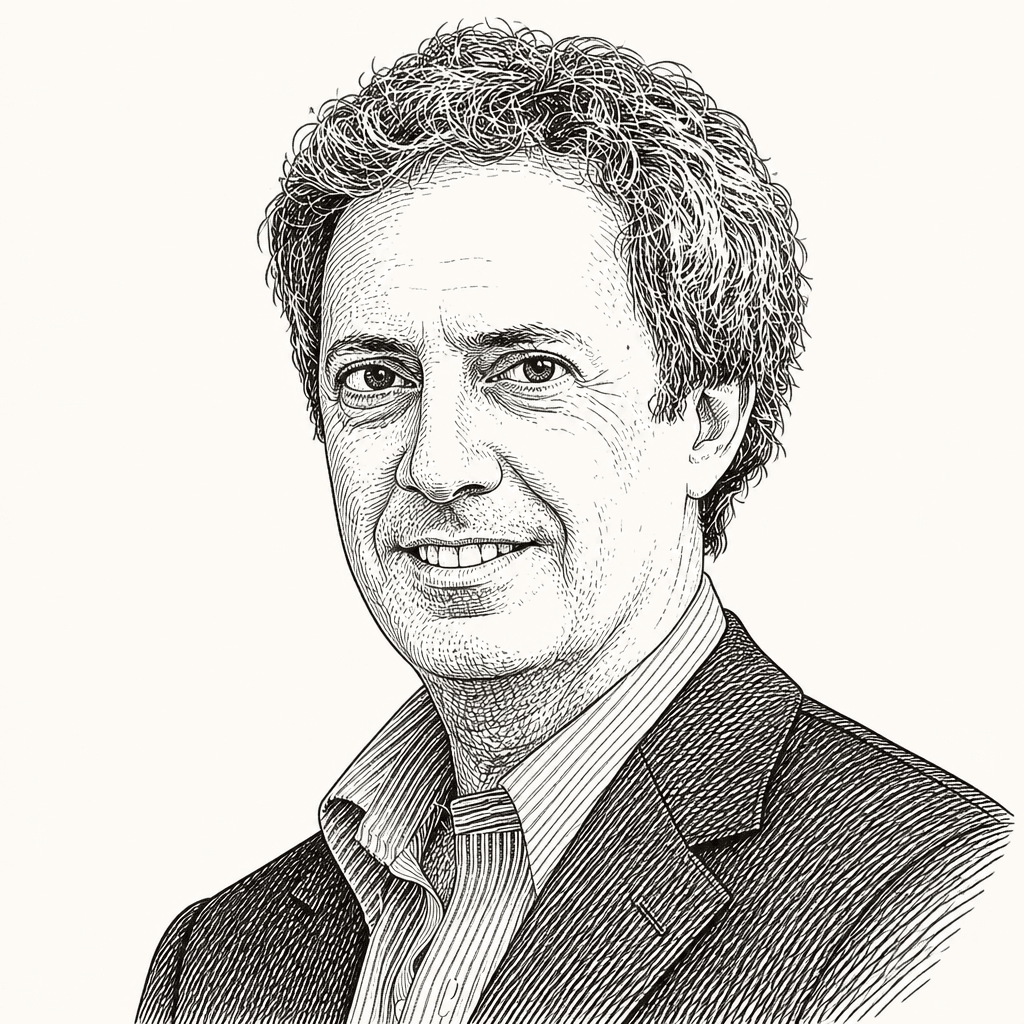


At a Hoover Institution book talk, Peter Berkowitz argued that American universities have failed to reconcile research and professional training with their responsibility to provide undergraduates a liberal education. In his view, that education should prepare students to exercise the rights and responsibilities of freedom, not merely equip them for a profession. He called for universities to make the commitment concrete through a small required core of shared study and stronger protections for open debate and fair process.
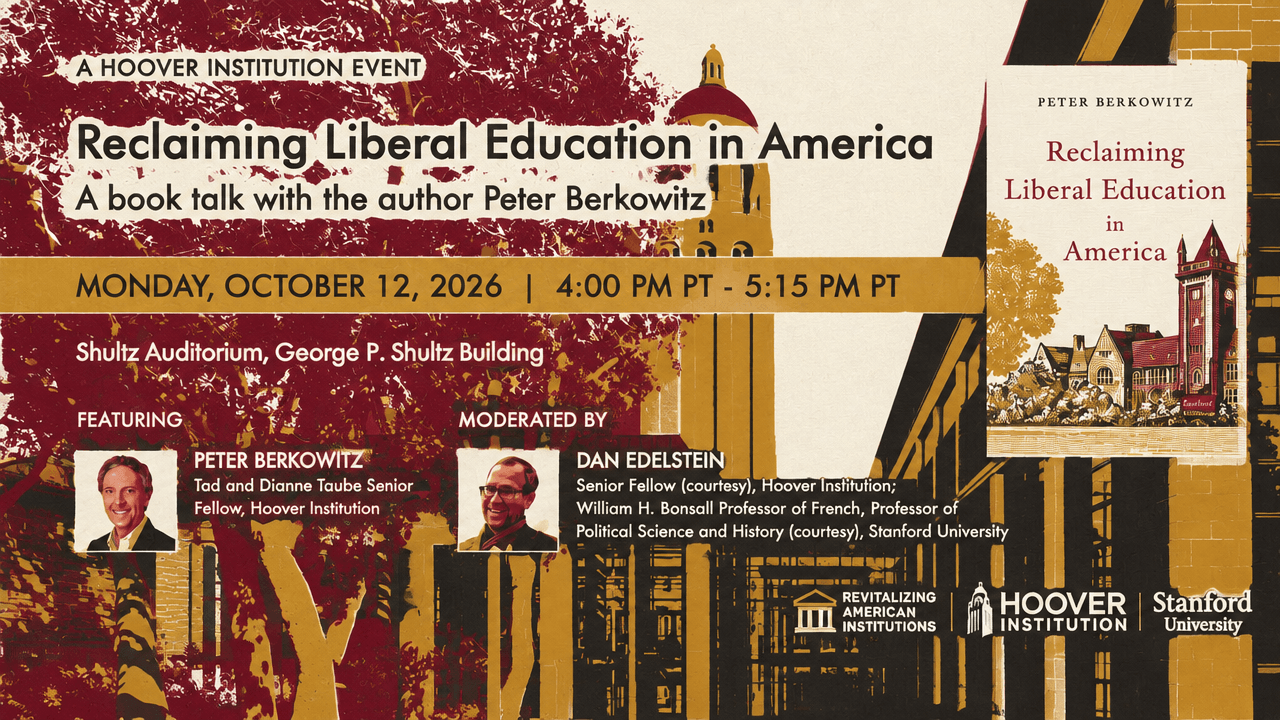
The university’s two missions have never been reconciled
The central institutional problem, in Peter Berkowitz’s account, is not that universities conduct research or train professionals. It is that they have not clearly reconciled those purposes with a second responsibility: giving undergraduates a liberal education. Research and professional training can take up much of a university’s attention, while the institution continues to claim that its graduates are prepared to participate thoughtfully in a free society. The resulting gap, Berkowitz argues, is one source of campus dysfunction and uncertainty about what students are meant to learn.
An audience member put the tension in historical terms. Beginning in the late nineteenth century, the questioner said, universities increasingly became producers of knowledge rather than institutions chiefly transmitting it. Faculty members want to teach courses connected to their research, the questioner suggested, and may have little incentive to teach introductory courses or a shared curriculum. Could this change help explain why universities struggle to provide the broad education Berkowitz wants?
Berkowitz agreed that it explains a great deal, though not all. He pointed to John Stuart Mill’s 1867 address on liberal education, which treated the distinction between professional and liberal education as an existing problem. Professional education prepares people for particular professions, including scholarship; liberal education has a different purpose. Universities, in Mill’s account as Berkowitz presented it, need to perform both functions.
That distinction does not make the two missions impossible to combine. Berkowitz argued that even students with professional ambitions could use four or six undergraduate courses devoted to American ideas and institutions, Western history, philosophy, and literature. He also suggested that universities could develop two faculty tracks or otherwise organize teaching to protect time for general education. He acknowledged that faculty members may be jealous of their standing as scholars, and that administrators would face practical difficulties. Still, he argued, a wealthy university could make room for both forms of education if it chose to.
The missions conflict. It’s not to say we can’t weave them together better, but we’re not, we haven’t really brought it to consciousness.
The questioner’s description of the problem also prompted Dan Edelstein to identify a change in undergraduate education that he said happened with little discussion: the undergraduate major moved into academic departments built to administer doctoral study. Departments inherited authority over majors that had previously belonged to the college. At Stanford, he noted, there is no separate college in that older sense; at some East Coast universities, a college structure remains, but may no longer determine much of the curriculum.

Edelstein offered the University of Chicago as a possible institutional model. In the humanities and social sciences there, he said, faculty members owe half their teaching to the College. They remain specialists in their departments but also teach undergraduates in the core. Berkowitz welcomed the idea of creating a separate college or division of liberal education within a research university. Such a structure, he suggested, could give general education a home that is not simply an extension of individual departments’ priorities.
That proposal answers part of the question about how to reconcile the missions: preserve departments and research, while assigning a distinct institution within the university responsibility for shared undergraduate learning. For Berkowitz, the stakes are larger than course design. Universities continue to tell graduates that their education prepares them to go out and change the world—not merely to become technically skilled professionals. That claim, he argued, commits institutions to educate students for life as citizens of a free republic as well as for work in a profession. The problem is not the existence of professional education. It is a university’s failure to define, support, and deliver the other education it says students are receiving.
A core curriculum would make liberal education an institutional commitment
Peter Berkowitz’s curricular proposal is a small, required sequence—perhaps four or six courses—with a meaningful order, rather than a set of distribution requirements that students can satisfy with almost any course. A requirement that asks students to take something in the sciences, social sciences, and humanities, he argued, can communicate that the university does not regard the content as important. If students can choose any course that suits their present tastes, the institution may appear indifferent to what they learn.
An audience member who had studied at an engineering school described a contrasting experience. Its technical core, the questioner said, was taken seriously by both students and faculty because it provided foundations for later work in a major. Students could see why an engineering student needed some biology and chemistry, even if those subjects were not the student’s future specialty. The questioner wondered whether liberal-education courses could earn similar commitment if students and faculty understood them as foundational and could see their broader value.
Berkowitz agreed with the comparison. Students recognize when a degree has a progression: one learns basic material before more advanced work, and introductory study contributes to later understanding even when its immediate professional use is not obvious. In his view, distribution requirements often send the reverse signal. A student can reasonably infer from the university’s indifference to what satisfies the requirement that general education itself is not a serious part of the degree.
His alternative would give the courses both sequence and shared substance. He mentioned American history, classical history, medieval and modern history, and literature as possible elements. He also emphasized that science belongs in liberal education: students need some basic knowledge of how the physical world operates and of how the social sciences explain the world. The goal is not to turn every undergraduate into a specialist, but to introduce students to multiple forms of knowledge and to make those introductions count.
A core also creates common material for students to discuss. Berkowitz rejected the objection that shared study necessarily means shared conclusions. If students have read some of the same books, they can argue about them from a common starting point and discover both where they agree and where they differ. He named Dostoevsky, Jane Austen, Shakespeare, and Sun Tzu as examples of writers whose work could give students material for such conversations. Shared study, he suggested, might support friendship across disagreement as well as intellectual exchange.
The proposal remains deliberately modest in scale: four or six required courses, not a complete redirection of every undergraduate’s education. But the obligation it implies is substantial. The university, rather than the student alone, would take responsibility for deciding what broad knowledge a degree should include. Berkowitz’s response to the claim that this disrespects student choice was that universities grant the degree and therefore have a responsibility to ensure graduates are well educated.
Faculty members may resist that responsibility, he said, partly because many were themselves educated at institutions that did not require a general education in American ideas and institutions or Western civilization. Building a serious core would therefore require more than writing a list of courses. Some faculty would have to retool, and a larger group would have to agree to teach material outside a narrow specialty. Berkowitz proposed beginning gradually, by finding faculty who still value liberal education and building “pockets” within the university. He described universities as bureaucracies that do not readily change; the incremental approach recognizes that constraint.
The 1988 removal of Stanford’s Western Culture requirement gives the debate a local history. Berkowitz supported students who later argued for restoring Western civilization study, and he believes it belongs at or near the core of liberal education. His case was not that a core should settle what students think. It was that a university needs to decide what students should have the opportunity to study together, and to show through its requirements that it regards that study as valuable.
Student demand is shaped by the institution as well as by the job market
The case for a required curriculum becomes more pressing, Peter Berkowitz argued, when students arrive with vocational aims. Dan Edelstein raised the familiar observation that many students come to college focused on getting a good job rather than pursuing a liberal education. Berkowitz did not deny that students have professional ambitions. He argued instead that those ambitions do not determine what an institution should count as an education.
He compared the question to a medical consultation: a patient’s preferred treatment does not settle a doctor’s judgment about what the problem requires. Likewise, professors and administrators must decide what students need to learn. Students at selective universities may go on to exercise considerable power in their professional lives; Berkowitz wants them to be prepared to exercise it responsibly. Study of American institutions, Western civilization, and other peoples, in his view, helps equip them for that task.
An audience member challenged the assumption that the problem could be solved within the university alone. Perhaps, the questioner suggested, economic structures shape what students want from college. Students may choose professional training because of the larger system they expect to enter; incentives within the university, including decisions about departments and funding, may also make liberal education harder to sustain. The questioner raised Stanford’s position in Silicon Valley as part of that context.
Berkowitz agreed that structural incentives matter, but located the most consequential ones elsewhere. Stanford, he observed, turns away many applicants for each place it offers. If it required four or six courses through a college of liberal arts, he argued, he doubted it would lose many students; if it did lose some, other candidates could fill the places. He also doubted that such study would make graduates less able to flourish professionally.
For Berkowitz, the more important incentives are those affecting faculty and institutional decision-makers. He recalled the removal of Stanford’s Western Culture requirement and cited a former Stanford student who told him that students had liked the requirement and that faculty wanted it gone. He also pointed to students at Chicago, Columbia, and Yale’s Directed Studies program who, in his account, showed interest in studying classical texts and political philosophy. Some students who expect to become doctors, lawyers, or business executives may see college as their last opportunity to study Plato. In Berkowitz’s experience teaching undergraduates and young adults in Washington, many ambitious students do not view liberal education as an obstacle to professional success; they see it as part of living a good life, including one with professional success.
This answer shifts the explanation away from student preference as an independent cause. Berkowitz argued that students are not the main policymakers: they come and go, pay for their education, and often have professional reasons to keep a low profile. Their choices are made within a curriculum and institutional culture set by others. Professors, administrators, and boards decide what is required, what is supported, and what the university treats as worthwhile.
Liberal education is a preparation for freedom, not a single canon
Peter Berkowitz defines liberal education as education designed to equip young people “to live lives well in a free society.” For American students, he argues, that requires serious study of the political ideas and institutions of their own country, including its failures, conflicts, and achievements. But national self-understanding cannot be separated from the larger civilization in which the United States developed, or from comparison with other civilizations.
He describes the American political tradition as a convergence of at least three inheritances. The biblical tradition includes the teaching that human beings are created in God’s image. The classical tradition, especially Rome, supplies an account of active citizenship: people cherish freedom, defend it, serve in politics, and then return to private life. The modern tradition of freedom, associated in his account especially with John Locke, begins from the premise that human beings are naturally free and equal. Berkowitz sees that premise in the Declaration of Independence and argues that its significance has faded. He invoked Abraham Lincoln’s observation that no nation had previously come into existence dedicated to a universal principle.
That is why Berkowitz thinks Western civilization should be studied, even when requiring it is controversial. But he does not argue that Western study is enough. Drawing on Aristotle’s view that serious political study is comparative, he says students should learn about the culture, history, religious life, and military conflicts of other peoples. Studying other civilizations gives students a basis for identifying what is distinctive about their own, including both its strengths and its weaknesses. It also reminds them that one civilization does not exhaust what it means to be human.
Berkowitz acknowledged that the traditions he described can be refined and contested. The purpose, as he presented it, is to give students enough knowledge to understand their society and to consider its place in a wider human world. A curriculum that teaches only approved conclusions would undermine that purpose.
His historical account connects contemporary campus conflicts to a longer dispute over what universities are for. Berkowitz traced an important change to the early 1970s, when students shaped by the political movements of the 1960s began entering graduate and professional schools. Many, he argued, brought a new idea of education: that teaching and scholarship should change society, rather than chiefly transmit knowledge and cultivate students’ capacity to think for themselves. The concern, in his account, is not social improvement as such, but what happens when scholarship organized around a political cause leaves too little room for competing interpretations or questions that challenge the cause.
Berkowitz situated later controversies within that conflict over the university’s purpose. The late-1980s books The Closing of the American Mind, Illiberal Education, and Tenured Radicals criticized politicization; David Bromwich’s 1992 book warned of universities suppressing dissent; and Alan Charles Kors and Harvey Silverglate’s The Shadow University (1998) chronicled campus speech restrictions and failures of due process. These examples establish that, for Berkowitz, disputes over speech and procedure long predate the more recent episodes he cited, including Larry Summers’s departure from Harvard in 2005, conflicts at Yale in 2015, and campus disputes in 2020.
Berkowitz also addressed campus responses to Hamas’s October 7, 2023 massacre in southern Israel. He described the subsequent eruptions on campus in support of Hamas as one reason some people now trace higher education’s dysfunction to the period after the attack. His larger point was that these events did not originate the problem. They made visible, again, a longstanding disagreement about whether universities should educate through knowledge and competing ideas or use teaching and scholarship chiefly in the service of social change.
The core needs teachers who develop both criticism and imagination
A former Stanford student who had been in the last graduating class to take Western Culture said the experience had not been especially good. Learning facts about Locke and Mill, the questioner argued, was not enough. The deeper need was to teach critical thinking and to help students reason about emotion.
Peter Berkowitz agreed that the quality and spirit of teaching matter. Drawing on Mill, he said that even a carefully designed curriculum is worthless if it is taught in the wrong spirit. He also questioned the tendency to equate thought with “critical thinking.” Students need the ability to ask whether a law or public policy can be justified. But they also need to ask where it came from and what needs or purposes it has served.
He described the second form of thought as sympathetic or generous: an effort to understand matters from another point of view. Liberal education, he said, should enliven the moral imagination. Studying political thinkers and writers can help students question established institutions while also understanding what those institutions have provided. Berkowitz named Locke, Mill, Adam Smith, Edmund Burke, Elizabeth Cady Stanton, and Frederick Douglass as examples of figures whose work can support that kind of questioning and understanding.
For Berkowitz, thinking for oneself therefore requires both tough criticism and generosity toward other perspectives. A curriculum of texts and facts is not enough; it must be taught in a liberal spirit that expands students’ ability to understand other people and civilizations.
Free speech and due process are conditions for learning together
Peter Berkowitz identifies free speech, due process, and curriculum as three connected areas in which universities have fallen short. His proposals for orientation are aimed at making the principles of a learning community explicit. Orientation should introduce students to toleration, civil argument, and the protection of free speech—not as abstract values, but as practices that allow members of a community to speak and to hear views they may oppose.
He argued that free speech offers the same basic opportunity to everyone: to express opinions and to encounter the opinions of others. That does not mean speakers are entitled to avoid criticism. On the contrary, he said, a lack of pushback would indicate that something had gone wrong. The point is that a community organized around free expression makes disagreement possible in both directions.
Berkowitz used John Stuart Mill’s argument in On Liberty to explain why discussion matters whether a person’s views are right, wrong, or mixed. If a community is wrong, open discussion increases the chance that its members will hear truer opinions. If it is right, challenge can prevent true opinions from becoming dogma by exposing their assumptions, implications, and weaknesses. And, Berkowitz said, moral and political opinions are commonly mixtures of truth and error. Conversation gives people a way to examine both their own views and those of others.
He proposed an annual university-wide free-speech week, with a distinguished speaker each year and opportunities to meet with faculty and students. The event would demonstrate that the institution gives free speech attention and resources, while providing time for sustained discussion. Berkowitz said he had made a related proposal in an open letter to Heather Gerken, then dean of Yale Law School, after a speech controversy there.
Orientation should also cover due process and principles of the American justice system, including the presumption of innocence and the right to confront one’s accuser. Berkowitz sees those protections as part of the structure of what he called a “small society of learning.” Speech rules help make disagreement possible; fair procedures matter when serious accusations arise. Both are, in his account, part of establishing a community organized around freedom rather than discretionary punishment.
Boards and administrators have authority to make the mission real
Peter Berkowitz places responsibility for the status quo primarily with professors, administrators, and university boards—not students. In his view, boards and administrators in particular have more power than they often acknowledge. They can decide whether a university treats liberal education as an obligation alongside research and professional training, and whether that commitment is reflected in structures and rules.
He used Columbia’s campus encampments as an example of institutional authority. Berkowitz rejected the claim that the university president was powerless to remove them, arguing that the president could have enforced the rules if the board had supported her. He emphasized that he supports students’ right to protest as part of free speech. His distinction was between the right to protest and the conditions under which a protest takes place: in his account, protests are subject to time, place, and manner restrictions, and the right to protest does not entail an unrestricted right to camp wherever and whenever one chooses.
The example illustrates Berkowitz’s wider point about governance. Universities may describe themselves as unable to act when students or faculty would object, but, he argues, administrators and boards still make consequential choices. The same institutional authority that could enforce campus rules could, in principle, establish a liberal-education division or require a small sequence of shared courses. Doing so would require governing bodies to support that commitment when implementation meets resistance.
Asked whether he felt optimistic about higher education, Berkowitz said he did not, but that the situation was too serious to spend time indulging pessimism. He was encouraged by civic-education and civic-thought programs around the country, including efforts at Arizona State, the University of Texas, the University of Florida’s Hamilton School for Classical and Civic Education, North Carolina, and Ohio State. He also cited summer programs in Washington where students study political philosophy and public policy, reports by the chancellors of Vanderbilt and Washington University on politicization in the humanities, and a Yale report on declining trust in universities.
He described these initiatives as “beachheads” for the study of liberal education: signs of a growing recognition that universities are not fully performing their responsibility to help young people understand what it means to be American and, more broadly, human. Their lasting significance depends on whether universities give this work sustained institutional support.