Iran’s 1979 Revolution Replaced a US-Israeli Alliance With Decades of Confrontation

Abbas Milani argues that Iran’s 1979 revolution turned a close strategic partnership with the United States and Israel into a durable confrontation, driven by the Islamic Republic’s ideological project. He traces the shift from pre-revolutionary cooperation—including Israeli support for Iran’s nuclear program—to the embassy seizures, hostage crisis and sanctions that followed, and says Tehran later built regional armed groups to extend its conflict with Washington and Israel.
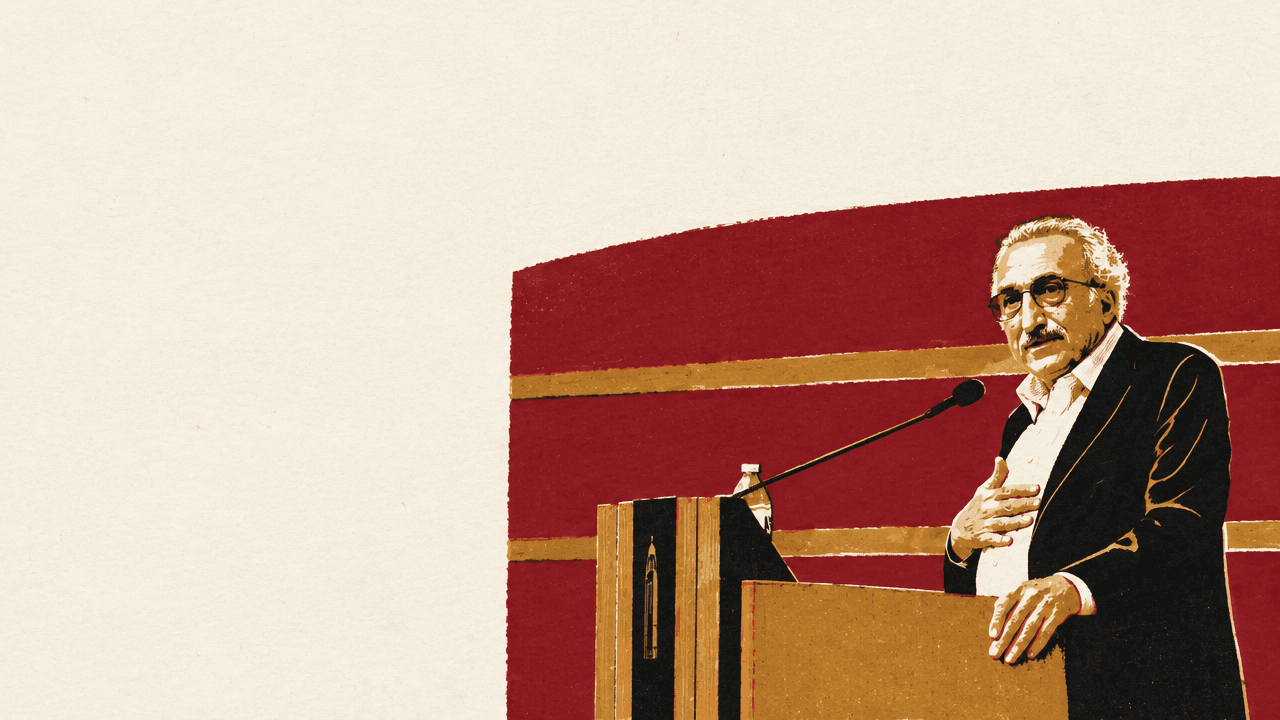
The revolution replaced an alliance with a durable confrontation
When the revolution happened in 1979, Iran went from one of the United States’ closest allies to, in Abbas Milani’s description, one of its most intransigent enemies. The reversal was not simply a rupture in diplomacy. It replaced a strategic partnership with an Islamic Republic that, Milani argues, treated confrontation with the United States and Israel as part of a broader ideological project.
The break with Israel came quickly: the Israeli embassy in Iran was taken over and handed to the Palestine Liberation Organization. Soon afterward, Iranian militants occupied the US Embassy in Tehran and held American hostages for 444 days. Milani says the hostage crisis transformed relations with the United States. Sanctions began in its aftermath and have remained in place, at varying levels, since 1980.
For Milani, the crisis marked the start of a longer pattern. The Islamic Republic’s leaders came to see the United States and Israel as opponents in a protracted conflict. They built regional relationships and armed groups as instruments in that struggle, while promoting an account of the conflict that cast Western ideas and institutions as threats to Islam.
That history is especially consequential now, Milani says, because Iran may be both at its weakest point in decades and unusually emboldened. He rejects descriptions of Iran as a new superpower. In his view, the regime’s sense of opportunity does not reflect strength so much as its reading of a changing regional moment.
Before the revolution, Iran’s ties with Israel were unusually close
Milani sets the pre-revolutionary reversal against a long history of Jewish life in Iran. He says Jews have lived there for at least 2,500 years, tracing that presence to the period of the Babylonian captivity and the Iranian king Cyrus. He describes Jews, Christians and Zoroastrians as protected religious minorities who could maintain their faith while occupying a second-class status and paying an additional tax. In his account, the regular pogroms seen in medieval and nineteenth-century Europe were absent in Iran, although there were occasional attacks on Jewish neighborhoods.
The modern relationship with Israel was also closer than the post-revolutionary picture might suggest. Milani says Iran was, alongside Turkey, among the first Muslim countries to recognize Israel de facto, and that Iran was one of the few Muslim countries to vote at the United Nations in favor of establishing Israel and a Palestinian state under the partition plan. The Palestinian state envisioned in that plan did not come about, he says, because Arab states rejected it.
During the Shah’s rule, from 1941 to 1979, Iran maintained close ties with Israel. Milani says that between 1950 and 1979, no country other than Turkey had a relationship with Israel as close as Iran’s. Israel had a de facto embassy in Iran, and the two countries cooperated on multiple fronts.
That cooperation included nuclear technology. Milani says Iran began developing a nuclear program in 1970 and that Israel was its closest supporter. The United States, by contrast, pressed Iran to forgo enrichment and pursue nuclear technology in a way that would not create tensions with other countries, offering assistance along a path Milani compares to South Korea’s. Iran did not take that route; he likens its choice to North Korea’s, while stressing a difference in outcome.
Milani says that after 47 years and hundreds of billions of dollars spent, Iran has neither a nuclear bomb nor economic benefits from what its government calls a peaceful nuclear program. He and nuclear technology scholar Sig Hecker, he notes, have argued that Iran should have listened to the United States in the 1970s. His account of the earlier cooperation makes the later hostility especially stark: Iran’s revolutionary government broke with a relationship in which Israel had supported the very program Washington was urging Iran to constrain.
Washington saw Iran as a counterweight before it became an adversary
Milani traces Iran’s relationship with the United States to Iranian efforts to find an outside partner against Russian and British pressure. In the nineteenth century, he says, Iran sought a power without colonial interests in the region. The United States appeared to offer that possibility because it was distant and did not yet have the same involvement in Iran. Relations developed from the middle of the century onward; particularly after the Second World War, Iran became one of Washington’s closest allies in the Middle East.
Iran mattered to the United States before the Cold War as well, Milani argues. He points to colonial-era American newspapers that discussed Iran and offers an anecdote about the “Boston Brew,” a mix of bourbon and rum that he says was a major colonial export and widely consumed in Iran. The example is part of his larger point that the United States’ interest in Iran did not begin with the 1979 revolution or the end of the Cold War.
The Cold War deepened the strategic relationship. Milani describes the Soviet occupation of Iran’s Azerbaijan region after the Second World War as an early major confrontation of the Cold War. The Soviet Union did not leave when expected, he says, and the United States used the threat of a nuclear attack on the Soviet Union as pressure. Milani credits US pressure with helping bring about the withdrawal. In his account, the Soviets were seeking access to Caspian oil. The episode reinforced Iran’s belief that the United States could help counter Russian and British power.
After Israel’s establishment, Washington increasingly treated cooperation among the United States, Iran and Israel as a foundation for peace and continuity in the Middle East, Milani says. Iran’s strategic importance and its close ties with both countries were therefore connected: Tehran was not just a US ally, but part of a regional alignment that included Israel.
The Carter administration misjudged the force it was backing
Milani argues that the United States misread the crisis that brought Khomeini to power. In late 1978, he says, the Carter administration believed Iran’s government was close to collapse and that the Islamists were the only force capable of holding the country together. Khomeini presented himself as able to preserve Iran, keep the Soviet Union at bay and ensure that Iranian oil could be sold internationally. Washington saw the Islamists, in part, as a barrier to Soviet expansion.
Milani says that US Embassy assistance in Tehran helped make the Islamists’ rise possible. He argues that the Carter administration, like others at the time, did not understand what it was getting into: it thought it was helping keep Iran in the Western camp, but the movement it backed claimed a mission to expand Islam’s and Shiism’s influence globally.
The turn against Israel was similarly rapid. Iran transferred the Israeli embassy to the PLO, whose leader, Yasser Arafat, was among the first foreign visitors after the revolution. Milani says Arafat wanted Iran to take a more radical position in the Middle East, though he adds that Khomeini and his allies needed no encouragement to do so.
Under Khomeini and then his successor, Ali Khamenei, Iran developed and supported armed partners across the region. Milani names Hezbollah in Lebanon, groups in Syria and Iraq, the Houthis in Yemen, and Palestinian Islamist groups, including Hamas. He says Iran trained and armed these groups as part of its confrontation with Israel and the United States.
The regime promotes its conflict as a culture war
Milani locates the regime’s ideological strategy in Khamenei’s conviction that the West is trying to undermine Iran and Islam. He says Khamenei developed a theory of “culture wars” and directed substantial resources toward promoting the Islamic Republic’s account of the conflict. Milani points to satellite mosques and universities, including one university that claims to have offices in more than a hundred countries. The network, as he describes it, is intended to circulate Iran’s interpretation of the relationship between Islam, the West and Israel beyond the country’s borders.
In this worldview, the disputed ideas are not confined to foreign policy. Milani says the regime portrays secularism, separation of religion and state, religious pluralism, freedom to change one’s faith, and equality between women and men as Judeo-Christian ideas and as part of a new crusade against Islam. The regime’s answer, he says, is to challenge secularism with a theological account of society and politics.
That account has domestic consequences. Milani says people born Muslim are not permitted to convert to another religion in Iran, and that some Shiite clerics regard conversion out of Islam as punishable by death. He says Christians are imprisoned for converting and that Baha’is have faced persecution and are not recognized by the state as a religious minority.
Milani sees weakness alongside growing boldness
Milani cautions against reading Iran’s ambitions as proof of its strength. Some commentators, he says, describe Iran as a superpower. He argues instead that the regime is probably at its weakest point in 44 years, even as it may feel unusually emboldened and believe it can become the dominant power in the Middle East.
Iran is probably both at its weakest point that it has been in forty-four years, and also, ironically, maybe at its most emboldened.
Milani also warns that current accounts of Iran are often filtered through political agendas. Discussions of Iran, he says, can become a vehicle for arguments about Israel, Donald Trump or the Iranian regime itself. He urges caution about commentary from people without a record of writing about Iran. His distinction is between the regime’s perception of an opportunity and the country’s underlying strength: in his view, those can move in opposite directions.