DOGE’s Legacy Is Spending Controls That Persist Inside Federal Agencies

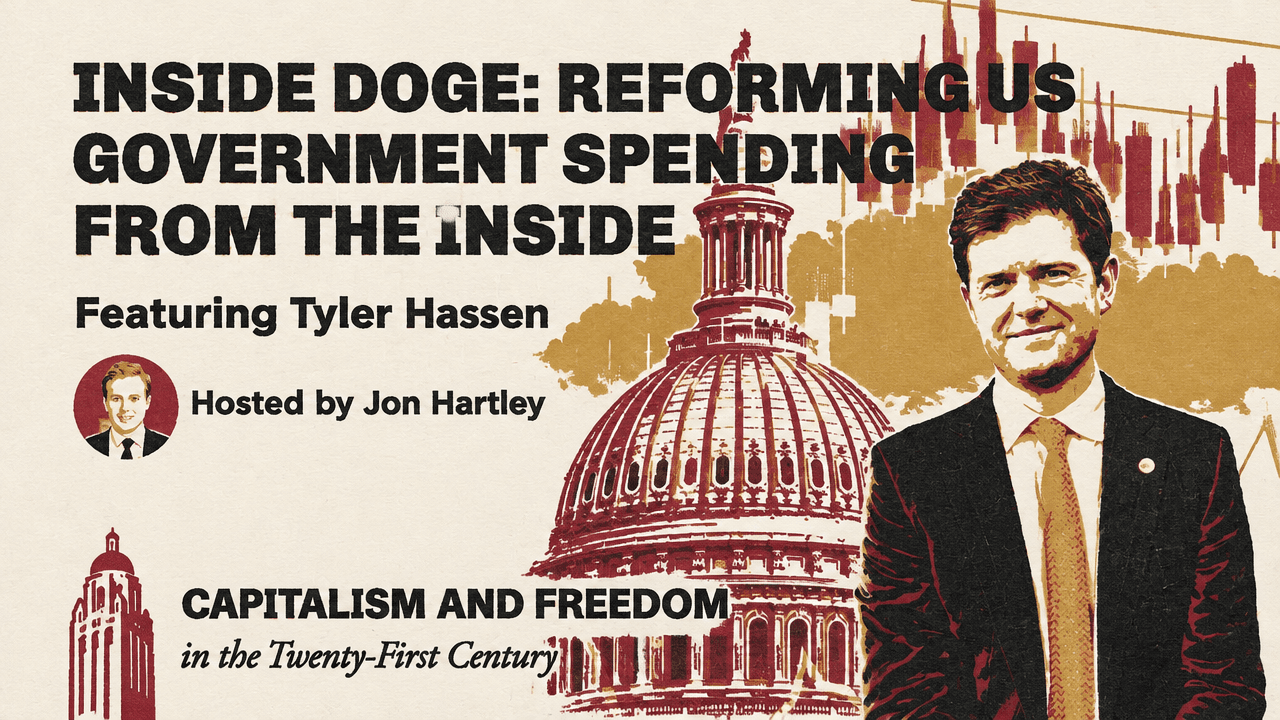
In his account of DOGE, former team member Tyler Hassen argues that its significance lies less in the spending it cut than in showing how much government money could go unexamined. At the Department of the Interior, he says, his team built a clearer picture of contracts and grants, required review of new commitments and reorganized support functions, though court challenges disrupted plans to reduce staffing. Hassen acknowledges that DOGE did not solve the deficit; he argues its controls and practices should continue inside agencies and beyond them.
Interior’s spending was difficult to assess because no one had assembled it
Tyler Hassen described his first task at the Department of the Interior as building a usable picture of where money was going. He focused on three main categories—contracts, grants and people—and said that, when he arrived, the department had not been compiling the information in a way that let him assess it across the organization. At first, he was the only DOGE representative at Interior. He had to request data from the department, then work out how to sort through it.
The scale made the first pass difficult. Interior had roughly 10,000 to 11,000 active contracts, Hassen said. He separated them by bureau, then used product and service codes to identify types of work he thought were more likely to be nonessential, including outsourced consulting and special studies. He selected about ten or twelve codes for each bureau and asked contracting officers to assess the contracts against several questions: Was the work mission-critical? Was the contractor actually doing it, and doing it competently? Did the contract involve DEI? And, most important to Hassen, who was responsible for it?
That last question addressed a gap he encountered repeatedly: he could not always tell who had made a decision to spend the money. A name attached to each contract gave him someone to ask about its purpose and performance. When contracting officers identified only three of 900 contracts above $50,000 as non-mission-critical, he challenged them to look again. He said other bureaus returned more substantial lists, but the initial responses were decisions made by the bureaus themselves.
The review produced examples Hassen found difficult to justify. One was a $4.2 million assessment of groundwater in Mauritania. He said he asked why Interior had the contract but received no answer. The amount, he acknowledged, would not move the needle against the federal government’s overall spending. What troubled him was that the department could not readily explain why it was paying for the work.
A larger example emerged while he reviewed proposed spending. Hassen received an $830 million request for customer-service survey contracts over four to five years, not in a single year. Some of the work, he said, involved spreadsheets and Word documents with misspellings, and examples were simple enough for a middle-school student. The surveys asked questions such as whether users liked Interior’s or the National Park Service’s website. He could find no meaningful feedback loop showing that anyone was using the results. After showing the work to Interior Secretary Doug Burgum, Hassen said, the contracts were canceled.
His approach was not simply to identify contracts he considered wasteful and cancel them. Hassen said he wanted contracting officers to assess the work, but found that some were reluctant to make a decision. In one group, 98 of 100 contracts drew no objection when his team stopped them; the other two were restored. He described that as a way to allow staff to identify necessary work while avoiding a default in which every expenditure continued because no one had made a decision.
The review also exposed a problem with looking only at contracts already in place. Hassen could see existing contracts, but said he lacked visibility into new contracts being approved. He described the process as a treadmill: the team might cancel one expenditure while another was authorized without its knowledge. To address that, he emailed every contract and grant officer and required his own approval, or approval from someone he designated, for proposals over $50,000. He said that threshold applied across a department with $36 billion in spending. Reviewing proposals took nights and weekends, and eventually became a team effort.
Hassen’s account of grants is less detailed than his account of contracts, but grants were part of the same review and approval process. He said the department’s main spending categories were contracts, grants and people, and his email to officers covered both contracts and grants. His examples of individual expenditures, however, centered on contracts. He also said Interior’s work combined analytics and review across those categories rather than relying on a single list of cancellations.
The approval process, he argued, surfaced spending that would not appear on a public tally of canceled contracts. Those proposals had been stopped before they became active commitments. Hassen acknowledged that DOGE made mistakes: some contracts were canceled and later reinstated, and some may have been duplicates. His point was that visible cancellations did not capture spending his team said it prevented before it went out the door.
Interior’s effort eventually gained staff with different skills. Katrina, whom Hassen described as better with Excel and contract analysis, helped review contracts and grants. Stephanie, a former chief people officer at Okta, focused on personnel. Lawyers and engineers joined as well. Hassen said the combination of technology, people, contracts, grants and analytics made Interior a model for what DOGE could do. He also credited the working relationships among the DOGE team, Burgum and their staffs.
DOGE’s reach depended on cooperation, access and legal authority
Hassen rejects the idea that DOGE regarded career civil servants as a single adversarial group. He said he made friends among civil servants during his government service and continued to praise their work. As one example, he pointed to the head of Interior’s Office of Natural Resources Revenue, whom he said had recently helped bring in an unusually high level of revenue. He described her as doing a fantastic job and said many career employees were hardworking and capable.
At the same time, he said the team encountered employees who made its work harder. Some, in his account, tried to stop DOGE at every step; others practiced what he called “malicious compliance,” appearing to agree with an instruction and then not carrying it out. Hassen presented this resistance as a reason for verifying whether instructions had been followed, not as a description of the civil service as a whole.
That was his explanation for why DOGE sought access to agency systems: without access, he said, the team could not verify whether contracts had actually been canceled or hiring freezes properly implemented. At Interior, he described the access primarily as a deterrent. He said he personally logged in only once, when he was shown how to use the systems, and had no interest in going through them himself.
The scope of what DOGE could change was also constrained by the distinction between agency decisions and spending set through law. In framing the issue, Jon Hartley noted that Congress controls appropriations and that discretionary spending can be easier for an executive agency to cut than mandatory spending. He also observed that it can be difficult to determine which category applies. Hartley’s point was that an agency-level review could not, by itself, resolve every source of federal spending or debt.


Hassen’s account adds another limit: decisions could be disrupted by courts. At Interior, he said, his team consolidated HR offices and IT functions, but when it moved to right-size the organization, court proceedings intervened. He cited two temporary restraining orders and said the legal actions disrupted the plan. The account distinguishes between reorganizing functions—which he said the department accomplished—and reducing the workforce after the reorganization, which he said did not happen as planned.
Hartley also pointed to a rescissions bill passed in the summer of 2025, saying that some DOGE cuts, including some that courts had blocked, were put into law. He estimated that the bill saved approximately $10 billion. That estimate and description were Hartley’s; Hassen did not independently provide a figure for the bill. The example nevertheless illustrates the difference between an agency effort to stop spending and a congressional decision to formalize cuts.
Hassen’s description of DOGE’s limits sits alongside his account of its controls. In his view, the team could examine contracts and grants, require approval for new commitments, and check whether agency instructions had been carried out. But the effort was not equivalent to changing congressional appropriations, and the Interior reorganization shows that even an administrative plan could be affected by litigation.
The workforce changes targeted support functions, not frontline staff
Hassen argues that business practices can be useful in government, while acknowledging that his experience came from a particular kind of business. Before government, he worked in energy services, where drilling activity could fall sharply in a matter of months. He cited downturns in 2015–16 and around COVID, when he said companies had to make quick workforce decisions to survive. He described those cuts as difficult but humane, and argued that government should also be able to adjust when its functions are organized inefficiently.
His comparison was not that government and private companies have identical purposes. It was that the government workforce should not be treated as immune from questions about staffing and structure. Hassen argued that some functions had accumulated in ways that made little operational sense, while the difficulty of reducing staffing allowed those arrangements to persist.
At Interior, he said, more than 2,000 human-resources professionals served a workforce of about 65,000, distributed across 50 HR offices. The department also had more than 2,000 IT professionals. Hassen estimated that roughly 4,300 to 4,400 of the 65,000 employees worked in HR and IT. In his account, the support functions were fragmented across the bureaus, each maintaining its own staff and capacity for the busiest periods. Because it was difficult to reduce staffing, he said, those arrangements accumulated and remained in place.
The proposed reorganization was to bring the 50 HR offices into one and consolidate bureau-level IT functions in a single group. Hassen said the department completed those consolidations and described them as among the largest reorganizations of functions in recent government history, possibly in decades. He said the next step—right-sizing the organization after consolidation—was disrupted by court proceedings.
He stressed that the effort was not aimed at frontline workers in parks. Hassen specified that the team was not focused on park rangers, firefighters or people helping visitors. Instead, he described its focus as support functions he considered fragmented or duplicated, particularly HR and IT. In his account, reorganizing those functions was an attempt to reduce duplication before deciding what staffing level the consolidated offices required.
Hassen also described an attempt to change annual performance reviews. According to him, the prevailing practice before the administration was for employees to receive a five, the highest score on a five-point scale. His team wanted to reset the baseline at three, so that stronger performance could receive a four or five and weaker performance a one or two. He said the proposal met substantial resistance. He characterized the existing reviews as a rubber stamp and said the aim was to make them more informative.
He connected these changes to a broader contrast between government and business. In the private sector, he said, companies sometimes cut jobs when markets contract, even when the employees are good people. Government, by contrast, can treat its workforce as if any reduction were categorically different. Hassen’s argument was that some public employees perform essential services while other functions may be reorganized or reduced; the distinction should be made through examination of the work rather than by treating all government positions as equally protected from scrutiny.
Hassen’s case for business urgency came with a debt warning
Hassen said his concern about government spending began with the national debt. When he graduated from college in 2005, he said, the debt was about $8 trillion and GDP about $13 trillion. At the time of the interview, he put debt above $40 trillion and GDP in the low-to-mid $30 trillions. He said government projections put debt at $100 trillion in 20 years without changes, with annual interest payments of roughly $3.5 trillion. He compared that estimate with annual national-defense spending of around $1 trillion.
Hassen connected those projections to the question of what the federal government would be able to afford in the future. He said he thought about his five-year-old daughter and where the debt might be in 20 years. In his view, the potential interest bill would be several times annual national-defense spending. Those figures were Hassen’s estimates and framing, not a claim that DOGE itself could prevent debt from reaching that level.
He said the concern made him feel he should do something after the election rather than continue complaining. Hassen had no existing connection to Elon Musk’s group. Friends helped him connect with someone on the transition team, and the interview process took a long time, including one interview on New Year’s Eve. He received the call to go to Washington on January 3, his birthday.
The team he joined brought together experienced business leaders and young technical staff. Hassen named Musk, Steve Davis, Anthony Armstrong, Joe Gebbia and Tom Krauss among the people he worked alongside, as well as engineers with strong academic records and achievements in mathematics. He said titles and age mattered less than production, urgency, accuracy and getting things done. One lesson he took from working with Musk’s group was to compress timelines: “Why do tomorrow when you can do it today? Why do it in a week when you can do it tomorrow?”
He described Musk’s leadership as hands-on. In meetings where departments and projects were discussed, Hassen said, Musk asked detailed follow-up questions and was good at identifying who knew a subject well. Hassen interpreted those questions as an effort to help move the work forward, not simply to test the person presenting.
One interaction began after Hassen gave an update on contracts and grants. Someone mentioned his earlier work in California on a water crisis, and Musk asked him to explain what had happened and what he had accomplished. Hassen said he had been sent to California in his first week in government and tried to explain the crisis, an executive order and the conflict he described as putting people over fish. The exchange took about five minutes, though it felt longer to him. He recalled Musk asking strong questions and treating him with respect. In late meetings, when people were tired, Hassen said, Musk sometimes made jokes or asked Grok funny questions.
The conflict surrounding DOGE was not, for Hassen, limited to disputes over spending. He said he learned about the USAID findings around the time the press did, because he was focused on Interior and was not included in every discussion. He was not surprised by reports of waste, which he said he had seen in a different form in his own department. What stayed with him most was the death threats received by engineers working on the effort. He said those engineers had come to Washington to serve the public despite having other opportunities, and recalled checking on them and being struck by their resolve.
Hassen’s defense of DOGE is not that the effort eliminated the deficit. He explicitly said it did not. He calls it a success because, in his view, it demonstrated that government could waste money in substantial and sometimes absurd ways. He argues that treating the effort as simply a failure would make it easier for contracts to return to autopilot, for the federal workforce to grow without scrutiny, and for debt to continue compounding.
The debt is fine until it isn’t.
DOGE’s legacy, in Hassen’s account, is an unfinished set of controls
Hassen’s account of DOGE’s legacy is not confined to the cancellations made during its most visible period. He said former DOGE colleagues continued working inside agencies and described efforts to improve Treasury payment controls, modernize IRS systems and fix permitting processes. He also pointed to OneGov, which he described as a way to combine separate purchasing agreements into one lower-cost arrangement—for example, replacing twelve contracts with Amazon with one. These were examples of work he said was underway, not evidence in the interview that each initiative had achieved its intended savings.
Hartley noted that DOGE-inspired initiatives had also appeared at the state level. He said he had worked with Texas’s Regulatory Efficiency Office on cost-benefit analysis and asked how Hassen viewed the effort’s wider influence. Hassen’s answer emphasized the potential for people and operating practices to remain after DOGE itself had ended. He said the book did not provide all the answers, but argued that government would have a better chance of improving if people with varied experience were willing to serve.
Hassen’s claim of success is therefore narrower than a claim that DOGE solved federal spending. He said the effort proved the concept that government could waste money, while conceding that it did not eliminate the deficit. The case he makes is that reviews, approval controls and reorganized functions can interrupt routine spending—and that this work can continue through staff embedded in agencies and practices adopted elsewhere.
The limits remain substantial in his own account. Agency-level reviews cannot settle every question about mandatory spending or congressional appropriations; court proceedings disrupted the Interior workforce plan; and Hassen acknowledged mistakes in cancellations. Hartley’s account of the rescissions bill offered one route for some cuts to become law, but his approximately $10 billion estimate was presented as Hartley’s estimate, not as a figure Hassen supplied.
For Hassen, the alternative to continuing the work is a return to the conditions he says DOGE encountered: contracts approved without a clear view of what was already being committed, fragmented functions left in place, and spending that no one had been asked to defend. He sees the effort as a jolt to government’s habits rather than a completed fiscal remedy.