Courts Have Yet to Set Limits on Police Searches of License Plate Data


Stanford legal scholar Orin Kerr argues that the central Fourth Amendment question raised by Flock license plate cameras is not whether a single camera records a car on a public road, but whether a searchable network can reveal a vehicle’s movements across places and over time. Existing Supreme Court decisions offer competing ways to assess that kind of tracking, leaving unsettled when a database query counts as a search and what limits it should face. Kerr also says the debate lacks solid evidence about how often the cameras help police or how warrant requirements would affect their use.
The surveillance concern is the network, not the camera
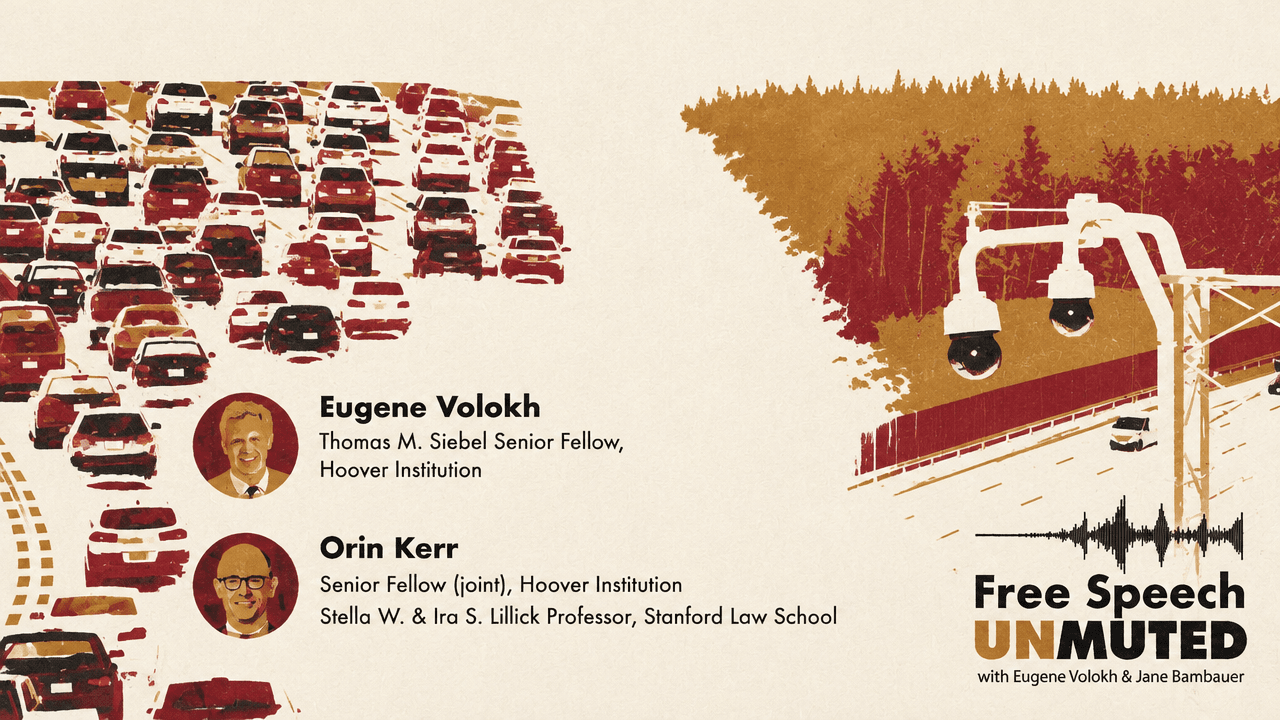
Flock cameras are automated license plate readers made by Flock Safety, one of several companies selling such systems. Orin Kerr describes them as cameras, often mounted on traffic poles and powered partly by solar panels, that take images of passing vehicles. Flock has become a familiar name in the debate in part because the company has a substantial market presence, advertises its products, and, Kerr says, appears to offer them at lower prices than competitors.
A single camera can record a car passing a particular point. The more consequential capability comes from linking cameras and allowing participating organizations to search across their records. An authorized user can enter a known plate and look for where the vehicle has been seen. The system can also alert officers when a camera reads a plate on a watch list—for example, the plate of a reported stolen car.
The search need not be limited to a plate number. Kerr says the system stores photographs of the backs of vehicles, which can be searched using descriptions such as “a red SUV with a bumper sticker” or a damaged bumper. AI-assisted queries can therefore look for features of a car, not just a particular registration.
Participation in the wider network is not automatic everywhere. A city or other organization that purchases the cameras can choose whether to share data through the national option, and state law may constrain that choice. Kerr says California had opted out of interstate sharing under an interpretation of state law, and that three states had opted out at the time of the discussion.
The concern is what this combination of searchable images, connected cameras, and retained records could enable. If many towns install cameras and officers can search across a large network, the system may reveal where a vehicle has traveled over time. The scope depends on how many cameras are connected and how long their records are kept. The issue, as Kerr describes it, is not simply that a camera sees a license plate in public; it is that a network may make it possible to find a vehicle’s movements across places and over time.
That raises the initial constitutional question. Driving on a public road exposes a vehicle to observation, and a license plate is meant to be visible. But recording an observation and assembling a searchable history of movements are not necessarily the same kind of surveillance. The Fourth Amendment does not mention privacy by name; it prohibits unreasonable searches and seizures. The question is whether the government’s use of this technology counts as a search—and, if so, when that search is reasonable.
The law no longer treats public tracking as a simple question
The older starting point, Kerr says, was that people generally had no reasonable expectation of privacy in movements visible on public roads. In the 1980s case United States v. Knotts, the Supreme Court considered police use of a radio beeper placed in an item in a suspect’s car. The beeper helped officers follow the suspect to the location of a meth lab. The Court treated the tracking as observation of activity in public.
Later cases complicated that rule. In United States v. Jones in 2012, the Supreme Court considered police placement of a GPS device on a car and tracking it for 28 days. The majority focused on the physical installation of the device. But concurring opinions raised a different possibility: prolonged tracking itself might invade a reasonable expectation of privacy, even when the movements being tracked were public. Justice Alito, as Kerr recounts, distinguished the beeper in Knotts, which tracked someone for only a few hours, from GPS monitoring over 28 days.
In Carpenter in 2018, the Court treated government access to historical cell-site location records as a search. Those records can give a rough indication of where a phone was when it was connected to a cell site. Kerr reads the decision as recognizing a privacy interest in the whole of a person’s physical movements, even if a person may not have such an interest in every isolated movement. The scale of the records mattered.
Kerr says a more recent case, Chatrie, pushed the analysis further. It involved Google’s former Location History service, which could keep records of where a phone had been. Police investigating a bank robbery in rural Virginia asked Google which phones had been near the bank at the time. The records identified Chatrie, who had enabled the tracking feature before robbing the bank.
As Kerr describes the decision, the Court treated the collection of Chatrie’s location records as a search, although the records showed him in public and the government obtained only some of his location history. Kerr says the Court focused on the sophisticated tracking system and the privacy interests it implicated, rather than on how many records of Chatrie’s movements were obtained in that particular instance. He also describes two distinctions from Knotts: the newer technology could potentially reveal when someone was at home, and sophisticated tracking technology may warrant different treatment from a rudimentary device.
That account does not settle how Chatrie applies to Flock cameras. Kerr sees two plausible readings. One is that Flock queries resemble the sophisticated tracking tools discussed in Chatrie: the fact that the system records vehicles in public would not prevent a query from being a search. The other emphasizes that Flock cameras, by their nature, track public movements, and distinguishes them on that basis from a system that can potentially show someone inside a home. Kerr presents both as possible paths, not as a settled rule.
Kerr’s formulation of the point was that “the important thing is that records were obtained from a very sophisticated tracking system.” The distinction matters because calling a query a search does not by itself make it unconstitutional. It brings the Fourth Amendment’s requirement of reasonableness into play. The constitutional question has at least two parts: whether a particular use of the network is a search, and, if it is, what limits make that search reasonable.
A warrant can target one car, but database searches raise harder limits
Whether Flock queries count as searches is only one part of the constitutional problem. The Fourth Amendment also requires that a search be reasonable. A warrant generally rests on probable cause, but it must also be particular: it cannot authorize an unnecessarily broad search. How to apply that requirement to a large database is a separate and unresolved question.
Orin Kerr says the issue arose in the oral argument in Chatrie. Federal appeals courts have taken different approaches. Some ask how to confine a warrant by time period or geographic area. Another approach, adopted by a different court of appeals, is that a warrant to search a sufficiently large database would resemble a search of millions of people’s homes and should not be allowed at all. Kerr identifies the disagreement as one between the Fourth and Fifth Circuits. A circuit is an intermediate federal appeals court; the Supreme Court sometimes resolves disagreements among these courts.
Eugene Volokh sees a way to distinguish searching a database from searching everyone in it. If police have probable cause to believe a particular car has been stolen, he argues, a warrant asking for records associated with that car’s plate could be sufficiently particular. The fact that the records sit in a very large database would not mean that police are searching everyone else’s vehicle history. Kerr agrees with that analysis and says he has made the same argument in a law review article. But, in Kerr’s account, the Supreme Court sent the issue back for more consideration by lower courts rather than resolving it. He says the question remained pending and that another trip to the Supreme Court would not surprise him.

Even a warrant tied to a particular vehicle leaves questions about scope. How far back can investigators look—last week, last month, or years earlier? How much of the network can they search? The constitutional question is not just whether the government may search a record; it is what limits make the search particular.
A Massachusetts case illustrates why courts may disagree about those limits. In Commonwealth v. McCarthy, decided in 2020, police used license plate readers to track a drug dealer who crossed a bridge onto Cape Cod to visit a co-conspirator. Cameras at both ends of the bridge helped police determine when he crossed. The Massachusetts court concluded that the observation was not invasive enough to be a search. As Kerr characterizes the reasoning, it was close to having an officer stationed on the bridge watching a particular person pass.
But Kerr says Chatrie rejected the idea that the amount of information collected in a particular instance is enough to decide whether a search occurred. That complicates reliance on the limited number of observations in McCarthy. The constitutional question is not simply how much data happened to be retrieved in one query; it also concerns the nature of the tracking system and the authority used to search it.
Volokh proposes thinking about the basis for searching particular cameras. A query of a small number of cameras might be justified by reasonable suspicion that those cameras would capture something relevant; a nationwide query would be different if investigators had no basis to suspect that most of the cameras would provide evidence. Reasonable suspicion is a standard below probable cause, which Volokh notes is used to justify a brief stop and questioning.
Kerr considers a tiered approach possible, but says it would be a difficult judicial judgment. Probable cause is traditionally tied to a place or entity, such as a home. A larger database search creates more opportunities for evidence to turn up somewhere, so the scope of the search itself matters. Kerr offers as a possible policy line reasonable-suspicion queries within a limited area and probable cause for broader searches, perhaps beyond the city that installed the cameras. He does not present that as settled doctrine.
The difficulty is partly institutional. Courts sometimes apply sharp thresholds, but Kerr says judges generally need a legal rationale for drawing them; tradition can supply one even when the number itself is not scientifically dictated. Legislatures, by contrast, can directly set a limit on how many cameras an officer or department may query. Volokh and Kerr discuss examples of legal lines around jury size, age limits, and the seriousness of an offense to illustrate why judges may be reluctant to choose a number simply as a policy compromise.
The constitutional framework is not necessarily the only constraint. Kerr notes that state courts can interpret their own search-and-seizure provisions more protectively than the federal Constitution, and that some states have done so in other contexts. He does not say whether any state has adopted a more protective rule for Flock cameras or related tracking systems.
The policy trade-off is whether cheap public observation changes the bargain
The legal rules do not answer the broader policy question: which investigative methods should police be able to use before they have probable cause? Volokh frames the familiar argument this way. Investigators who want to search someone’s home are told to get a warrant; if they do not yet have probable cause, they can do more legwork—speak to people, talk to neighbors, or conduct a stakeout. Supporters of camera networks can respond that they are doing that legwork, observing people in public before seeking more intrusive authority. Critics answer that the technology makes gathering information so cheap that police may collect far more of it than they could through traditional observation.
Orin Kerr calls both positions legitimate. The dispute is over which less-invasive methods police may use to develop probable cause and which methods should themselves require probable cause. Flock complicates that familiar question because its capabilities can vary: a query may concern a particular camera, a limited set of records, or a much broader system. But the central policy tension is not merely the number of cameras. It is whether low-cost, repeatable observation of public movements becomes a qualitatively different form of surveillance when it can be collected and searched at scale.
The cases in which investigators want to use the system also differ. A reported stolen car presents a relatively straightforward example: police have a specific vehicle and want to find it. Kerr says that should be a situation in which investigators could obtain a warrant. An active kidnapping in which police know the suspect left in a particular car is different again; Kerr says an emergency exception would likely mean a warrant was not needed, even if the search otherwise counted under the Fourth Amendment.
The harder cases arise when investigators use camera records to determine whether someone is involved in a crime. They might suspect a person has been kidnapped but not know whether the person ran away, or suspect someone of drug dealing without knowing whether that person is a participant or merely acquainted with the people involved. Investigators may want to see whether a car repeatedly visited a warehouse or traveled to places associated with suspected co-conspirators. At this preliminary stage, they may have suspicion but not probable cause to believe that a particular record will be evidence of a crime.
That is where the competing accounts of “legwork” meet. Supporters can argue that checking public-camera records is a less intrusive way to develop a case than searching a home, business, or car. Critics can argue that the ease of collection changes the bargain: information that would once have required sustained police attention can now be gathered across a network. The fact that the observations concern public roads does not resolve how much monitoring is appropriate before investigators have a stronger basis for suspicion.
Kerr finds it difficult to locate a workable middle ground. A rule permitting queries of individual cameras could be evaded through repeated searches; a rule requiring a warrant for every public-camera query could treat a narrow observation much like a comprehensive search. Volokh suggests tailoring the threshold to the cameras for which investigators have a reason to search, rather than using one standard for all queries. Kerr regards that as a possible approach, while emphasizing that determining the right legal line is difficult.
Safeguards are available, but the benefits have not been measured
Orin Kerr does not treat a warrant as the only policy response. He says there are relatively direct safeguards against misuse, including limits on who may query the database and laws making improper queries a crime. A rule requiring a warrant or other judicial approval may also make sense. In his view, there is little reason for an officer to search the system without at least reasonable suspicion, though he is less certain about which queries should require probable cause.
Those safeguards address different risks. A warrant rule concerns the legal authority to search; limits on access and penalties for personal or bad-faith queries concern who can use the system and for what purpose. Volokh raises the example of an officer searching because of a personal suspicion about a girlfriend. Kerr treats that kind of misuse as a comparatively clear target for regulation.
Kerr also favors trying different approaches at the city or state level and reporting what happens. A jurisdiction could impose a warrant requirement and examine which cases it helped solve and where it impeded investigations. Eugene Volokh adds that experimentation is useful only if it is transparent and carefully documented, so other jurisdictions can learn from it. Once a constitutional requirement is established, cities cannot opt out of it; until then, jurisdictions may be able to test policies where the legal arguments allow.
But the evidence needed to choose among policies is missing. Kerr says there is a surprising lack of real analysis of whether Flock cameras improve public safety. The company and law-enforcement groups make claims about their value, while critics make claims about risks. What is not clear, he says, is how often the cameras help, which cases they help with, and whether similar benefits would remain under a warrant system.
There’s a surprising absence of real analysis of the safety benefits of these tools.
There are anecdotes. Kerr mentions a child kidnapping in which police used a license plate observation to locate the car and free the child. But such a case establishes a possible use, not how common that use is. Kerr also says it is unclear how often a plate hit for a stolen car identifies the stolen vehicle, how often law enforcement pursues a hit, or how often officers lack the resources to act.
Those are among the questions a useful evaluation would need to answer: how often alerts lead officers to take action, how often that action contributes to solving a case, and whether a warrant requirement would change those outcomes. Kerr also points to the need to know whether the system is especially useful in particular kinds of cases, and how much a warrant regime would restrict investigators. He describes these as important unanswered questions, not results already established by the available anecdotes.
The policy debate therefore has to contend with unsettled constitutional rules and an incomplete account of effectiveness. Kerr’s proposed route is to test safeguards in jurisdictions willing to do so and to build the evidence needed to compare them. Without better information about what the cameras accomplish and what limits would cost, the trade-off remains difficult to assess.