White House Press Room Exclusions Face a Clear Rule Against Viewpoint Discrimination


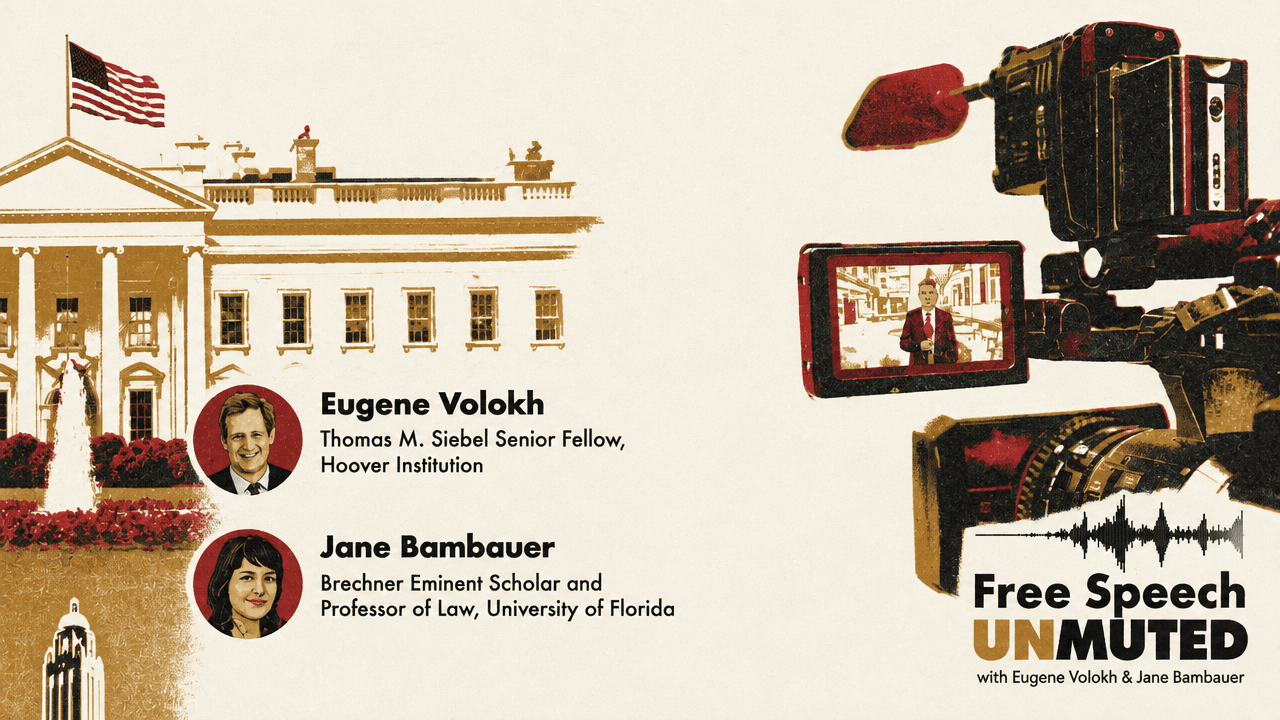
Eugene Volokh and Jane Bambauer argue that the legal question in the White House’s exclusion of CNN, MS NOW and Politico turns on where reporters were barred. A 1977 D.C. Circuit precedent protects access to the press briefing room from viewpoint-based exclusion, they say, while a newer ruling treats the Oval Office as the president’s own space, where he can choose whom to meet. A judge restored the reporters’ access on due-process grounds without deciding the broader First Amendment claim.
The briefing room is a forum; the Oval Office is not
The law turns less on whether reporters have a general right to enter the White House than on which part of it they are trying to enter. As Eugene Volokh explains, the First Amendment protects the press’s ability to report, but does not generally give reporters an affirmative right to walk into a government building. The White House is both a government workplace and the president’s residence; the government could, in principle, bar everyone who was not an employee or specially invited.


The press briefing room is different because the White House has opened it to a large group of reporters. That makes viewpoint-based exclusion constitutionally significant. In Sherrill v. Knight, a 1977 D.C. Circuit decision, the court held that the government could limit access to the press room in neutral ways—for example, to members of the media rather than the public generally—but could not deny press access because of a reporter’s viewpoint. The court also held that a press pass carried a protected interest under the Fifth Amendment’s Due Process Clause. Volokh describes the precedent as requiring an opportunity to be heard before access is taken away, along with clear rules explaining what reporters can and cannot do.
Jane Bambauer emphasizes that this reasoning does not apply everywhere at the White House. Some areas are not forums at all: they are spaces not opened for public access and fully under the president’s control, such as a bedroom. A government facility can include both spaces open to a defined group and spaces that are not forums; the constitutional analysis depends on the access being sought.


The D.C. Circuit addressed that distinction again last year in Associated Press v. Budowich. The case concerned the AP’s exclusion from the Oval Office press pool after it continued to call the Gulf of Mexico by that name rather than “Gulf of America.” The court treated the Oval Office as the president’s office, even though the government owns it, and held that the president could choose whom to speak with there. Bambauer describes such access as closer to an invitation to an interview than access to a place where the government has made announcements. The president may decide not to spend time talking to a particular outlet; that is different from excluding it from a press room opened to reporters.
The current dispute, Volokh says, fits the older Sherrill precedent rather than the Oval Office ruling. President Trump said he would remove CNN, MS NOW, and Politico from the White House, calling them “fake news” and objecting to their negative, biased coverage. The outlets were denied access to the White House broadly, including the press briefing room. Volokh says there was strong evidence that the decision was based on viewpoint. If so, the First Amendment rule in Sherrill applies. And because the reporters apparently received no meaningful chance to contest the loss of their passes, the due-process rule applies as well.
The distinction is not that reporters have a right to every government space where news might be gathered. It is that the government cannot open a press forum to reporters and then use their perceived political viewpoint as the reason to exclude them. Conversely, an invitation to speak with the president in his office is not a general press entitlement.
The judge relied on a procedural rule, not a final First Amendment ruling
The White House argued that national-security concerns, including possible leaks of classified information, justified the exclusions. In Volokh’s account, the court was not persuaded by the examples offered to support that rationale: some involved people who did not hold press passes, and for others there was no indication that the reporting was connected to access obtained through a pass.
The outlets sought emergency relief, arguing that the exclusions violated both the First Amendment and due process. The district judge issued a temporary restraining order in the early hours of Thursday. The judge did not decide the First Amendment claim. Instead, relying on existing D.C. Circuit precedent, the judge concluded that the reporters’ due-process rights had been violated.
Volokh thinks there is room to question whether due process should protect access to a government building that the government chooses to grant to a very small portion of the public. Bambauer adds that the Supreme Court could eventually have to address how the First Amendment interacts with procedural protections of this kind. For the district judge, however, the precedent was binding. Volokh’s view is that the judge followed the law as it stood, even if the underlying question could be debated.
That procedural route left the broader First Amendment question unresolved. Volokh notes that procedural protections can help safeguard speech, including through rules designed to prevent speech from being restricted without adequate safeguards. Here, the judge could restore access without deciding the full scope of any First Amendment right to enter the White House.
The badges came back, but the longer-term order was still ahead
CNN reporters were still not admitted early on the morning after the order. Their lawyers told the court the White House was not complying, and the judge promptly scheduled a hearing. Shortly before it was due to begin, the White House filed an affidavit describing the steps it had taken: operations staff were notified at 7:10 a.m.; the process of restoring access began at 7:25; the affected reporters’ badges were reactivated at 9:07; and confiscated badges were available for collection at the entrance around 9:55.
Volokh presents the affidavit as the White House’s account that it needed a few hours to pass the order along and implement it. He allows that the administration might have treated the order with greater urgency, but says it did not appear to be digging in its heels or systematically defying the court. Bambauer observes that the dispute over the delay was difficult to separate from the publicity surrounding the original exclusion, which she characterizes as a four-day publicity stunt initiated by the president. Volokh says the outlets were not wrong to alert the court quickly: waiting could have weakened an emergency request.
The temporary restraining order was set to expire within a couple of weeks. The judge had scheduled briefing on the outlets’ request for a preliminary injunction, which could remain in effect for months. Volokh said the motion was due September 28, the response October 2, and the reply the following Monday. The court intended to rule expeditiously, he said, so that a preliminary injunction would either be in place or denied by the time the temporary order expired.
That next ruling could carry the dispute beyond the emergency stage. A preliminary injunction could be appealed, potentially leading to an expedited appeal in the D.C. Circuit. That court would remain bound by its own precedent unless the case went further, perhaps to an en banc review or the Supreme Court. The administration could also decide the dispute was not worth pursuing. Volokh cautions that such predictions are difficult: he had thought from the outset that the fight was not worth the administration’s time and effort.
For the moment, Volokh says, the outlets had won because the facts fit the D.C. Circuit’s existing rule. Bambauer likewise describes the legal analysis as relatively straightforward given that fit, while noting that broader questions about affirmative press access remain unsettled. The temporary order restored access; it did not settle those broader questions or determine how the court would rule on the preliminary injunction.
A right to publish is not a right to obtain
The case also exposes a limit that Volokh says is easy to miss: strong rights to publish information do not usually create a constitutional right to obtain it from the government. Once the press gathers information lawfully, it generally has broad freedom to publish it. As Volokh puts it, “The First Amendment is not a Freedom of Information Act.”
Bambauer points to examples of the limits on affirmative access: she says the Supreme Court has rejected a First Amendment right to travel to Cuba to see what it is like, and a right to enter a prison, even though access could serve public accountability. Volokh distinguishes those access claims from laws that specifically grant access to government records. The federal Freedom of Information Act provides a statutory route to federal records, while states have their own public-records or freedom-of-information laws. Those statutes define what must be disclosed, what may be withheld or redacted, and the procedures and timelines for requests.
Volokh describes access to judicial proceedings and records as an important exception. He says the Supreme Court has recognized a right of access to criminal trials and other criminal hearings, and that lower courts have extended access principles, generally speaking, to civil cases and to court documents as well. The resulting presumption of public access is strong, but not unlimited: some records are categorically secret, as in the juvenile justice system, and courts may keep other material confidential on a case-by-case basis. In some courts the access rule is grounded in the First Amendment; in others it is a common-law rule.
The distinctions are about the source and kind of access being claimed. A press forum opened to reporters carries limits on viewpoint-based exclusion; an invitation to speak with the president does not create a general right to an interview. Access to government records, meanwhile, often comes from statutes that specify what must be disclosed and under what conditions. Volokh’s broader point is that the First Amendment’s protection for publishing information does not, by itself, supply every means of obtaining it.