Private Companies Now Shape National Security And Sovereignty
 Daniel BinghamChristopher Wray
 Svetlana KhutkaHoover InstitutionTuesday, November 24, 202615 min read
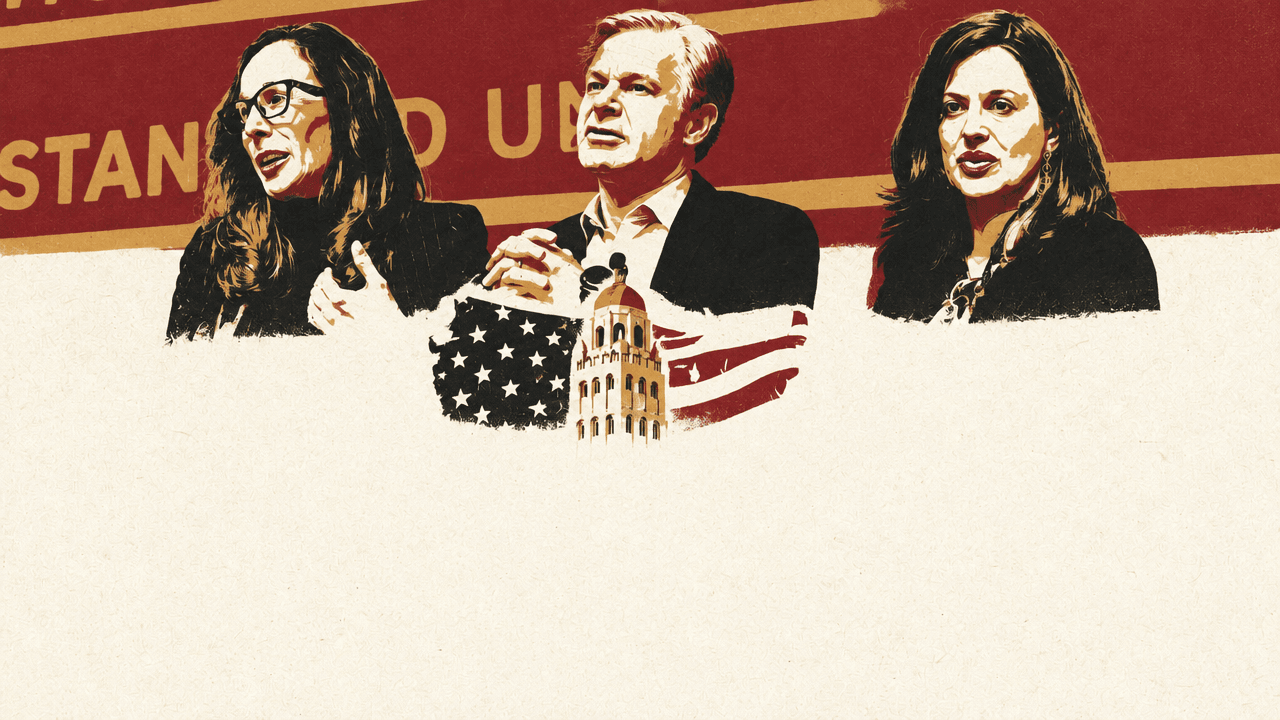
A quarter century after 9/11, former FBI Director Christopher Wray and former Deputy National Security Advisor Anne Neuberger argue that the security system built after the attacks must adapt to threats moving faster than law and policy. In a Hoover Institution discussion moderated by senior fellow Amy Zegart, they contend that protecting the public increasingly depends on private technology companies—and that democratic safeguards, oversight and public trust must keep pace with their growing role.
Private companies now shape national security and sovereignty
National security is no longer only a question of what government may do to protect the public. Technology companies own and operate infrastructure governments rely on, hold much of the country’s innovation, and make choices that can affect people’s safety and other countries’ sovereignty. Former FBI Director Christopher Wray described the relationship as a triangle: government, the public, and private industry. Treating security and privacy as a binary dispute between government and citizens, he said, misses the growing influence of companies whose formal responsibilities run to shareholders.
Wray said the shift matters because much of the United States’ critical infrastructure and innovation is in private hands. He cited the private sector’s control of 85% of American critical infrastructure. Protecting the public, he argued, increasingly means protecting private-sector innovation and intellectual property, while working with companies as they build technologies that may introduce security risks.
Wray described the Chinese government as presenting a broad threat to U.S. innovation, economic security, and national security. He stressed that his criticism was directed at the Chinese government, not Chinese people or Chinese Americans, whom he said are often victims of the same regime’s repression. The targeting, he said, extends beyond government agencies and defense contractors to businesses and research institutions, where much American innovation takes place. Methods include intelligence officers, scientists, engineers, and businesspeople acting as nontraditional collectors, as well as cyber operations. Wray said China’s hacking program was larger than that of every major nation combined, and that it had stolen more American corporate and personal data than every other nation, large or small, combined.
Former Deputy National Security Advisor for Cyber and Emerging Technology ? anne-neuberger contrasted the two countries’ approaches to technology development and protection. She described China as having closer ties among government, universities, state-owned enterprises, and companies, including in areas with both commercial and military uses. She cited quantum computing and sensing, artificial intelligence, satellite communications, and bioengineering. In the United States, she said, research and industry are more decentralized. Intelligence agencies face limits on collecting information regarding U.S. persons and companies, and may provide a company with a threat briefing without actively getting involved in protecting it.
Those limits reflect a commitment to civil liberties, but Neuberger said they can leave gaps as companies operate infrastructure on which the economy and national security depend. She also warned that AI could enable attackers to build deeper, more scalable cyberattacks, probing digital systems continuously and at volume. China, by contrast, can use national firewalls to monitor and protect critical services. Neuberger did not argue that the United States should adopt that model. “We don’t want to trade our environment,” she said. She argued that legal and policy frameworks need to keep pace with technology while preserving democratic safeguards.
Wray said decisions about the balance between security and privacy should be addressed through democratic institutions, rather than left to a company acting alone. He did not present this as a criticism of industry. His point was that companies’ choices can have major consequences for public safety, and that government and businesses need a more effective partnership: government should be better able to help protect the intellectual property on which the country depends, while businesses anticipate and build in security protections.
Neuberger illustrated the shared responsibility with an example from a European World Cup. U.S. agencies were tracking a significant threat and had come to Silicon Valley to talk with social media companies because terrorists were using their platforms to communicate. During a break, she saw the game on a television in the company’s office and thought about the threat to the people attending. She returned to the meeting and told the companies that the threat was evolving on their platforms. She described the effort as a shared responsibility, given the agencies’ limited visibility into those platforms.
She also described a conversation with a national security policy colleague at a frontier AI lab. The colleague said employees sometimes saw users asking questions that suggested a threat might be developing, but the company lacked a legal framework for when to alert the government. Neuberger referred to a case in Canada in which an individual killed several people and then himself, and said OpenAI later apologized. She argued that a framework was needed to address how companies should pass on threat information while protecting them.
The question of private power extends beyond the United States. An audience member asked how accountability should work when private satellite services can affect another country’s sovereignty, referring to Ukraine’s reliance on privately owned satellite services during the war with Russia. The questioner invoked Starlink and Starshield as examples of how a private company’s role could affect a democracy in conflict with an authoritarian state. Wray responded to the broader issue rather than addressing the particulars: private companies can shape other countries’ security and sovereignty as well as America’s. The challenge, he said, is preserving a free-market system while preventing private capabilities from being exploited in ways that fundamentally alter the security of the United States, its allies, or its partners. He did not advocate a particular regulatory response, but argued that governments and companies need to work together more responsibly.
Hoover senior fellow ? amy-zegart argued that the architects of the emerging international order are no longer only governments. Executives at companies such as Meta and Nvidia can wield powers once associated primarily with states. Sovereignty is being contested not just across physical borders but in digital and outer space: questions include what counts as sovereign AI or a sovereign data center, and what rules apply to infrastructure that serves one country but sits under another country’s laws.
Zegart compared the moment with the postwar creation of institutions and rules at Bretton Woods, arguing that there is no equivalent settlement in place today. She raised data centers as one example of the questions that need attention: where a country’s laws apply and what activities they govern. Companies’ growing role in national security and geopolitics, she argued, raises questions about the rules that will govern the capabilities countries and their allies depend on.
Space presents a related security problem. Neuberger said intelligence agencies track what other countries deploy in space, including surveillance and military capabilities, and work with some allies on the issue. Countries also seek to protect their own systems from surveillance. Commercial expansion has added another dimension. She cited Starlink’s large low-Earth-orbit constellation and its resilience to jamming as an example of how a commercial system can become strategically important. Satellites are refreshed every four to six years, she added, allowing continued technological advances. Protecting commercial capabilities is therefore part of the security landscape, even as many details remain classified.
Wray warned against looking only at threats close at hand. Terrorism, cyberattacks, and espionage can reach across oceans or through a few keystrokes. A country that focuses only on what is happening nearby may miss dangers driven by developments elsewhere.
After 9/11, authorities and agencies had to connect across borders
? anne-neuberger identified two major changes after September 11. One was a response to a system organized around a distinction between domestic and foreign surveillance. U.S. persons and people in the United States were covered by one set of rules; intelligence collection overseas operated under a more permissive framework. Those different authorities affected which agency could collect information, what it could do with it, and what it could share.
As communications crossed borders, information could fall between those authorities. Neuberger described a call between someone overseas and someone in the United States as an example: domestic agencies could see their remit as domestic, while foreign intelligence agencies viewed the communication as foreign. Before 9/11, she said, information was not always connected, and threats could be missed. She said new laws passed after the attacks addressed the problem that the legal framework had not kept pace with changing technology.
The second change was greater cooperation. Neuberger said rivalries and restrictions on sharing had kept agencies from combining information effectively. After the attacks, the approach shifted toward sharing information when another person or organization might be able to use it, rather than defaulting to a narrow “need to know.” That change applied within agencies and between them.
Christopher Wray agreed that failure to connect disparate information was one of the central failings exposed by 9/11. During his time at the FBI, he said, the agency’s mantra was “share till it hurts.” The shift was more than a change in procedure. Better information-sharing encouraged teamwork across the intelligence community, federal, state, and local law enforcement, and foreign partners. Wray described a more cohesive system than the one he encountered in the immediate aftermath of the attacks.
Share till it hurts.
Wray also pointed to a change in the purpose of security work: moving from response and punishment toward prevention. If an attacker is prepared to die in an attack, the threat of later punishment may not deter them. The operational goal, he said, is to get “left of boom”—to prevent the attack before it happens. That applies to terrorism, cyberattacks, and other threats.
We needed to be left of boom.
The persistent problem is pace. Threats move at the speed of current technology, while laws and policy often lag behind it. Wray contrasted a sleeper cell training in a camp in Afghanistan before 9/11 with an operative inspired online by someone thousands of miles away. In cyber operations, he said, one keystroke can produce catastrophic consequences within seconds. Government must be able to act quickly enough to prevent harm, but legal and institutional processes are slower to change.
Democratic checks make intelligence stronger, but trust takes work
The tension in democratic intelligence is often framed as a trade-off: more surveillance for greater security, or more privacy at the cost of protection. Christopher Wray argued that this framing can obscure how constitutional restraints may strengthen intelligence work. The FBI’s mission, he said, is to protect the American people and uphold the Constitution—not to pursue one at the expense of the other. In his view, checks and balances, rules, and rigor can make the intelligence apparatus more effective, not merely constrain it.
Wray pointed to oversight by Congress, courts, and the executive branch. Intelligence committees can be briefed in classified settings, and the Foreign Intelligence Surveillance Court can review matters without exposing sources and methods. Secrecy and oversight, he argued, need not be opposites: classified processes can protect sensitive information while still allowing review. He also described the oath taken by public servants to support and defend the Constitution as part of the framework that distinguishes U.S. intelligence agencies from adversaries that lack comparable checks.
? anne-neuberger described the challenge from the perspective of public trust. Intelligence agencies often succeed by preventing a threat without public attention. Keeping an operation quiet can protect sources that may be needed to identify the next threat. But, she said, “nobody trusts a black box, deservedly.” Citizens need enough information to believe that intelligence services act both within the law and in keeping with democratic values.
That creates a difficult question about transparency. Revealing too much can expose the sources and methods that made an operation possible; revealing too little can leave citizens unable to judge whether agencies are acting within their authority. Neuberger said an average educated American needs enough knowledge to feel confident that intelligence services operate under both law and democratic values, while agencies need to preserve capabilities they may rely on again. She argued that trust should be built before a disclosure or crisis, so that people encountering troubling information have reason to ask questions rather than assume the worst.
Wray offered a practical reason why disclosure is difficult: the sensitivity of intelligence often lies not in the information itself, but in how the government obtained it. He asked listeners to imagine intelligence that Vladimir Putin eats a particular breakfast cereal. The detail sounds trivial. The method behind it—a listening device, a camera, or a recruited person with access—could be exceptionally sensitive. If adversaries can infer the source from information released, even a seemingly harmless detail can compromise a capability.
That distinction complicates public debate. Some classified information may be mundane on its face but reveal a valuable method; some dramatic or interesting information may be unclassified. When officials cannot explain the facts that make an operation compelling, they can appear evasive. Wray said a fuller account may reveal precisely the source or method the government is trying to protect. It is not enough to remove a person’s name or address if other details allow an adversary to work out how the information was obtained.
Both speakers grounded the debate in personal experience. Wray recalled meeting families of people killed on September 11. One man’s wife called from a hijacked plane while he was asleep and left a goodbye message on his voicemail. He woke in time to speak with her, but after returning from funeral arrangements, he heard the earlier message on his answering machine. For Wray, that story made the protective mission concrete: security was not an abstraction but an effort to prevent other families from receiving such calls.
Neuberger’s family history held both sides of the democratic-security tension. Her father fled Soviet-occupied Hungary after the 1956 revolution. As a child, she saw him become anxious even during a routine traffic stop in New York. Years later, on a visit to Hungary, he refused to walk past the local police station. He had learned to fear the surveillance and coercion of an authoritarian state. That memory, Neuberger said, stayed with her at the National Security Agency as a reminder of why civil-liberties constraints matter.
Her family had also been directly affected by terrorism. When Neuberger was six months old, her parents were among 106 passengers held hostage after hijackers diverted their flight to Uganda. They were released in a rescue operation in which three hostages were killed. The experience left her with a parallel understanding: an effective intelligence community and military can protect people from threats that cannot be addressed by law enforcement alone. The challenge is preserving both security and the values that distinguish a democracy from the regimes it opposes.
Snowden made operational controls and public trust inseparable
? anne-neuberger was working at the NSA when contractor Edward Snowden removed a vast quantity of classified material. She described the disclosures as revealing operational failures: a contractor without a need to know was able to collect and remove documents from a highly protected environment and leave the country. She said there were multiple failures in how risks had been managed, including operationally and in the agency’s relationships and transparency. Several months after the disclosures, the NSA director asked her to become the agency’s first chief risk officer. Neuberger said the agency had also created a civil liberties and privacy officer.
Some of the released material described proposals that had been reviewed by legal and compliance staff, then rejected or shelved. Neuberger said that, because the agency’s work was a black box to many people, the material prompted questions about what it was doing and what controls applied. She said the National Security Agency and other intelligence agencies had not acted unlawfully, while acknowledging that people looking at the material could reasonably ask what the agency was doing and whether internal constraints were adequate.
She distinguished legality from judgment. The surveillance of German Chancellor Angela Merkel’s phone, for example, was a lawful foreign-intelligence operation, she said, but probably not a wise one. That is why agencies need risk review that asks not only whether an operation is permitted, but whether it serves broader U.S. interests and relationships. A decision can pass a legal test and still deserve scrutiny for its effect on trust or on the country’s dealings with a partner.
The disclosures also strained relationships with foreign partners. Neuberger said the United States supplied a large share of intelligence on cross-border threats such as terrorism, narcotics trafficking, and weapons proliferation. But intelligence relationships did not always map neatly onto political relationships within partner countries. When foreign officials challenged U.S. activities, the response sometimes involved pointing out that intelligence their governments had relied on came from American services. The episode exposed a gap between cooperation among intelligence agencies and what political leaders or publics in partner countries understood about those arrangements.
Neuberger’s broader lesson was that agencies need to explain their work before a leak or missed attack forces the conversation. Intelligence successes tend to remain invisible: a threat is detected or disrupted, and the public may never know it happened. Failure is different. When an attack is missed, people in the intelligence community feel that lives were lost as a result. That sense of responsibility, she said, is part of the story citizens need to understand, alongside the need for controls and public confidence.
Professional norms have to reach beyond what the law permits
Formal law cannot answer every difficult operational question. ? anne-neuberger said that intelligence decisions must account not only for whether an operation is lawful, but whether it is wise in light of the country’s broader aims, including relationships with allies and the trust of citizens.
That judgment requires institutions to stay connected to perspectives outside their own. Neuberger noted that many people join the NSA after college and spend their careers there, which can narrow their view of how the public understands surveillance. She said programs that expose intelligence personnel to privacy and civil-liberties experts—and allow people outside the community to understand its rules and culture—help keep those values in view. She described those exchanges as a way for staff to consider civil liberties alongside the operational urgency of detecting and preventing threats.
Christopher Wray described the FBI’s essential norm as doing the right thing in the right way, every time: with rigor, professionalism, and objectivity, and by following facts wherever they lead. The agency cannot be on a political team, he said. It must be on the side of the American people and the Constitution. That commitment is tested when the result is unpopular. People may support independence and objectivity until an investigation or analysis produces an outcome they dislike.
For Wray, the measure is not whether everyone approves of the result, but whether the process can withstand scrutiny. An investigation opened or not opened, or an intelligence analysis that reaches a particular conclusion, will always leave someone unhappy. The agency’s responsibility is to maintain a rigorous process that can be defended even by people who disagree with the outcome. Wray said he applied that standard across Republican and Democratic administrations, and credited the FBI’s rank and file with the same commitment to integrity.
Public service can be a chapter, not a lifetime
The discussion ended with a question about attracting young technical talent to government when private-sector pay is higher. Christopher Wray acknowledged that federal salaries are difficult to match. Public service offers different rewards, he said: the chance to take on sophisticated adversaries and consequential problems. He also argued that security work increasingly depends on collaboration with private-sector specialists, including people who may never become federal employees. People can contribute to shared security goals through partnership as well as through government service.
? anne-neuberger said a career need not be an either-or choice. Someone can bring technical skills into government for a period, leave to build a company or pursue other work, and return later with new experience and networks. She framed the case for service in terms of time and consequence: a person may never know how much time they have, but they can know they helped save a life or prevent harm.
Her appeal was also personal. The United States, she said, is a gift, despite its flaws; those flaws can be addressed by what is right in the country. The digital infrastructure on which daily life depends, the development of new weapons, and the potential for authoritarian surveillance all make technical expertise relevant to the defense of democracy. That work does not require a lifelong government career, she argued. It does require people with the ability to help deciding to give some of their time and talent.