IIT Madras Scales Online Data Science Degree Without JEE Entry
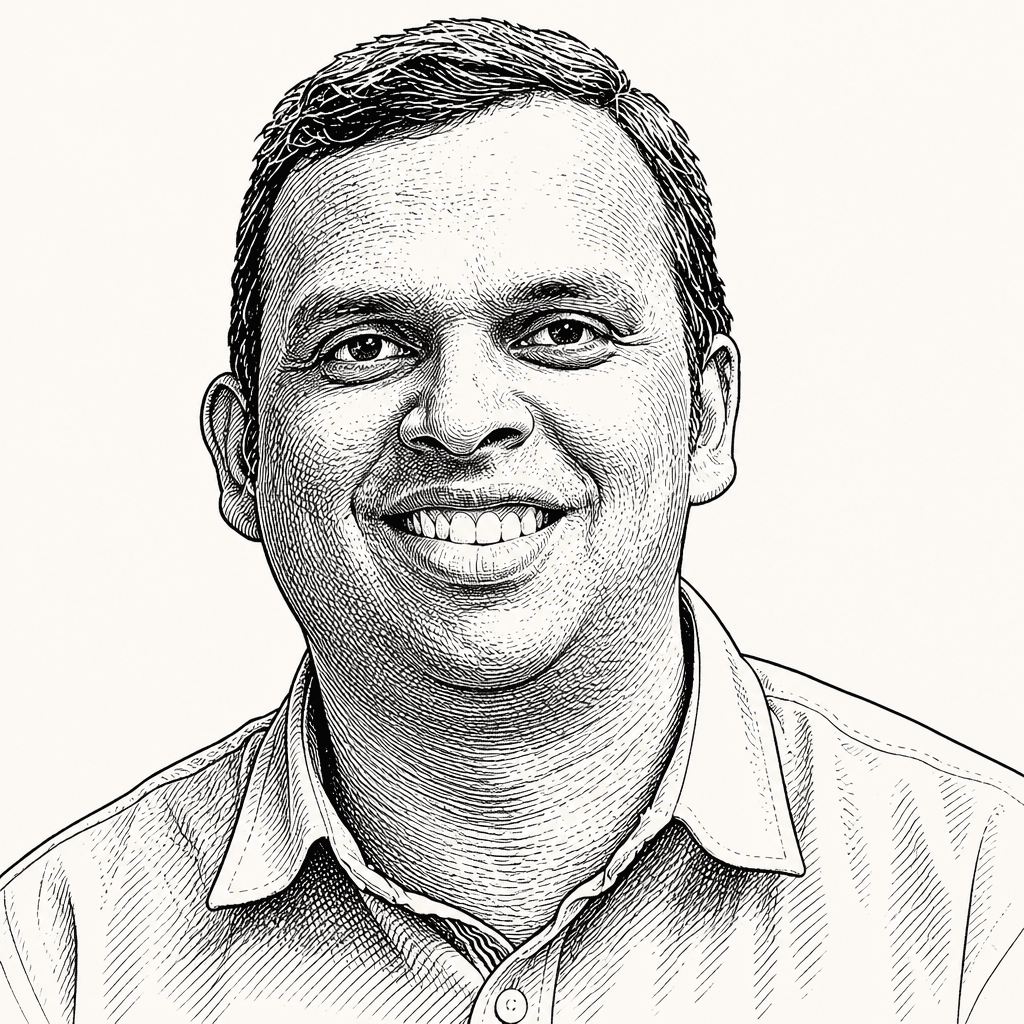
Speaking with Craig Smith on Eye on AI, IIT Madras electrical engineering professor Andrew Thangaraj argues that India’s AI talent problem begins with a higher-education system that filters too many students out too early and rewards exam knowledge over usable skills. He presents IIT Madras’s online undergraduate degree in data science — a low-cost, no-JEE program with a rigorous exit standard and project-heavy diploma stage — as an attempt to move the filter from admission to completion. Thangaraj says that model is necessary if India is to build AI capacity at national scale rather than through a handful of elite seats.
The scarce-seat model is the problem
India’s AI capacity problem, in Andrew Thangaraj’s account, starts before AI. It starts with a higher-education system in which the institutions with the strongest reputations serve only a tiny fraction of the students who need a credible path into technical work.
Every year, he says, about two and a half crore children reach college-going age in India — roughly 25 million. About 87 to 90 lakh, or around 9 million, actually get to college. The IITs, even after expansion to about 23 institutes, take only about 17,000 to 18,000 undergraduate students a year. Add the National Institutes of Technology and other Institutes of National Importance, he says, and the number still reaches only about 50,000 to 60,000.
That structure produces two costs at once. The first is direct financial cost: a reputed undergraduate degree in India can cost 25 to 30 lakhs, in Thangaraj’s estimate. The second is the cost of competition itself. Because the number of desirable seats is so small, the path to them has become an industry and, in his words, “very inhuman in some senses.”
The fiercely competitive students are losing their childhood. And then just, just for getting into college. And then, you know, your brain is not developed properly. And what do you do after college, right?
That is the context in which IIT Madras built its online undergraduate degree in data science. Thangaraj describes the question that emerged five or six years ago: could an IIT deliver a full undergraduate degree for under 5 lakhs — under about $5,000 — while still putting the IIT brand behind it and maintaining quality?
His answer, after five years of running the program, is yes. He calls it “low cost, highly scalable, very high quality” and “rigorous,” and says it is the kind of undergraduate program India needs now.
| Measure | Figure Thangaraj gave |
|---|---|
| Children reaching college-going age each year | About 2.5 crore, or roughly 25 million |
| Children who get to college | About 87–90 lakh, or roughly 9 million |
| Annual IIT undergraduate intake | About 17,000–18,000 |
| IITs plus NITs and other Institutes of National Importance | About 50,000–60,000 |
| Typical cost of a reputed undergraduate degree | At least 25–30 lakhs |
| Target cost of the IIT Madras online degree | Under 5 lakhs, or under about $5,000 |
Craig Smith places the program inside a larger question about India’s AI trajectory. In earlier interviews in his India AI series, he says, he had heard about India’s push to catch up with the United States and China, the gap between India and China, and the way global technology companies are building in India. His conclusion going into the discussion with Thangaraj is that India is not out of the AI race, but that catching up will require “speed, scale, and a very different approach to building AI talent.”
Thangaraj’s account of IIT Madras’s online degree gives one version of that approach: not more elite filtering at the top, but a different way to create a rigorous exit standard at scale.
IIT Madras moved the filter from the entrance to the exit
The program was conceptually developed in late 2019, formally approved by the IIT Madras Senate in 2020, and admitted its first batch in January 2021, according to Andrew Thangaraj. The significance, in his account, was not just that the degree was online. It was that IIT Madras agreed to offer an undergraduate degree without the Joint Entrance Examination as the defining entry filter.
He says one faculty member compared the move to Stanford deciding to run community college. The point was not that the academic work would be easier. It was that IIT Madras had to persuade people inside the institution to accept a model that did not rely on a sharp filter at admission.
Thangaraj describes the alternative as a funnel. Admit more people. Keep the process fair. Let students who are willing to spend the time and acquire the skills continue. Accept that not everyone will make it. But make the exit strong rather than using the entrance exam as the main proof of merit.
Let’s have the strength of the exit. Let’s have a strong filter at the exit and not at the entrance.
That design is tied to who the program is meant to reach. Thangaraj says IIT Madras wanted financially less privileged students, students who did not attend elite schools, and students from outside engineering to have a path into data science. The program therefore assumes only mathematics and related preparation up to India’s 10th standard, before students specialize in later school years. What the degree needs after that, he says, the program builds internally.
He also argues that data science cannot be left only to engineers. Lawyers, doctors, humanities students, and others need to learn data science because data will matter across society. The admission model reflects that view: it does not assume that a student took physics and chemistry in 12th standard or came through the conventional engineering preparation track.
The formal degree is nominally four years. But the program is deliberately modular. There is a foundation stage, a diploma stage, a three-year degree exit, and a four-year BS degree exit. That matters because financially constrained students often cannot set aside four or five years before earning. Even a low-cost degree does not solve the problem if a student’s household needs income immediately.
The diploma stage is therefore not a consolation prize. It is a central design feature. Students can complete a skills-heavy portion of the program, get internships or small jobs, earn some income, and continue if they can.
In practice, the timing is uneven. Thangaraj says the foundation stage is taking students about a year on average. The diploma stage, initially expected to take about two years, is taking closer to two and a half to three years. He links that to the difficulty of requiring hands-on work in an education system that has not emphasized skills. Once students finish the diploma, he says, the later degree stage becomes smoother; the fastest students finish the full degree in about three and a half to four years, while average completion seems closer to four and a half years. The maximum time allowed is eight years.
The program already has more than a thousand BS-level graduates, according to Thangaraj. He expects 300 to 500 graduates per term as the numbers grow, and projects roughly 1,000 to 1,500 four-year BS graduates per year. At the diploma level, he expects the annual number to be larger — in the few thousands.
The skills gap is not the same as a degree gap
When Craig Smith raises a claim he had heard elsewhere — that a significant number of IIT graduates are unemployed — Andrew Thangaraj rejects it directly. He says it is “completely untrue” that a large fraction of IIT graduates are unemployed, at least in the older IITs. He allows that campus placement figures can be complicated, and that a small number of students may still be looking for work near graduation, but he does not see the number as large or alarming.
The more serious labor-market issue, in Thangaraj’s view, is different. India may be producing many computer-science-adjacent graduates, but not enough graduates who can execute.
Thangaraj says the number of computer science, machine learning, AI, and related degree programs has “skyrocketed.” Many engineering colleges now teach mostly computer science and allied subjects, while mechanical and civil engineering have shrunk to much smaller numbers. But the Indian education system, he argues, remains oriented toward knowledge rather than skill.
He describes this as partly educational and partly social. Knowledge is valued; hands-on work is not always given the same respect. The result is a recurring problem: graduates with B.Tech degrees in computer science who may be able to write code on paper but cannot get code running on a computer.
That distinction explains how India can have many graduates and still have an AI talent shortage. Thangaraj interprets the India AI Mission’s concern as being less about raw degree counts and more about employable graduates — people who can be deployed into projects and execute on the ground.
IIT Madras’s program addresses that by putting skills before deeper theory. After the foundation stage, students enter a diploma stage explicitly focused on skills. They must complete four hands-on projects: two application-development projects and two machine-learning-oriented projects. They have to build apps and show that the apps run. They have to build ML models and show that they understand what they are doing.
Only after that do they go deeper into theory at later levels. Thangaraj says this ordering — foundations, then skills, then theory — is one of the program’s important innovations, even if it is not discussed as often as the online format or the IIT brand.
The difficulty of that skills stage is intentional. The projects, he says, are “incredibly strong funnels.” They identify students willing and able to sit down and build things. That is the exit filter in action.
Scale depends on instructors, not only lectures
The online degree has more than 40,000 active students across levels, according to Andrew Thangaraj. He is careful about what that number means: it is not a claim that 40,000 students will graduate. The funnel is operating. But it is evidence that the model can support a population much larger than a conventional IIT undergraduate cohort.
The program receives about 40,000 to 45,000 applications per year, he says. He believes it could handle up to 100,000 applications without being seriously strained, though beyond that he would have to wait and see where the limits appear.
| Operating measure | Figure Thangaraj gave |
|---|---|
| Active students | More than 40,000 across levels |
| Annual applications | About 40,000–45,000 |
| Application volume he thinks the program could handle | Up to 100,000 |
| Live instructor support at foundation level | Eight hours per course per week |
| Students working in companies | About 15% of the program |
The operating model does not depend on IIT faculty personally handling all large-class interaction. Faculty record the lectures. Instructors — full-time teaching staff, many with PhDs or master’s degrees from IITs and other top institutes — run live online sessions, solve problems with students, and translate the material into forms students can understand.
At the foundation level, Thangaraj says each course has eight hours of live instructor sessions per week. Students may be in large sessions, and a student’s voice may not always be heard immediately, but eight hours creates room for questions and doubt-clearing.
He compares this instructor layer to the distinction in many U.S. universities between research tenure-track faculty and teaching faculty. IIT faculty are busy, often running large research groups and contributing to many institutional processes. The online degree’s scale comes from using faculty where their contribution is most leveraged and building a teaching staff around the students’ daily needs.
But Thangaraj also argues that a large online program cannot work as a one-way content-delivery system. IIT Madras deliberately seeded student structures: 12 student houses named after Indian forests, elected student leaders, clubs, societies, regional meetups, and an annual on-campus event called Paradox. The name, he says, comes from the fact that an online program has an on-campus event.
Paradox is student-run and lasts a week. Students from across the country come to the IIT Madras campus during the summer, when regular students are away, and participate in sports, cultural events, and technical events. More importantly, they meet each other and then keep in touch.
Thangaraj treats that peer layer as essential. Anyone who has taught, he says, knows that the idea of knowledge passing directly from teacher to student “into their hearts and minds” is not how learning works. Students have to leave class, talk, debate, interact, and consolidate the material together. In the online degree, he says, that process is happening in a student-driven way.
The age mix changes the peer experience. There is no age limit. The oldest student for a while was over 80, though Thangaraj says supporting him was difficult and he does not think the student finished. There are quite a few students in their 60s, and many in their 30s and 40s, though the majority are under 30. About 15% are working in companies.
That creates peer groups unlike those at a conventional physical university, in Thangaraj’s view: younger students studying alongside people with work experience, who can tell them that life after college works differently from what they may imagine.
International enrollment is still small. Thangaraj estimates 350 to 400 students outside India, many of them Indian expatriates, with a small number of foreign citizens. He says the United States may account for around 25 or 30 students, certainly under 50, but he is not sure of the exact number. The program has not focused on international publicity; most overseas students are in places such as the Gulf and Singapore, where there are substantial Indian communities.
The student stories are part of the argument
For Andrew Thangaraj, the lower-entry, strong-exit model is best tested by what happens to students who would not have had a conventional route into high-level technical education.
One example is a doctor who had completed an MBBS from AIIMS, which Thangaraj identifies as India’s top medical college. After a few years, the student decided he did not want to continue in medical service and wanted to move back toward technology. In India, Thangaraj says, that kind of switch is not easy. The student entered the IIT Madras program, performed extremely well, then wrote GATE — the national exam for admission to master’s programs at IITs, IISc, and other top institutes. He ranked first nationally and is now doing an M.Tech in AI at the Indian Institute of Science.
Thangaraj says three of the top 10 GATE ranks in that cycle came from the online program.
Another example is a young filmmaker in Kolkata. He did not finish with a high CGPA, according to Thangaraj, but he learned enough and made enough connections to start a company doing AI production work for movies.
The program is therefore serving more than one constituency. It is not only a cheaper path for conventional undergraduates who missed the IIT entrance route. It is also a bridge for midstream career change, for working adults, and for people in other domains who need enough data science and AI competence to build something in their field.
Students are also going on to postgraduate programs in India and abroad. Thangaraj says some are entering master’s programs at campuses, not only online degrees, and some have gone to the United States, the United Kingdom, and Germany.
Admissions filters can freeze people into tracks too early. A doctor who wants to move into AI, a filmmaker who wants to build AI production tools, or a student from a weaker school system may not have a conventional path back into high-level technical education. Thangaraj presents the IIT Madras model as one way to create that path without eliminating rigor.
India’s AI catch-up is possible, but not automatic
Craig Smith frames the question through China’s AI trajectory, describing a view he had heard from a Berkeley professor: China’s higher-education system was badly damaged in the 1960s, remained weak through the 1980s and 1990s, and later benefited from state investment and the return of Chinese nationals who had gone abroad. In Smith’s framing, neural networks and then generative AI gave China a chance to move quickly once it had enough qualified researchers.
He asks whether India could do something similar: build human resources, invest in infrastructure, and be positioned to move when the next major AI breakthrough arrives.
Andrew Thangaraj says such a leap is possible for India. At the undergraduate level, he believes India is now producing good people in much larger numbers. He also points to work happening around IIT Madras and the broader Indian ecosystem: researchers such as Mitesh Khapra, the AI for Bharat project creating datasets for Indian languages, and companies such as Sarvam, which he says has ambitions around foundation models and works closely with the India AI Mission.
The comparison with China has limits. The way money and investment flow in China is different, Thangaraj says. India’s regulations, courts, and rights structure also enter the picture. Even if the talent ecosystem is improving, infrastructure and coordination remain hard.
Smith asks whether data-center capacity is a key constraint. Thangaraj agrees. The question is whether India can build the required power and compute infrastructure quickly enough. He gives the example of nuclear power: if someone proposed a nuclear power plant to power data centers, he expects major protests and a long persuasion process. Maybe India solves the problem with solar, he says, or something else. But the issue remains unresolved.
He is similarly cautious about who will invest: global companies such as Google and OpenAI, Indian firms, or some coordinated national effort. He describes the India AI Mission as something he is “reasonably optimistic” about, while making clear that he is not directly involved in the AI development side. His own work is primarily AI education.
On research capacity, Thangaraj’s assessment of IIT Madras is positive but measured. Every department, he says, has one or two researchers who are globally well known. But U.S. and Chinese departments are often larger, so they have more people operating at that level. If Indian departments grow and create more critical mass, he thinks they can compete better — perhaps first with European countries, while the U.S. and China remain harder comparisons.
The private-sector pull is also ambiguous. Smith asks whether global technology companies operating in India both support research and draw people away from academia. Thangaraj says it goes both ways. Some people apply to IIT Madras but end up at Google Research or Microsoft Research because those jobs are more lucrative. But some leave companies and come into academia too. For a university researcher, he says, the crucial question is whether one enjoys interacting with students and transforming them. If that is missing, a research job in industry may be the better fit.
The open question is whether India will move beyond being the back office for global companies and build cutting-edge products of its own in AI. Thangaraj says he can think of Indian companies in other sectors, such as cars, producing products that look competitive from the outside. Whether the same happens in AI remains unresolved.
AI is useful in education, but not yet reliable enough to disappear into the system
IIT Madras is already experimenting with AI inside the online degree, Andrew Thangaraj says. The program has bots on its portals, is testing a coding assistant, and has an interview bot that interviews students. He believes bots could help scale the support remote students need.
But he identifies two constraints: cost and error rate.
Large-scale deployment is not as cheap as providing internet access, he says. Serving 10,000 or 20,000 users with AI support remains expensive, and he also points to the energy burden. More importantly, the tools still make too many mistakes for high-stakes use.
In one experiment, the program tested AI feedback on coding assignments. Students wrote code; the system could evaluate it with test cases, but the program wanted an AI model to read the code and comment on what was right, what was wrong, and what could be improved. In those experiments, Thangaraj says, the system made mistakes 10% to 15% of the time.
For a single use case, 85% to 90% correctness may sound useful. At the scale of 10,000 students, he says, the remaining error rate hurts. He would be much happier if the error rate fell below 5%.
The program does not directly build all of these systems itself. Thangaraj says companies help, likely using foundation models from providers such as OpenAI or Gemini through API calls, with fine-tuning or application layers on top.
Students also have access to Perplexity. Smith mentions that he had interviewed Aravind Srinivas, Perplexity’s founder, and Thangaraj notes that Srinivas is an IIT Madras graduate. He says Srinivas offered Perplexity free to all IIT Madras students, including the BS data science students, and that students are using it quite a bit.
Even so, Thangaraj does not treat current AI tools as a solved substitute for teaching. He is interested in a teaching-assistant bot that would be genuinely useful, but says he does not know whether a product like that exists or whether IIT Madras should build one itself. The aspiration is clear: reliable AI support could matter enormously for students without access to high-quality education. The caution is equally clear: reliability must improve before the system can be trusted at scale.
The biggest social uses of AI may be outside corporate productivity
When Craig Smith asks how AI might matter for people struggling to make a living in India, he contrasts that question with the more familiar claim that AI can speed corporate processes. Andrew Thangaraj starts with the fear that AI will reduce India’s IT back-office jobs. Those jobs, he says, lifted a large section of Indian society into a much higher income bracket than previously seemed possible. There is anxiety that they will go away, though he notes that others argue new kinds of back-office jobs will emerge around maintaining AI systems.
He then widens the frame to India’s internal variation. The south, he says, is generally in a dramatically different situation from many northern states. He attributes part of that to historical isolation from some northern developments and to early post-independence political leadership in the south that invested heavily in grassroots education, schools, and schemes such as free food in schools. Across measures such as maternal mortality, infant mortality, and gross enrollment ratio, he says southern states such as Kerala, Tamil Nadu, Karnataka, Andhra, and Maharashtra are much better than many northern states.
The point of that comparison is not to celebrate one region. It is to say that systems matter. Education works when people believe that school will teach them, college will improve their life, and effort inside that system will pay off. In many states, Thangaraj says, that belief is not broadly present, even if it exists in pockets.
AI’s promise, in his view, is that it may help some states short-circuit the long path of institutional development if deployed wisely. He points especially to Indian languages. If a farmer in a small village can ask a question in a local language and get a useful answer, AI could change the practical value of information. If children can be educated better through AI-supported systems, or farmers can grow crops better, the impact could extend far beyond office automation.
He also names the justice system. Indian courts are, in his words, famously clogged. If AI could improve the functioning of the courts, he says, fundamental societal change could follow.
He does not claim that this will happen. He calls it a dream and says “we’ll wait and see.” But it is the most expansive version of his argument: the same country that cannot rely on scarce elite institutions to educate enough people also cannot judge AI’s value only by how it changes corporate workflows. The important question is whether AI can reach education, languages, agriculture, and courts — the systems that shape ordinary life.