ElevenLabs Adds Studio and Flows Agents to Automate Creative Production
Luke Harries used ElevenLabs’ Warsaw summit to argue that AI creative production is moving beyond prompt-based asset generation toward agent-directed workflows. Presenting ElevenCreative, he introduced Studio Agent and Flows Agent as layers above models and editing tools, intended to help teams ideate, script, prompt, edit, localize, and reuse campaigns. His case was that marketers’ role shifts from executing each production step to directing and approving systems that can produce hero assets, performance variations, and localized creative continuously.
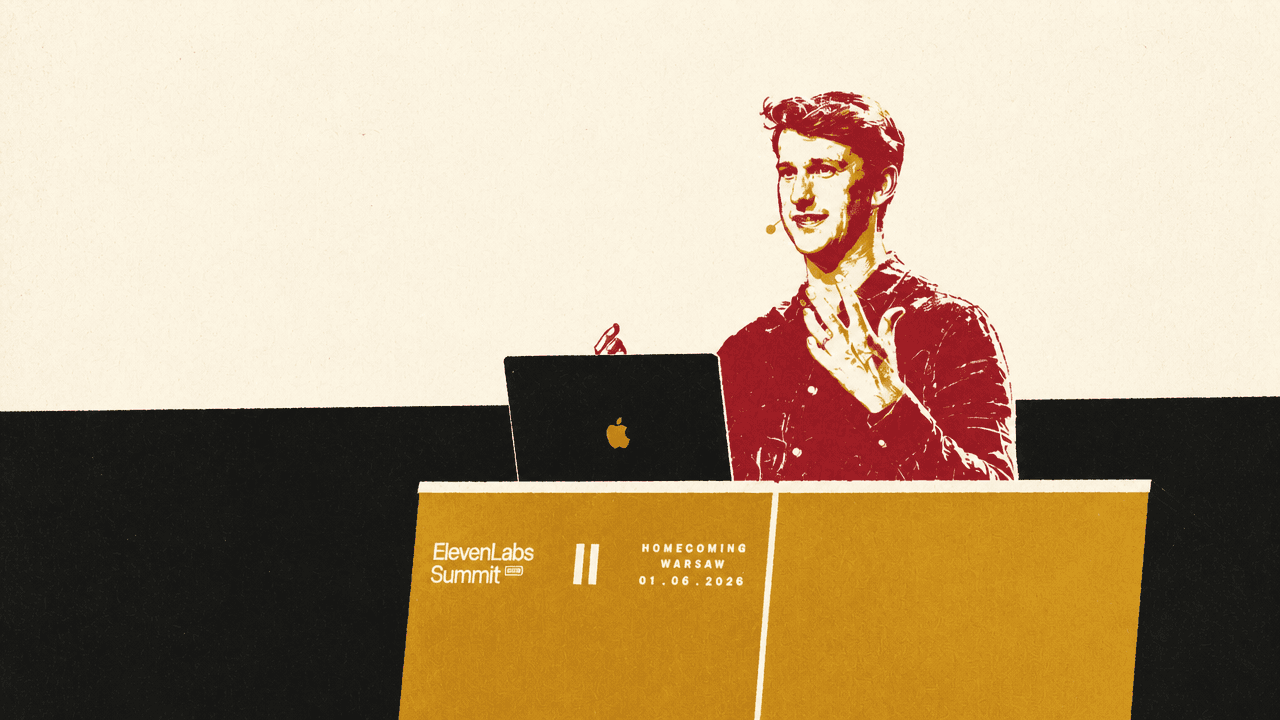
ElevenCreative shifts production from manual steps to agent direction
Luke Harries presented ElevenCreative as an all-in-one creative platform for marketers and creators making brand films, performance marketing campaigns, and social content at scale. The platform combines models and tools inside one creative environment, and Harries said it has more than 1 million users, including Disney, Microsoft, Nvidia, Adobe, Netflix, and other major brands shown on screen.
AI has already compressed creative production from months or weeks into days because filming can often be replaced by prompting, Harries said. A TV campaign that once required three months and in-person filming, or a social ad that required a staged photo shoot, can now be made in less than a day.
That first compression left the underlying process mostly intact. Teams still ideate, script, prompt or film, edit, and localize themselves. The work moved behind the desk; it did not become a different operating model. Harries put the limitation plainly: “The only real change is we've switched that filming to prompting.”
Harries’s next step is a ladder of further compression: Studio Agent moves production from days to hours, Flows Agent moves performance marketing variation from hours to minutes, templates move repeat work from minutes to seconds, and Creative Engine turns the process into a continuous loop that runs in the background. The intended role for the creative team becomes direction and approval rather than manual execution of each production step.
The platform is built from models, tools, and agents
Harries described ElevenCreative as a three-layer system: models, tools, and agents.
The model layer includes text-to-speech, background music, sound effects, dubbing, image, and video. Harries pointed to ElevenLabs’ text-to-speech V4 and said its main step change is reliability: when an agent prompts for a particular sound, the output should be dependable enough to use. Music V2, which he said had recently launched, is meant to create cinematic background tracks. Sound effects matter especially for hooks. The new dubbing model, described as the first end-to-end dubbing model, is meant to carry emotion through the whole performance. ElevenCreative also aggregates image and video models into the same platform.
The tools layer consists of Studio, Flows, and Templates. Studio is the browser-based, human-in-the-loop timeline editor. Flows is the node-based environment for orchestrating creative production pipelines. Templates let teams save and reuse those pipelines.
The agent layer sits above both. Studio Agent and Flows Agent are meant to let a user specify what they are trying to achieve and direct the result while the agent helps ideate, script, prompt, edit, and localize.
| Layer | Components Harries named | Role in the workflow |
|---|---|---|
| Models | Text to Speech, Background Music, Sound Effects, Dubbing, Image, Video | Generate the media assets used in the creative |
| Tools | Studio, Flows, Templates | Edit, orchestrate, save, and reuse production workflows |
| Agents | Studio Agent, Flows Agent | Ideate, prompt, shape, localize, and help execute creative work |
Studio Agent shapes a single polished asset
Studio Agent’s first use case was a LOT Polish Airlines brand film around a Warsaw–San Francisco route. Luke Harries framed the route as a campaign opportunity: Warsaw as a center of European innovation, San Francisco as a center of American innovation, and the flight as a bridge between the two.
Inside ElevenCreative Studio, the interface showed a browser-based timeline editor with a new Studio Agent sidebar. Harries used the prompt: “Create a brand video for LOT airlines to celebrate the Warsaw to San Francisco route. Make it about innovation.” He then added a LOT brand kit, naming premium quality, comfort, and Polish hospitality as brand attributes that should carry into the creative.
The agent does not simply return a finished asset from one command. It proposes scene ideas, asks the user to choose a creative direction — for example, “sleek and cinematic” or “energetic and forward-looking” — and then handles the underlying prompting in the background.
The hero-film demo showed historical-style images of Warsaw and San Francisco, maps, and planes. Its narration connected the two cities through rebuilding, invention, resilience, and the exchange of ideas: “Warsaw knows something about rebuilding from nothing. About taking what was lost and making it new again. San Francisco knows something about starting from nothing. About imagining what had never existed.”
Harries said the voice used for the narration was Albert Einstein’s, licensed through Einstein’s estate. He connected that choice to the campaign theme: innovation, new knowledge, and bridging worlds. The music came from Music V2, and the text, images, and videos were made through the agent’s prompting. His claim for this layer was that Studio Agent produced a hero film in a few hours.
Flows Agent turns a campaign idea into reusable variation
Flows Agent handles repeatable performance marketing work rather than a single hero asset. Luke Harries described Flows as a node-based editor for creating, iterating, experimenting, and turning workflows into scalable pipelines.
The example started from an existing LOT poster. Harries said the flow had been made in a few minutes with Flows Agent. A user could ask it to create performance marketing ads for the new route, and the agent could adapt the poster’s style, use the previous image as a reference, incorporate the Warsaw–San Francisco message, generate variations, adjust formats, and localize the ads into different languages.
The workflow itself could be expanded, not merely used to generate one batch of variants. Harries said the agent expanded the flow so campaigns could run at scale across different cities and languages. Because anything in Flows can be saved as a template, that pipeline can then be reused by a team.
In Harries’s ladder, Flows Agent moves campaign variation into minutes, while templates make the same production pipeline reusable in seconds.
Creative Engine keeps the agent loop running in the background
Creative Engine is Harries’s move beyond linear production. Once agents can handle ideation, scripting, prompting, execution, localization, and iteration, he said, the process does not have to remain a step-by-step workflow. Creative Engine uses background agents to keep running that loop.
Creative Engine connects to existing ads platforms and uses that context to generate and improve creative, according to Harries. Localization is one of the first jobs. For a company like LOT, which Harries described as operating in more than 30 markets and 50 languages, that means adapting creative across markets rather than treating localization as a final manual step.
Harries also described optimization from past ad performance, competitor activity, trends, and product changes a team may want to test. His marketing premise was that more specific messaging — at the demographic level or individual level — can speak more directly to customers and produce better-performing ads.
The live Creative Engine interface showed a grid of generated LOT image and video ads connected to a mock Meta account. From a single ad, Harries said the system could automatically localize into different languages and produce variants with different visual styles. He described it as “constantly learning to understand what will actually deliver the best results.”
The product can be used interactively, with a marketer tweaking creative and using performance data inside the platform, or placed into auto-run mode. In that mode, Harries said, the system generates new localizations, concepts, and variants every night, sends suggestions through Slack or Teams, and lets the user approve them to go live.
For the Warsaw audience, Harries said ElevenLabs had looked at attendees’ email domains, identified people running Meta accounts, and generated ad variants for them, including localizations, concepts, and personalizations. He said those assets could be shared with attendees who spoke to ElevenLabs, along with access to a private beta for Creative Engine shipping the following month.