Geography Keeps Russia and China Trapped in Continental Power Politics

Military historian Sarah Paine argues that Russia and China’s strategic behavior is rooted less in ideology than in geography. In this lecture, she contrasts continental powers, which seek security through territory, buffers and mass armies, with maritime powers such as Britain and the United States, which can use the sea as a shield and build wealth through trade, alliances and rules for the commons. Her case is that Russia and China may want the benefits of maritime power, but their borders, neighbors and constrained sea access keep pulling them back toward the older logic of land empire.
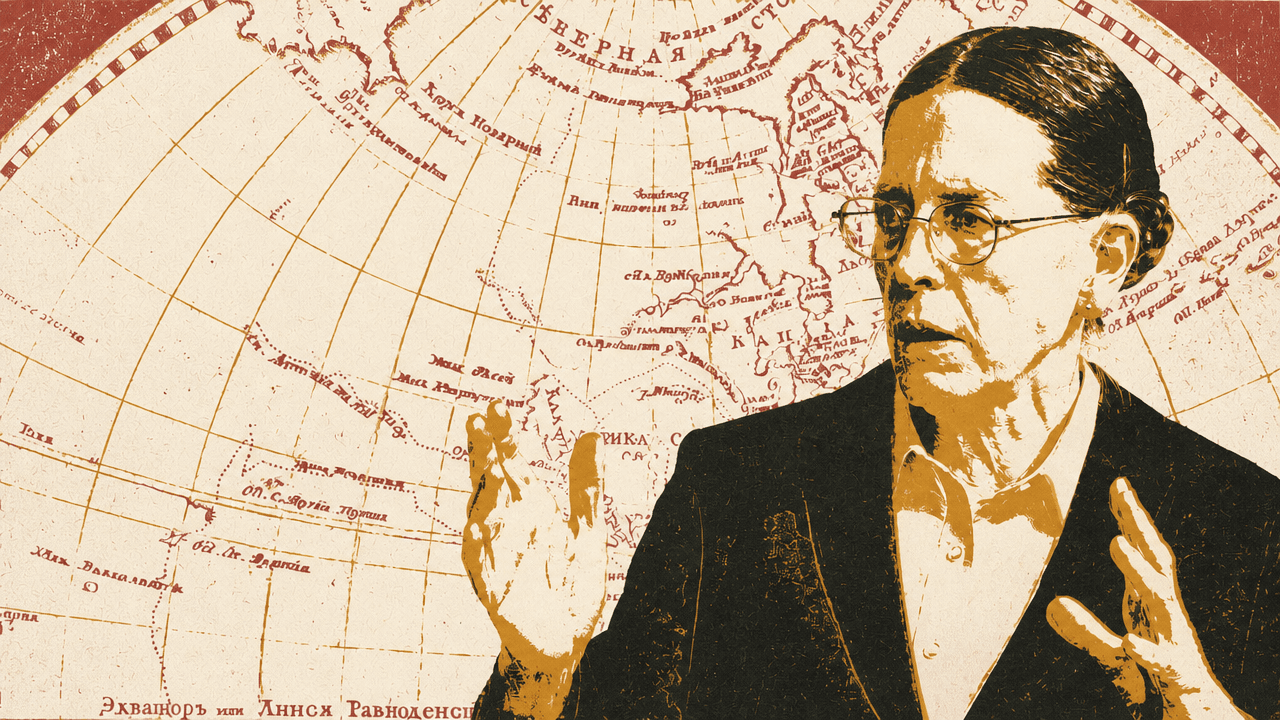
Geography produces rival world orders
Sarah Paine’s central distinction is not between good and bad states, or liberal and authoritarian ones. It is between powers that can defend themselves primarily at sea and powers that cannot. From that physical fact follow different armies, economies, institutions, alliance systems, and ideas of order. Continental powers tend toward territory, buffers, armies, and spheres of influence. Maritime powers tend toward trade, naval access, alliances, and shared rules for the commons.


Continental and maritime powers tried to organize the world in very different ways, and these have real implications in our own day.
The opening example is D-Day: sea power meeting land power at Normandy on June 6, 1944. Maritime powers are the exception. Continental powers are the rule. If a country’s problem is Russia across the border, as in Ukraine, “a navy’s not going to save them.” A continental state needs a competent army because homeland defense happens on land. A maritime state needs a competent navy because homeland defense can happen before an enemy reaches shore.
That difference reaches beyond military procurement. A state that can use the sea as a shield has more discretion about when and how to fight. A state whose neighbors can cross land borders must organize around immediate defense, internal control, and buffer zones. One world tends to think in terms of closed zones and strategic depth. The other tends to think in terms of open routes and access to markets.
The United States began, in this framework, as a continental power. It expanded toward the West Coast, tried to invade Canada in 1775 and 1812, and announced the Monroe Doctrine as a classic sphere-of-influence claim — a “stay out of my backyard” doctrine that the early United States was too weak to enforce against Europe. American territorial expansion mixed purchase and war: Louisiana bought from Napoleon when he needed cash; Alaska bought when Russia was short of money; Mexico did not accept the check, so the United States used the “standard massed armies approach” in the Mexican-American War, after which the next check was accepted for the Gadsden Purchase. Paine’s point is not a legal chronology of annexation but the pattern: checkbook diplomacy where possible, massed armies where checks failed.
The moralized name for the project was Manifest Destiny. Paine also makes clear what that expansion meant domestically: the longest counterinsurgency in American history, she says, was not in the Middle East but against the Native population. The country that later became the leading maritime power first became continental through territorial expansion.
The late nineteenth-century shift comes through Alfred Thayer Mahan, the Naval War College figure who argued that global position was not mainly a function of continental consolidation. It depended on the wealth that could be accumulated through trade. But Mahan’s maritime paradigm required more than ships. It required geography, infrastructure, commerce, population, and institutions.
| Prerequisite | Why it matters in Paine’s framework | Russia and China in Paine’s assessment |
|---|---|---|
| Moat | A maritime power must not be easily invaded across a land border. | Neither has one; both have many neighbors. |
| Internal transportation | Goods must move efficiently to ports in peacetime. | Russia’s grid is poor; China’s has improved. |
| Reliable egress by sea | Navies and merchant ships must be able to reach open water in wartime. | Both face constrained, blockadable maritime approaches. |
| Dense coastal population | Commerce depends on people and institutions concentrated around ports. | China has one, but on narrow seas; Russia’s northern access lacks it. |
| Commerce-driven economy | Trade must be central enough to fund and justify maritime strategy. | Russia has not had one; China moved closer under Deng, but Paine says Xi has privileged the crony sector. |
| Stable institutions | A navy and commerce policy require consistent funding and law over time. | Neither meets Paine’s litmus test of transparent, regular elections. |
Russia and China can have maritime ambitions without possessing the full maritime package. Neither has the geographic insulation that Britain enjoyed. Both have large numbers of neighbors, many of whom have reasons to distrust them. China’s coast is economically dense, but it opens onto narrow, island-clustered seas. Russia has northern sea access, but Paine dismisses it as strategically limited because the population and commerce are not there. Her institutional test is blunt: transparent, regular elections. “Dictatorship for life,” she says, “does not remotely qualify.”
The heartland is protected from the sea, not by it
Mahan’s maritime argument has a land-power counterargument in Halford Mackinder. Mackinder saw Russia’s position in Eurasia not as a liability but as perhaps the best geopolitical location in the world. His 1904 map centered on the “pivot area,” also called the Great Heartland: the citadel of land power on the world’s largest mainland.
The heartland was, in Mackinder’s formulation as presented by Paine, “the greatest natural fortress on earth.” Mountains, deserts, frozen seas, and rivers emptying into inaccessible waters insulated it from maritime attack. Britain could not easily get at it. Its strengths were defense in depth, strategic retreat, and self-sufficiency. Paine’s compression of the point is the key: the heartland is not insulated by the sea; it is insulated from the sea.
That creates the maritime power’s recurring strategic problem. If Britain, or later the United States, wants to influence the Eurasian heartland, it cannot do so directly by navy. It must operate on the periphery. In the imperial period, that meant colonies in strategic places. In the contemporary period, it means allies with bases in those places.
Nicholas Spykman sharpened the American version of the problem. A naturalized American from the Netherlands writing during World War II, he worried that whoever controlled Eurasia could control the world. The United States occupied, in his words, “the safest position of any nation in the world,” yet had still been drawn into two devastating world wars within a quarter century and had at one point in the second been in serious danger of defeat.
The United States could bring influence to Europe and the Far East only through seaborne traffic. Eurasian powers could reach America effectively only by crossing the seas. Air power did not change the basic condition, because “the preponderant element in the transport of all but the most specialized items” would remain ocean shipping. The equation on Paine’s slide is stripped down: “US security = f(sea).” American sanctuary at home depends on a maritime shield.
But sea power alone does not let a maritime power impose outcomes on the main land theater. Access across the Atlantic and Pacific determines what kind of foreign policy is possible, and effective land power still requires continental allies. In World War II, victory depended on alliances and allies. A maritime power can defend itself at sea, accumulate wealth through trade, and move resources across oceans. When it must defeat or contain a continental power, it needs partners on land.
Continental empires treat land as security, wealth, and danger
China is Paine’s original land power. Sun Tzu’s Art of War gives advice to rulers living among many neighbors, any of whom might invade. Third-party intervention is normal. The text has no maritime warfare and only tangential riverine references because it belongs to the older world of continental empires.
The geography comes first. Precipitation, temperature, and topography maps show that much of China’s land is poorly suited to agriculture: too dry, too cold, too mountainous, or too vertical. Paine says that helps explain why famine afflicted China for centuries and why China depends on food imports today. An ethnic map then shows the Han population concentrated in “China proper,” the best arable real estate, surrounded by heterogeneous borderlands.
The answer to how the Han ended up with the prime real estate is violent. Paine says competing Dzungar and Tibetan empires were laid waste. In the continental world, she frames the choice as assimilation or destruction: “you either become Han or they will kill you.” She calls genocide what happens to losers in continental warfare and adds, as her judgment about the present day, that “apparently in our own day the Uyghurs are slated for genocide.”
The historical map sequence is meant less as dynastic chronology than as a pattern: expansion, contraction, conquest, recovery, and bloodshed. Han polities begin in the Yellow River Valley and spread; walls are built; territory shrinks and expands; non-Han conquest dynasties intervene. The Yuan dynasty was Mongol, not Han, and therefore not simply another Chinese dynasty. It was part of the Pax Mongolica, a Mongol world order in which the Han were a subjugated people. The Qing dynasty was also a conquest dynasty, ruled by Manchus. Paine notes the irony that contemporary Chinese historical claims often invoke the territorial reach of the Mongol Yuan or Manchu Qing, periods when the Han themselves were ruled by outsiders.
The larger point is the scale and persistence of continental warfare. China raised armies in the hundreds of thousands for millennia. The West did not do this regularly until the Napoleonic wars. Continental empire is a mass-army world.
Russia follows a similar logic in a different direction. Paine describes Russians as “Mongols in reverse”: beginning in Moscow, defeating other princely city-states, then expanding outward in search of furs and territory until they encountered countries able to resist. Maps of the Russian Empire show small administrative units near Moscow and vast units in Siberia. Recently conquered or not-yet-digested territories were treated differently, under military-administrative arrangements such as governor-generalships. Finland, Poland, Ukraine, the Caucasus, Turkestan, Siberia, and the maritime regions appear as conquered areas under these overlays.
These shifting civil and military boundaries function as mechanisms of ingestion and digestion. If an empire cannot turn a conquered population into a regular province, it can at least neutralize it as an ethnic or political threat. Paine compares this to China’s moving provincial and military boundaries, contrasting both with the relative stability of U.S. state boundaries.
Mackinder’s advantage — internal lines of communication — comes with the continental disadvantage: neighbors. Around 1900, Russia’s major security threats ran from Britain, Germany, Austria-Hungary, and the Ottoman Empire to China and Japan. Russia’s environment was nothing like Britain’s “360 degree ‘you can’t get me’ moat.” Russians fought repeatedly with Germans, Austro-Hungarians, and Ottomans, and suffered catastrophic defeats to Mongols, Swedes, Napoleon initially, Germans in World War I, and in the Cold War. The central position let Russia rise again, but it also exposed Russia to repeated landward threats.
In the continental world, power is a function of land. Neighbors are dangerous. Unstable neighbors can bleed disorder across borders. Strong, stable neighbors with agendas may be worse. Armies therefore have a different purpose than they do in maritime states. A maritime army is largely expeditionary: it crosses the ocean to fight somewhere else. A continental army first protects the ruling regime. Paine cites the People’s Liberation Army’s first mission as keeping the Communist Party in power. Its second purpose is to garrison the empire and prevent defections. Its third is border defense. Since most fighting occurs on or near the border, occupied territory can quickly become “home.” Away games are rare.
Land war makes civilian catastrophe normal, not exceptional
World War II deaths show what it means when war is fought on or near home territory. The figures displayed separate military, civilian, and total deaths for major belligerents. Paine’s emphasis is not casualties but deaths: “sunk casualties,” people for whom no one is “breathing life” back in.
| Country | Military deaths | Civilian deaths | Total deaths |
|---|---|---|---|
| Germany | 3,250,000 | 3,810,000 | 7,060,000 |
| Japan | 1,506,000 | 300,000 | 1,806,000 |
| Italy | 330,000 | 80,000 | 410,000 |
| USSR | 8,668,000 | 16,900,000 | 25,568,000 |
| Poland | 850,000 | 6,000,000 | 6,850,000 |
| China | 1,324,000 | 10,000,000 | 11,324,000 |
| France | 340,000 | 470,000 | 810,000 |
| Britain | 326,000 | 62,000 | 388,000 |
| USA | 295,000 | 295,000 |
The pattern matters more than any single number. Land powers suffered deaths in the millions. Maritime powers suffered deaths in the hundreds of thousands. Civilian deaths, in particular, exploded for continental powers because fighting occurred on home territory. Paine notes that, by some statistics, Britain and the United States suffered fewer deaths than Italy or France; when civilian deaths are added, the distinction between land powers and maritime powers becomes sharper.
The explanation is geographic. If oceans do not insulate a country, fighting tends to happen where civilians live. When a neighbor invades, the continental state must decide that day whether to capitulate or fight, on the invader’s timing. That is Ukraine’s problem. A maritime power watching an invasion has strategic choices: whether to intervene, when to intervene, and which instruments of national power to use. That flexibility is a privilege of geography, and Paine warns that the United States should think carefully before it intervenes widely and overextends itself.
Continental warfare can deliver territorial rewards if the state survives and wins. Stalin’s domination of Eastern Europe after World War II is the example Paine uses. But territorial domination came at a huge price. The object had better be worth the cost before a state attempts it.
The continental theory of security has rules. First: no two-front wars. With so many neighbors, a coalition against you can be disastrous. Second: no great-power neighbors, because today’s friend can become tomorrow’s foe. The method that follows is sequential predation: take on neighbors one at a time, set them up to fail, destabilize rising states, ingest failing ones, create buffers, and wait for the moment to pounce and absorb. Paine explicitly identifies this as “Vladimir Putin’s game.”
Better still, from the predator’s perspective, is to make neighbors weaken each other. Sow mutual resentments, push fake news, and play what Paine calls the “jackal state”: when others have made the kill, move in and steal it.
This security model is self-defeating over time. It surrounds the hegemon with failing states. It prevents enduring alliances because neighbors eventually understand that the hegemonic power is a long-term problem. It offers no internal rule for when to stop: how much territory can be taken before the empire chokes on it? Both China and Russia, in Paine’s telling, have histories of overextension that help explain imperial and dynastic implosions.
The paradigm should not be dismissed as ineffective. Before the Industrial Revolution, it worked. It did not care about collateral damage or innocent life. It was built for killing people, breaking things, and taking territory. Paine says the same logic has been visible in Syria, Ukraine, and elsewhere. Ancient ruins remain ruins because this kind of warfare is ruinous.
Russian political thought supplies examples of how deeply rooted the territorial frame is. Vasilii Kliuchevskii, the late tsarist historian, described Russian history as a country “in the process of colonizing itself,” its historical periods defined by the occupation and development of acquired land. Paine notes what is missing: the people who already lived there. Dostoyevsky’s diary framed Asia as the place where Russia could go “as masters,” in contrast to Europe, where Russians were “hangers-on and slaves.” Sergei Witte, finance minister in the late tsarist period, wrote in 1903 that Russia should obtain as large a share as possible of the “outlived oriental states,” especially China, and that Russian absorption of a considerable portion of the Chinese Empire was only a question of time unless China protected itself.
Putin is placed in this lineage. The danger for any continental power is that if it botches strategy, its known world can disappear. Imperial China, Imperial Russia, and other venerable civilizations did not merely lose campaigns; they lost the political and social world that had made them intelligible. Paine’s image for this is an aristocratic Russian palace in ruins, tied to the Bolshevik Revolution, civil war, collectivization, and the Great Purges. The continental world, she says, is “a world without insurance policies.”
The maritime alternative turns the sea into a commons
The maritime world begins with trade routes. In the nineteenth century, the Atlantic appears as the center of the world economy, with rimlands producing wealth, loading goods onto ships, and sending them port to port. The seas are the original network connecting everyone to everything.
Paine traces the logic back to rimland empires: Athens along the Aegean and Ionian coasts, Rome around the Mediterranean, Byzantium after it. Language marks the contrast. “Mediterranean” means the sea in the middle of the lands. “Zhongguo,” China’s name for itself, means central kingdom. One term centers the sea; the other centers land.
East-west trade produced recurring fights over the western toll booth of the Silk Road, where routes split toward the northern and southern Mediterranean. Muslim conquests controlled it for a time. The Crusades, in this account, were partly an attempt by larger European powers to regain that toll booth; they failed. The Ottomans held it for a long time. Europe’s maritime turn came from being blocked: if European powers wanted Asian trade, they would have to go by ship, the long way around. Spain and Portugal tried, encountered the New World — new to them — found gold and silver, and shifted away from the original trade objective.
The Dutch are the cleaner case of maritime empire: trading bases rather than territorial consolidation. Their problem was vulnerability in Europe. It is not surprising, in Paine’s framing, that Hugo Grotius, a Dutch jurist, becomes a founding figure of international law. Maritime empires need seas as commons, safe trade, and rules against piracy and predation. Grotius’s Mare Liberum says every nation is free to travel to every other nation and trade with it. His Law of War and Peace cites older Roman and Byzantine formulations that the use of the sea belongs to all, and that air, flowing water, sea, and seashore are common by natural law.
This is presented as a Western legal tradition, not a universally shared instinct. Paine’s example is China’s 1996 ratification of the UN Convention on the Law of the Sea while, as she puts it, saying that freedom of navigation does not extend within 200 nautical miles of China’s coastline. Under UNCLOS, she says, the number is 12 nautical miles. In the East and South China Seas, that difference matters.
Britain is the decisive maritime case. Unlike the Dutch, Britain had a 360-degree moat. It was the only European power that did not need a large standing army, because a competent navy could prevent an army from reaching British shores. Britain could turn dependence on trade into strength: trade financed the navy; the navy protected the homeland and trade; the system compounded wealth while continental neighbors spent heavily on armies, destroyed wealth in wars, and risked coups from the forces they had to maintain.
A navy can provide a “prevent-defeat strategy.” It can stop invasion. It cannot by itself provide a “deliver-victory strategy” against continental problems. Navies are rarely decisive in wartime. Armies sometimes are. Britain’s answer, developed through trial and error against Napoleon, was grand strategy: integrating multiple instruments of national power.
Paine’s shorthand for British grand strategy is “elephant hunting.” A maritime whale confronting a continental elephant should keep the home economy growing, because money funds military power and allies. It should close down enemy trade through blockade and commerce raiding, throwing the enemy back on its own resources and embittered allies. It should “rent an elephant”: find the continental power most directly threatened, then fund and arm it to keep the main front alive. It should fight in a peripheral theater where sea access is easier than land access, forcing the enemy to divide attention and divert resources. It should not take on the enemy’s main force directly, certainly not at the start. If it fights on the main front, it should do so late, after the enemy has been badly weakened, and with many friends.
| Rule | Strategic purpose |
|---|---|
| Keep the economy growing | Sustain the revenue base for military power, allies, and a long war. |
| Close down enemy trade | Use blockade and commerce raiding to deny the enemy resources. |
| Rent an army | Support the continental ally most directly threatened on the main front. |
| Fight in a peripheral theater | Exploit sea access, divide enemy attention, and relieve pressure on the main front. |
| Do not take on the enemy main force directly | Avoid opening with the continental power’s strongest instrument. |
| Fight on the main front only late and with friends | Enter after the enemy is weakened and the coalition is strong. |
A continental power cannot easily copy this playbook. It lacks reliable maritime access, lives on narrow and blockadable seas, and has too many neighbors who may invade. If Britain keeps playing the maritime game, it can set itself and its enemy on opposing trend lines: war increasingly encroaches on enemy territory, undermines the enemy economy, erodes living standards, undercuts morale, and destroys the ability to continue fighting. The strategy wins by exhausting the enemy first.
Its focus is not primarily military. It is economic, coalitional, and institutional. Its prerequisites are sanctuary at home, access to markets and allies, and institutional stability over time. After the Napoleonic Wars, Europe experienced, in Paine’s phrase, a “long and profitable peace,” with no continent-wide war for a century. The maritime game was simple in principle: trade by rules, compound wealth, and do not level one another’s buildings.
The Industrial Revolution changed the currency of power
The second great distinction is between insulation from neighbors and access to markets. Continental powers face contiguous threats, so they focus on national security, insulation, and exclusive zones. Maritime powers, protected by a moat, focus more on prosperity. Trade becomes the path to both wealth and security. They want access to markets, open seas, and shared rules.
Those preferences generate mutually exclusive world orders. One divides the world into large spheres of influence, each a world unto itself. The other insists on universal rules and open seas.
The Industrial Revolution upended both continental and maritime empires and made a maritime rules-based global order possible. It introduced compounded economic growth through technological and institutional change: steam power, iron, textiles, insurance, banking, railways, telegraph, steamships, mass markets, trade, general staffs, and armaments. Institutions matter because they organize people for more efficient action. Insurance and banking are not incidental to trade; they are part of the system that makes large-scale trade work.
Before this shift, power was a function of land. Land supplied commodities and peasant conscripts. After industrialization, wealth became a function of commerce, industry, and trade. That changed who became rich and powerful. Countries’ fortunes increasingly depended on industrialization and integration into trade.
The Suez Canal is one example of how industrial maritime infrastructure wrecked older continental economics. The Silk Road had once made the western terminus in the Middle East prime real estate. But steamships and the canal made it vastly cheaper to move goods by ship than overland with draft animals. Maritime economics displaced the economics of the camel route.
The 1967 war gives Paine an example of an operational action with a different strategic effect. Egypt sank blockships in the Suez Canal to stop Israeli use. Operationally, the canal was closed. Strategically, global shipping adjusted.
| Measure shown in Paine’s Suez example | 1963 | 1968 | 1972 |
|---|---|---|---|
| Ships of 50,000 DWT or less | 87.0% | 51.0% | 28.7% |
| Ships of 201,000 to 300,000 DWT | 2.8% | 29.3% | |
| Total DWT | 74 billion | 124 billion | 217 billion |
Before the war, almost 90 percent of ships were 50,000 deadweight tons or less, small enough for Suez. The canal’s closure from 1967 into the early 1970s encouraged larger ships. By 1972, nearly 30 percent of ships by number were in the 201,000-to-300,000 deadweight-ton range. Bigger ships going the long way around Africa could still be cheaper per ton than smaller ships using the canal. Paine’s conclusion is that overhead in shipping is absorbed by ship size; the decisive variable is not simply distance.
Containerization is the other transport revolution. Malcom McLean, a trucking executive, put truck bodies without chassis onto ships: containers. Loading costs fell from $5.86 per ton to 16 cents per ton in 1956. Port time fell too, meaning ships spent more time earning revenue. Then the International Organization for Standardization set global container sizes from 1968 to 1970, allowing containers to fit by truck, rail, and ship. Paine uses this as a concrete rejoinder to blanket skepticism about international organizations: a relatively obscure standard-setting body transformed daily life by reducing transport costs.
That cost structure is why Paine is dismissive of Xi Jinping’s Belt and Road land ambitions. Land freight remains expensive relative to sea freight. Until 1960, the average tanker was 20,000 deadweight tons; today, the smallest ultra-large crude tankers exceed 250,000 deadweight tons. The longest container train might carry 600 containers; the largest container ships carry more than 21,000, with cargo valued above a billion dollars. Belt and Road’s land routes, she says, are not continuous, do not use a single gauge, and require repeated loading and unloading. They also pass through unstable places. To make a land route secure, a power must control the whole route end to end. Maritime trade has alternatives: if Suez is blocked, ships go around Africa.
China’s geography, in Paine’s assessment, makes maritime access fragile in war. Its seas are narrow and shallow, crowded with islands and neighbors, and connected to the high seas through predictable choke points. In wartime, she says, those places become kill zones. Merchant traffic cannot pass unless China is friendly with everyone, which she says it is not; even surface warships may not get out reliably.
The contrast is the surge in global trade after the Cold War. Paine calls it “the miracle of your lifetimes,” lifting hundreds of millions of people out of poverty. The problem for Putin, as she states it, was that this wealth-producing trade was happening among those vested in the trading order, not in the system of extortion. The second Cold War, in her view, is pushing the world back toward less efficient arrangements.
A global alliance system is a maritime power package
The third distinction between continental and maritime powers is the reliance on interior versus exterior lines of communication. Continental powers historically used interior lines to garrison empires, deploy armies against neighbors, and build contiguous alliance systems. That worked when power was a function of land.
Maritime powers use exterior lines — sea routes — to reach global markets and wartime allies. This permits a global alliance system rather than merely a contiguous one. The Industrial Revolution put continental empires on notice not only because land transport became relatively expensive, but because it opened the possibility of a positive-sum world order.
Paine frames the contrast bluntly. A continental global order is negative sum: territorial confiscation, spheres of influence, conquest, destabilization of neighbors. One wins, the rest lose, and wealth burns. She illustrates this with the destroyed town of Saint-Lô in Normandy in 1944: even if territory is won, the object has been damaged in the taking.
The maritime global order, in her framework, is positive sum: freedom of navigation, free trade, international law and institutions that facilitate trade, and alliance systems as insurance against rogue land powers. The purpose is wealth creation through lower transaction costs and compounded growth. Most countries are not maritime by geography, but they can acquire a collective maritime position through alliance. If enough countries coordinate instruments of national power, they can protect the rules that protect all of them.
The post-World War II institution-building program is Paine’s clearest example of an “insurance policy.” She attributes it to the generation that experienced World War I, the Great Depression, and World War II: people who were sent over trenches, survived, raised families in depression, and later sent their own children into another world war. Their conclusion was that depressions and world wars required institution-building on a global scale.
| Year | Institution shown | Description on Paine’s slide |
|---|---|---|
| 1944 | IBRD | International Bank for Reconstruction + Development |
| 1945 | UN | United Nations |
| 1945 | IMF | International Monetary Fund |
| 1947 | GATT | General Agreement on Tariffs + Trade; 1995 → WTO |
| 1949 | NATO | North Atlantic Treaty Organization |
| 1951 | ECSC | European Coal and Steel Community |
| 1957 | EEC | European Economic Community; 1993 → EU |
The broader institutional list shown also includes domestic U.S. bodies created or reorganized in the same period: the Council of Economic Advisers in 1946; the CIA, Department of Defense, Joint Chiefs of Staff, U.S. Air Force, and National Security Council in 1947; and the Organization of American States in 1948. Paine’s claim is that these institutions lasted into the present and helped hold peace in the industrialized world until, in her phrase, Vladimir Putin “decided to work his magic.”
The institutional logic was to hash out disputes with diplomats and lawyers rather than soldiers. The Cold War was not peaceful everywhere. It was cold in the industrialized world and hot elsewhere, especially along Mackinder’s inner marginal crescent, where maritime and continental worlds met. Civil wars there became sites where each side of the Cold War put its finger on the scale. That destroyed wealth and helps explain weaker growth in affected regions.
The maritime order is hard to see because its objectives are negative
One of Paine’s most useful conceptual claims is that the continental world is visible while the maritime world is invisible. Continental powers pursue positive objectives: seize territory, take wealth, make something observable happen. Either territory was taken or it was not. But this clarity can mislead. A continental power can mistake operational wins for strategic ones: win the territory, lose the economy and the allies.
The maritime world often pursues negative objectives. It prevents bad things from happening: destruction of the global trading system, limits on freedom of navigation, territorial expansion by large states against small ones. Success is hard to prove because the prevented event is not visible. “Maybe no one was trying anything to begin with,” Paine says. Navies, in this account, mostly work in peacetime, and their core missions are often preventative: keep trade functioning, preserve freedom of navigation, and deter territorial predation.
Paine links this preventive logic to sovereignty. If states invade one another freely, international law has little foundation. The bedrock principle is that countries do not simply absorb their neighbors. When rogue continental powers challenge that rule, the maritime toolkit includes alliances, diplomacy, sanctions, embargoes, containment, naval deterrence, blockade, and commerce raiding. In Paine’s metaphor, the elephant gets “a time out from the rules-based order” because it cannot behave.
These measures can compound over time even when they do not deliver decisive operational victories. Sanctions are “like economic chemotherapy”: they may prevent one or two percentage points of growth per year. With leaky sanctions, the short-term result may look modest. Over generations, the difference can be the difference between North and South Korea. North Korea still exists, but with a much smaller piggy bank than it otherwise would have. The aim is not total elimination of the problem, especially when the rogue state has nuclear weapons. The aim is containment at acceptable cost.
This world is not about the operational win of totally eliminating a problem. It’s rather, it’s containing it at acceptable cost.
Optimists at the end of the Cold War assumed everyone would want to join the maritime order. They did not. Putin and Kim Jong Un, in Paine’s account, want to upend it by hollowing out international institutions, undermining international law, killing alliance systems, and returning the world to warring spheres of influence.
The choice is between exclusive zones and commons
Paine’s summary returns to geography. Continental and maritime powers differ first in their ability or inability to defend primarily at sea; second in their focus on insulation from the world versus access to it; and third in their reliance on interior versus exterior lines of communication. Those conditions predispose preferences.
Continental powers tend to see territory as something to take. Maritime powers tend to see the same territory as a market with which to trade. Continental powers seek self-sufficiency; maritime powers prefer access to markets. Continental powers want exclusive zones; maritime powers want commons — not just in the seas, but also in space, cyber, and air.
Most countries are not purely maritime or continental by geography. Only a few islands fit the maritime ideal; only fully landlocked countries fit the other extreme. The corollary is that alliances can bestow a collective maritime position and power package that individual members lack alone. A country that cannot be maritime by itself can participate in a maritime order with others.
That choice is financially consequential. Paine says continentalists are typically dictators — not always, but typically — and they hemorrhage cash to dominate their own citizens and their neighbors. Maritime powers, by contrast, keep growth compounding. China is the central case of tension: it benefited more than any other country from rejoining the family of nations and the maritime world under Deng Xiaoping, but its historical burden and continental outlook still press toward projects such as taking Taiwan.
The conclusion is stark because nuclear weapons change the cost of continental war. The international order is flawed and unfinished, but Paine’s only win-win solution is to use diplomats and lawyers in international forums. If states send soldiers instead, the result could be a third world war with nuclear follow-on effects. The stakes, in her framing, are whether humanity can keep the wealth-generating maritime order from being pulled back into the older continental logic of conquest, buffers, and ruins.