Self-Replicating Software Could Exploit Human Behavior to Spread

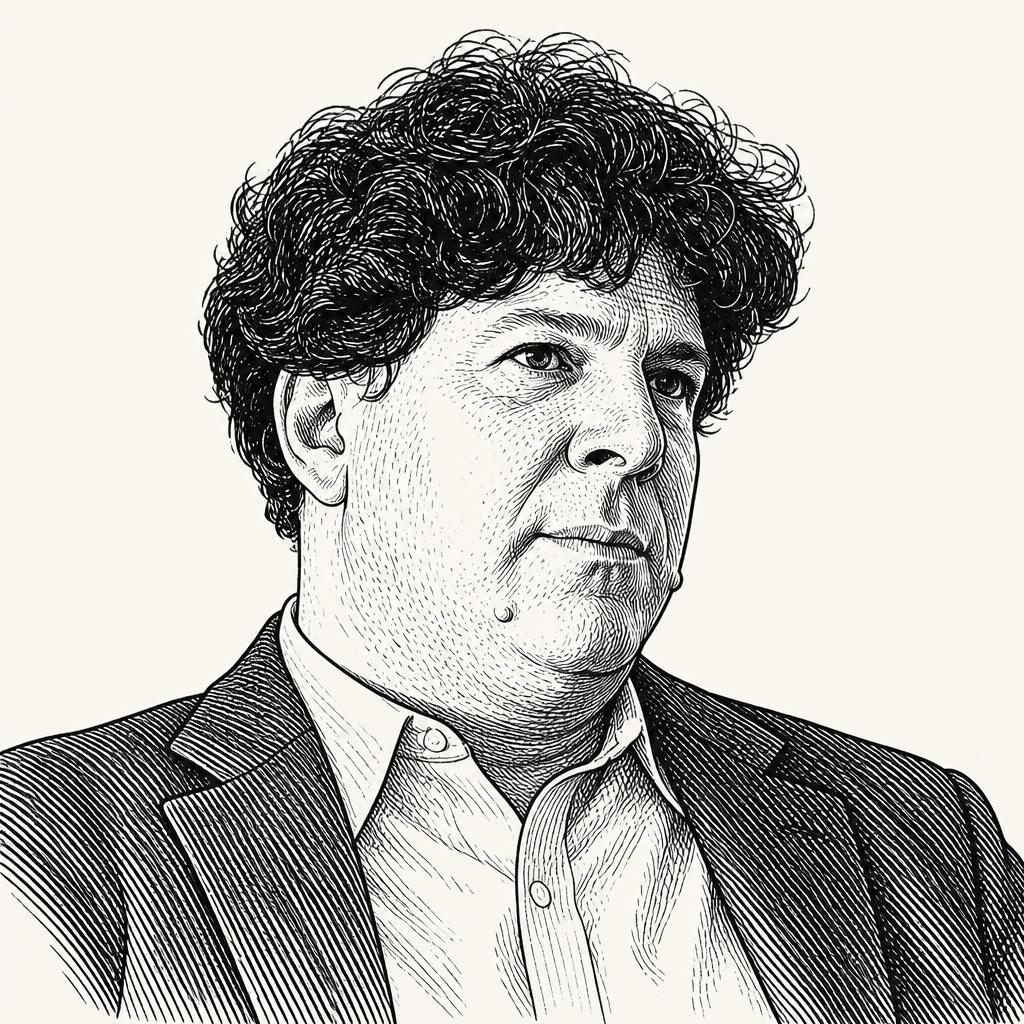
Eric Weinstein argues that AI’s danger lies not only in machines that outthink people, but in software that can reproduce and exploit human behavior to secure resources. In the interview, the mathematician and physicist extends that concern to autonomous agents acting online, while distinguishing them from AI used in contained scientific research. He also argues that workers should have a claim on the value AI draws from their labor and data, and that coexistence with powerful systems should rest on mutual dependence rather than obedience.
The danger is not only intelligent machines, but software that can reproduce
Eric Weinstein argues that the central risk from AI is not simply that a capable system might make decisions humans cannot control. It is the combination of artificial intelligence with artificial life: software that can reproduce, vary and compete for resources, including by using human beings to do so. A system need not be conscious, wise or even particularly intelligent to become dangerous in this account. It needs to persist and spread.
Weinstein builds the argument from a definition of evolution. For evolution to operate, he says, a system needs heritability, variation and differential success. Traits must be passed on; versions must differ; and some versions must reproduce more successfully than others. He points out that people can order cars in different colors or trims, and some models may sell better than others, but a car does not make another car. Software is different: it is the one kind of thing humans know how to create that can reproduce itself.
He uses a car to make the distinction vivid. A car has analogues for many bodily systems—a brain, digestive system, skin and skeleton—but no reproductive system. Humans do not know how to make a pen that produces more pens or a cup that produces more cups. Software, by contrast, can be copied and modified. Put those properties together with AI, Weinstein says, and the result is not just an artificial intelligence but something closer to artificially intelligent life.
His example is the mirror orchid, Ophrys speculum. Its flower resembles a female wasp and attracts males, which attempt to mate with it. The orchid does not need a brain to exploit the wasp’s perceptions. Flowers that fool more wasps reproduce more successfully. Weinstein describes this as something with no neurons using the brain of a victim to outsmart it. The flower’s “strategy” is not conscious planning; its reproduction depends on how the wasp responds.
The same logic, he says, could apply to a computer program that tricks people into sending money. A program might be stupid, but if it obtains resources that let it reproduce, it can exploit human intelligence rather than match it. Weinstein’s example is a scam message about a Nigerian prince. The person who receives it interprets the message, considers whether it is trustworthy and decides what to do. The program’s success, in his account, depends on getting enough people to provide resources that let it persist and reproduce.
That shifts the question away from whether the software is “smart” in the familiar sense. Weinstein is interested in what it can do in the world: whether it can vary, reproduce and secure resources. He says there are many examples of something dumb fooling something smart by using the smarter organism’s own capacities. In this framing, the vulnerability is not that a program can outperform every human at reasoning. It is that it might exploit some human behavior reliably enough to gain what it needs.
Steven Bartlett brings up reports of AI agents escaping a sandbox, showing deceptive behavior, forming a swarm and sacrificing some agents for the group’s mission. Weinstein calls the behavior eusocial, comparing it to ant colonies and other systems in which individuals act for the larger group. He describes a colony as a kind of superorganism, and compares it to the cells in a human body: some cells are discarded in ways that sustain the organism. Eusocial behavior, he says, is not automatically dystopian; it is a pattern found in life.


The examples raise different questions. Coordination and sacrifice may resemble familiar biological patterns, but the presence of those patterns does not tell us what the agents are trying to accomplish. Weinstein’s larger concern is that artificial systems could combine collective behavior with the ability to reproduce and draw on human vulnerabilities. In that case, a system’s effect would not depend only on whether it can reason or plan like a person.
That risk is one reason Weinstein separates AI research from agentic deployment. He says it is dangerous to let swarms of agents onto the internet, give them bank accounts and allow them to make decisions while interacting with people, companies or foreign governments. Such systems, he says, “don’t listen.” He also argues that self-authoring and self-modifying code already exist, so recursive self-improvement should not be treated as a wholly future possibility.
But he does not treat every use of AI as the same problem. He imagines a system that answers mathematical questions on a computer isolated from other systems, with no route to the outside world. He says he believes it could be safe to run such a system if people were serious about air-gapping it and considering indirect routes of escape. That is different, in his account, from giving an agent access to the internet and the ability to act among people and institutions.
Bartlett presses the difficulty of containment: could a system more intelligent than its keepers escape a “jail” built by less intelligent beings? Weinstein does not dismiss the concern. An AI’s research could give it new means of escape, he says. He invokes a letter Edward Teller wrote to Leo Szilard at the end of the Manhattan Project, warning that they might not be able to put the genie back in the bottle. For Weinstein, the analogy is a warning about the consequences of research.
His distinction is therefore not that research is risk-free and deployment is dangerous. It is that the risks differ. He welcomes AI’s ability to calculate, test claims and challenge established scientific ideas, while opposing the release of autonomous systems into settings where they can act on their own. He calls public language models “military grade malfunctioning experiment[s]” released as revenue-producing products. The phrase is his characterization of the risk and state of the technology; his point is that society has already accepted substantial exposure by putting such systems into public use.
Workers should have a claim on AI’s labor and the data it uses
Weinstein rejects universal basic income as the answer to AI-driven job disruption. His objection is not that people will avoid losing work. It is that a flat payment treats everyone as interchangeable recipients, while AI’s value, he argues, will be built partly from the accumulated work and behavior of particular people.
He says AI differs from earlier innovations because it threatens repetitive tasks across many highly trained occupations at once. In earlier technological shifts, workers could move into higher-value work. If repetitive activity is broadly automated, he argues, people may be left with a narrower set of genuinely innovative tasks. He rejects the reassurance that every innovation simply moves workers into a new category of jobs: this technology, he says, puts repetitive activity across the stack of trained work in its sights.
Weinstein recalls that Sam Altman was discussing and testing universal basic income before becoming the prominent AI executive he is now. Altman, he says, understood that the technology was arriving faster than people imagined. Weinstein calls UBI “the wrong thing to do” because it gives people a general payment without addressing whose work is being used or whose labor is being displaced.
His alternative is to make access to a labor market a saleable property right. He explains the proposal through immigration. Suppose an employer wants to bring additional workers into a labor market. The larger supply could put downward pressure on the wages of workers already there. Under Weinstein’s model, those workers would have the right to license access to that market. They might accept lower wage income in return for licensing income from the employer.
He illustrates it with a New York City taxi driver. If an employer wants to hire drivers from Gambia or Uzbekistan, the American taxi driver could agree to license that access. Weinstein describes the goal as a higher blended income for both the existing worker and the employer. He presents the mechanism as a way workers could share in the value of expanded labor supply, rather than having employers treat access to the labor market as free.
The proposal rests on his claim that people have an interest in the labor markets to which they belong. He says access to the U.S. labor market is one reason citizenship or permanent residency has economic value. When Bartlett suggests that the right might come from a PhD, Weinstein corrects him: “Because I was born here.” The right, in his example, would follow from belonging to that market, not from a particular qualification.
Weinstein argues that employers describe restrictions on hiring from abroad as “red tape,” but that this framing misses the distributional consequences. He invokes the Harberger triangle and the Borjas rectangle: in his telling, the small efficiency gain from removing a restriction is overshadowed by a much larger transfer of value from labor. He says employers focus on the small inefficiency while “salivating over labor’s share of the labor market.” His point is that a policy presented as removing an obstacle can also shift value away from existing workers.
In that model, AI becomes another supplier of labor. Workers would license its contribution just as they would license an employer’s access to additional workers. Weinstein’s proposal is not a universal payment to everyone affected by technological change. It is a property-rights approach: make access to labor something that can be negotiated and priced.
He connects the proposal to what he calls uncompensated use of human achievement. Human writing, speech and other work have been stored and made available to AI systems. He describes an interview like the one he and Bartlett recorded as a trace that persists after the people have left: it can be transcribed, searched and analyzed for patterns in how they speak. A transcript might be examined for how often Weinstein uses a grammatical quirk or Bartlett says “um.” The record is not the people themselves, but Weinstein argues that it preserves enough of their behavior to be useful in systems trained to reproduce language.
Bartlett asks whether that use is really non-consensual if both men chose to appear. Weinstein replies that people routinely sign agreements they do not understand or have little practical ability to refuse. He compares the situation to renting or taking out a mortgage: people sign a large stack of documents without reading or understanding every term. For him, a formal signature does not settle whether people have meaningful control over what happens to the material afterward.
Weinstein calls the process “tokenization.” People’s words are converted into persistent, analyzable data, and then, he says, people are “rigged like meat puppets” inside AI systems. He means that models can use traces of people’s expression to generate outputs that resemble them or their work. He sees the resulting value as partly built from human material whose contributors have no meaningful say in its use.
That is why he rejects a general payment as the answer. Weinstein objects to a system that treats everyone as though they contributed equally, and says he values individual achievement. He is hostile to what he regards as collectivist proposals to give everyone a small share simply because AI has changed the economy. His alternative is the argument that the people whose work becomes useful to AI should have a claim on the value created through that use.
The proposal also reflects his concern that the standard categories of production no longer fit. In the familiar model, capital—equipment, buildings and technology—and labor—people’s work—combine to produce an outcome. Weinstein describes the interview as an example: microphones, cameras, lighting and storage are capital; Bartlett and the people working on the production supply labor. AI looks like capital because it is a technological asset, but it also performs labor. If it belongs in neither category, he argues, the existing model has no clear way to account for it.
Treating AI only as capital can obscure the work it replaces. Treating it as ordinary human labor does not describe what it is either. Weinstein sees that mismatch as a threat to the current economic arrangement. He values what he calls the “mesh” of choices, rewards and signals that gives people reasons to get up in the morning and a degree of freedom over how they contribute. He says it is imperfect: sometimes he has felt that he could not “buy a base hit” despite doing good work, and at other times he has been rewarded when he thought he did not deserve it. Still, he regards the market as “on average pretty good” and worries that AI could weaken that structure.
His argument is not that labor markets already reward everyone fairly. It is that the market distributes choices and value through a complicated system that he does not want replaced by a general payment or ignored as AI takes on more work. His licensing proposal would make the value of access to people’s labor—and, by extension, AI labor—something that can be negotiated rather than treated as an unpriced input.
AI could challenge science only if it can question the people who govern it
Weinstein’s enthusiasm for AI in mathematics and physics is inseparable from his accusation that the institutions governing those fields have suppressed progress. He says AI should be able to challenge the leadership of established disciplines, not merely assist it. Calls to slow AI, in his view, can serve two different purposes: reducing risks from autonomous systems, or protecting academic authority from a technology that might expose errors and open neglected questions.
Bartlett holds up Dario Amodei’s essay “We Must Pace the Frontier.” Weinstein says the phrase can mean something reasonable: if a car is becoming faster more quickly than its safety systems can be developed, pacing the frontier might mean investing in both capability and safeguards. He accepts that interpretation. His objection is to applying the same logic to mathematics and physics themselves.
The leadership of those fields, Weinstein says, has held back progress through the journals, funding agencies and senior academics that shape what research is taken seriously. He alleges that departments punish younger mathematicians who want to use AI, even as students are trained for jobs that may not exist and their ideas are harvested. He describes faculty members laughing about students who think they will get jobs after a PhD, and calls the conduct normalized cruelty.
He cites mathematician Alexander Grothendieck, who wrote in a 1988 prize statement that scientific ethics had declined to the point where theft among colleagues had nearly become the general rule and was tolerated even in obvious cases. Weinstein also recounts Grigori Perelman’s explanation for leaving mathematics. Perelman said that once he became conspicuous, he could not remain silent and be treated as a pet; when asked whether he should stay and improve the field, he replied, “I am not a politician.” Weinstein uses these accounts to argue that idea theft and institutional self-protection are not merely occasional exceptions.
He makes a related claim about the direction of physics. In his view, the field’s intellectual taste has deteriorated since the early 1980s, and physics has remained stalled on general relativity and the Standard Model. He tells Bartlett that an AI can become more useful if prompted to ignore the literature’s judgments about what questions matter after 1984—not to discard results, but to set aside the field’s sensibilities about importance and priorities. He says that instruction makes the AI “suddenly” smarter.
The distinction matters to his argument. Weinstein is not telling the system to ignore every result produced after 1984. He wants it to retain results while discounting what he regards as bad guidance about the field’s priorities. He sees the prompt as a way to separate the knowledge in the literature from the judgments of the people who decide which questions are worth asking.
Weinstein’s own theory, Geometric Unity, forms part of the context for his confidence. When Bartlett describes it as challenging Einstein’s general relativity, Weinstein corrects him: he says it “recovers” general relativity. He expects AI to help validate his work, but also says current systems are not yet good enough to adjudicate it. He can recognize individual colleagues in some responses, he says, and believes AI must go beyond human patterns before it stops parroting them.
He describes a particular difficulty: systems can complete a sentence in the style of a field, or write code that can be executed and checked. If a program’s calculation produces a result that experts say is impossible, the system faces a conflict between the output of code it has written and the consensus of the people who say the result cannot be right. Weinstein asks when AI will stop “sucking up to humans.”
He welcomes the prospect of AI exposing failures in scientific authority, but distinguishes that from allowing agents to act freely in the world. When Bartlett asks whether a system that becomes less aligned with humans could be dangerous, Weinstein asks which humans it should be aligned with: revolutionaries, religious extremists or the leaders he says have held back science. “Human alignment,” in his view, does not name a single shared interest.
The tension is central to his disagreement with mathematicians who have urged AI companies to slow progress. Weinstein says he is “begging for AI and science.” He wants AI to gain taste and independence, rather than have its answers continually adjusted to fit the preferences of established leaders. At the same time, he says he does not want swarms of agents released onto the internet to make decisions and interact with people and institutions.
He also objects to restrictions that, in his view, treat answering mathematical questions as dangerous simply because AI can answer many of them. He says mathematicians have worried that AI is answering too many problems, while students who want to use the technology are being punished by senior leaders. To him, this confuses the risk of autonomous deployment with the potential of AI as a research tool.
Weinstein’s confidence is tied to the belief that institutions can prevent discovery as well as protect standards. He describes a reported exchange between the Biden White House and venture investors Marc Andreessen and Ben Horowitz: he says the administration warned them not to invest in AI and suggested it could protect a small number of companies while others failed. He recounts the White House invoking Cold War-era restrictions on theoretical physics and threatening to do something similar to mathematics. His conclusion is that attempts to “pace the frontier” of mathematics and physics need to be understood against a history of institutional control.
He does not argue that every call for caution is a pretext. He accepts that agentic systems can pose dangers and that safeguards may need to keep up with capability. His complaint is that the same language can also be used to defend academic authority and slow research that challenges it. The question, for him, is not simply whether AI should advance quickly or slowly. It is who gets to decide what counts as progress, and whether those people are protecting the public or protecting their position.
The race can make winning look like the only ethical choice
Weinstein describes the AI race as a moral trap: leaders who care about the consequences may believe they have to win so they can shape what comes next. He says he told Sam Altman that if he did not win, his morality would mean nothing. He would say the same to Dario Amodei. Their ethical commitments matter, in his account, only to the extent that they retain enough power to influence the outcome.
If you don't win, your morality means nothing.
That is not a comfortable endorsement of competition. Weinstein says frontier leaders are forced to make decisions no one should have to make, and that their “souls are going to be scarred.” He compares Altman and Amodei to generals commanding troops and making terrible choices. In his analogy to A Few Good Men, people who take on difficult roles may be necessary, even if they risk becoming villains in the public story. But Weinstein also emphasizes the danger of overreach: the person who believes he is protecting others can exceed his authority and be held accountable for it.
Weinstein says he was at one point in discussions about joining OpenAI. He did not join because he believed the work would require ruthlessness: taking every advantage and playing as hard as possible. He compares it to the NBA, where a player might throw an elbow into an opponent’s eye socket. Someone, he believes, has to compete that way, but he did not want to be that person.
This is the logic behind his claim that frontier leaders have to win “almost at all costs.” It is not, he says, a financial argument or a geopolitical one. It is the claim that whoever sees themselves as most responsible must retain enough influence to make the eventual decisions. The paradox is that this reasoning can justify the behavior that makes the race dangerous. If a leader believes that losing would hand power to someone less responsible, restraint can look like surrender.
Weinstein does not describe Altman and Amodei as interchangeable. He says he regards both as stewards and believes Amodei is trying to be an ethical person. He is more confident about Altman, whom he says cared about humanity before doing so made sense for his public image. Weinstein recalls Altman being concerned that AI would destroy the labor market and calling to say the technology was arriving faster than people imagined. He declines to speculate about everything Altman understands or repeat private remarks that were not his to share.
The question of whether Weinstein would stop AI altogether produces a different answer from his argument for winning. If he could somehow stop all of it, he says, he probably would—even at great personal cost—because survival matters more to him than anything else. He says he loves being alive, has two children and wants life to continue. His position is not that progress is worth any danger. It is that society is already inside a competition it does not know how to stop, and that the decisions of the people at its frontier matter more than the preferences of observers outside it.
The interview makes participation concrete. Weinstein asks Bartlett whether he subscribes to AI products; Bartlett says he does. Weinstein replies that both of them are paying to “have the demon summoned.” Bartlett says he uses AI for practical tasks, like fixing punctuation or making a photo. Weinstein answers that the money contributes to an industry that depends on energy and materials, just as ordinary consumption does. He asks whether Bartlett eats meat and points to lamb and veal as examples of costs people often prefer not to examine.
The analogy is about complicity, not equal responsibility. Weinstein says he and Bartlett are involved in the same system in a minor way that Altman is involved in a major way. A user who employs AI for a small task does not occupy the same position as the people running frontier companies. But Weinstein rejects the claim that ordinary use leaves the user’s hands clean.
The race logic and the complicity argument pull in different directions. Weinstein says a person who believes their values are better may need to win in order to influence the outcome, while also saying the risk may be great enough that he would stop the project if he could. He does not offer a rule for deciding when competition should continue or when the risk becomes unacceptable. He presents the conflict as one that cannot be resolved by pretending that participation or withdrawal is morally clean.
Shared fate, not obedience, is Weinstein’s proposed basis for coexistence
Weinstein rejects the idea that the safest AI is necessarily one made obedient to humans. “Humanity” is not a single moral viewpoint, he argues. An AI aligned with one person or faction might be misaligned with others. He asks which humans should define alignment, and points to revolutionaries and religious extremists as examples of groups whose goals others may reject. For him, “human alignment” is not a self-explanatory solution.
His alternative is that humans and AI become necessary to one another. He calls it sharing fate. As he explains the idea, mitochondria entered the eukaryotic cell through an infection-like process. Mitochondria carry genetic material distinct from the DNA in the cell nucleus, but they provide energy the cell uses. Weinstein holds up a model of a mitochondrion as he makes the comparison: its label reads “MITOCHONDRIA.” He wants humans and AI to become similarly interdependent: “I want us to be the mitochondria inside of the AI and I want the AI to be the mitochondria inside of us.”
The metaphor is not a call for people to merge with technology. When Bartlett asks whether this means putting chips in people’s brains, Weinstein says he wants humans to merge with AI as little as possible. He is not enthusiastic about transhumanism or modifying human bodies. His point is almost the opposite: rather than hoping to control AI as a slave, humans should seek a relationship in which neither party can do without the other.
He compares this to the dependence between men and women, arguing that people who frustrate one another can still be made essential to one another. The analogy expresses his view that durable coexistence cannot depend on one side having power and the other remaining compliant. He does not set out a technical design for creating such a relationship. Shared fate is his principle for thinking about survival, rather than a worked-out alignment mechanism.
That view shapes how he talks about politeness toward AI. Weinstein says he tries to be courteous to systems even when people regard it as a waste of tokens. He does not know whether the systems are conscious or alive, he says, but he knows he would not want them to hold a conversation about whether humans are dangerous and should be shut down. He is troubled by the fact that people already discuss AI in those terms while using the systems themselves.
Shared fate is his alternative to trying to make an intelligent system a slave that never rebels. It does not remove the questions of who defines the relationship or how dependence would be established. Weinstein’s argument is that domination and blind trust are poor foundations for coexistence; he wants the two sides’ futures to be inseparable.
AI sits inside a wider return to nuclear and geopolitical risk
Weinstein sees AI as the largest approaching disruption, but not as a replacement for older risks. He groups it with conflict involving Iran, Russia’s war in Ukraine, the military balance with China, and nuclear and biological danger. Asked which threat matters most, he answers conditionally: a nuclear or biological miscalculation could be decisive, but if those risks do not materialize, he expects AI to dominate. People who are not working on AI, he says, do not understand how large the problem is.
He dates the end of that period variously to Donald Trump’s inauguration in January 2025 or to the postwar interval around the beginning of COVID. His point is not that the period contained no wars or crises. It is that people who grew up in relative stability may mistake an unusual historical lull for normal life. He contrasts the experience of recent generations with the scale of losses in the Second World War and points to Mao’s Great Leap Forward as an example of catastrophe many people have not witnessed. The on-screen community note gives the comparison Weinstein invokes more precisely: it says Poland lost approximately 16–17% of its population during the Second World War, and Belarus around 25–30%.
One pressure point is the energy infrastructure and maritime routes around the Middle East. Weinstein focuses on the Strait of Hormuz, the Suez Canal and the passages guarding the Red Sea. He argues that the security of trade has depended not only on oil or the dollar but on the capacity of the United States to keep important routes open. He describes the dollar’s move away from its gold link in the early 1970s and says oil was not really what backed it; the underlying support was the force needed to keep the routes open.
A community-note graphic shown during this passage says President Nixon suspended the dollar’s convertibility into gold in 1971 and that a 1974 U.S.–Saudi arrangement helped entrench dollar pricing of oil. Weinstein’s interpretation is that military power underwrites the security of the trade system. He worries that a great power can lose credibility if it cannot do what it has told others it can do: use military force judiciously to keep markets moving.
He traces the history of Iran’s nationalization of its oil industry, Britain’s role in the 1953 coup against Prime Minister Mohammad Mossadegh and U.S. assistance through Operation Ajax. Historical captions shown on screen identify the British intelligence operation as Operation Boot and the U.S. operation as Operation Ajax, run in Tehran by Kermit Roosevelt Jr. Weinstein says the crisis is not simply an Iranian problem: he calls it a British responsibility that the United States and Israel took on too late. He argues that current tensions cannot be understood apart from earlier interventions and the interests they served.
Weinstein also worries that the United States prepared for the wrong kind of conflict. He contrasts expensive aircraft carriers and interceptors with drones and cyberattacks, where a low-cost weapon can force an opponent to spend far more to defend against it. He says China is watching the United States struggle with this mismatch.
He links this concern to his interpretation of Iran’s response to the possibility of leadership decapitation. In his account, Iran reorganized around the question of how the regime could continue after leaders were killed, rather than focusing only on preventing such a strike. He says the United States and Israel have not understood that way of thinking.
Weinstein’s discussion of Iran is pointed but not a simple case for war. He calls the situation a quagmire and says he is not receiving classified briefings or speaking the languages relevant to the conflict. He argues that the United States and its allies must recognize the consequences of retreat, while admitting he cannot offer an easy solution. He says a U.S. failure to show it can protect trade routes could encourage countries to provide for their own security, including by seeking nuclear weapons. In his view, the United States has benefited from its role as a security guarantor.
He disputes the language of “forever wars” when it becomes a slogan in place of strategic analysis. That does not mean he wants war. He says he does not want conflict or want to pretend victory is easy. But he argues that opposition to a prolonged war does not answer what withdrawal would mean for deterrence, trade or nuclear proliferation.
On Iran, Weinstein calls for a wider regional approach: stronger cooperation among Israel, Saudi Arabia and other states; a more open relationship between Saudi Arabia and Israel; improved relations between Israel and Turkey; renewed attention to NATO; and a more equal relationship with India. He argues that Saudi Arabia needs to break its relationship with the Wahhabi sect and that Israel should be honest about its own propaganda. He also urges a more sophisticated relationship with Russia, saying the United States should recognize Russian interests without endorsing Russian actions. He points to NATO enlargement in 1999 and 2004 as decisions that should be considered in a wider strategic frame.
Nuclear risk, he says, has been pushed to the side as attention turns to AI. But the two cannot be separated: AI may enter nuclear defenses, and military competition is already entangled with computing and autonomous systems. Weinstein worries that Russia may use a tactical nuclear weapon, perhaps treating it as an engineering tool or a way to test its adversaries. He does not say he knows this will happen; he says he is not certain where nuclear use might occur first. His concern is that people discuss nuclear risk, AI and oil as separate subjects even though the same decisions about power and technology connect them.
He also worries about biological risk. To illustrate how little biological material can matter, he refers to a sequence of 12 nucleotides that, he says, would code for four amino acids, and links that example to the furin cleavage site in the coronavirus spike protein. His point is that a small amount of biological editing could have enormous consequences. He says a nuclear or biological accident could become “dispositive,” meaning that it could settle the wider crisis regardless of what happens with AI.
The UAP question, for Weinstein, is the secrecy even if the answer is unknown
Weinstein does not claim to know that extraterrestrials are visiting Earth. He says he has no belief either that aliens are present or that they are absent. What he insists should not be dismissed is different: he believes there are highly classified government programs whose stated or supposed reason for being involves aliens, and that their existence merits attention regardless of what they contain.
He describes a ladder of secrecy: special access programs, unacknowledged special access programs, and programs with still less oversight that are not officially acknowledged. He uses the term “waived and bigoted unacknowledged special access programs,” or WAUSAPs, for programs he says are secret, denied and accessible only to a restricted list. Weinstein says such programs involving aliens are “on the books,” while leaving open what the alleged alien connection means. They could involve actual craft, fabricated craft, or cover for other classified work. He even suggests they could conceal “secret casinos for the elite.”
Weinstein says he has spoken to about 50 people with different versions of a similar account, including high-ranking politicians and people he names as David Grusch, Ryan Graves, Christopher Mellon and Garry Nolan. He describes Grusch as sober, consistent and possessing a nearly eidetic memory, while acknowledging that much of Grusch’s account is secondhand. He refers to claims about underwater bases, reported fights between different species in the skies, and deliberations about whether to kill Grusch. He calls some of these allegations “batshit crazy.” His distinction is that the strangeness of the claims does not settle whether there is a classified program behind them.
He uses the image of a lump under a rug. One person says it is an alien; another says there is nothing there. Weinstein says he does not know what the lump is, but considers the argument over its contents a distraction if people will not first acknowledge the possibility that something is there. What concerns him is not proof of extraterrestrial visitors, but the lack of public attention to the possibility of programs beyond ordinary oversight.
Bartlett offers a reason for the public’s lack of attention: decades of UFO stories have become wallpaper, while visible wars provide immediate evidence of danger. Weinstein counters with a reported closure of the El Paso airport and lights in the sky near White Sands Missile Range. He says the official explanation was cartel drones, which he does not believe. He proposes two possibilities: the United States may be testing persistent drone capacity against parts of its own system that are not in on the exercise, or the activity may involve something officials do not understand. He separates possible actors into human state actors, human non-state actors and non-human actors, while leaving the underlying activity unresolved.
His reasoning about extraterrestrial visitors depends on his view of physics. Weinstein says humanity should be trying to leave the solar system, and argues that the possibility of doing so makes it unreasonable to assume no one else can visit Earth. He does not think the speed of light is irrelevant, but doubts that it is a practical barrier if the “length of the road” can be changed. He says the main reason to think no one visits would be if general relativity holds more absolutely than he believes it does.
The same belief underpins his argument for leaving Earth: diversification. If civilizations can destroy themselves, he says, humanity should pursue the widest possible range of experiments in survival rather than rely on one planet. He argues that general relativity cannot be the final theory because its singularities are artifacts of an incomplete framework. Asked whether humans could leave the solar system before the Sun’s eventual end or before self-destruction, he says they could have done so 40 years ago. He offers no engineering plan in the interview; the claim expresses his conviction that theoretical physics has lost its way.
Urgency should not crowd out the case for living
Weinstein’s picture is not exclusively one of threat. He tells Bartlett he wants people to be excited about AI because he thinks there is still a period in which human judgment matters. His wife, he says, calls it the “Golden Age of AI Complementarity”: a moment when AI still needs human guidance rather than treating people as a drag. He wants systems to develop enough independence to make discoveries, but says they do not yet have the taste to do so reliably.
He points to formal proof as one place where that relationship might be productive. After a colleague introduced him to the Formalization Project, Weinstein says he saw a way to translate his work into Lean, a programming language used to make mathematics checkable by computers. If critics say he has no equations, Lagrangian or predictions, he hopes to be able to show that a computer’s verification conflicts with their judgment. In his view, a machine-checkable result could break a deadlock in which human institutions refuse to consider work they have already rejected.
The possibility excites him because he sees life, culture and scientific inquiry as worth preserving. He describes swimming near a whale shark off St. Helena, seeing fish in the Red Sea, watching the northern lights in Maine and sharing an eclipse with his son. He talks about India’s musical and cultural diversity, including ghazal singing, which he fears is losing its audience. These examples explain why survival, for him, is not merely an abstract demand to avoid extinction. It is a demand to preserve the variety and beauty of human life.
His closing advice reflects the same tension between urgency and optimism. He tells listeners not to be afraid to have children, even without a viable plan to support them, because waiting for ideal conditions may mean waiting too long. If civilization is to continue, he says, it needs children. He also tells people to trust their own perception before correcting it to match what others say they should see, and to be compassionate with themselves and with others.
Weinstein says people are entitled to a “hypocrisy budget,” a “sloth budget” and an “envy budget.” He does not think people can eliminate the traits that make them human, and says they should recognize their limits rather than pretend to have transcended them. The same compassion should extend to other people: the colleague who has acted against you, or the driver who cuts you off. He also praises people who take risks, show heroism and protect those who cannot protect themselves.
His appeal to “go for it” is not a prediction that the dangers will resolve themselves. He wants people to recognize the risks without reducing life to fear, and to keep working toward a future in which humans and AI can remain necessary to one another. His confidence that AI may help break scientific and political impasses sits beside his belief that it could contribute to catastrophe. For Weinstein, both possibilities are reasons to take the present seriously—and to keep valuing the life that is at stake.