Confession Tactics Reframe Guilt Before Asking Suspects to Admit It

Chase Hughes, speaking with Chris Williamson, describes a five-step confession method used in military and law-enforcement-style questioning to move a suspect toward admission without directly demanding guilt. Hughes argues that the process works by changing the suspect’s available story: testing their responses, then reframing the alleged act as understandable, less severe, externally pressured and finally as a choice between two motives that both assume guilt.
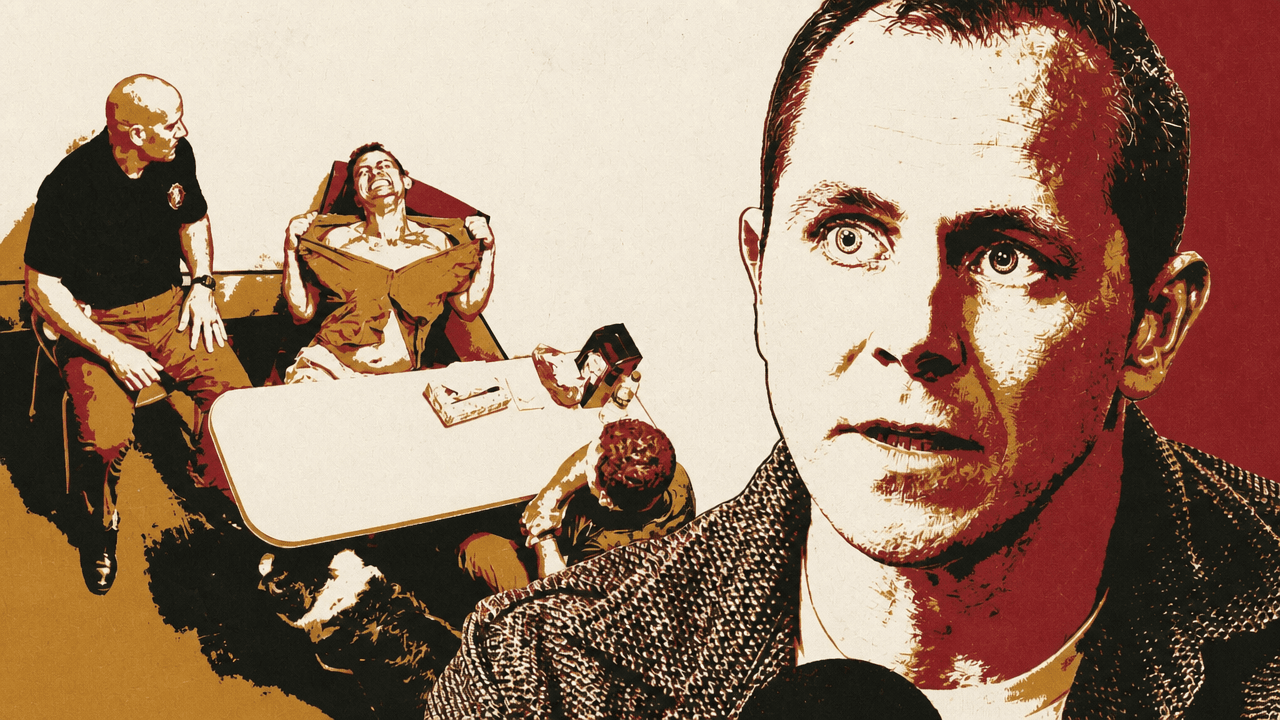
The confession method changes the suspect’s available story
Chase Hughes describes the confession protocol as “a massive shift in context and perception.” The method is not presented as a direct demand for guilt. It first changes the meaning of guilt: from “I am a bad person who committed a crime” to “I am a decent person who got pulled into something understandable.”
There's like a five-step protocol that people use to make someone confess to a crime. And if you really examine what the protocol is, it's just a massive shift in context and perception.
Hughes first names the sequence as “socialize, minimize, rationalize, and project,” then adds that the fifth move is an alternative question at the end. The sequence does not ask “did you do it?” so much as make confession compatible with a tolerable identity. In the example he builds with Chris Williamson, the suspected crime is arms smuggling.

| Move | How Hughes describes it in the example |
|---|---|
| Socialize | Tell the subject that people will understand, and that the act can be explained as something a good person got wrapped up in. |
| Minimize | Reduce the perceived severity by contrasting the act with worse crimes and worse people. |
| Rationalize | Offer a motive the subject can inhabit, such as poverty, medical bills, or family pressure. |
| Project | Move blame outward by emphasizing conditions, threats, pressure, or circumstances. |
| Alternative question | Ask the subject to choose between two explanations, both of which assume the act happened. |
The process begins after an interview phase, when Hughes says the questioner decides to shift into what he calls “the confrontation.” That confrontation is not, in his telling, an ego-threatening accusation. The interviewer signals experience and certainty without saying bluntly that the subject is lying: “I’ve talked to a lot of people, and if there’s one thing I know for sure, it’s when I’m not getting the full story. And I don’t think I’m getting the full story here.”
From there, the socializing move tells the subject that other people will understand. The script is not “you are guilty”; it is “you did this because you’re a good person,” followed by the promise that once people see the steps that led there, “they’re going to understand.” The aim is to make an admission compatible with self-respect.
Minimization lowers the moral and practical stakes. Hughes’s sample interviewer tells the suspect he deals with “bad people all the time” and with people who have done “way worse stuff than this.” The suspect is explicitly separated from “some mass murderer.” The act remains the subject of the interrogation, but its perceived weight is reduced.
Rationalization supplies a motive the suspect can inhabit. In the arms-smuggling example, Hughes gives the subject poverty, a difficult background, and an aunt with several hundred thousand dollars in medical bills. The subject is offered a reason that makes the crime legible without requiring him to describe himself as corrupt.
Projection moves responsibility further outward. Hughes says this is “basically it’s not your fault.” The suspect is told that anyone handed the same conditions and life might have made the same choices, and that arms-smuggling rings may use threats and pressure to pull people in. The interviewer invites a version of events in which the suspect did not “deliberately decide to do this.”
So now it's an alternative question of, "Are you a piece of crap, or did you try to do something good for your family?"
The final question appears to offer choice, but both options concede the central fact. In Hughes’s example, the interviewer asks whether the subject was smuggling arms to make money, buy drugs, and live elsewhere, or whether he was trying to help a family member. Williamson immediately identifies the structure: “Both of them are admissions of guilt, though.”
Hughes agrees. He says the interviewer is “trying to find out the reason it happened,” but accepts Williamson’s correction: the method is pursuing an admission of guilt through a question framed as a choice of motive. The subject is not being offered innocence versus guilt. He is being offered a worse reason versus a better reason for guilt.
Before the confession script, Hughes tests responses
Chase Hughes says the confession methodology follows a “long series of questions.” If the subject responds in certain ways, the interviewer moves toward the confession protocol. One setup is the bait question: a conditional question that places the subject inside a dilemma without directly claiming evidence exists.
Hughes uses a hypothetical burglary near the interview location in Austin. Someone steals a bike from a garage, and police invite the person in as a possible witness who “might have seen something.” The interviewer then says officers have been collecting evidence through the night and asks one question: “Is there any reason whatsoever that one of the neighbors would have a Ring doorbell camera that shows your vehicle in that area?”
The pressure comes from the asymmetry of the answer. If the suspect says no and video is produced, he has made himself a liar. If he says yes, he has placed himself near the scene. Hughes stresses that the interviewer does not have to say he actually has the footage. The wording is conditional: “Is there any reason” an officer would have received doorbell footage showing the vehicle in the area.
For Hughes, the value of the question is hesitation and confidence. His claim is that an innocent person would answer “Nope” immediately and with certainty: there would be “absolutely no reason.” The suspected person, by contrast, has to calculate the risk of denying something that might later be shown.
Chris Williamson notices the evidentiary implication: this works regardless of whether the Ring footage exists. Hughes confirms that, while emphasizing the phrasing. He does not say, “I have it.” He asks whether there is any reason such footage might exist.
Punishment answers can reveal who feels implicated
Chase Hughes describes the punishment question as shorter: “What do you think should happen to the person that did this?” He says it works on both children and adults, and illustrates it with a household example involving his own children.
He describes coming home in camouflage uniform to find a white living-room rug with a small carton of chocolate milk tipped on its side and a pool of milk on the carpet. His two children, around seven and eight years old, were playing Xbox nearby. Both denied knowing what happened. Hughes separated them: one to the kitchen, one to the dining room. Chris Williamson calls it “prisoners’ dilemma”-ing them.
With his daughter Charlotte, Hughes asked what should happen to the person responsible. Her proposed punishment escalated: spankings, grounding, no Xbox, no playing with friends, no sleepovers, no more eating in the living room. Williamson describes this as a child’s equivalent of capital punishment.
When Hughes asked his son William the same question, the answer was much narrower: “Maybe no more chocolate milk in the living room?” Hughes says that was enough: “I had my guy.”
The contrast is the point of the question. The uninvolved child proposes sweeping punishment because the punishment will fall elsewhere. The implicated child proposes a consequence that contains the damage and preserves the thing he wants. Hughes treats that difference as a fast cue inside a questioning context.