Dersu Uzala Read the Siberian Forest Through Years of Close Attention
Robert Greene argues that ordinary life may leave some human capacities dormant, but his examples point to different processes. Dersu Uzala learns to read the Siberian forest through sustained attention to its signs; a climber, injured and facing a storm, experiences a brief surge of strength under extreme threat. Greene uses the contrast to question what people can perceive or do beyond the limits of everyday experience.
Human capacities emerge along two different paths
Robert Greene describes two kinds of ability that ordinary life may leave unused. One is cultivated through close attention to the environment: learning to read tracks, weather and animal behavior over time. The other appears under acute pressure, when danger and physical need seem to release capacities a person cannot summon at will. Greene connects both to a deeper relationship with the body and senses, but the stories describe different things: practiced perception and an intense, temporary response.
The first is the knowledge of Dersu Uzala, an Indigenous hunter and trapper whom Russian cartographer Arsenyev meets while mapping parts of the Siberian taiga at the turn of the 20th century. Arsenyev invites Dersu to guide the expedition. As Greene tells it, Dersu can read the forest almost like a book: tracks reveal what animal passed and its condition; broken branches offer clues; the smell of the air helps him anticipate weather. He describes the forest as alive and breathing.
That knowledge is not presented as a sudden supernatural gift. Dersu has acquired it through living in close contact with the place. His physical energy also astonishes the expedition: Greene says that, in his 50s or 60s, Dersu has far more energy than the younger men. Greene suggests he is less constrained by assumptions about what he cannot do. But the story’s central contrast is between Dersu’s practiced attention and the explorers’ relative unfamiliarity with the environment. His ability depends on noticing and interpreting details, not on a single extraordinary burst.
Dersu’s knowledge depends on treating the forest as more than a backdrop
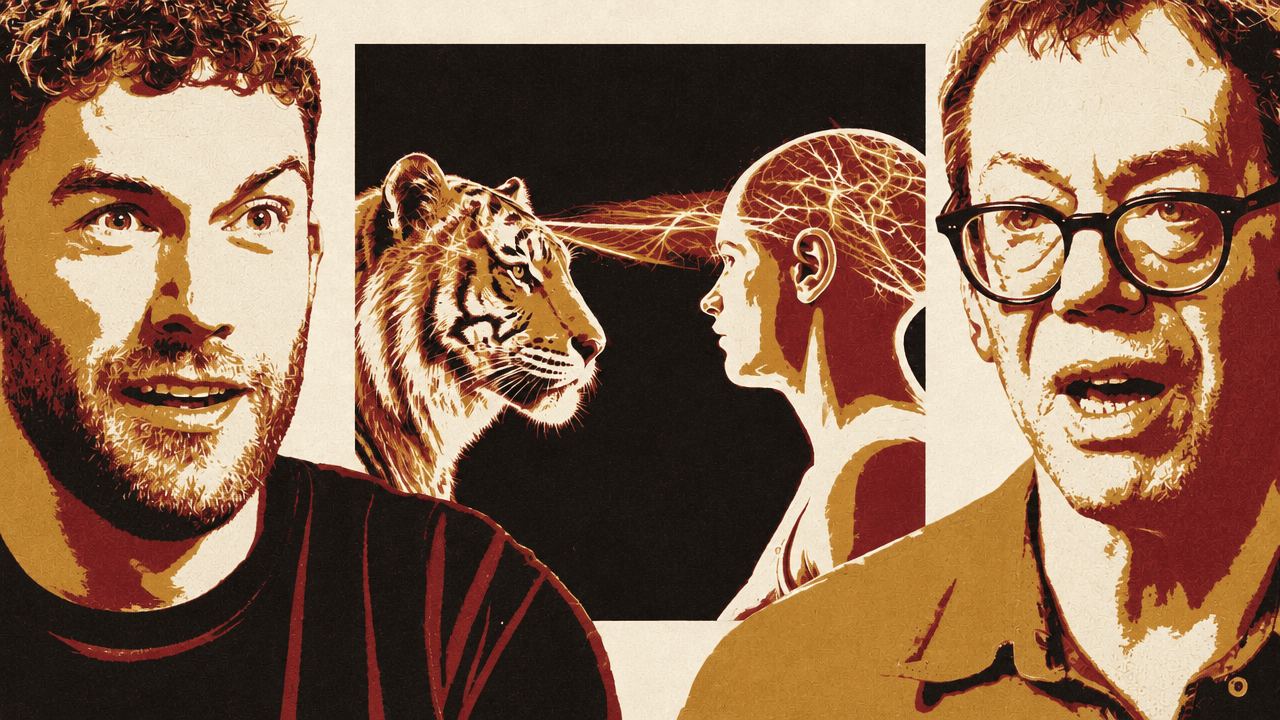
A Siberian tiger encounter makes the contrast concrete. When the group hears the tiger roar, Arsenyev reaches for his rifle. Dersu tells him to put it away, approaches the animal, and speaks to it as Amba. He asks it not to be angry: they are only passing through and will not bother it. The tiger walks away. Dersu tells Arsenyev that shooting it would violate the forest, and that he would never again be his friend if he did.
Greene relates the episode as an expression of Dersu’s understanding of the forest as a living system, not simply terrain to cross or danger to eliminate. Arsenyev is a scientist, but comes to believe that Dersu possesses a kind of intelligence his own training does not supply: the ability to notice and interpret details of the natural world. The difference is not that one man has knowledge and the other has none. Arsenyev can map the territory; Dersu reads its signs as they change.
Dersu is later murdered by robbers. Greene presents Arsenyev’s grief at the loss of this way of life alongside his thought that scientific knowledge might be more powerful if it retained some of Dersu’s closeness to nature. The possibility Greene raises is not a rejection of science, but a loss incurred when knowledge of the environment is separated from intimate, embodied attention to it.
Danger can release a capacity that cannot be summoned on demand
Greene’s second example is a climber descending a Colorado mountain as a storm approaches. The man falls about 30 feet, cracks open his knee, and lands on a ledge roughly a foot wide. Alone and injured, he begins to sob. Then, Greene says, an inner voice tells him to try to stand. He manages it, spots a precarious route between ledges, and feels a surge of energy. He makes his way down with an agility he later compares to a mountain goat.
The experience feels ecstatic, but the climber cannot explain it or reproduce it reliably. Greene says he spends years trying, including climbing Everest and running long distances. He gets moments of intensity, but not the same experience. In Greene’s telling, the climber eventually interprets what happened in physiological terms: he believes danger triggered hormonal effects, including dopamine and adrenaline, that gave him unusual strength and capacity. That is the climber’s explanation of his experience, not a mechanism Greene establishes.
The climber also reads about brain science and looks into Indigenous cultures and initiation rituals. Greene recounts his conclusion that some people who conducted such rituals had learned to bring participants to the brink of death and back, producing experiences like the one the climber had. This, too, is presented as the climber’s interpretation. Greene’s point is less that the climber has solved the biology than that the experience exposed a capacity he could not access through ordinary effort.
The contrast with Dersu is important. Dersu’s knowledge accumulates through repeated contact with one environment; the climber’s response arrives suddenly under extreme threat and proves difficult to call up again. Greene uses both accounts to question how much ordinary life reveals about what people can perceive or do. His hypothetical is a tightly wound, conservative stockbroker dropped alone on an island: with survival at stake, the person’s senses would begin to wake up. Some seemingly “supernatural” effects might emerge—not because the person has acquired a new faculty, but because ordinary life has left existing capacities dormant.
Mortality can make the body’s capacities newly perceptible
Greene also speaks from his own experience of being close to death. He describes sensing a powerful force within himself that he cannot verbalize. After emerging from the experience, he says, his physiology and brain felt slightly altered, and the world looked different. He does not describe this as acquiring supernatural powers or taking a drug; he connects it instead to being brought into contact with his body and mortality.
Your brain has these weird, weird, weird powers that you're not even accessing because you're not even connected to your body anymore.
Greene’s account returns to the distance he sees between people and their senses, bodies and mortality. Dersu’s perception is built through familiarity with the forest; the climber’s capacity appears in a crisis and then recedes. Greene’s own account describes a changed view of the world after coming close to death. Together, the examples suggest different ways ordinary awareness may fall short of what the body can register or do.