Self-Improvement Advice Works Only When It Counters Existing Tendencies

Chris Williamson argues that both optimisation culture and its anti-optimisation backlash fail when they treat advice as universally applicable. For people already prone to anxiety, perfectionism or obsessive self-management, more discipline can deepen burnout; for those avoiding responsibility, calls to relax and accept themselves can become an excuse to stay stuck. The Modern Wisdom host says intense self-improvement can be a necessary, temporary corrective, but only when it redirects rather than amplifies a person’s existing tendencies.
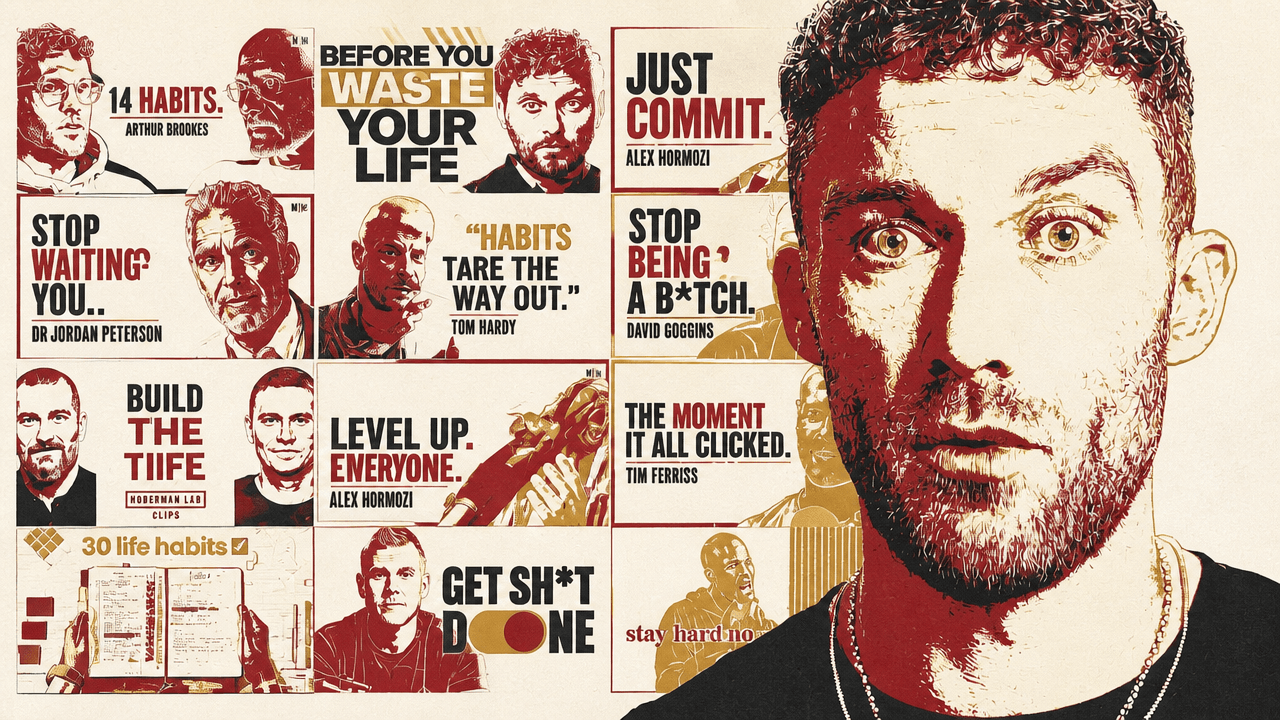
Advice becomes hazardous when it intensifies the tendency a person already has
Chris Williamson argues that the problem with both optimisation culture and its backlash is not whether discipline or relaxation “works” in the abstract. Advice does not land evenly.

The person most likely to consume productivity and optimisation content, he says, is often not “the lazy guy on the couch.” It is someone already anxious and disciplined, lying awake at night auditing the day and tallying every failure. Add more routines, protocols and standards to that person’s life and self-improvement can curdle into burnout and resentment.
The reverse problem applies to anti-optimisation advice. For someone who has spent years being told they are inadequate, “you’re fine as you are” may be precisely what they need to hear. But the same message can become a permission slip for someone who already avoids responsibility. Williamson’s examples are deliberately stark: “Fuck your feelings, just work harder” may be rocket fuel for a genuinely lazy person and poison for someone already grinding themselves into the dirt. “Be kinder to yourself” can be a lifeline for a perfectionist and an excuse for the person who lets himself off the hook every day.
Guidance never lands evenly. The people who least need a particular piece of advice are usually the ones most likely to overdose on it. While the people who desperately need it are somehow completely immune.
The practical test is therefore not whether the next piece of advice is conventionally healthy, demanding or permissive. It is whether it offsets an existing tendency or intensifies it. A more useful question than “what works?” is: “what works for me right now?”
That distinction also limits the anti-optimisation response. Criticism of grind culture can turn into an instruction to stop trying altogether: log off, touch grass, eat a pizza, get high and do whatever one wants because effort is pointless anyway. Williamson understands the appeal after years of pressure to do more. But he rejects the idea that trying too hard in the wrong direction is fixed by blindly heading to the opposite extreme.
“Grind slop” is what happens when improvement becomes a second job
Williamson calls hyper-optimisation “a disease,” describing the internet’s tendency to take a good idea, strip out its nuance and turn it into something ridiculous. He uses “grind slop” for this loss of proportion.
Self-development, in his account, expanded from exercising a few times a week and eating clean into HRV tracking, cold plunges, red-light therapy, expensive supplements and VO2 max measurements. Add the elaborate morning routine and the implied side hustle, and improvement becomes another full-time job.
The package attracts criticism because it can make life feel like “a performance review and homework that never ends.” It can leave people burned out and miserable, or so relentlessly managed that friends no longer enjoy being around them. It can also become fragile: a ritualised system whose absence makes someone feel worse, even when its individual steps look arbitrary from the outside.
The backlash includes a TikTok in which Hannah Glanz says, “optimisation is stealing our lives,” alongside headlines including “How Self Improvement Ruined My Life,” GQ’s “I’m Done ‘Optimizing’ My Lifestyle,” and “The self-improvement trap.” Williamson does not dismiss those criticisms. He says he has warned about the perils of grind slop and argued for the importance of relaxing.
But he objects to treating this failure mode as proof that self-development is inherently fraudulent. An elaborate routine may be compulsive escalation; it may also be someone’s temporary effort to pull themselves out of circumstances an observer cannot see. The relevant question is not whether a routine looks cringe-worthy, restrictive or excessive in isolation, but what role it is playing in that person’s life.
An intense corrective can be a chapter rather than an identity
Williamson presents his own history as a case for taking that context seriously. He describes himself as a “reformed degenerate turned into a reformed optimiser,” someone who redirected the same appetite for excess into a more disciplined form. Earlier in life, he says, he was a professional party boy, DJ, model and reality-TV participant; eventually, he concluded that he needed to grow up.
He saw that earlier period as a debt he needed to repay. Rather than gradually building the habits he might have developed between 18 and 28, he chose what he calls the equivalent of a Navy SEAL hell week lasting about five years, beginning at 28. His routine included morning walks, sunlight, salt water, meditation, journaling, breathwork, yoga, food preparation and reading.
He now finds aspects of that routine cringeworthy to discuss, but does not regret it. It took him from someone he was not proud of to someone he was. For Williamson, intense self-improvement can be a period: a “lonely chapter” between being a person one dislikes and becoming closer to one one does.
That period may require isolation and restriction. It may look like fragility, or like a complicated rain dance that adds little to life. Williamson concedes that personal development can be taken too far. Yet he argues that someone emerging from an unstructured or destructive life may need a concentrated corrective rather than a gradual adjustment. His point is not that everyone needs his routine, but that observers may not know what a person is trying to leave behind.
The search for a better life is legitimate; the advice market is not a manual
Williamson describes the search for improvement as noble, even though the landscape of advice is a “minefield.” His own aim in building Modern Wisdom, he says, was to speak with highly knowledgeable people, understand himself and the world better, and offer people something more positive toward which to direct their intensity.
That does not make the resulting material a set of instructions. Williamson compares it instead to a large, sprawling, “slightly chaotic” library. A reader does not enter a library to obey every protocol in every book or agree with every author. They encounter ideas, keep what helps and discard the rest.
This is especially important for obsessive people, Williamson says, because obsession is both a gift and a curse. He describes himself as deeply obsessive and doubts it is a setting that can simply be dialed down. Someone built to fixate will fixate on something; left to its own devices, the mind may select the path of least resistance—drinking, scrolling, pornography or rumination.
The aim is not necessarily to eliminate intensity but to choose where it goes. Williamson says there is no miracle cure that dissolves the fundamental difficulty and balance of being human. His instruction is narrower: absorb new ideas, keep the ones you like, discard the rest, and be gentle with the part of yourself that is still trying.