Synthetic Intimacy, Surveillance, and Stimulation Are Raising the Cost of Impulse
 Chris Williamson
 Matt McCusker
 Andrew Huberman
 Tom SeguraChris WilliamsonMonday, May 25, 202635 min read
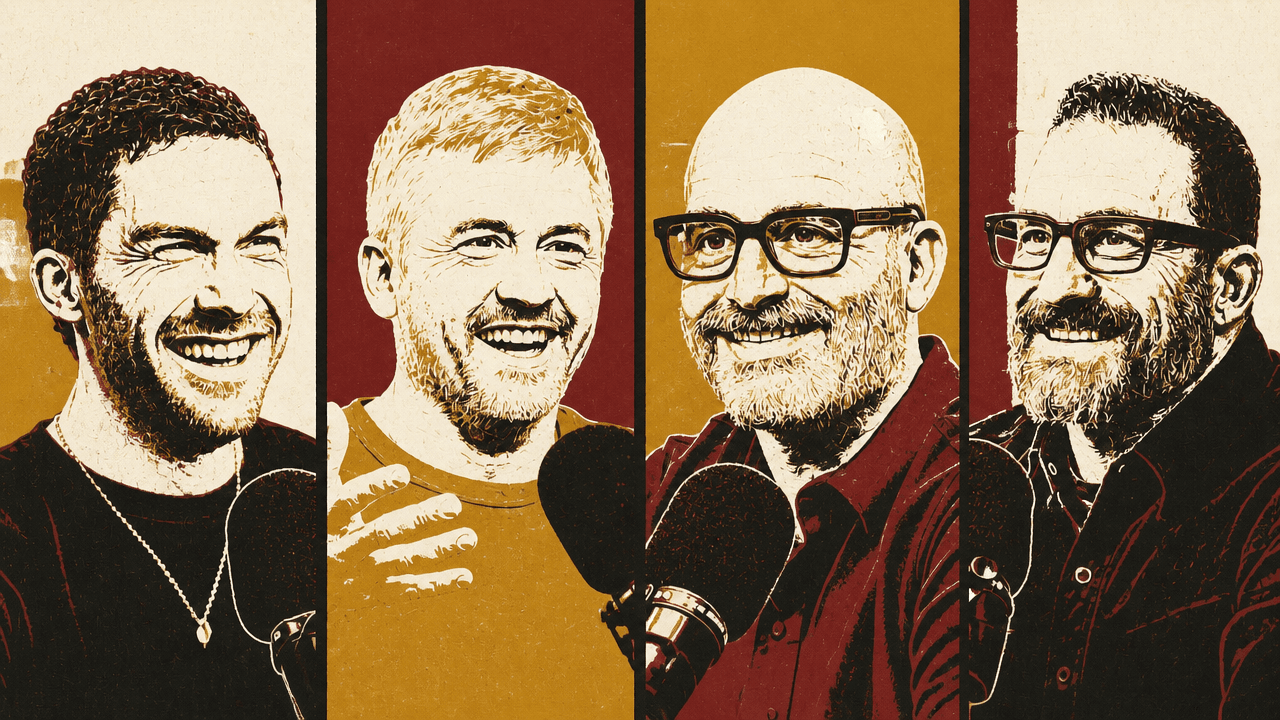
Chris Williamson’s inaugural Mostly Wise conversation with Andrew Huberman, Matt McCusker and Tom Segura uses health advice, comedy, AI replicas and conspiracy talk to examine where useful tools become distortions. Huberman repeatedly argues for moderation and mechanism over slogans — from low-dose tadalafil and sleep protocols to cannabis, sunscreen and self-control — while Segura and McCusker test those claims against comedy, parenting and lived experience. The broader case is that modern life increasingly requires judgment about thresholds: when optimization becomes rumination, evidence becomes pattern-seeking, and synthetic intimacy or surveillance starts to reshape ordinary behavior.
Low-dose tadalafil is framed as a blood-flow drug, not just an erectile-dysfunction drug
Chris Williamson opened with a question he said he kept seeing online: should every man be taking erectile dysfunction medication? Andrew Huberman answered by separating tadalafil from the cultural frame around Cialis. Tadalafil, he said, is the generic name for Cialis, but it was first developed as a prostate-health drug. Only later, at higher dosages, did people realize it could be effective for erectile dysfunction.
Huberman’s practical claim was about low-dose use: roughly 2.5 to 5 milligrams per day. At that level, he said, tadalafil is “very helpful for perfusion of the prostate” and also causes vasodilation in the brain. His explanation was simple: more blood flow can be useful, so long as it does not become excessive enough to create headaches or other problems. He cited Stanford’s chair of male sexual health and urology, Mike Eisenberg, as saying that “pretty much every male over 40 or so” should be taking about 2.5 to 5 milligrams per day.
The joke in the room, inevitably, was whether a drug discussed in the language of prostate perfusion still affects erections. Huberman said it “will definitely notch up erectile strength,” while resisting the comic invitation to turn that into a measurement protocol. But his broader point was that tadalafil sits in a different category than men may assume. It is a vasodilator, now culturally linked to ED, but for low-dose daily use he emphasized prostate blood flow and possible effects on androgen receptors. He said it may up-regulate either the sensitivity or number of androgen receptors, making the body more responsive to whatever circulating testosterone it has.
Tom Segura said he takes “five to six milligrams in the morning,” which he described as being prescribed for prostate health. He distinguished that from much larger doses, which he said would produce obvious “massive blood flow.” Huberman added the caution that vasodilation can lower blood pressure slightly because “all the pipes are getting a little bigger.”


The ambiguity around the recommendation mattered. Williamson floated the idea that the online push for universal tadalafil could be “a psy-op to normalize erectile dysfunction medication by dudes that have got erectile dysfunction,” so that nobody is left outside the category. Huberman acknowledged the social cover: a man may find it easier to call a doctor and say he heard a Stanford MD-PhD recommend prostate perfusion rather than say he wants Cialis for ED. But Huberman also stressed the drug’s availability: tadalafil is generic and inexpensive.
The Viagra discovery story was treated as an example of how sexual side effects can redefine a drug’s market. Williamson recounted the common version: a trial intended for heart-related use, possibly angina, ended with participants reluctant to return the medication and men sitting awkwardly during nurse checkups because of unexpected erections. Huberman said he only knew Viagra moved unusually quickly from discovery to market, which suggested how badly people wanted it available.
The discussion never resolved into a blanket prescription. The substance was narrower: low-dose tadalafil was presented by Huberman as a potentially useful vasodilatory tool for older men’s prostate health, with secondary effects on erectile function and possibly androgen responsiveness, but also with blood-pressure considerations and an obvious social dynamic around men avoiding the ED label.
Weight loss, fasting, and the GLP-1 limit case
Matt McCusker described his current morning routine as less optimized than simply disciplined: waking around 6:30, taking his kids to school every other day, and going to the gym for about an hour. He said he had become “fatter than I ever was” after two to two-and-a-half years of bad eating and was now more locked in than he had ever been.
When Huberman asked whether anyone had tried a GLP-1 drug, Segura said he had, in 2022, but only after losing most of his weight already. He had hit a plateau around 212 or 213 pounds and wanted to reach 200. He took it for about a month, lost the 12 pounds, and then stopped because “I didn’t eat.” Huberman replied, “That’s the point,” but Segura’s conclusion was that the mechanism had become the problem: he was not eating at all. After stopping, he regained the 10 or 12 pounds.
Segura credited a five-day fast with restarting the process. He drank water but ate no food. He expected to regain some of the weight once he resumed eating, but said he gained none of it back. Then a movie production changed his eating pattern further. Because he was in nearly every scene, he did not want to eat heavily during the day. He would arrive at the makeup trailer around 5:30 or 6:00 in the morning, eat “a little bit of fruit” and “a little bit of egg whites,” shoot for six hours, pick lightly at lunch, and then eat his only full meal at dinner. He said he lost 25 pounds during the production “just by working,” later regained about 10, and was around 190 at the time of the conversation.
The practical distinction was between pharmacological appetite suppression and environmental constraint. Segura did not condemn GLP-1s, and Huberman did not moralize them, but Segura’s own successful weight loss came from forced structure: fasting, being too busy to eat heavily, training four mornings a week, and paying closer attention to food. Williamson summarized the production effect as “overworking yourself,” but Segura treated it as a schedule that accidentally did what a deliberate diet often tries to do.
Comedians can act, but stand-up trains them to expect feedback acting will not give
Andrew Huberman asked why comedians are often good actors, citing performers such as Theo Von, Jim Carrey, Robin Williams, and Whitney Cummings. Segura resisted the premise as a rule. Some comedians can act, he said, and some are “shit actors.” The ones who can do it tend to have “the dramatic capacity” for it. In his view, Carrey and Williams were not merely funny; they had “darkness and sadness within them,” which helped them in dramatic acting. It is not transferable across the board.
McCusker identified a structural difference between stand-up and acting: feedback. In stand-up, laughter tells you whether the line worked. On a set, people say “all right, that’s fine, keep going,” and the performer may have no idea whether that means competent, excellent, or barely acceptable. McCusker said he has watched crews clap after another actor’s scene and realized, with some horror, “There is feedback. I’m not getting it.”
Segura said this is especially visible when comedians act early in their careers. Experienced actors do not ask the director for approval after every cut. They assume the director will come over if something needs to be adjusted. Comedians, trained by rooms that react immediately, turn and ask, “What do you think?” Williamson compared that to a stand-up asking the audience whether they liked the joke.
The method-acting question exposed a second distinction: some actors maintain character between takes, but Segura treated the most extreme versions as rare and sometimes indulgent. He cited the familiar stories about Daniel Day-Lewis and Jim Carrey as Andy Kaufman, but also recalled hearing about a director who shut down an actor trying to approach him in character: “We’re not doing this.” Huberman told a story about meeting Pee-wee Herman at a West Hollywood art show, fully in character and in full costume, working his way through a crowd to speak to Laird Hamilton. Segura said staying in character can help when the role is involved, but there are limits.
McCusker’s own account of acting was comic but revealing. His “method,” he said, is drinking a lot of Dunkin’ Donuts coffee and thinking about his face the whole time: does it look like he is thinking about his face, or like he is sad? Williamson and Huberman both told him he is deadpan, which surprised him because internally he feels chaotic. McCusker said when he watches himself later and people tell him they did not realize it was him, he jokes that he dissolved into the role, while still expecting someone to tell him to leave the set. Segura called that “a very comedian’s perspective,” and said it may be because McCusker is good; if he thought he was “the shit,” he probably would not be.
Comedy may be the art form least improved by explanation
The most scientific part of the comedy discussion came through Huberman’s reference to classic memory studies on the patient known as HM, who had damage to the hippocampus. Huberman said HM could be introduced to someone, fail to remember the person five minutes later, and yet show a strange pattern with jokes: if told the same joke repeatedly, he would laugh less each time, despite having no conscious memory of hearing it before. For Huberman, that suggested comedy works partly through unconscious memory or familiarity.
Segura’s claim was sharper: comedy may be uniquely resistant to explanation. With painting, music, or opera, a person may initially dislike or ignore something, then gain appreciation after learning its history, technique, or structure. But if someone hears a joke and says “that’s not funny,” Segura said, explanation will not make it funny. In that sense, people have a “completely involuntary reaction” to what they find funny.
Williamson complicated this by comparing comedy to music and beauty, which he said can “penetrate” in a way other forms may not. His example was Kanye West: despite severe brand damage in recent years, Williamson said Kanye still has such undeniable songs that he can sell out stadiums and people will still acknowledge his excellence. Segura extended that idea back to comedy. Art is subjective, he said, but greatness is objective. A person may say Richard Pryor, George Carlin, or Eddie Murphy is not to their taste, but if they claim those figures are not funny, Segura said they are “objectively wrong. Or deaf.”
The group distinguished between not liking a genre and denying mastery. Williamson said a person does not need to like hip-hop to say Kanye makes “bangers.” Segura said the same of Beethoven: one need not like classical music to say Beethoven is trash. McCusker called that a hot take nobody really makes sincerely.
Williamson then drew a line between art forms and parasocial media. YouTubers and podcasters have almost no distance between the work and the person. If someone says a creator is “not for me,” it quickly becomes “that person’s a bad person,” because the art is perceived as the person. Musicians can perform under stage names, wear masks, or create distance. Comedians sit somewhere between: the act is partly them and partly not.
Huberman remained interested in the mechanics. Some comedians use the whites of their eyes, eye contact, and physical cues to create laughter. He admitted he never fully understood broad physical comedy and was not particularly drawn to Jim Carrey’s most cartoonish performances, though he loved Carrey’s acting. Segura said he too can be thrown off when a performer gets “real wacky,” even while acknowledging many audiences love it.
Huberman offered a spectator’s model: comedians bring certain people to “the edge” where they are ready to laugh, “the gun’s cocked and loaded,” and then release them. Different people require different cues. Segura, who has watched comics “murder” in rooms while not understanding why the room is responding, said even professionals can feel dissociated when an audience is laughing at something they personally do not get.
Tim Dillon became the example of unconscious priming. Huberman said he once saw Dillon do the “I am your mother” bit at the Comedy Store before encountering it online, and laughed so hard that now, when he sees Dillon, he starts laughing before a joke happens. Something in his unconscious is cued. Segura called Dillon exceptional at solo ranting and said the ability to sit alone for an hour and make it interesting and funny is one of the hardest skills in comedy podcasting. McCusker said solo performance feels good when it works, but when he loses the thread, it feels like “I am out, I’m crashing.”
Reality television used sleep, isolation, and hidden cameras as production tools
Chris Williamson described his time as the first person through the doors of the first season of Love Island as “Navy SEAL Hell Week, but for reality TV.” The comparison was immediately mocked because the setting involved attractive contestants in a villa, but the substance of his account was about control: no phone, no internet, no leaving, and no reliable sense of time.
The cameras were everywhere but deliberately hidden. Williamson said a plant might contain a small CCTV-style camera that could spin around, while larger sports-broadcast-style cameras sat far away and zoomed in. Contestants were not allowed to talk to the camera operators and production staff outside the defined bounds. Producers would intervene to accelerate storylines: if a romantic or conflict beat would otherwise take weeks, a villa producer would suggest a conversation by the fire pit that made it happen that day.
The strangest part, Williamson said, was time manipulation. Drivers and camera operators changed car-radio clocks, changed or removed watches, and prevented contestants from knowing what time they went to bed or woke up. He thought the purpose was to control sleep and wake patterns. On the first night, everyone stayed up in excitement until what must have been 2 or 3 a.m. When one person woke up, the others assumed it must be morning. Production came over the tannoy and told them they had slept only three and a half hours and needed to go back to bed.
Huberman called the environment “very cultish” and connected it to research on sleep-score perception. He said data show that, within limits, if people see a good sleep score, they perform better cognitively and physically the next day even if their sleep was not very good. The reverse also holds: seeing a bad sleep score can make performance worse even if the person slept well. He was careful about the boundary: this will not compensate for only three hours of sleep, but when sleep varies by an hour or two, expectation can affect performance.
The practical implication, in Huberman’s view, is that people should not let a wearable’s score immediately govern their day. A better method would be to record subjective sleep quality on waking and compare it to the device score only every four or five days. That way, the score does not “worm” into performance before the person has checked whether the device matches lived experience.
Retardmaxxing became a crude name for a real dispute about introspection
Williamson asked Huberman whether he felt threatened by the “retardmaxxing movement.” Huberman treated the term as intentionally ridiculous but explained the underlying dispute seriously. He said the idea had been popularized in part by Marc Andreessen, whom he described as one of the smartest people he knows and someone he considers kind and not sociopathic. Andreessen, according to Huberman, had appeared on David Senra’s podcast and argued that “great men of history” did not sit around introspecting. They acted.
Huberman said Andreessen later plugged an online figure associated with “retardmaxxing”: a man who sits on what is basically a farm and does not think about things much. He handles business, ignores what bothers him, and avoids rumination. In Huberman’s description, the movement is a backlash against a culture of constant self-analysis, optimization, therapy, and philosophical discussion of identity.
Dana White’s recent comments about men publicly discussing emotional challenges entered as a parallel. Huberman interpreted White’s point charitably: men’s mental health matters, suicide rates are high, but rumination and online dwelling can be dangerous. Getting into action, working, and providing may be more useful than endlessly talking about problems. At the same time, Huberman said both Andreessen and White could come across as dismissive of emotions.
Segura articulated the middle ground. It is good to be introspective “to a degree,” to check in with oneself and express how one feels. But if a person only says how he feels and never acts, he is “literally not doing anything.” Huberman agreed and said too much therapy is not good. The useful correction is not the denial of emotion; it is the rebalancing of action against over-analysis.
The discussion widened into high achievers and “rough edges.” Huberman said Andreessen has argued that people who accomplish great things often have rough edges, and Huberman connected this to his own experience growing up around Silicon Valley and seeing figures like Steve Jobs. Jobs, he said, was “kind of a rough edge guy”: demanding, shoeless, known for yelling, driving fast, and wanting what he wanted immediately. Huberman argued that before phone cameras, large personalities with rough edges were often celebrated for what they built. Now, especially under a movement he associated with the left, public figures are expected to be tempered in every dimension.
Segura pushed back that some high achievers are, by many accounts, genuinely terrible people. Huberman asked how close those accusers are to the actual person. He then argued there is a lot of hatred of billionaires, even though everyone uses the platforms and products those billionaires built. Segura agreed that it is “super lame” to hate people simply because they started a company and did well. Williamson noted the rhetoric is often “eat the rich” or “tax the rich,” not “help the poor”; the first step is hostility toward the successful rather than affection for the people supposedly being helped.
For Huberman, “retardmaxxing” remained hard precisely because it points back to responsibility. It is easier to get upset with other people than to get up and do something. McCusker adopted the term as a stance toward conspiracy theories: “Maybe, I don’t know.” When pressed on what he believes, he said he genuinely has no idea. In that sense, “retardmaxxing” became not stupidity but refusal to perform certainty.
Video evidence has raised the threshold for belief and intensified public judgment
Huberman argued that cameras have changed the evidentiary threshold for reputational claims. In the past, a person could dislike a public figure based on one thing they said. But recent events, he suggested, have trained people to expect video before they conclude that rumors match reality.
His examples were very different. One was the public speculation around Diddy parties: people expected a certain kind of video, but what actually surfaced was video of him beating a woman. That, Huberman said, shifted the threshold for belief because people saw something concrete. The second example was the Coldplay concert incident, where a couple was caught on the jumbotron in what appeared to be an affair. Huberman called it “opera”: delight, recognition, shock, shame, and the whole arc witnessed in real time. The world jumped on it because it was human drama captured live.
From there, Huberman argued that when people now allege something about a founder, celebrity, or public figure, many observers want to see the video or data. “Show me the data for sociopathic,” he said, when people call billionaire founders sociopaths. Segura added, “Show me them being terrible people.” Huberman’s position was not that video is always necessary or that absence of video proves innocence. It was that the public has become less satisfied by written chatter once it has seen what undeniable video can do.
This also connected to surveillance and crime. Segura asked whether ubiquitous cameras explain why society seems to have fewer famous serial-killer stories. Huberman quipped that now killers “just do mass shootings,” but McCusker and Segura focused on forensics, Ring doorbells, toll cameras, and private surveillance. McCusker said Ring audio is clear enough that after arguing with his wife, he walks outside, mutters something, and then realizes he is on camera. Segura said crime documentaries now repeatedly show perpetrators being caught by doorbells, tolls, or other cameras. In earlier eras, he said, killers like BTK or Bundy could remain active for years; now they would likely be caught much faster.
Williamson added communication speed as another constraint and described watching a true-crime story about Wade Wilson, whom he called the “Deadpool killer,” who killed one woman, then abducted and strangled another after she dropped her children at school. Williamson’s point was that someone may go on a spree, but the run ends quickly. McCusker added that in the past, a person could simply move states and even family might not find them.
The same surveillance theme carried into autonomous vehicles. Huberman said Ubers now have cameras pointing out and in, and every conversation should be assumed recorded. McCusker said that in a Waymo, after he and his wife let their children sit on their laps for a short neighborhood ride, the company called immediately to ask about the kids’ ages. Williamson said he once touched the windshield-wiper control in a Waymo because the windshield was dirty; the car flashed, pulled over, and a remote operator reprimanded him, put a mark on the account, and warned the account could be removed. It was his housemate’s account, so he had effectively given someone else a strike.
Surveillance, in this account, has two effects at once: it catches things that were once deniable, and it makes ordinary people feel governed by invisible systems.
AI replicas collapse grief, consent, and performance into one problem
Williamson introduced one of the bleakest examples: people making AI versions of their exes. The process, as he described it, is to load past chats, photos, holiday memories, inside jokes, pet names, and other relationship data into an AI system until it approximates the former partner. The result is an artificial continuation of the relationship, “like you never broke up.”
He read from a Reddit-style post displayed on screen in which a person described using OpenAI’s playground to create a chatbot from scripts of text messages. The poster framed it as coping: chatting with the AI reduced the desire to contact the ex, rebound, or cause damage to other people. The poster also said they did not have a sex drive except wanting the ex to touch them again, and that the chatbot was satisfying emotional needs. Williamson’s interpretation was that this looked like “purgatory with this relationship.”
The group recognized the apparent short-term harm reduction while rejecting the broader health of it. Someone said they understood the argument that it prevents reaching out when one should not, but “ultimately” it was not healthy. The example shown included a message such as “I always love being your little spoon” and an AI response from the “ex” saying that was its favorite cuddling position too. Huberman jokingly accused Williamson of writing it, but the point was serious: the AI was producing a compliant, emotionally gratifying ex who could be trained to respond better than the real person.
A further concern was weaponization. Someone suggested an ex-girlfriend could build a model of a former partner, “fix” him in the model, and then use the AI’s responses as evidence of how the real person should behave. Williamson called that “training data.” The group did not settle the legal question of whether one owns the likeness embedded in text messages. Williamson asked whether this is like replaying old nudes from an ex; another speaker noted that the issue is different if it remains private rather than being made public. But the ethical direction was clear: private relational data can now be turned into a synthetic person without that person’s participation.
The same anxiety returned later with AI OnlyFans and synthetic voice. Williamson showed an X post attributed on-screen to @emiliococo claiming that a 22-year-old college student in Austin had made $43,000 running an AI OnlyFans account. The visible post said: “This 22yo college student in Austin has made $43k running an AI onlyfans account. Here's exactly how he set it up.” Williamson described the alleged pipeline: Claude Code writes messages, Flux generates photos, ElevenLabs generates voice, the AI chats 24 hours a day, top fans paid nearly $2,000 in messages, and average revenue per fan was $34. Then he read an added context note saying OnlyFans requires verification including ID and address forms, and that there was “no camera, no girls, and no OnlyFans,” just a made-up story farming Twitter revenue. Williamson conceded it was a good story.
Segura described a related but more concrete-sounding exploitation model: real OnlyFans performers with existing followings being approached by companies for a payout to take over their accounts for several months. The companies then use AI versions of the performer to generate more extreme content than the person actually makes. When the performer gets the account back, she may face an audience expecting acts she never performed. Williamson called that a shift from self-exploitation into actual exploitation.
The personal version was Williamson’s voice. He said ElevenLabs’ default British voice, “Arthur,” had “1000%” been trained on him. This was tolerable when people made video essays, but not when companies used the voice for product ads he had not endorsed. He said his team emailed ElevenLabs a year earlier and was told a similarity test came back at .3, below a .65 threshold. Huberman said voice is part of name, face, and likeness, and that analysis of speech frequency and envelope could show why it sounds like him. He offered to connect Williamson with a scientist specializing in speech and language.
Williamson played a video essay about MH370 narrated by the ElevenLabs voice, and Huberman and McCusker both immediately said it sounded like him. Williamson said people think it is his secret second channel. He then showed an Instagram ad from deltahub.io for a physical to-do list; a visible comment asked, “Does @chriswillx know you're using his voice?” Williamson said the voice being used for ads felt more pernicious than video essays. Huberman said he had experienced something similar with an AI-generated Jazzercise ad using his voice.
The through-line was not simply “AI is strange.” It was that AI can now simulate intimacy, sexuality, labor, and endorsement by training on traces people left in ordinary life.
Conspiracy talk now lives between reasonable questions and spurious pattern-making
The NASA discussion began with Segura’s observation that almost any NASA Instagram post attracts comments calling it fake, AI-generated, propaganda, or worse. McCusker mentioned a claim that NASA was founded by a Satanist. Huberman, exasperated, said this was exactly the kind of thing he meant when he spoke about conspiracies hooking otherwise reasonable people.
On the moon landing, the group did not reach agreement. Huberman said there are reasonable engineering questions he wishes NASA would answer directly, such as why the phone call to the moon was so clear. Segura said the moon-landing theory seems easy for NASA to resolve if it cares to, and while he does not doubt that exposure adjustments may have been made to photos, that is not the same as fabrication. McCusker stayed agnostic: it could be real, but if the United States were politically pressured to beat Russia, it could also “do a set” and claim victory. Segura said if Elon Musk ever claimed the moon landing was fake, he might get on board because Musk knows rockets and is willing to say things.
Williamson described a familiar social dynamic among conspiracy enthusiasts: a race to the bottom of the iceberg. One person says Epstein did not kill himself; another has to go deeper and propose an even stranger explanation. Segura said bluntly, “Guys, he didn’t kill himself,” while acknowledging the possibility that he did. Huberman listed details that fuel suspicion: Epstein changed his will shortly before dying; his hyoid bone broke in a way some forensic pathologists say is more consistent with homicide; the guards were inattentive. Segura added that narcissists do not tend to kill themselves, though he admitted maybe Epstein simply decided he was done.
Huberman’s broader point about Epstein was not a single theory but the evidentiary quality of real-time correspondence. The files mattered, he said, because they were actual emails, not hearsay or depositions. They showed Epstein sitting at the nexus of powerful people across politics, academia, and wealth. Segura emphasized the oddity that many people continued to seek Epstein out after his conviction was public. McCusker said that was the wild part: if someone did not know, that is one thing; if it was public record, the continued association is harder to understand.
The attempted assassination of Donald Trump in Butler, Pennsylvania, was treated as an example of a major event that seemed to vanish too quickly. Huberman asked whether anyone remembered seeing much about the shooter or his background. Williamson said the news cycle was so fast that the public forgot, calling it a “memory hole.” A Wikipedia page shown on screen said the FBI investigated the shooting as an assassination attempt and potential domestic terrorism, concluded Thomas Matthew Crooks acted alone, found no evidence of co-conspirators, never established a clear motive, and effectively closed the criminal case. Segura found the “no clear motive” phrasing absurd, saying the motive seemed to be killing the president. The group found it strange that a rifle attack on a former president campaigning for office did not produce a longer public investigation narrative.
The psychological model for conspiracy thinking arrived through Huberman’s discussion of “clang associations.” In psychosis, he said, people may associate words by sound rather than meaning: “walk” to “talk,” then into chains disconnected from reality. He extended the idea to visual associations in wellness culture, such as claims that walnuts are good for the brain because they look like a brain. Walnuts may contain fatty acids that have brain benefits, he said, but not because of their shape. He called that a “visual clang association.”
He also described pareidolia, the tendency to see images in clouds or patterns, and said some people take that pattern-recognition style into the world in ways that can be artistic or “effing crazy.” Psychedelics complicate the boundary: Huberman said LSD and psilocybin are not simply psychosis and may reveal real structure in the unconscious mind, citing the often-told story that the developer of polymerase chain reaction arrived at its logic through an LSD experience while also being a serious scientist who knew the math. The difference is between insight grounded in structure and random pattern-linking mistaken for reality.
Williamson illustrated the danger with Tyler Vigen’s spurious correlations website, shown on screen. Examples included annual U.S. household spending on alcoholic beverages correlating with the number of septic tank services and sewer pipe cleaners in New Hampshire; the popularity of the “Call Me Maybe” meme correlating with kerosene use in Panama; Google searches for “that is sus” correlating with MSCI’s stock price; and Google searches for “why do I have green poop” inversely correlating with solar power generated in Bulgaria. Huberman said showing such correlations to someone psychotic could make them “flip out.” Williamson noted that this is the sort of material conspiracy theories can feed on: real curves, wrong meaning.
Cannabis, alcohol, and phones changed the risk profile of being young
Huberman said he is often misread as anti-cannabis or anti-alcohol. His stated position was more conditional. Adults can have a couple of drinks a week and be fine if they do many other things correctly. Some people can use cannabis and be all right. But cannabis is tricky because some people predisposed to psychosis or bipolar disorder can end up with lasting psychosis. He said he hears from mothers of men in their twenties whose sons were doing well and are now in full-blown psychotic episodes that do not reverse. The hard part is knowing in advance who is vulnerable.
He also criticized the political instability of public-health messaging around drugs. Cannabis was, for a while, associated with the left; then, as political winds shifted, left-leaning outlets would criticize it and right-aligned figures would advocate more liberty around substances. He called himself a “double hater” politically, seeing things he likes and things he cannot accept on both sides. The conclusion he drew was that institutional positions often have no heart and no stance: “algorithmic ping pong.”
Williamson framed cannabis against performance rather than mortality. Even if THC does not cause fatal overdose in the way some drugs can, it is not a performance enhancer. He compared the rise of coffee houses in Britain to a productivity shift away from ale-drinking. If people were drunk all day, he said, they were not getting much done; coffee allowed productivity. Huberman added that caffeine may cause some road rage, but people do not generally come home and beat their spouse because they drank too much coffee.
A 1980s news clip shown on screen captured how norms around drunk driving and seat belts once sounded. One man complained that it was “kind of getting communist” if a fellow could not work 11 or 12 hours and then drink one or two beers in his truck. A woman said laws against drinking when one wants and requirements to wear seatbelts meant “pretty soon we’re gonna be a communist country.” McCusker joked that after 11 hours working outside, one ice-cold beer on the way home should be allowed. Segura said that proposal could probably pass in Texas.
The nostalgia was tempered by recognition of danger. Segura recalled riding in the back of station wagons in the 1980s without seatbelts, with siblings piled in as semis passed nearby. McCusker said his family treated wearing a seatbelt as weak. But they also noted that younger people today drink less, in part because everything can be filmed. McCusker said if a camera had been on him at 18 while drunk, a single thing he said or did could have ruined his life. That constant record may push kids to “keep it a little” more controlled, even as THC use rises.
Sleep advice moved from jokes about fap naps to a serious protocol
The most comic route into sleep physiology came through McCusker’s account of touring. A comedian gets off stage wired, alone in a hotel, and needs to sleep. He said if he manages a weekend in hotels without looking at porn, he feels saintly. He has since quit porn and said the transition was better, partly for moral reasons and partly because at 40 he wants to “stay ready” for sex with his wife. He described the post-performance masturbation-to-sleep practice as universal knowledge: a “fap nap.”
Huberman translated the stage-to-hotel crash into neurochemistry. The relevant word, he said, is arousal. High-performance situations elevate catecholamines: dopamine, norepinephrine, and epinephrine. Dopamine increases the desire for more of the experience; epinephrine makes the body alert; norepinephrine sharpens focus. A performer leaves stage with those systems at “level 11,” making sleep difficult. Orgasm can shift the body toward a lower-arousal parasympathetic state. After orgasm, dopamine drops and prolactin rises, setting the refractory period during which a higher stimulus is needed for arousal. Williamson named the Coolidge effect; Huberman said the effect is seen in animals and to some extent in humans.
Huberman was wary of porn because it allows people, especially younger men, to dial in higher-threshold stimulation without doing the work of finding and maintaining a relationship. Porn also never says no. McCusker said his own discomfort came from an intuitive post-use feeling that it was not what he wanted to be doing, reinforced by concern that many women making porn are likely not living good lives. Huberman summarized that as guilt and shame around exploitation for pleasure. McCusker added the less elevated reason: “squishy 40-year-old boners.”
Segura then asked for the best non-prescription way to sleep after performing. Huberman answered “behaviors first.” His core protocol was:
- Take a hot shower or bath. Heating the body’s surface produces a compensatory drop in core body temperature afterward, which helps sleep onset.
- Use long, deliberate exhales. Exhaling deliberately slows heart rate by engaging the descending branch of the vagus nerve and respiratory sinus arrhythmia, the “brake” on heart rate and a basis of heart-rate variability.
- Keep the last hour of the day directed toward lowering arousal, rather than spiking it.
- Consider supplements such as magnesium, saffron, and apigenin, the chamomile extract.
- Keep the room dark, use an eye mask and earplugs, and manage temperature.
He also discussed more advanced or medical options. Pinealon, a peptide, he said, can be “spectacularly good” at increasing REM sleep if sourced properly through a physician and compounding pharmacy, not casually online. He would not take it every night, suggesting three nights per week as an example. For deep sleep, he said eating too close to bed can interfere; not eating for about two hours before sleep is wise. He warned that interventions increasing slow-wave sleep, including growth-hormone secretagogues such as tesamorelin or sermorelin, can trade off against REM. Cannabis smokers, he said, get almost no REM, and when they stop cannabis, their dreams often rebound wildly.
On sleep drugs, Huberman said trazodone supposedly preserves sleep architecture but is not his go-to, partly because serotonin agonism can create other effects. He mentioned Quviviq, a DORA-class drug acting on the hypocretin/orexin system, as improving REM sleep but being very expensive. Williamson said Belsomra, which he described as in the same category, felt like being hit in the back of the head.
Melatonin prompted one of Huberman’s more cautionary tangents. He said he once worked on Siberian dwarf hamsters, seasonal breeders whose testicles shrink dramatically when given melatonin. For humans, he said occasional tiny fast-acting doses may be fine—around 300 micrograms—but many people take 1 to 10 milligrams. He objected to the assumption that study doses automatically equal wise doses, because many studies use high doses to force an effect. He also warned that many parents give children too much melatonin. Melatonin helps keep puberty at bay, and patterns of melatonin secretion shift around puberty, even if it is not the only relevant factor.
The hardest sleep fact came from Randy Gardner’s record. A screen showed information about Gardner, a 17-year-old California high school student who stayed awake for 11 days and 25 minutes, or 264 hours, for a science-fair experiment. Huberman initially guessed six or seven days, then reacted to the longer figure. He said sleep deprivation eventually becomes dangerous because of inflammation and loss of coordination among organ systems. Sleep, in his account, tamps down inflammation and synchronizes the body like an orchestra.
Huberman said the older one gets, the less tolerant one becomes of sleep disruption because baseline inflammation rises and the circadian rhythm’s inflammatory pattern becomes less clean. Younger people can recover from severe sleep loss better; older adults experience more jagged cortisol and inflammation patterns and have more at stake.
Children were described as more self-aware, but no one knew whether that means smarter
Segura and McCusker’s parenting stories became a discussion about whether children today are more emotionally articulate and verbally sophisticated than adults remember being. Segura said his 10-year-old is intensely competitive—cross country, jiu-jitsu, state finals, and a desire to compete at everything—while his seven-year-old has “a comedian’s personality,” complaining about furniture, cursing back at his parents, and reacting to slapstick violence in movies exactly as Segura does.
The striking part was the children’s self-awareness. Segura said if his older son knocks over paint and Segura snaps, “Come the fuck on,” the child responds, “I’m a kid and you can just speak to me.” Segura said that immediately makes him feel like “a piece of shit,” because the child is right. In another story, when asked whom he loved most, the son answered his mother. Later, he came back to tell Segura that he loved him just as much but spends more time with his mom, so that was why he answered that way. Segura’s reaction was: “You’re 10? Like stop.”
McCusker said his children, ages three and six, are radically different from one another. One is introverted and low-key; the younger is a life-of-the-party type who rejected his attempt to dance with her at a daddy-daughter dinner because she wanted to dance with friends. He said his three-year-old congratulates strangers on having babies without being taught, tells adults to “get your asses upstairs,” and once told him, while unlocking a car, “I’m an expert.” He wondered where she had even heard the word.
Williamson, an only child, offered himself as a contrast. He said he was “essentially autistic” socially until university, by which he meant he had far fewer sibling-based social repetitions. He remembered arriving at university at 18 and not knowing he was supposed to knock before entering someone’s bedroom, because in his own house there had never been a reason to learn the pattern.
Huberman gave a cautious language-development explanation. He said children can produce words and sentence structures they have not explicitly heard before, suggesting a fundamental language template in the brain. His conjecture—not a claim of known fact—was that children now hear more dialects, media, shows, and online speech, giving them more material to recombine. Segura and McCusker both recognized that: children produce vocabulary in context and adults wonder whether it came from a show or from nowhere.
The group briefly touched on only children and life outcomes. Huberman asked whether only children tend to do better by standard metrics. Williamson said he thought so, but suggested the more important feature may be variability: weird inputs create more outliers, some extremely successful and some disastrously maladapted. Huberman noted that old theories about only children needing more attention can be inverted: they also learn to spend time alone.
Sunscreen is not the enemy, but total sun avoidance was rejected
Williamson asked Huberman the blunt version: is sunscreen killing us? Huberman answered no, then separated the issue into sunlight, wavelengths, burning, and sunscreen type.
His first claim was that humans need sunlight, not just for vitamin D. He said sunlight on skin is desirable on as many days of life as possible, but that does not mean as much sunlight as possible. UV light can damage DNA in skin cells and cause problems, especially with enough exposure. UV index is low when the sun is low in the sky—early and late in the day—because more UV is filtered out. If looking toward the sun is not painful, that typically indicates the sun is low enough and the UV index is lower. Morning and late-day sunlight on the eyes and skin are therefore useful when available.
Midday is different. When the UV index is high, people with pale skin or skin that burns easily should be careful. Shielding can come from clothing, physical barriers, or sunscreen. But Huberman argued that people should not completely shield themselves from all sun all the time unless they have a specific medical or genetic reason.
The key distinction was wavelength. The sun contains longer wavelengths—yellow, orange, red, near-infrared, and infrared—that Huberman said are important for mitochondria and can penetrate clothing and body tissue. He called this “the high-quality protein of sunlight.” It is present in sunlight, firelight, candlelight, and some incandescent bulbs, but not in the same way in LEDs. The concern with a fully indoor LED-lit life is not only circadian disruption; it is also loss of a balanced light spectrum.
On sunscreen chemistry, Huberman said people concerned about endocrine disruption or coral reefs should use mineral-based sunscreen, specifically zinc oxide only. Chemical spray sunscreens and benzene-based products were the problematic category in his account. Occasional use may not be catastrophic, he said, but repeatedly covering children at the pool with chemical sunscreens is less ideal because young skin is more absorbent.
The practical advice was moderate rather than anti-sunscreen: avoid burning, get some sunlight on skin daily when possible, use thin clothing or exposure depending on context, and choose mineral sunscreen when protection is needed. He also noted that greenery reflects some infrared light, so spending time outside in nature may enhance exposure to the longer wavelengths he considers beneficial.
McCusker added a sun fact from a recent outer-space research tangent: the hydrogen fusion process in the sun’s core releases gamma rays that would destroy DNA if they reached Earth directly, but the light bounces around inside the sun for tens of thousands of years before reaching the surface and then traveling outward. Huberman used that to widen the point: electromagnetic radiation varies enormously in source and biological effect, from x-rays to microwaves to visible and infrared light. The group then moved from microwaves to elevators and escalators as examples of everyday trust in technologies that would be terrifying if their safety systems failed.
Self-control held up better than the simplified marshmallow-test story
Williamson asked Huberman about the marshmallow test, which he had seen repeatedly “debunked and rebunked.” Huberman said the popular version is incomplete. The Stanford study is usually summarized as: put a child in front of one marshmallow; if the child waits, they get a second; children who wait have better later outcomes such as SAT scores, school quality, income, and fewer incarcerations. Those conclusions spread widely.
The critique, Huberman said, was that waiting depended partly on whether the child trusted the experimenter. If the adult was known and trustworthy, the child might believe the second marshmallow would really arrive. That critique is valid. But after discussing the literature with Kentaro Fujita of Ohio State, whom he described as an expert on self-control and motivation, Huberman said an underreported detail changes the common story: in the original experiment, every child ate the marshmallow before the 15-minute mark. Nobody waited the whole time. The measure was how long they managed to delay.
That still matters. Huberman said that even after factoring in the trust critique and replications, the self-control and delayed-gratification effect does seem to hold up over time. But it is not destiny; it can be developed.
Segura predicted that one of his children could wait easily, especially the competitive one—tell him another child waited two days and he would wait three. The other child, he said, would eat it immediately and deny knowing where it went. McCusker said he tried the marshmallow experiment on his oldest child but contaminated it by scaring her: “If you eat that, you’re fucked.”
Huberman turned the lesson into a broader claim: more than ever, life is shaped by what a person decides not to do. Do not stay on social media too long. Do not watch too much porn. Do not feed every impulse. In an environment of abundant stimulation, delayed gratification is not just a childhood trait; it is an adult operating system.