Conspiracy Thinking Spreads as Institutions Fail to Settle Public Doubt
 Chris Williamson
 Tom Segura
 Matt McCusker
 Andrew HubermanChris WilliamsonWednesday, May 27, 20267 min read
Chris Williamson, Andrew Huberman, Tom Segura and Matt McCusker use the Epstein case to examine why conspiratorial explanations now appeal to people they consider otherwise rational. Huberman argues that Epstein’s death is not plausibly explained by suicide, while the group’s wider discussion moves between skepticism of sprawling government cover-ups and concern that institutions have left too many public questions unanswered.
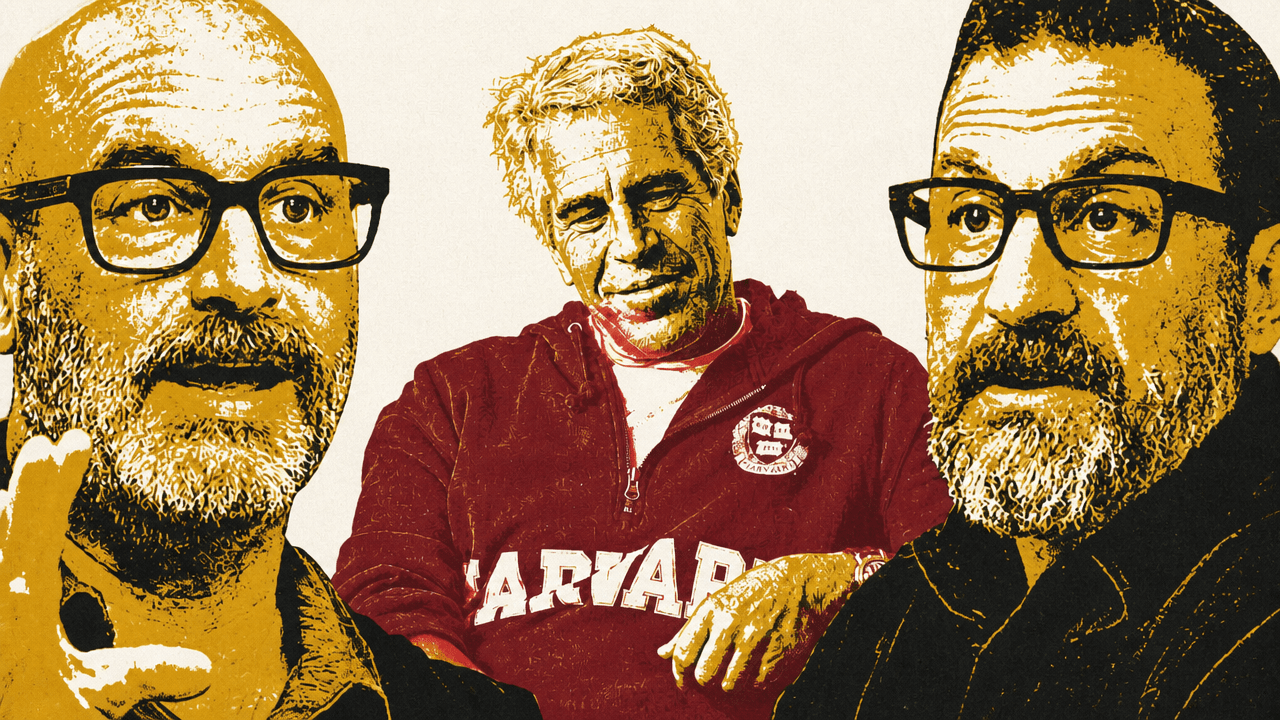
Conspiracy thinking now attaches to ordinary institutions, not just fringe claims
Andrew Huberman framed the problem less as any single conspiracy theory than as the widening audience for conspiratorial explanations. He said he has “otherwise completely rational friends” who do not believe the Challenger explosion was real, and described the number of conspiracies that now “hook” basically reasonable people as “staggering.”
The number of conspiracies that actually hook now with otherwise basically reasonable people is staggering.
Tom Segura gave the same point in a more everyday register: an Uber driver in Dallas had immediately launched into a detailed claim that the CIA killed JFK, telling him it was a “12-man job” and offering to “set” him up with the tour. Segura’s example showed how quickly conspiratorial certainty can appear in ordinary conversation, complete with logistics, confidence, and invitation.

NASA became the live test case. Segura said that “any post from NASA on Instagram” attracts thousands of comments accusing the agency of faking images, using AI, or deceiving the public. The group pulled up NASA’s Instagram account on screen; the visible posts included astronauts, Earth from space, and an astronaut in a spacesuit, all under the displayed NASA account header.
“More propaganda.” “Bullshit.” “Smells like bullshit.”
Those were the kinds of NASA Instagram comments Segura read aloud while the posts were on screen. The point was not a single hostile reply but the regularity Segura described: “It’s for everything.”
Matt McCusker half-joked that “the word on the street” was that NASA had been founded by “a Satanist,” then immediately softened the claim: “That could be true though.” The exchange kept landing between belief and non-dismissal, with implausible claims left open long enough to remain in circulation.
Huberman, who described himself as someone who believes in “science and nature,” did not treat every institutional answer as sufficient simply because it was institutional. On the moon landing, he said there are “basic questions” he wishes NASA would answer directly. He cited Joe Rogan’s recurring question about how a phone call from the White House or Cape Canaveral could be so clear, and said NASA could explain the engineering without needing to go into exhaustive detail.
At the same time, Huberman distinguished between questions about presentation and claims of fabrication. He said he did not doubt that some exposure adjustments may have been made to photos, but noted that the accusation being made is stronger: that the moon landing itself was fabricated. In his view, that should be “pretty straightforward” for NASA to resolve if the agency cared enough to resolve it.
McCusker remained agnostic. He said the moon landing could “totally be real,” but also that if the United States had been politically pressured to beat Russia, it could “totally do a set” and announce success. Huberman offered a different heuristic: if Elon Musk, whom he characterized as knowledgeable about rockets and unafraid to speak publicly, claimed the moon landing was fake, Huberman said he “might get on board that hypothesis.” He added that he does not know Musk personally.
The social game rewards deeper and darker versions of the same theory
Chris Williamson described conspiracy talk as having its own status competition. Around a table of people who spend time thinking about conspiracies, he said, there is a “race to the bottom of the iceberg”: if one person says Epstein killed himself, another has a more elaborate theory; if one says Epstein did not kill himself, another escalates into a still more extreme claim. The dynamic becomes a game of who has descended furthest into the most intense online rabbit hole.
Epstein’s case gave the group a subject where that escalation could run, but Andrew Huberman was not agnostic about the central question.
Guys, he didn't kill himself. I mean, come on.
He cited several reasons the conclusion that Epstein killed himself felt inconsistent to him: the cellmate, described as an ex-cop and murderer serving multiple life sentences; guards who were “chillin’”; someone going up the stairs; and Epstein’s widely described narcissism, which Huberman said did not seem consistent with suicide.
Williamson interjected that there was a suicide note. Huberman replied that he had seen the note online and allowed that perhaps Epstein had concluded “there is no fun” and was “out.” But he returned to the larger point: the account “does not seem consistent with everything else.”
Tom Segura added details that cut in both directions. Epstein had changed his will shortly before his death, passing everything to his brother, which Segura said could be interpreted as someone preparing to die. But he also pointed to the broken hyoid bone, saying that some forensic pathologists consider that pattern more consistent with homicide than suicide, depending on the force and manner of injury.
Matt McCusker refused to resolve the case. His position was deliberately noncommittal: “maybe, I don’t know.” He said it is plausible there was a “giant government cover up,” but also that he genuinely has no idea. He described the posture plainly: stay in the middle, and everyone can keep talking.
Epstein remained unsettling even under skepticism about government competence
Andrew Huberman separated the possibility of a grand clandestine operation from the strangeness he saw in Epstein’s circle. He said people he knows who have worked in government on “spooky” online matters describe the government as inefficient even at high levels. In that view, clandestine coordination inside institutions is hard, and secrecy becomes harder as more people are involved. A small group might act, but keeping a secret is difficult because human beings talk.
That institutional-skeptic argument did not make Epstein less disturbing to him. Huberman said the case “blew a hole in the internet for a while” because the available files, as he described them, were not merely rumor or deposition summaries. What interested him was that they included real-time correspondence: “the real emails at the time.” Williamson suggested that the correspondence could be fed into a chatbot and queried conversationally.
Huberman described tools that, in his telling, organized Epstein-related communications into searchable or visual interfaces. One, which he referred to as “Jmail,” turned conversations into an interface; another plotted names over time, showing the number of conversations particular people had with Epstein. Huberman said the material showed Epstein sitting “at the nexus” of many people and organizations, cutting across right and left, academia, public life, money, and status.
What Huberman found “wild” was not simply that Epstein sought access to prominent people, but that prominent people continued to seek him out. Many had “tons of money” and “tons of public accolades or private accolades.” He said he did not understand why they wanted his time.
Matt McCusker emphasized the post-conviction dimension: people overlooked that Epstein had already been convicted. Huberman agreed that this was the “wild” part. If someone did not know, that would be one thing; but once the conviction was public record, the continued association looked different.
Williamson invoked Bill Gates as one example of a high-profile person who had met with Epstein. McCusker then introduced Al Seckel, whom he described as peripheral to the science community, someone he had never met, a “lousy failed scientist,” and a researcher of visual illusions whose data were “always kind of eh.” McCusker said Seckel had married Ghislaine Maxwell’s sister and had been part of a small group trying to bury Epstein’s sex-offender status after Epstein’s first conviction.
Huberman added his account of that effort: he said the group created benign-sounding online material — “Jeff Epstein whatever sports or whatever” — to push other search results down. Huberman then said Seckel was found dead at the bottom of a cliff around 2015 and that the French government would not comment on cause of death. “There are a lot of dead people around this,” he said.
The Epstein material therefore sat in two registers at once for Huberman. He was skeptical that large institutions can easily carry out clean, secret operations. But the emails he described, the social proximity, the post-conviction access, the alleged search-result cleanup, and the deaths around the case left him unwilling to treat simple dismissal as adequate.