Constant Self-Analysis Can Become a Substitute for Necessary Action
 Chris Williamson
 Tom Segura
 Andrew Huberman
 Matt McCuskerChris WilliamsonTuesday, May 19, 20266 min read
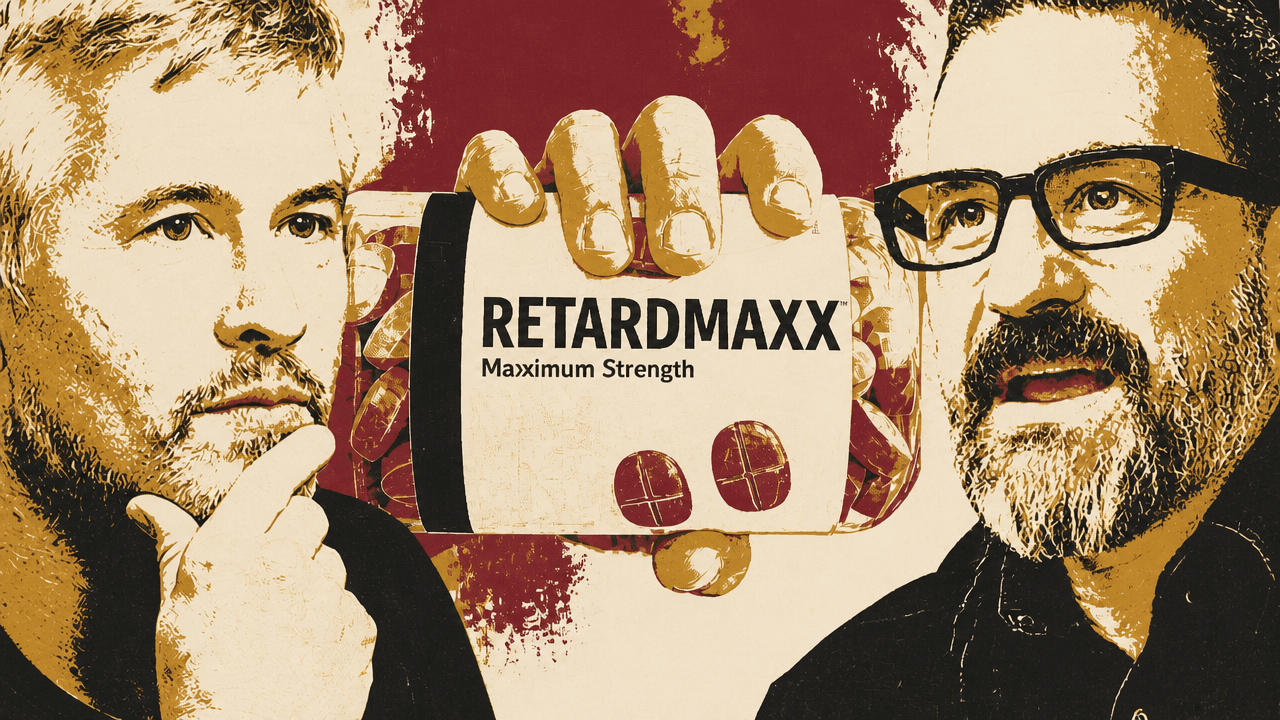
Andrew Huberman uses the crude meme “retardmaxxing” to make a narrower argument about self-improvement: introspection becomes harmful when it turns into rumination and replaces action. In a discussion with Chris Williamson, Matt McCusker and Tom Segura, Huberman links that idea to Marc Andreessen and Dana White’s critiques of excessive emotional processing, while acknowledging that the posture can sound dismissive of mental health. The conversation extends the same concern to public judgment of high achievers, where Huberman argues that resentment and secondhand reputational claims can also become substitutes for doing something concrete.
The dispute is not introspection versus action, but when one becomes avoidance
“Retardmaxxing” enters as a deliberately crude internet label, but Andrew Huberman treats it as shorthand for a real self-improvement argument: people can spend so much time examining their thoughts, feelings, identity, and problems that reflection becomes a substitute for doing what needs to be done.


Huberman describes the meme as an inversion of optimization culture. Where “lookmaxxing” names an attempt to improve appearance, “retardmaxxing,” in his account, means not thinking too much. Its representative figure is “a guy on the internet” sitting in a backyard or farm-like setting, offering advice that amounts to handling business, ignoring what bothers you, and refusing to ruminate.
You basically just don't think about shit at all. You just do what needs to be done. If something bothers you, you just ignore it.
That posture is set against protocols, therapy language, relationship analysis, self-perception, philosophy, and constant self-monitoring. Huberman explicitly places Chris Williamson’s own terrain in the contrast: interviews with thinkers about relationships, selfhood, and meaning.

Huberman connects the meme to Marc Andreessen, whom he describes as “easily one of the smartest people I’ve ever met.” According to Huberman, Andreessen helped popularize the idea after appearing on David Senra’s podcast, where Andreessen argued that “great men of history” did not sit around thinking about their thoughts. The emphasis, as Huberman paraphrases it, was more action and less introspection.
Huberman does not present that as a simple absolute. He says men’s mental health is critical and says suicide rates are “way up.” But he also argues that rumination, especially online rumination, can become dangerous when it replaces action. The criticism is aimed less at reflection itself than at reflection that becomes an end state.
Tom Segura states the moderate version plainly: checking in with yourself and expressing how you feel can be useful, but not if it never leads anywhere.


I think it's good to to be introspective to a degree, check in with yourself, you know, express how you feel, but don't just sit there and say this is how I feel and then don't do anything.
Huberman agrees with that distinction and adds that “too much therapy is not good.” He also says Andreessen and Dana White, in making related arguments, could come across as dismissive of emotions. The line is therefore deliberately unstable: he is defending action against rumination, while conceding that the anti-introspection posture can be heard as anti-emotion.
Andreessen and Dana White become two versions of the same correction
Andrew Huberman links Andreessen’s comments to Dana White’s criticism of men publicly discussing emotional challenges. As Huberman summarizes it, White’s posture is old-school: get up, go to war, make money for your family. Huberman reads White sympathetically, but not without qualification. He says White may have been pointing toward action and responsibility over public emotional processing, while acknowledging that both White and Andreessen could sound dismissive.
The practical question is narrower than therapy versus stoicism: when does language about the self help a person move, and when does it become a way not to move?
Matt McCusker responds to that practical side when Huberman later says “retardmaxxing is hard.” McCusker agrees: “That’s 100% true.” Refusing to indulge every thought, grievance, or spiral is treated as difficult in its own right. Thinking, reacting, and resenting may be easier than doing the next necessary thing.


Huberman also defends Andreessen personally. He says Andreessen is not a sociopath, but “a very, very kind person” and “an incredible human being at many levels,” adding that he expects to “catch a lot of shit” for saying so. In Huberman’s account, Andreessen’s anti-introspection line became an opening for critics to cast him as a billionaire who dislikes self-examination. Huberman’s answer is testimonial: he knows Andreessen, knows his family, and does not recognize the caricature.
Segura punctures the defense with a joke — “And now he’s a retard” — but the underlying issue remains whether high achievement, rough edges, and public judgment can be separated cleanly.
Rough edges are not treated as proof against accomplishment
Andrew Huberman expands the argument from introspection to the temperaments of people who build, lead, and disrupt. He says Andreessen has argued that people who accomplish major things often have “pretty rough edges.” Huberman’s example is Steve Jobs, whom he remembers from growing up in the same town and seeing at the skateboard shop where Huberman worked. Jobs, in Huberman’s recollection, came in for rollerblade wheels, did not wear shoes, wanted what he wanted immediately, was known for yelling at people, and drove very fast.
The point is not that those traits are admirable. Huberman’s claim is that there used to be more tolerance for “big personalities with some rough edges” when those people also did important things. He argues that phones with cameras changed the environment. Williamson sharpens the point by describing the current condition as “constant CCTV,” with a phone camera within a few yards of almost anyone, making rough edges look harsher under scrutiny.
Huberman connects this to a broader cultural expectation, which he describes as coming “largely from the left”: public figures are expected to be tempered, and big personalities are less tolerable unless they are “perfect in every dimension.” His counterclaim is that public figures, scientists, CEOs, and other high performers often contain both “dark and light.” In his telling, some great CEOs are highly disagreeable, conscientious, and “high friction people.”
Tom Segura pushes back by separating Huberman’s personal confidence in Andreessen from a wider category of high achievers. Some men who accomplish a great deal, Segura says, are also, by many people’s accounts, terrible people. Huberman’s first response is not to defend every such person. He asks how close those critics are to the actual person.
That response shifts the issue from character to evidence. Huberman is not saying achievement disproves bad conduct. He is saying secondhand moral consensus about powerful people can be unreliable, especially in a culture that, in his view, is already primed to hate billionaires.
Video has raised the threshold for reputational claims
Andrew Huberman says recent public spectacles have changed what people need in order to believe that rumor matches reality. His claim is not developed as a formal evidentiary theory; it is an observation about public expectation. Real footage, he says, has raised the threshold for reputational claims.
His first example is the speculation around Diddy and his parties. Huberman says people expected video to emerge, and that no such party video aired, but that there was video of him beating a woman. His second example is the Coldplay concert incident, which he describes as a couple being caught on camera in a moment widely interpreted as cheating. Huberman says he was not interested in the private relationship context, but was struck by the structure of the footage: delight, recognition, shock, shame, all visible in real time. He calls it “like opera,” and Williamson says it resembles a sketch from one of Segura’s shows.
Huberman’s argument is that footage like this changes expectations. When people now hear claims about a celebrity, founder, billionaire, or public figure, they increasingly ask for video or data. If someone says a founder is a sociopath, Huberman says the response should be: “show me the data for sociopathic.” A written anecdote about “one little thing” is no longer enough, in his view, to shift many minds.
This is where the billionaire question returns. Huberman says there is “a lot of hatred of billionaires.” Matt McCusker distinguishes between different billionaires doing different things, and says he would not hate someone simply for having a billion dollars: “You’re busy and you’re doing well.” Huberman’s broader claim is that resentment can become another avoidance mechanism. It is easier, he says, to be upset with other people than to get up and do something.