A Stroke Revealed How the Brain Filters Ordinary Reality
Robert Greene argues that a neuroscientist’s altered perception during a life-threatening stroke shows how the brain constructs the ordinary sense of self and reality—and how strange experience can become when those systems fail. She found the change exhilarating, even blissful, but could not work out how to make a phone call; Greene says her cognitive abilities took eight years to recover. He connects her account to evolution, arguing that human life and the bodies that sustain it are contingent outcomes, not facts to take for granted.
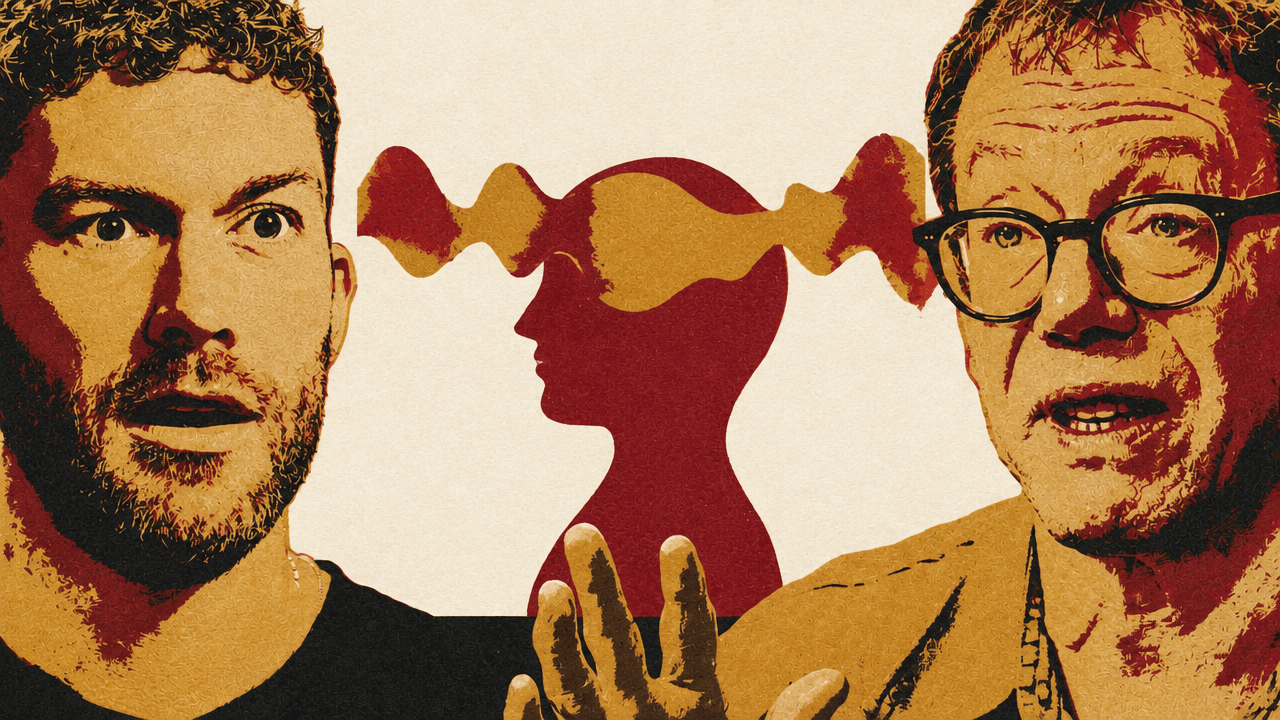
The sublime begins where ordinary perception stops
Robert Greene defines the sublime as an experience that breaks through limits imposed by both culture and the brain. Culture shapes what people take to be real: a technological society reaches for metaphors involving computers and AI, while another era would understand the world differently. Those assumptions are difficult to see from inside them. The brain imposes a more immediate boundary by constructing the reality a person perceives. Greene’s point is not that people can simply choose to see the world without that construction, but that ordinary experience is filtered by mechanisms most people do not notice.
He illustrates that limit through the account of a neuroscientist who suffered a hemorrhagic stroke. As the bleeding shut down parts of her brain, she experienced the loss of systems that normally organize sensation and separate the self from the surrounding world. Greene describes the brain’s somatosensory system as helping a person navigate space and distinguish the body from what is around it. In the shower, as that system failed, she felt the water was part of her. Her internal chatter went quiet. Visual experience broke into what Greene describes as pixelated points rather than familiar objects.
At first, she found the changes exhilarating: the world seemed strange and vivid, and she felt released from the brain’s usual restrictions. Greene calls it a mystical experience. But it was happening as the stroke threatened her life, not as a chosen experiment. She could not work out how to make a phone call and survived with language and comprehension severely impaired. Greene says it took eight years for her to recover her cognitive abilities. She remembered the period when her brain’s filtering mechanisms were failing as blissful, even heavenly; after recovery, she could think and write again, but felt that ordinary life was hell by comparison. She wrote My Stroke of Insight about finding her way, as a scientist, back to some of the sensations she had experienced during the stroke.
For Greene, the account makes the brain’s role in ordinary reality tangible. People experience objects, space, and a distinct self, but those experiences depend on the brain’s organizing and filtering activity. He argues that the human view is not reality in its only form: a bat, fly, or dog does not encounter the world as people do. The sublime is a doorway beyond the familiar frame, toward experiences the brain and culture do not normally allow. Looking through it can bring a shock of strangeness—an awareness that life is stranger than it seemed. Greene says his own “death experience” left him with a feeling inside his body that he could not simply return from: “There’s no going back.”
Evolution makes human existence look contingent
Chris Williamson asks whether people should be perpetually astonished simply to be alive, given how unlikely it is. Greene begins with the body’s ordinary work: breathing and heartbeat continue without conscious direction; wounds heal; and, under threat, the body produces responses that can help preserve life. Long-distance running, too, brings bodily effects that help a person keep going. These processes happen without requiring constant attention, but Greene says their complexity is astonishing. He asks where the body, brain, and consciousness come from, and points to an evolutionary history extending back millions of years.

He widens the frame from the body to the history of life. Greene describes the brain as carrying layers of experience that reach back millions of years, including what he calls a “reptilian” part. He says that during the Cambrian explosion, multiple other body forms nearly became dominant. He names Opabinia and Hallucigenia as examples of creatures whose forms look nightmarish to modern eyes. The familiar body plan, he argues, was not inevitable: other forms might have prevailed, leaving life unlike what people know now.
Greene makes the same point with the extinction of the dinosaurs. He says that if an asteroid had not hit Earth and caused their extinction, dinosaurs would still be walking the Earth and humans would not be here. The examples are not just a catalog of unusual creatures or bodily abilities. They widen the time horizon until the present looks like one outcome among many: life nearly took different forms, and events could have left no place for human beings at all.
Together, the stroke and evolutionary examples unsettle confidence in what seems fixed. The stroke account makes the brain’s perceptual limits tangible; the evolutionary account shows how contingent the bodies and minds people have become. Greene’s conclusion is that thinking about the body, the long history behind the brain, and the forms of life that might have prevailed makes it harder to take existence for granted. As he puts it, “You can’t take anything for granted.”