SpaceX’s $100 Billion Revenue Goal Puts Capital Spending in Focus



Ahead of SpaceX’s third-quarter results, Bloomberg Intelligence’s Mandeep Singh said investors would focus on whether the company can finance the infrastructure needed to meet its growth targets. He cited the prospect of capital spending above $150 billion in 2027, arguing that contracted demand and guidance for $100 billion in annual recurring revenue do not settle whether investors will accept the cost of building capacity. George Ferguson said launches mainly enable businesses such as Starlink and future space-based data centers, while Singh described revenue from Grok itself as less certain than income from renting compute.
The earnings question is how much investment the growth requires
Ahead of SpaceX’s third-quarter results, the central question for Mandeep Singh was not whether the company could point to demand for computing capacity. SpaceX has contracts to rent out compute, and Singh said the company had guided to $100 billion in annual recurring revenue by year-end. He said that guidance suggested the company had visibility into the target. The uncertainty is what it will spend to support that growth—and how investors will assess the spending.


Singh focused on the 2027 capital-expenditure outlook. A figure above $150 billion would be significant, he said, because SpaceX does not have the operating cash flow of other hyperscalers to fund investment. He pointed to investor jitters around CoreWeave as a reason the market might scrutinize such a number. The question is not just whether demand supports the revenue target, but whether investors will accept the cost of building capacity ahead of it. In Singh’s framing, contracted demand and the ability to finance the infrastructure are related but distinct questions: visibility into future revenue does not settle how much capital the company must put in first.
The near-term figures set up that question. SpaceX’s second-quarter capex was $18.4 billion; consensus expected $19.6 billion for the third quarter. Bloomberg’s October 19 estimates also put revenue at $12.9 billion, up 65% from the prior year, and adjusted diluted EPS at $0.15, up 263%. The same estimates put launches at 41, up 7%, and Starlink subscribers at 14.2 million, up 19%.
| Metric | Third-quarter estimate | Growth versus prior |
|---|---|---|
| Revenue | $12.9B | +65% |
| Adjusted diluted EPS | $0.15 | +263% |
| Capital expenditures | $19.6B | -7% |
| Rocket launches | 41 | +7% |
| Starlink subscribers | 14.2M | +19% |
Launches enable the businesses that make money
George Ferguson drew a distinction between SpaceX’s identity and what currently drives its business. Though the company is known for rockets and launches, Ferguson described spaceflight as an enabler: Starlink connectivity is generating most of the profits in the near term, while turning the AI business into a profitable enterprise is the broader goal.


More than two-thirds of SpaceX’s launches are internal, Ferguson said, and the company records no revenue for those launches. They do not appear as paid launch revenue, but their value is indirect: they support Starlink now and could support space-based data centers later. Starship, he said, could provide the scale needed for data centers in space and larger satellites that would improve Starlink’s connectivity with the ground. That makes launch activity important to the other businesses even when it does not generate revenue as a launch service.
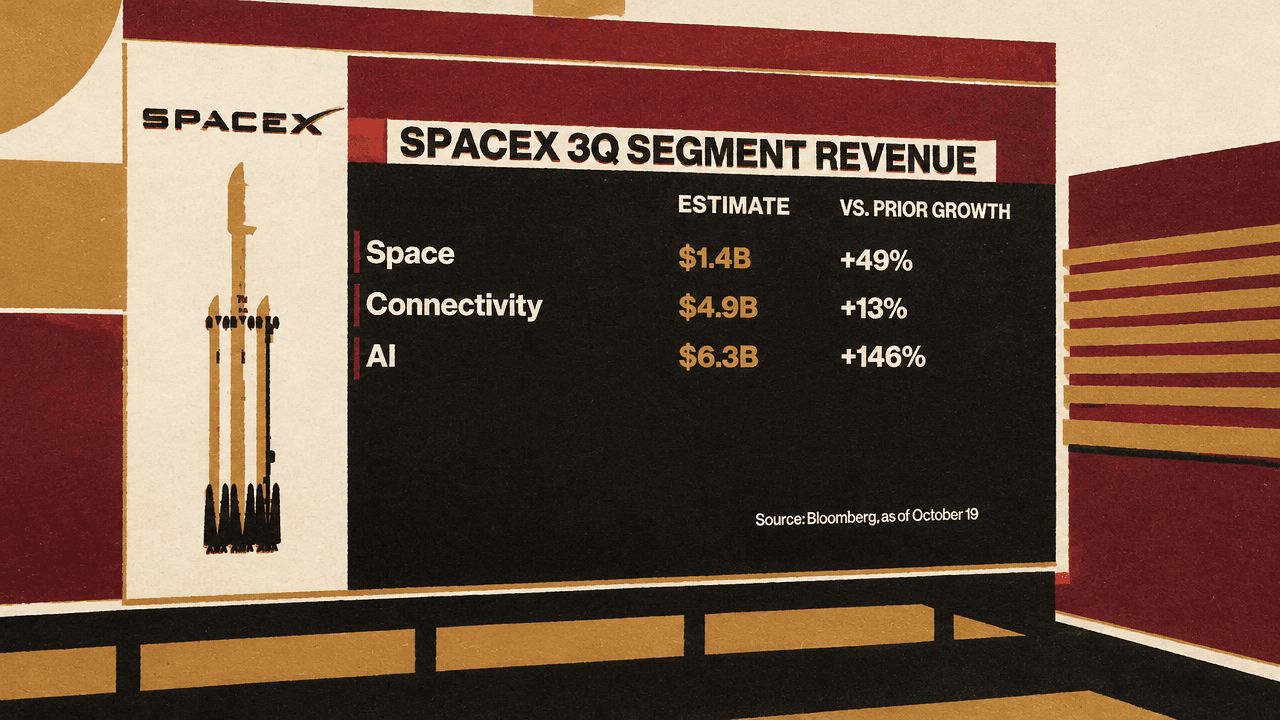
Ferguson also referred to a recent move to buy broadband wavelength so Starlink could be used inside buildings. Ed Ludlow pointed to SpaceX president Gwynne Shotwell’s stated goal of taking customers from carriers with direct-to-mobile service. The estimates put connectivity revenue at $4.9 billion, below AI’s $6.3 billion but above space’s $1.4 billion. AI was estimated to grow 146% year over year, compared with 13% for connectivity and 49% for space.
| Segment | Third-quarter revenue estimate | Growth versus prior |
|---|---|---|
| AI | $6.3B | +146% |
| Connectivity | $4.9B | +13% |
| Space | $1.4B | +49% |
Grok’s model revenue is less clear than compute rental
The AI business presents a second set of questions beyond infrastructure spending. Mandeep Singh said Cursor could grow quickly, pointing to coding agents as one of generative AI’s successful use cases. But he distinguished that opportunity from the performance and monetization of Grok itself. Cursor’s expected growth, in his account, is not by itself an answer to how SpaceX will make money from its own model.
In Singh’s comparison, Meta already had a multimodal app at the frontier, while Grok had not yet reached that level of capability on its own. He said investors would want more information about xAI’s training spend, Grok’s capabilities relative to the frontier, and how the company plans to monetize the model. He also identified API revenue as an open question: investors have more clarity, in his view, on the compute-rental business than on what Grok can earn as a model.
That distinction separates two parts of the AI opportunity. Renting compute capacity has contracts behind it and, Singh said, a clearer revenue path. The model business raises questions about capability, training investment, subscriptions and API sales. The source does not resolve those questions; they are among the issues Singh expected investors to press on. They also connect back to the capex debate: the company’s spending supports infrastructure that can be rented, while the return from Grok depends on capabilities and monetization that Singh described as less clear.