Apple’s Revamped Siri May Be Good Enough to Ease Its AI Crisis


Bloomberg’s Mark Gurman argues that Apple’s revamped Siri is not a leap ahead of ChatGPT, Gemini or Claude, but may be good enough to stabilize Apple’s position in AI. Speaking with Ed Ludlow, Gurman said the new Siri finally delivers on much of the assistant promise Apple made years ago, while still falling short on advanced tasks such as deep research, long-document summaries and creating spreadsheets or slide decks. His case is that Apple can ease its AI crisis if Siri now handles the everyday questions and device-assistant tasks most of its 2bn-plus users actually need.
Apple’s Siri reset is framed as adequacy, not leadership
Mark Gurman described Apple’s revamped Siri as a product that finally fulfills the original Siri promise, rather than as a system that clearly surpasses the current chatbot market. He said the new version — “Siri 2.0,” if one wants to call it that — is “terrific” and broadly comparable to recent versions of ChatGPT, Google Gemini, and Claude.


Gurman’s formulation was pointed: the new Siri “fulfills the promise of Siri that the company made 15 years ago when it debuted the first version as part of the iPhone 4S in 2011.” That is a catch-up claim, not a claim of clear category leadership.
The comparison came with an immediate limit. Gurman did not present the new Siri as a full replacement for advanced chatbot workflows. He said there is “a lot it can’t do”: in-depth research of the kind users can perform in ChatGPT, major summaries of very long PDF documents, tax preparation, and creation of Excel files or PowerPoint slide decks.
The point was narrower: Siri may not match the competition at the high end, but it may now be sufficient for how most people actually use general-purpose AI assistants. Gurman’s argument turns on a distinction between the most demanding AI tasks and the common ones. For most users, he said, ChatGPT and Gemini are used for web AI search, historical information, and asking questions about almost anything. The new Siri, in his assessment, can now do those tasks.
It also keeps the device-assistant role that Siri has long been expected to perform. Gurman said the new system can “actually do the things that Siri’s been supposed to do,” including correctly playing music and correctly navigating users to places. That combination — chatbot-like answers plus more reliable assistant functions — is what he called “a big win for Apple.”
The missing advanced workflows still define the ceiling
The examples Gurman excluded define where Apple’s assistant still falls short. Users should not expect the new Siri to handle deep research, produce comprehensive summaries of long PDFs, prepare taxes, or generate spreadsheets and presentation decks. Those omissions place Siri below competitors for some complex work people may ask of AI assistants.
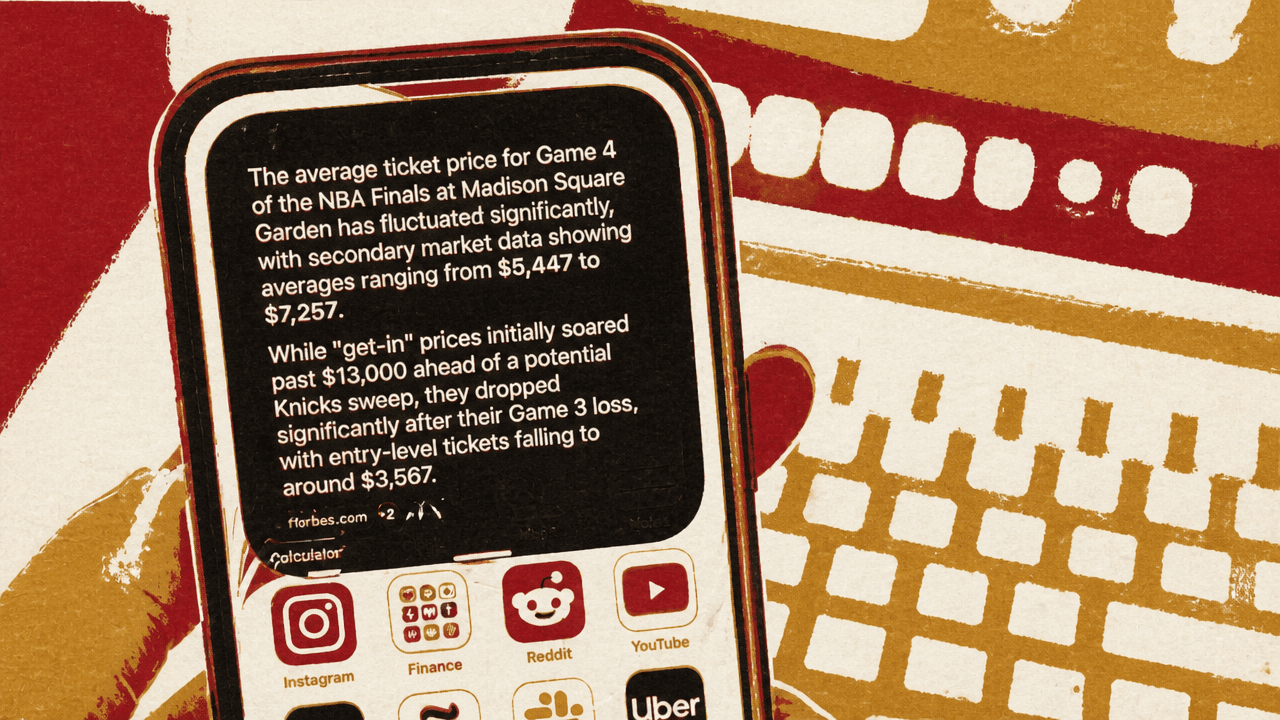
The product examples shown fit the everyday category Gurman emphasized. One phone screen displayed an AI-generated response about events in San Francisco for the weekend of June 12–14, 2026, including Pride Month celebrations, concerts, and sports games, with “sftravel.com +1” visible in the response. Another showed a Notes app result saying it had created a note with “three top dinner spots near Bloomberg’s San Francisco office,” including three recommended dishes for each. A separate phone screen summarized NBA Finals ticket-price ranges at Madison Square Garden, using secondary-market averages and “get-in” prices as part of the answer.
Those examples illustrate the kind of work Gurman says accounts for most consumer chatbot use: answering questions, surfacing local recommendations, summarizing information, and retrieving practical details. They make his threshold clearer without erasing the capability gaps he named.
That “95%” claim is central to his evaluation. Gurman’s view is not that Apple has closed every capability gap. It is that the remaining gaps may matter less to most users if Siri can handle broad questions, web-style AI search, and standard assistant functions.
The AI crisis eases if Apple serves its installed base
Ed Ludlow pressed Gurman on the phrasing of his Power On headline: Apple’s new Siri is “just good enough to ease AI crisis.” Ludlow asked whether the emphasis belonged on “just good enough.” Gurman agreed with that framing.


Gurman said it is “just good enough” because it is “not exactly as good as the competition.” He added that the new Siri meets the needs of the majority of Apple’s user base, which he described as “2 billion plus strong.”
The implication is about fit rather than technical supremacy. Apple does not need every advanced AI workflow to be solved if the new assistant satisfies the everyday needs of most of that user base. Siri is catching up to chatbot competitors in mainstream use cases that matter to many consumers, while still lacking some advanced capabilities that define the upper range of current AI assistants. Gurman’s claim is that this may be enough for Apple: not a leap ahead, but enough to ease what Ludlow, quoting the Power On headline, called an AI crisis.